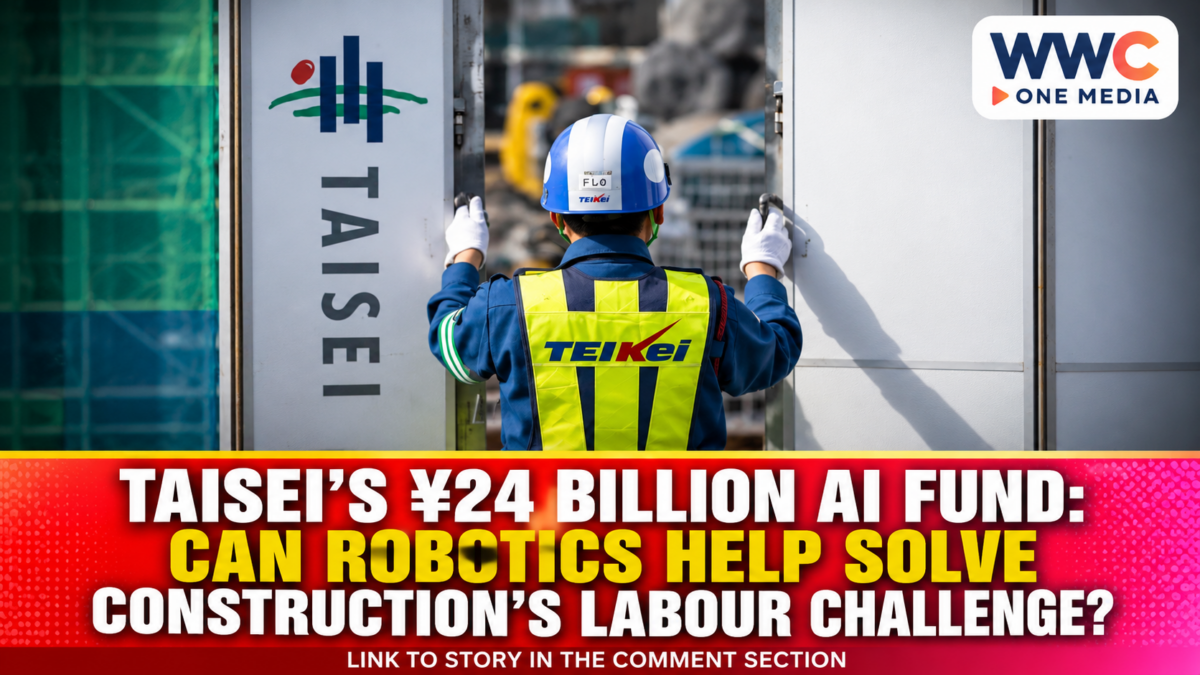
Japan’s Taisei Corporation has decided to establish a ¥24 billion corporate venture capital fund with Silicon Valley-based Pegasus Tech Ventures, targeting startups working on artificial intelligence, robotics and digital twins.
The 10-year initiative, scheduled to run from November 2026 to November 2036, is designed to connect emerging technologies with the construction company’s existing operations. But the bigger question is whether investments in startups can translate into practical improvements on construction sites, where skilled labour, productivity and operating efficiency remain major challenges.
Why Taisei Is Putting ¥24 Billion Into Technology
The fund is structured as a corporate venture capital partnership. Taisei will participate as the limited partner, or investor, while a legal entity established by Pegasus will serve as the general partner responsible for operating the fund. Yahoo Finance
The announced fund size is approximately ¥24 billion, equivalent to US$150 million. Its investment scope includes artificial intelligence, robotics, digital twins and other advanced technologies and business models developed by startups around the world.
Taisei said it intends to use Pegasus’ international startup network and investment expertise to identify promising companies and strengthen collaboration with them.
The stated objectives extend beyond acquiring new technology. Taisei wants to maintain and improve the competitiveness of its existing businesses, make operations more efficient and create new business opportunities.
That distinction matters. The fund is not simply a financial investment vehicle seeking returns from technology companies. It is also intended to give Taisei access to innovations that could eventually be applied to construction, infrastructure and other areas of its business.
The announcement does not disclose how much will be invested in individual startups, how many companies the fund will support or when its first investments will be completed. Yahoo Finance
What Pegasus Brings to the Partnership
Pegasus Tech Ventures is based in Silicon Valley and operates as a global venture capital firm. Taisei’s announcement identifies it as the fund’s operating partner and highlights its experience investing in companies across different technology sectors.
The company disclosure lists investments in businesses including SpaceX, OpenAI, Anthropic, Airbnb and Coinbase. It also identifies Japanese companies and startups in its portfolio, including Money Forward, Mujin and SkyDrive.
Pegasus reported investments in more than 300 companies worldwide, including 50 unicorn companies, and approximately ¥300 billion in assets under management. These figures describe the investment firm’s stated track record, not the performance or guaranteed results of the new Taisei fund. Yahoo Finance
For Taisei, the partnership offers a way to look beyond technologies developed internally. Startups may be working on specialised systems that a large construction company could find difficult or time-consuming to develop independently.
However, identifying a promising startup is only the beginning. Technologies still need to meet construction-industry requirements involving safety, reliability, cost, compatibility with existing equipment and performance under actual site conditions.
Taisei Has Already Tested Robots on Construction Sites
The new fund builds on a business environment in which construction automation is not entirely new to Taisei.
The company’s technical research has documented several robotics and automation initiatives, including systems designed to reduce manual work in construction activities.
One example is the T-iROBO Rigid Dump, an automated 55-tonne dump truck developed for transporting aggregate materials. In a documented construction-site application, the company combined the vehicle with its T-iDigital Field system, which makes site information and operational data available to project stakeholders.
The trial recorded the transport of 47,217.8 tonnes of aggregate materials over 988 trips while keeping the work area unmanned during the operation. Taisei reported improvements in productivity, safety and working conditions from the automation project. taisei.co.jp
Another example is T-iROBO Welding, a system designed to automate field welding for structural steel columns. Taisei’s technical documentation describes the use of compact welding robots to perform welding operations that traditionally require specialised skills.
These examples show why robotics could be relevant to the company’s operations. Automation can take on specific repetitive or demanding activities, while workers remain responsible for supervision, technical decisions and other tasks that require human expertise. taisei.co.jp
The new venture fund could expand Taisei’s access to technologies beyond those it has already developed. But the company has not announced that any particular startup product will be adopted through the fund.
The Construction Industry’s Productivity Challenge
Construction projects depend on a combination of skilled workers, heavy equipment, materials, engineering and coordination. Delays or inefficiencies in one area can affect the wider project schedule.
Robotics and artificial intelligence may help address some of these challenges. Automated equipment can perform selected physical operations, while digital systems can help teams monitor progress, analyse information and coordinate work.
Digital twins could also become relevant. These systems create digital representations of physical assets or environments, allowing companies to examine conditions, test scenarios and support planning before making decisions on actual projects.
However, the technology must work in complicated real-world environments. Construction sites change as projects progress, and machines must operate around workers, equipment, materials and unpredictable conditions.
That makes practical deployment more demanding than demonstrating a technology in a controlled setting.
The challenge is not simply whether a robot can perform a task. It is whether the system can do so consistently, safely and at a cost that makes commercial sense.
The regional shift towards automation is also worth watching. WWC previously examined Singapore’s construction robotics trials, which illustrate how contractors and governments are testing autonomous equipment in real construction environments.
What the Fund Could Mean for the Philippines
The partnership is centred on Taisei’s global business, but its technology priorities have relevance to construction markets across Asia, including the Philippines.
Local contractors face pressure to complete projects efficiently while managing labour requirements, equipment costs and increasingly complex infrastructure needs.
Robotics could eventually support selected activities such as welding, material handling, inspection and earthmoving. AI-based systems could also help with planning, monitoring and identifying potential construction problems.
The potential benefits are not limited to reducing the number of workers needed for a particular task. Technology may also allow employees to move into equipment supervision, maintenance, programming, quality assurance and other specialised roles.
The same transition is taking place in manufacturing. WWC’s report on Epson’s collaborative robotics push in Southeast Asia examines how companies are introducing machines designed to work alongside employees.
For the Philippines, the wider lesson is that adopting advanced equipment requires investment in people as well. Training, technical education and workplace safety systems will influence whether local businesses can make effective use of automation.
There is also an infrastructure dimension. AI and robotics systems require dependable computing, connectivity and power. WWC has separately examined the growing demand for AI infrastructure and specialised equipment, another part of the technology ecosystem that could shape future industrial investment.
What Happens Next
The immediate next step is the establishment and operation of the fund, with a planned 10-year period extending to November 2036.
The most important developments to watch will be the startups selected, the technologies they bring and whether Taisei moves from investment to actual deployment across its construction and infrastructure businesses.
The announcement establishes the fund’s size, structure, investment themes and broad objectives. It does not yet provide a list of portfolio companies or specific projects that will use the technologies.
That leaves the central test ahead: whether the partnership can turn startup innovation into measurable improvements in construction productivity, operating efficiency and competitiveness.
Frequently Asked Questions
1. How much is Taisei investing in the new technology fund?
Taisei and Pegasus Tech Ventures have decided to establish a corporate venture capital fund worth approximately ¥24 billion, equivalent to US$150 million.
2. Which technologies will the fund target?
The announced investment areas include artificial intelligence, robotics, digital twins and other advanced technologies and business models.
3. How long will the fund operate?
The planned operating period is 10 years, from November 2026 to November 2036.
4. What role will Pegasus Tech Ventures play?
A legal entity established by Pegasus will serve as the general partner and operate the fund. Taisei will participate as the limited partner.
5. Will the fund immediately introduce robots to Taisei construction sites?
Not necessarily. The announcement concerns investment in startups and collaboration with technology companies. It does not identify specific products, deployment schedules or construction projects that will use technologies financed through the fund.