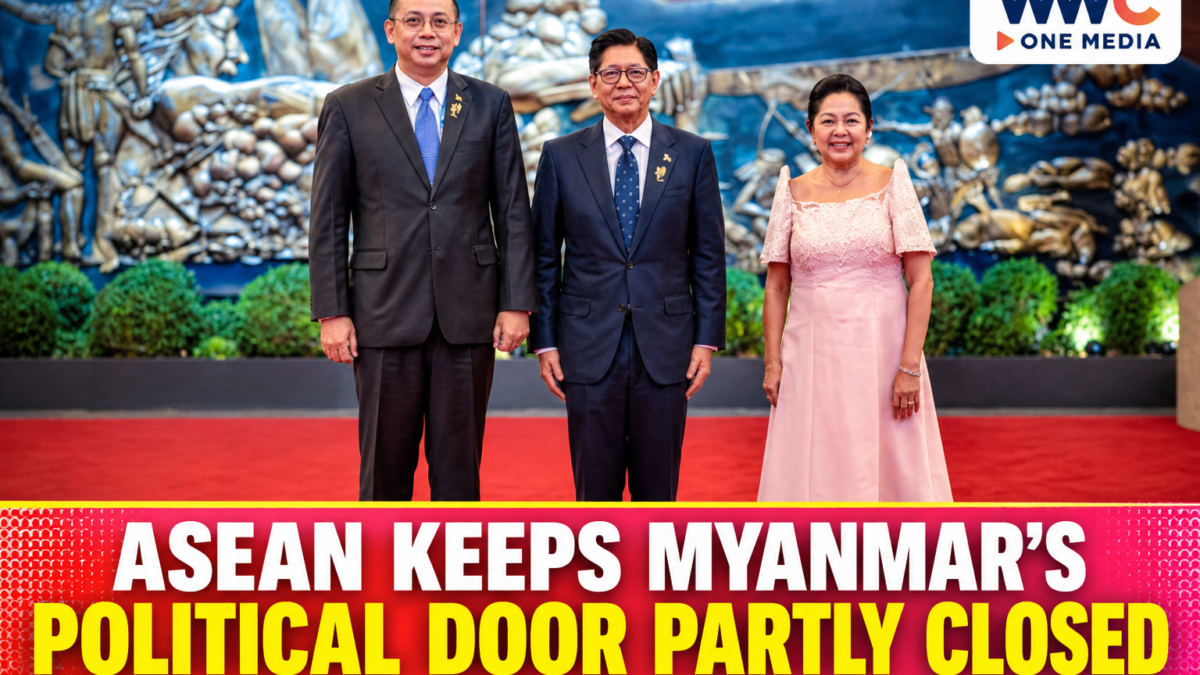
ASEAN leaders have agreed to maintain restrictions on Myanmar’s political representation at the bloc’s highest-level meetings while allowing a gradual path towards restoring its full participation if the country demonstrates meaningful progress on the regional peace plan.
The decision was adopted in Manila on Nov. 15, 2026, during the Philippines’ chairmanship of ASEAN. It keeps the Five-Point Consensus (5PC) at the centre of the bloc’s response to Myanmar’s continuing political and humanitarian crisis, while giving member states room to pursue carefully managed diplomatic engagement. ASEAN Main Portal
The decision is significant because ASEAN is trying to balance two objectives: keeping Myanmar connected to the regional organisation and maintaining pressure for progress towards peace. The outcome does not immediately restore Myanmar’s full political representation, but it does establish conditions under which that could gradually happen.
ASEAN’s Myanmar policy remains tied to the Five-Point Consensus
The leaders reaffirmed the Five-Point Consensus as the main framework for addressing Myanmar’s political crisis. The plan remains the regional bloc’s reference for pursuing an end to violence, dialogue among concerned parties, mediation, humanitarian assistance and engagement by the ASEAN chair’s special envoy.
The Nov. 15 decision also acknowledged that implementation has produced insufficient progress overall, despite limited advances in humanitarian assistance delivered through the ASEAN Coordinating Centre for Humanitarian Assistance on disaster management, or AHA Centre. ASEAN Main Portal
That assessment is important. It shows that ASEAN is not treating diplomatic contact or isolated humanitarian developments as proof that the broader political crisis has been resolved.
Instead, the leaders called for the full implementation of the existing peace framework and urged all parties involved in Myanmar to reduce violence and stop targeted attacks against civilians and civilian infrastructure.
Full political representation is still conditional
One of the clearest parts of the Manila decision concerns Myanmar’s participation in ASEAN meetings.
The leaders agreed to continue the existing collective policy requiring non-political representation from Myanmar at ASEAN summits and ASEAN Foreign Ministers’ Meetings until there is meaningful progress in implementing the Five-Point Consensus.
However, the decision makes an important distinction: Myanmar’s participation in other meetings of ASEAN sectoral ministerial bodies or mechanisms should remain unrestricted at all levels. ASEAN Main Portal
In practical terms, Myanmar is not being removed from every ASEAN activity. The restriction applies specifically to political representation at the bloc’s highest-level summits and foreign ministers’ meetings.
The leaders also agreed to pursue calibrated engagement through a phased and progress-based approach. They said ASEAN may consider gradually restoring Myanmar’s full political representation if the country achieves sustained and concrete progress in implementing the 5PC. ASEAN Main Portal
This creates a possible route towards greater participation, but it does not establish an automatic timetable or guarantee that Myanmar’s senior political leadership will return to future summits.
The Philippines’ special envoy has a continuing role
The decision recognised the work of Philippine Foreign Affairs Secretary Ma. Theresa P. Lazaro, who served as the Special Envoy of the ASEAN Chair on Myanmar during the Philippines’ 2026 chairmanship.
The leaders welcomed her visits to Nay Pyi Taw on Jan. 6 and Oct. 29, 2026, as part of her mandate to meet relevant parties in Myanmar.
They also recognised her work in establishing engagement with different stakeholders, including through meetings held in Tagaytay, Philippines, and Pattaya, Thailand. The document noted that further engagements were planned before the end of her term. ASEAN Main Portal
The special envoy’s role matters because ASEAN’s approach depends on communication with multiple parties rather than relying exclusively on contact with one political authority.
The leaders also encouraged closer coordination between the ASEAN special envoy and the United Nations Secretary-General’s special envoy on Myanmar. They tasked senior officials with continuing discussions on a possible longer-term ASEAN special envoy arrangement to provide continuity beyond individual chairmanships. ASEAN Main Portal
Humanitarian assistance remains one of ASEAN’s practical priorities
While political progress remains difficult, humanitarian assistance continues to be one area where ASEAN has reported concrete activity.
The leaders welcomed the AHA Centre’s monitoring mission to Myanmar on Oct. 28, led by the ASEAN chair’s special envoy. The mission marked the start of a month-long distribution of humanitarian support to more than 11,000 households.
The operation also included four new priority townships that had not previously been reached by the AHA Centre. ASEAN Main Portal
The Manila decision called for humanitarian assistance to be delivered safely, effectively and transparently, with particular attention to internally displaced persons affected by armed conflict.
It also urged Myanmar to facilitate access for the AHA Centre and other humanitarian organisations, including to communities in need that have not yet received adequate assistance. ASEAN encouraged regional and international partners to increase financial support for these efforts. ASEAN Main Portal
This part of the decision is especially important because political negotiations do not immediately address the daily needs of people affected by conflict. Access to food, essential supplies and humanitarian services remains a separate and urgent concern.
Why ASEAN’s decision matters beyond Myanmar
Myanmar’s continuing crisis tests ASEAN’s ability to maintain regional cooperation while responding to serious instability within one of its member states.
The bloc must balance its commitment to regional unity with the need to demonstrate that agreed principles have practical consequences. The Manila decision attempts to maintain that balance by keeping channels of engagement open while retaining the restrictions on political representation.
The issue also reflects the wider diplomatic environment in Southeast Asia. WWC has previously examined China’s diplomatic engagement with Myanmar and neighbouring countries, as well as Thailand’s growing direct engagement with Myanmar’s military leadership.
These developments show why Myanmar remains a regional concern rather than an issue confined to its domestic politics. Its instability affects neighbouring countries and complicates ASEAN’s efforts to maintain a coordinated approach.
For readers seeking a broader explanation of the organisation’s role, WWC has also outlined how ASEAN works and why its regional decisions matter.
What happens next
The Nov. 15 decision directs ASEAN foreign ministers to continue monitoring developments and report progress to the next ASEAN Summit. It also calls for coordination among the previous, current and incoming ASEAN chairs to maintain policy continuity. ASEAN Main Portal
Singapore is scheduled to assume the ASEAN chairmanship in 2027. The transition will test whether the bloc can sustain the Philippines’ diplomatic efforts and maintain a consistent approach to the Five-Point Consensus.
For now, Myanmar’s full political representation remains restricted at ASEAN summits and foreign ministers’ meetings. Any gradual restoration will depend on sustained and concrete progress, not simply on renewed diplomatic contact.
The central question is whether continued engagement can produce measurable improvements in peace, humanitarian access and inclusive dialogue. ASEAN has kept the door open, but the conditions for a wider political return remain firmly in place.
Frequently asked questions
1. Has ASEAN restored Myanmar’s full political representation?
No. The Nov. 15 decision maintains non-political representation at ASEAN summits and foreign ministers’ meetings until meaningful progress is made on the Five-Point Consensus. ASEAN Main Portal
2. Can Myanmar still participate in other ASEAN meetings?
Yes. The decision states that Myanmar’s participation in other ASEAN sectoral ministerial meetings and mechanisms should remain unrestricted at all levels. ASEAN Main Portal
3. What conditions could allow Myanmar’s political leaders to return?
ASEAN may consider gradually restoring full political representation if Myanmar achieves sustained and concrete progress in implementing the Five-Point Consensus. ASEAN Main Portal
4. What is the Five-Point Consensus?
It is ASEAN’s main framework for addressing Myanmar’s crisis. It provides for ending violence, dialogue among concerned parties, mediation by the ASEAN chair’s special envoy, humanitarian assistance and engagement with relevant parties.
5. What role did the Philippines play?
The Philippines chaired ASEAN in 2026. Foreign Affairs Secretary Ma. Theresa P. Lazaro served as the ASEAN chair’s special envoy on Myanmar and conducted engagements intended to support implementation of the Five-Point Consensus. ASEAN Main Portal