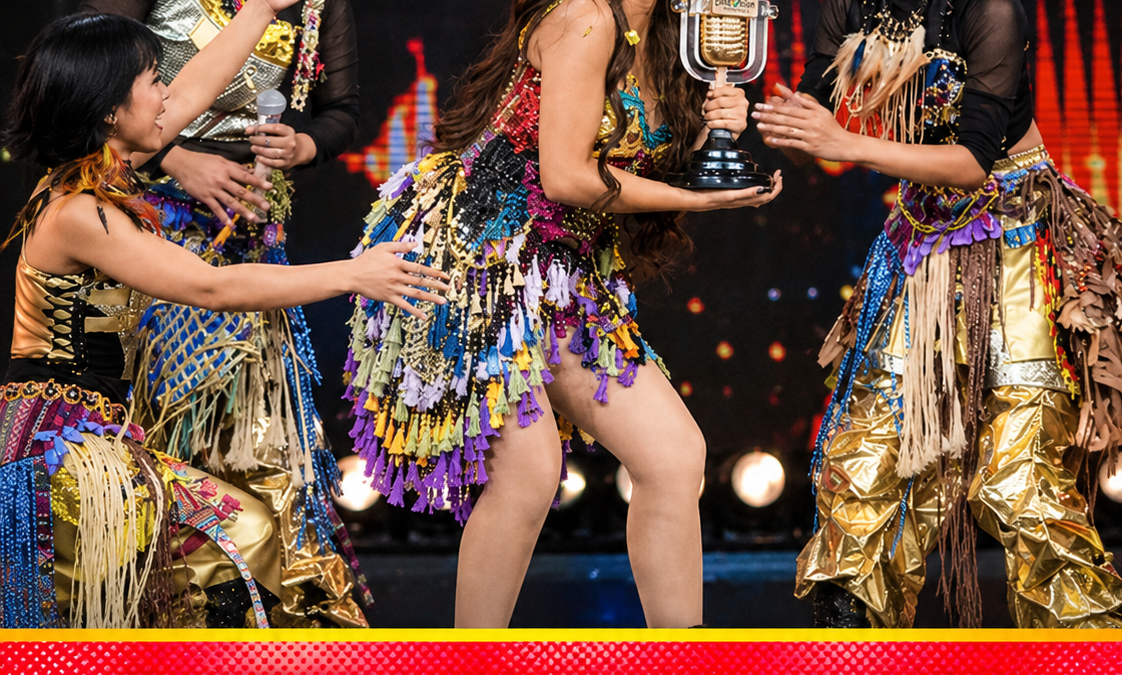
BANGKOK, Thailand — November 15, 2026 — The Philippines has claimed the first-ever Eurovision Song Contest Asia championship after Filipino singer CARMELLE won the inaugural Grand Final in Bangkok on Nov. 14 with her song “Sobra-Sobra”.
CARMELLE finished with 211 points, beating Thailand’s MANG x DAOU, which received 169 points, and Vietnam’s Tóc Tiên, which placed third with 165. The result makes the Philippines the first country to win the newly launched Asian edition of the Eurovision competition. Eurovision Song Contest+1
The victory gives Filipino music a prominent result on a regional stage. It also marks the conclusion of a competition that brought together 11 countries, with votes received from 183 countries and territories.
For the Philippines, the achievement is both a contest victory and an opportunity to introduce a wider audience to an original Filipino music entry.
Eurovision Asia gives the Philippines its first title
The Grand Final took place at One Bangkok Forum in Thailand, with performers representing 11 participating countries.
CARMELLE’s 211-point total came from two components: 93 points awarded by professional juries and 118 points from the public vote. She topped both voting categories, according to the official contest results. Eurovision Song Contest
Thailand secured second place with “Aroma”, performed by MANG x DAOU. Vietnam’s Tóc Tiên finished third with “EM TIÊN”.
The result combined votes from 11 national juries with the audience vote, which accounted for 50% of the overall result. A separate Rest of the World vote awarded a set of points equivalent to that of one participating country. Eurovision Song Contest
The contest also reported that votes came from 183 countries and territories, including the 11 participating nations.
That international reach is an important part of the event’s significance. The competition was not limited to a national television audience or a single host-country market.
From Philippine selection night to the Bangkok stage
CARMELLE’s international appearance followed her victory at the Philippine Selection Night on Aug. 30 at the New Frontier Theatre.
The selection process featured 10 original entries. “Sobra-Sobra” emerged as the winning song, while SAGA’s “Broken Beyond Repair” placed second and “Mapadama”, performed by JM Dela Cerna and Marielle Montellano, finished third. ABS-CBN Corporate
The Philippine selection used three voting groups: a professional jury contributed 40% of the result, Philippine viewers accounted for another 40%, and international voters supplied the remaining 20%.
The selection process therefore gave both local and international audiences a role in choosing the country’s representative.
CARMELLE’s win also followed a career that included televised singing competitions. The official contest profile identifies her as a former first runner-up on The Voice Kids, a winner of Tawag ng Tanghalan, and a participant in Pinoy Big Brother. Eurovision Song Contest+1
Those milestones provide context for her path to the international competition: her Bangkok appearance followed years of exposure through Philippine entertainment platforms.
What the 211-point result actually tells us
A contest score is more than a headline number. In this case, the breakdown shows that CARMELLE’s result was supported by both professional juries and public voting.
Her 93 jury points and 118 public-vote points demonstrate that she received substantial support from both groups. Neither component alone accounts for the full result. Eurovision Song Contest
The distinction matters because a public-vote result and a jury result measure different forms of audience and professional response within the competition’s voting system.
However, the final score should not be treated as proof of commercial success. The available contest announcement does not establish how many streams “Sobra-Sobra” will receive, whether the win will lead to international recording contracts, or how much additional revenue the performance may generate.
Those outcomes would require separate information, such as streaming data, confirmed business agreements and future performance records.
For now, the measurable achievement is the title itself: the Philippines won the first edition, and its representative topped the combined scoring system.
A regional stage for Filipino music
The contest’s inaugural line-up brought together performers from Bangladesh, Bhutan, Cambodia, Laos, Malaysia, Mongolia, Nepal, the Philippines, the Republic of Korea, Thailand and Vietnam.
The event featured songs in 10 local languages and English under the theme “United by Music”. It was produced by Voxovation and Bangkok-based S20 Productions, with the Grand Final hosted at One Bangkok Forum. Eurovision Song Contest+1
For Filipino music, the result adds another international milestone to a wider pattern of artists and groups bringing OPM and P-pop to audiences outside the country.
WWC has previously covered BINI’s performances at Japan’s Summer Sonic festival, as well as SB19’s international fan-voting achievement. These are different kinds of achievements, but they reflect the variety of ways Filipino performers and their audiences engage with international platforms.
The music industry also reaches audiences through collaborations and digital entertainment. Gloc-9’s partnership with GameZone illustrates another way Filipino music can enter a wider commercial conversation.
Meanwhile, Zack Tabudlo’s recent release inspired by a television reality-show pairing highlights the continuing connection between Philippine music and entertainment programming.
CARMELLE’s victory is distinct because it came through an international song contest rather than a fan poll, festival appearance or commercial partnership.
It provides a concrete result that Filipino music can build on, although the longer-term impact will depend on what happens after the competition.
What happens next
The immediate milestone is the Philippines’ position as the inaugural Eurovision Song Contest Asia champion.
The competition’s official announcement confirmed that CARMELLE received the winning trophy after the Bangkok Grand Final. It also identified the song’s credited writers as Gianina Camille, “Nico” del Rosario, Mart Sam Emmanuel and “Mat” B. Olavides. Eurovision Song Contest
The next developments to watch include any confirmed post-contest performances, official releases, streaming milestones and future participation announcements.
These would help establish whether the victory translates into sustained attention for CARMELLE and “Sobra-Sobra”, as opposed to a short-lived increase in visibility.
The contest organiser has not, in the result announcement reviewed for this report, confirmed a specific next performance or recording agreement for the singer.
For now, the result is already historic: the Philippines has won the first Eurovision Song Contest Asia, and CARMELLE’s 211 points put her name at the top of its inaugural winners’ list.
Frequently asked questions
1. Did the Philippines win Eurovision Asia 2026?
Yes. The Philippines won the inaugural Eurovision Song Contest Asia on Nov. 14, 2026, represented by CARMELLE and her song “Sobra-Sobra”.
2. How many points did CARMELLE receive?
CARMELLE received 211 points: 93 from professional juries and 118 from the public vote.
3. Who finished second and third?
Thailand’s MANG x DAOU finished second with 169 points. Vietnam’s Tóc Tiên placed third with 165 points.
4. Where was Eurovision Song Contest Asia 2026 held?
The inaugural Grand Final took place at One Bangkok Forum in Bangkok, Thailand.
5. How many countries participated?
Eleven countries participated in the inaugural edition: Bangladesh, Bhutan, Cambodia, Laos, Malaysia, Mongolia, Nepal, the Philippines, the Republic of Korea, Thailand and Vietnam.