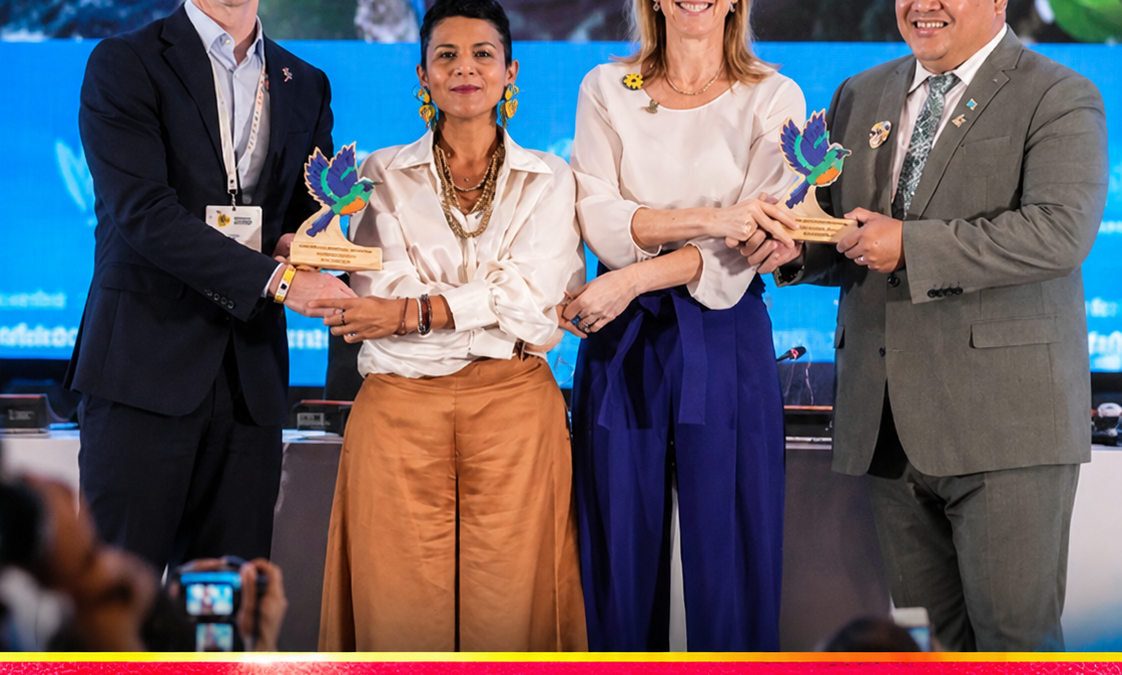
Fifty-seven countries took part in the first international Conference on Transitioning Away from Fossil Fuels in Santa Marta, Colombia, which concluded on April 29, 2026. The next stage is now being prepared by Ireland and Tuvalu, which plan to co-host a second conference in Tuvalu in 2027.
The fossil fuel transition process is moving beyond the diplomatic discussion of whether countries should reduce dependence on coal, oil and gas. Its next challenge is more practical: identifying the policies, funding and economic changes that can make the shift possible without leaving workers, communities and energy-dependent economies behind.
The conference’s official outcomes establish workstreams, a scientific panel and a coordination mechanism. But these structures are not the same as binding national commitments or completed projects. Their value will depend on what governments actually deliver.
Fossil fuel transition: what the Santa Marta process established
The April conference brought together 57 countries, 13 stakeholder groups and more than 1,500 participants, according to the Dutch government’s official conference summary.
Discussions covered three broad areas: reducing economic dependence on fossil fuels, changing energy supply and demand, and strengthening international cooperation.
The meeting produced five main outcomes. These included a coordination group to maintain continuity, three workstreams to develop practical areas of cooperation, and the creation of the Science Panel for the Global Energy Transition.
The panel is intended to help countries develop pathways aligned with the 1.5°C climate goal while addressing legal, financial and political barriers.
The conference also established a route for its work to connect with wider international climate discussions, including the COP30 Presidency’s roadmap, COP31’s roadmap and Action Agenda, and the second Global Stocktake.
This matters because international climate commitments often involve different institutions and processes. A coordination mechanism could help governments avoid duplicating work and identify areas where existing initiatives can support national transition plans.
However, the announcement of a workstream does not mean a country has adopted a new energy law, stopped approving fossil fuel projects or secured financing for renewable infrastructure.
Three priorities will shape the next conference
In a September 24 announcement, Ireland and Tuvalu presented their shared vision for the second conference, using the theme “From Pathways to Delivery: Making the Transition Possible for Every Country.”
The proposed approach has three connected pillars: plan the transition, finance the transition and transform the real economy.
The first pillar concerns national planning. Governments need to identify how their energy systems and economies can change, taking account of existing infrastructure, domestic resources, electricity demand and dependence on fossil fuel revenues.
The second concerns financing. Replacing or reducing fossil fuel dependence requires capital for power generation, transmission, storage, technology and workforce development. Countries with limited fiscal capacity may also need access to affordable finance and technical support.
The third pillar concerns the wider economy. A transition affects more than electricity generation. It can influence employment, industrial competitiveness, public revenue, transport, trade and the communities that depend on extraction-related activity.
The three pillars recognise that a country cannot simply announce a shift away from fossil fuels and expect the economic consequences to resolve themselves.
The 2027 conference is intended to bring these issues closer to practical implementation. The co-hosts have invited governments and partners to contribute ideas, technology, expertise and financing.
Why the process still needs measurable results
The Santa Marta conference created a framework for cooperation, but the official outcomes do not establish a single binding phase-out timetable for every participating country.
That distinction is important. Governments have different energy mixes, development needs and levels of dependence on coal, oil and gas. A country that imports most of its fuel faces a different set of challenges from one that relies on fossil fuel production for export earnings and government revenue.
The conference’s three workstreams are expected to identify practical areas for reducing fossil fuel dependence and strengthening cooperation. Their structure is to be developed between the first and second conferences.
For the process to demonstrate progress, governments will eventually need to show more than attendance and declarations. Useful measures could include published national transition plans, financing arrangements, new clean-energy capacity, grid improvements, worker-support programmes and clear implementation schedules.
These are analytical benchmarks rather than a list of commitments already adopted by all participants.
The importance of sustained action is also reflected in the wider debate over global emissions. WWC ONE MEDIA previously examined why a projected decline in fossil-fuel emissions does not necessarily mean total carbon pollution is falling. A lasting transition requires structural changes, not just temporary reductions in fuel use.
The energy security question cannot be ignored
For Tuvalu, the transition is closely connected to energy security and economic resilience.
The September announcement said the island nation relies on fossil fuels imported across long distances, leaving it exposed to prices it cannot control. That makes the shift toward cleaner domestic energy sources a question of economic vulnerability as well as climate policy.
This is an important point for developing economies. A transition strategy must consider whether electricity remains reliable and affordable while new infrastructure is developed.
Renewable generation also needs supporting systems. Solar and wind projects, for example, require suitable grid connections, storage or other flexibility measures, and financing structures that can sustain development over time.
The Philippines faces comparable questions as it expands its own energy infrastructure. Recent WWC coverage of the proposed 2-GW Ilocos Norte offshore wind partnership illustrates the difference between a development ambition and a project that has completed financing, technical assessment and construction.
The same distinction applies internationally: a transition pathway is a starting point, not proof that replacement capacity is already operating.
Colombia’s role and the separate alliance question
Colombia and the Netherlands co-hosted the first Santa Marta conference. The Dutch government’s summary identified both countries, alongside Ireland and Tuvalu, as part of the coordination structure intended to maintain continuity.
A separate international initiative, the Beyond Oil and Gas Alliance (BOGA), also works to support the managed phase-out of oil and gas production. Its official membership page currently lists Colombia among its “Friends”, a category for governments supporting the declaration and working towards policy measures addressing oil and gas supply.
These are distinct initiatives. BOGA has its own membership structure and commitments, while the Santa Marta process is a conference-based effort to develop broader cooperation on transitioning away from fossil fuels.
The distinction matters when interpreting reports about changes in a country’s participation in one process. A change in involvement in a particular conference would not automatically establish that a country has left every international initiative related to fossil fuels.
The public primary records reviewed for this article do not independently establish Colombia’s reported withdrawal from the Santa Marta process. That claim is therefore not treated as confirmed here.
What happens next
Ireland and Tuvalu are preparing the second Conference on Transitioning Away from Fossil Fuels, which is scheduled to take place in Tuvalu in 2027.
Their September announcement sets out a more implementation-focused agenda, with planning, finance and economic transformation at its centre. The co-hosts also intend to seek input from governments and partners as they develop the programme.
The next important test is whether the workstreams and scientific panel produce useful support for governments, particularly those that need help financing infrastructure or diversifying economies dependent on fossil fuel production.
For countries such as the Philippines, the international process is worth watching because energy security, investment, electricity affordability and climate commitments are closely connected.
The Santa Marta process has established a forum and a structure for continued work. Its credibility, however, will ultimately depend on whether those arrangements help countries make measurable changes beyond conference statements.
Frequently asked questions
What is the Santa Marta process?
It is an international cooperation process launched through the First Conference on Transitioning Away from Fossil Fuels, held in Santa Marta, Colombia, in April 2026.
How many countries attended the first conference?
The Dutch government’s official summary said 57 countries took part, alongside 13 stakeholder groups and more than 1,500 participants.
When is the next fossil fuel transition conference?
Ireland and Tuvalu plan to co-host the second conference in Tuvalu in 2027.
What are the three pillars of the 2027 conference?
The proposed pillars are planning the transition, financing the transition and transforming the real economy.
Does the Santa Marta process require every country to stop using fossil fuels by a fixed date?
The official conference outcomes reviewed do not establish a single binding phase-out date for all participating countries. The process is focused on cooperation and developing practical pathways.