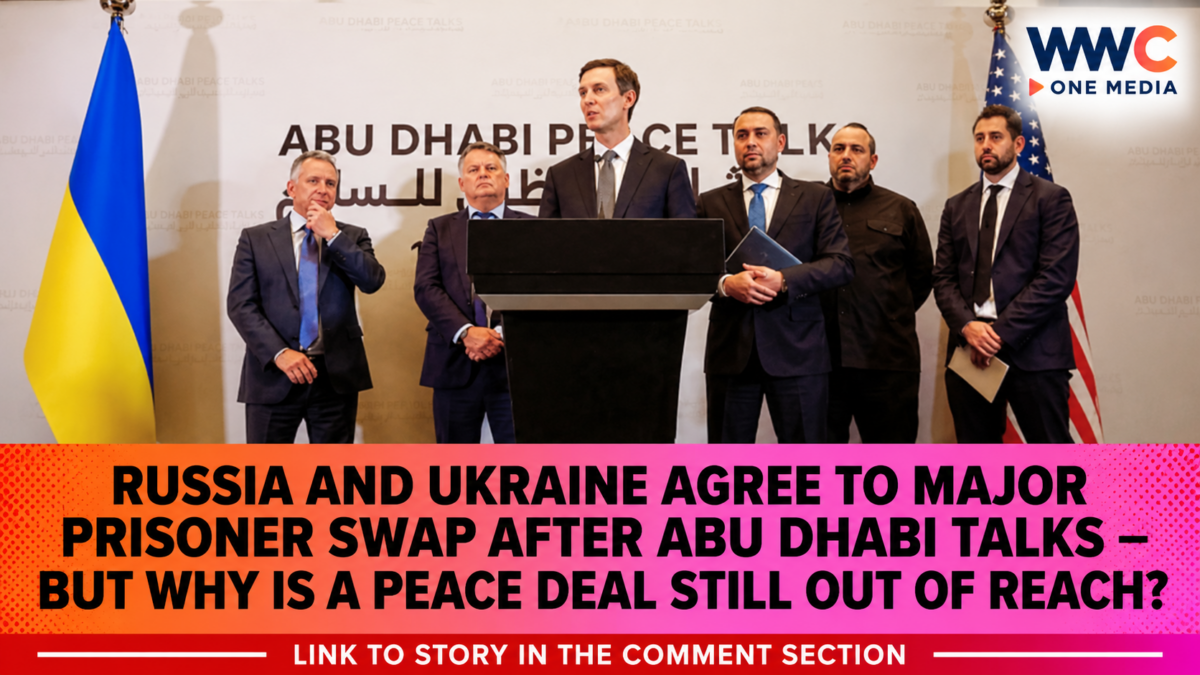
ABU DHABI, November 12, 2026 — Russia and Ukraine have agreed in principle to a major prisoner-of-war exchange following two days of US-brokered negotiations in Abu Dhabi, offering a rare humanitarian breakthrough in a conflict that has resisted years of diplomatic efforts.
But while the agreement could bring home a significant number of captured soldiers, it has not resolved the fundamental disagreements keeping the war alive.
US envoy Jared Kushner described the proposed exchange as potentially the biggest humanitarian release of prisoners since Russia launched its full-scale invasion of Ukraine in February 2022. The final number of people to be exchanged, however, had yet to be confirmed when the talks concluded on November 11.
Both delegations confirmed the agreement in principle, but neither announced a completed exchange or published a definitive list of prisoners. Russian officials indicated that the process could take another two to three weeks, subject to final arrangements.
A prisoner exchange becomes the clearest result of the Abu Dhabi negotiations
The November 10–11 meetings marked the first direct US-mediated negotiations between Russian and Ukrainian delegations in nine months.
The discussions brought together Russian negotiator Vladimir Medinsky, Ukrainian delegation leader Rustem Umerov, and US representatives Kushner and special envoy Steve Witkoff.
Although both sides described the discussions as productive, the prisoner exchange emerged as the most concrete outcome announced publicly.
Kushner said the final numbers would be determined after the meetings. Ukrainian President Volodymyr Zelenskyy had previously indicated that negotiators were discussing a possible exchange involving 1,000 prisoners from each side, with figures as high as 1,500 per side also raised.
Those figures should not be mistaken for a confirmed agreement. The final scale still needed to be settled.
If the exchange exceeds the 1,000-for-1,000 swap carried out in May 2025, it would represent a major development in the humanitarian track of the negotiations. But the number of people ultimately released will depend on the final lists and arrangements agreed by both governments.
Previous exchanges show that prisoner releases can move forward even when wider political negotiations remain deadlocked. That makes the latest understanding significant, but it does not necessarily indicate that either government is ready to compromise on the terms for ending the war.
US admits trust remains a major obstacle
Despite the progress on prisoners, Washington acknowledged that the negotiations remain difficult.
Kushner said there was currently no trust between Russia and Ukraine — a situation he described as understandable after years of war.
That mistrust is more than a diplomatic problem. It affects the central questions negotiators must answer: who controls occupied territory, what security arrangements will protect Ukraine after a ceasefire, and how can either side be confident that an agreement will be respected?
The territorial dispute remains particularly difficult.
Russian President Vladimir Putin has continued to demand that Ukraine surrender the parts of the eastern Donbas region still under Kyiv’s control. Ukraine has rejected giving up territory defended by its forces and insists that any settlement must protect its sovereignty.
Russia controls about one-fifth of Ukrainian territory, including areas seized before its full-scale invasion in 2022. The front line has remained largely static in recent months, even as both sides continue missile and drone attacks.
The disagreement over Donbas is therefore not simply about drawing a new border. It concerns whether a peace settlement would recognise territorial gains made through military force — a prospect Kyiv has consistently opposed.
Why the territorial question could derail the peace effort
For Moscow, control over Donbas remains a central demand. For Kyiv, surrendering the region would mean accepting a settlement that could undermine Ukraine’s territorial integrity and leave other areas vulnerable to future pressure.
The United States is attempting to move discussions beyond the immediate territorial deadlock by focusing on post-war security guarantees and a broader framework for European security.
But those issues are closely connected.
Ukraine wants credible protections against another Russian invasion. European governments also want assurances that a settlement will not create a new security crisis across the continent.
Russia, meanwhile, has repeatedly demanded changes to the European security order, including limits on NATO’s military presence and influence near its borders.
These competing objectives help explain why the prisoner agreement could advance while the wider peace process remains stuck.
WWC ONE MEDIA previously examined the central territorial dilemma in its report, Russia and Ukraine Resume Peace Talks as Trump Pushes for a Historic Deal — But Is Ukraine Being Asked to Give Up Too Much?. The latest negotiations have not publicly demonstrated that either side has abandoned its principal position.
Europe wants a seat at the negotiating table
Another major issue exposed by the Abu Dhabi meetings is the role of European countries.
European officials and NATO representatives were in Abu Dhabi for separate discussions with US and Ukrainian representatives. However, Russia’s delegation did not take part in direct meetings with them.
Ukraine has argued that Europe must be represented in any meaningful diplomatic process because the outcome will directly affect the continent’s security.
Zelenskyy has also stressed that European security cannot be decided without European participation.
Kushner said he and Witkoff wanted to discuss the possibility of bringing European partners into a broader negotiating format. He indicated that this issue would be raised during their next meetings with Putin.
The disagreement is significant because European countries have become major providers of financial and military assistance to Ukraine. They could also be expected to contribute to future security guarantees, reconstruction and the enforcement of any eventual settlement.
WWC ONE MEDIA explored this concern in G7 Allies Press Marco Rubio on Ukraine as US-Russia Peace Talks Resume — Could Europe Be Left Out of the Deal?, highlighting the growing debate over whether Washington and Moscow could shape Europe’s security arrangements without giving European governments a meaningful role.
US envoys prepare for meetings with Putin and Zelenskyy
The Abu Dhabi discussions are not the end of the latest diplomatic push.
Kushner and Witkoff were expected to travel to Moscow on November 12 to meet Putin and brief him on the discussions. They then planned to travel to Dublin, Ireland, for talks with Zelenskyy.
The meetings could provide another opportunity to test whether the two governments are willing to narrow their differences.
Washington is also seeking Russian proposals on a wider security agreement with Europe, including possible steps to reduce tensions. Axios reported that this broader framework has become part of the US effort to address Russian security concerns alongside negotiations to end the war.
However, the diplomatic challenge remains substantial. Russia has been reluctant to include European representatives in direct negotiations, while Ukraine and its allies argue that any lasting settlement must account for their security interests.
The renewed diplomatic effort follows months of attempts to bring Moscow and Kyiv back to the negotiating table. In its earlier coverage, WWC ONE MEDIA examined the preparations for the Abu Dhabi meetings in US to Bring Russia and Ukraine Back to the Table in Abu Dhabi — But Can Trump’s New Peace Push Finally Break the Deadlock?.
The latest round has now produced a prisoner-exchange understanding, but it has yet to deliver a ceasefire or a political agreement.
Fighting continues as diplomats negotiate
The continued violence during the talks underscores the gap between diplomatic progress and conditions on the ground.
Ukrainian officials reported Russian attacks on electricity infrastructure, including six substations in central Ukraine. An attack on a market in the Odesa region killed three people, according to local authorities.
Russian officials, meanwhile, reported a Ukrainian drone attack in the Belgorod region that killed one person. Russian authorities also reported damage and injuries connected to drone activity near the Ust-Luga port.
These reports came from the respective authorities and could not all be independently verified immediately.
The attacks demonstrate that neither side has suspended military operations while negotiations continue. For civilians, the prospect of a prisoner exchange offers hope for families awaiting the return of captured relatives, but it does not yet provide relief from the broader dangers of the war.
A humanitarian breakthrough — but not yet a peace breakthrough
The Abu Dhabi agreement is meaningful because prisoner exchanges can reunite families and return captured soldiers to their homes. It also shows that Russia and Ukraine can still reach limited agreements despite deep hostility.
But a prisoner swap is not the same as a ceasefire.
The most difficult questions remain unanswered: Will Ukraine be expected to surrender territory? What security guarantees would prevent another invasion? Will Russia accept a meaningful European role in the negotiations? And can both governments trust that any commitments will be honoured?
WWC ONE MEDIA also examined the diplomatic challenge in Putin and Zelenskyy’s Teams Face Off in Abu Dhabi as Trump Pushes for Peace — But Is Russia Ready to Stop the War?.
For now, the prisoner-exchange agreement is a limited but important step. Its eventual scale and timing will determine how many families benefit from the breakthrough.
The larger question is whether the same diplomatic momentum can be carried into the far more complicated negotiations over territory, sovereignty and security.
Until those disputes are resolved, the prospect of a lasting peace remains uncertain — even if the latest prisoner agreement becomes one of the biggest humanitarian developments of the war.