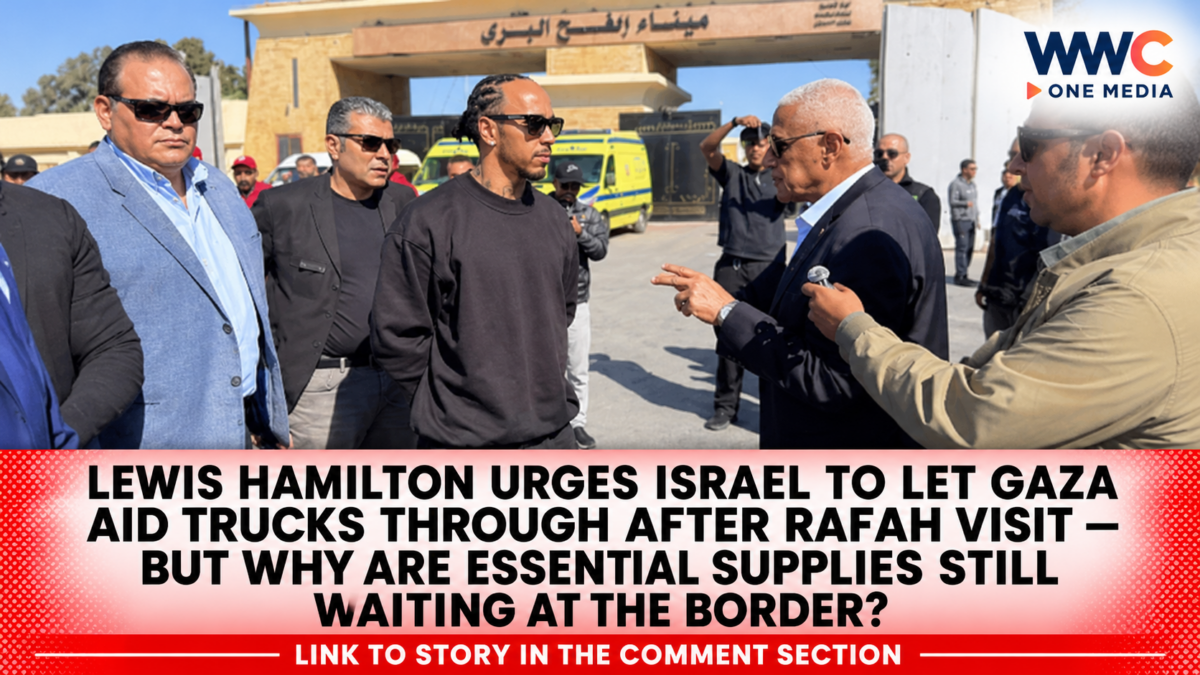
EL ARISH, EGYPT — Seven-time Formula One world champion Lewis Hamilton has called on Israel to allow humanitarian aid into Gaza after visiting Egypt’s Rafah border area and seeing food trucks and essential supplies waiting to reach Palestinians affected by the continuing humanitarian crisis.
The Ferrari driver made the visit on Tuesday, November 10, 2026, touring the Rafah crossing on the Egyptian side and logistics warehouses operated by the Egyptian Red Crescent in El Arish.
A day later, Hamilton used social media to describe what he had witnessed: trucks loaded with food waiting to enter Gaza, aid deliveries facing repeated delays, and essential items reportedly rejected or prevented from reaching people who desperately need them.
Among the supplies he identified were sleeping bags, first-aid kits, medical equipment, wheelchairs and footballs intended for children.
His message was direct: Israel must fulfil its obligations under the ceasefire and allow humanitarian aid trucks into Gaza.
The intervention has brought renewed attention to the difficulties facing humanitarian organisations, particularly as displaced Palestinian families confront damaged shelters, shortages and worsening weather conditions.
But Hamilton’s visit also highlights a bigger problem: humanitarian assistance can be collected, funded and transported to the border, yet still fail to reach civilians if access and delivery arrangements remain unresolved.
HAMILTON DESCRIBES SEEING AID TRUCKS WAITING OUTSIDE GAZA
Hamilton arrived in Egypt’s North Sinai region on November 10, where he was briefed on how humanitarian assistance is prepared and coordinated before being sent towards Gaza.
The visit included the Rafah border area and Egyptian Red Crescent logistics facilities in El Arish.
According to Reuters, Hamilton said he saw food trucks lined up and ready to travel into Gaza, with drivers regularly facing delays or being unable to proceed.
He also described speaking to a truck driver who had reportedly been waiting for more than 12 hours.
At a nearby logistics centre, Hamilton said he saw essential items that had been rejected, including sleeping bags, first-aid kits, medical equipment, wheelchairs and footballs for children.
He questioned why supplies intended to support vulnerable civilians were being prevented from reaching their destination.
In his statement, Hamilton wrote that the situation represented an injustice against people being denied freedom, safety and dignity.
He urged Israel to fulfil its obligations under the ceasefire and allow aid deliveries to proceed.
His comments were based on what he said he witnessed during the visit. They do not, by themselves, establish the reasons for every rejected shipment or the circumstances surrounding individual aid restrictions.
HAMILTON USES HIS GLOBAL PLATFORM TO SPEAK ABOUT GAZA
The 41-year-old British driver has previously used his public profile to highlight humanitarian issues and conflicts.
Hamilton has repeatedly expressed concern about the impact of the war on Palestinian civilians, including children, and has called for peace and a ceasefire.
In his latest statement, he described Israel’s actions over the past three years as genocide.
That is Hamilton’s characterisation of the conflict. Israel strongly rejects allegations of genocide and maintains that its military campaign is directed against Hamas.
The legal question of genocide is distinct from political statements and remains a matter of international legal proceedings and assessment.
Hamilton’s latest intervention nevertheless adds another prominent sporting voice to international calls for humanitarian access and civilian protection.
He also warned against allowing the suffering of Palestinians to become something the international community simply accepts or ignores.
WHY THE RAFAH CROSSING MATTERS TO GAZA’S HUMANITARIAN RESPONSE
The Rafah crossing connects Egypt’s Sinai Peninsula with the Gaza Strip and has long been an important route for humanitarian assistance, people and essential supplies.
The border area has become particularly significant because Gaza’s population depends heavily on humanitarian deliveries after years of conflict and widespread damage to infrastructure.
Hamilton’s visit took place on the Egyptian side. He toured the border area and aid facilities; he did not travel into Gaza.
The Egyptian Red Crescent plays a major role in receiving, organising and coordinating humanitarian assistance destined for the Palestinian territory.
However, the presence of supplies in warehouses or trucks near the border does not guarantee that they can enter Gaza.
Deliveries depend on border access, security arrangements, inspection procedures, coordination among authorities and humanitarian organisations, and the availability of routes for distribution inside the territory.
This is why the difference between aid being ready for shipment and aid actually reaching civilians is so important.
The Associated Press has reported that the ceasefire framework included an agreed minimum of 600 aid trucks entering Gaza daily. Actual deliveries have continued to fall short of that benchmark, according to reporting cited by the news agency.
The figure is an agreed target, not evidence that the required volume has consistently been delivered.
150,000 TENTS REPORTEDLY WAITING OUTSIDE GAZA AS WINTER CONDITIONS WORSEN
Hamilton’s visit comes at a particularly difficult time for displaced Palestinians.
Heavy rainfall has flooded makeshift shelters across Gaza, leaving families struggling to protect themselves from water, cold and damaged living conditions.
A Reuters report published November 7 said at least 70,000 tents had been flooded within 12 hours, citing figures from the Hamas-run government media office. The report also described damaged bedding, injuries and emergency services struggling with shortages of fuel and functioning equipment.
The situation has exposed the vulnerability of families living in temporary shelters after losing their homes.
Al Jazeera also reported that the United Nations said more than 150,000 tents purchased by humanitarian partners and member states were waiting outside Gaza for permission to enter.
UN humanitarian chief Tom Fletcher criticised delays in delivering winter supplies, saying the formation of a new Israeli government was not an acceptable reason for holding up essential assistance.
The supplies are particularly important for families who have already lost homes, mattresses, clothing and other basic possessions.
The weather emergency makes the availability of shelter materials, blankets, sanitation equipment and medical supplies even more urgent.
ISRAEL REJECTS ACCUSATIONS THAT IT IS DELIBERATELY BLOCKING HUMANITARIAN AID
The Israeli government has rejected accusations that it is deliberately preventing humanitarian assistance from reaching Gaza.
Israeli officials have maintained that aid deliveries are subject to security and inspection procedures and have accused Hamas of diverting humanitarian supplies for military purposes.
Those claims and the wider dispute over access have been contested by humanitarian organisations and Palestinian authorities.
The Israeli position is also important context when examining Hamilton’s remarks.
His account describes the delays and rejected items he said he observed. It does not independently establish why each shipment was held up or whether every rejected item was denied for the same reason.
The broader humanitarian dispute involves access restrictions, security checks, logistical challenges and disagreements over the implementation of the ceasefire.
Nevertheless, the immediate needs of civilians remain: food, shelter, medical care, clean water and protection from the weather.
A CEASEFIRE HAS NOT ENDED GAZA’S HUMANITARIAN EMERGENCY
The ceasefire agreement reached in October 2025 reduced large-scale fighting, but it has not resolved the wider humanitarian and political crisis.
Aid deliveries remain a major concern, while reconstruction, security arrangements and the future governance of Gaza continue to face significant obstacles.
The Associated Press has reported that major combat operations were halted under the agreement, but military incidents and humanitarian difficulties have continued.
A UN commission has also reported that Israeli forces expanded their control over parts of Gaza despite the ceasefire.
The continued displacement of civilians and destruction of infrastructure mean that humanitarian needs remain enormous.
Hamilton’s call for aid access therefore comes amid a broader struggle to translate ceasefire commitments into practical improvements in people’s lives.
SINGAPORE AND OTHER COUNTRIES ARE ALSO TRYING TO STRENGTHEN GAZA RELIEF
International organisations and governments continue to look for ways to support civilians in Gaza.
Singapore, for example, launched the SG for Humanity network on November 5, 2026, bringing together humanitarian organisations and community partners to strengthen coordination and public participation in relief efforts.
The initiative includes Humanity Matters, Mercy Relief, Rahmatan Lil Alamin Foundation and the Singapore Red Cross.
WWC ONE MEDIA previously reported on Singapore’s SG for Humanity initiative and the challenge of ensuring that humanitarian assistance actually reaches Gaza.
The network is intended to improve coordination among organisations, strengthen partnerships and create more opportunities for Singaporeans to contribute.
However, the initiative does not remove the border restrictions or logistical challenges affecting aid deliveries into Gaza.
It illustrates a wider reality: raising money and collecting supplies are only part of humanitarian relief. Getting assistance safely to the people who need it is often the more difficult stage.
GAZA’S RECONSTRUCTION PLAN FACES MAJOR OBSTACLES
The humanitarian crisis is also connected to the much larger challenge of rebuilding Gaza.
In September 2026, the US-backed Board of Peace proposed a six-month reconstruction and governance programme worth approximately US$2.45 billion.
The proposal covered infrastructure, healthcare, education, economic development and security.
But the plan represents an initial framework rather than a guarantee that reconstruction will begin at scale.
WWC ONE MEDIA examined the proposal in Trump’s Board of Peace reconstruction plan for Gaza and the major political and security obstacles standing in its way.
The wider rebuilding challenge is far greater than the initial funding package.
Gaza requires substantial investment in housing, hospitals, schools, roads, water systems and sanitation infrastructure. Rebuilding will also depend on reliable access to construction materials and a workable political and security arrangement.
Until those conditions are established, millions of dollars in proposed reconstruction funding cannot automatically translate into completed homes, functioning hospitals or restored public services.
FLOODING HAS MADE THE HUMANITARIAN CRISIS EVEN MORE URGENT
The November flooding has demonstrated how quickly already difficult living conditions can deteriorate.
WWC ONE MEDIA recently reported on Gaza’s flooding emergency, which left more than 106,000 people affected as shelter shortages and political disputes threatened winter preparations.
That report examined the damage to temporary shelters, the need for winter supplies and the continuing disagreement over responsibility for delays in humanitarian assistance.
The latest conditions make the delivery of tents, blankets, medical equipment and sanitation supplies increasingly important.
For displaced families, these are not simply items on an aid inventory. They can determine whether people have somewhere dry to sleep, whether children can stay warm and whether medical needs can be addressed.
The continuing challenge is to ensure that supplies already mobilised by humanitarian organisations can reach the people who need them.
HAMILTON’S VISIT ALSO COMES AFTER HIS 400TH FORMULA ONE START
The humanitarian visit followed a major milestone in Hamilton’s racing career.
The seven-time world champion made his 400th Formula One race start at the Sao Paulo Grand Prix in Brazil on November 8, 2026.
He made his F1 debut with McLaren in 2007 and later became one of the sport’s most successful drivers.
Hamilton founded Mission 44 in 2021, a charity focused on improving opportunities for young people, particularly in education and employment.
His humanitarian advocacy has increasingly become part of his public profile beyond motorsport.
The Rafah visit adds another international issue to the causes he has publicly highlighted.
THE BIGGER QUESTION: WILL THE AID FINALLY REACH THE PEOPLE WHO NEED IT?
Hamilton’s visit has drawn attention to a troubling gap between humanitarian supplies being prepared and civilians receiving them.
Food trucks are reportedly waiting. Medical equipment and other essential items have been identified among supplies facing restrictions. Meanwhile, displaced families are dealing with flooding, damaged shelters and shortages.
The Israeli government disputes accusations that it is deliberately blocking assistance and says security requirements are part of the process.
But the immediate humanitarian challenge remains difficult to ignore.
The ceasefire was meant to create conditions for greater stability and relief. Yet the continued shortage of supplies and the worsening conditions in displacement camps show how much remains unresolved.
Hamilton has used his global platform to demand that aid be allowed through.
Now the responsibility rests with the authorities and organisations involved in the delivery process to ensure that humanitarian assistance reaches civilians safely and without unnecessary delay.
The question is no longer simply how much aid has been collected.
It is whether the food, medical equipment, winter supplies and shelter materials waiting near Gaza can finally reach the families who need them most.