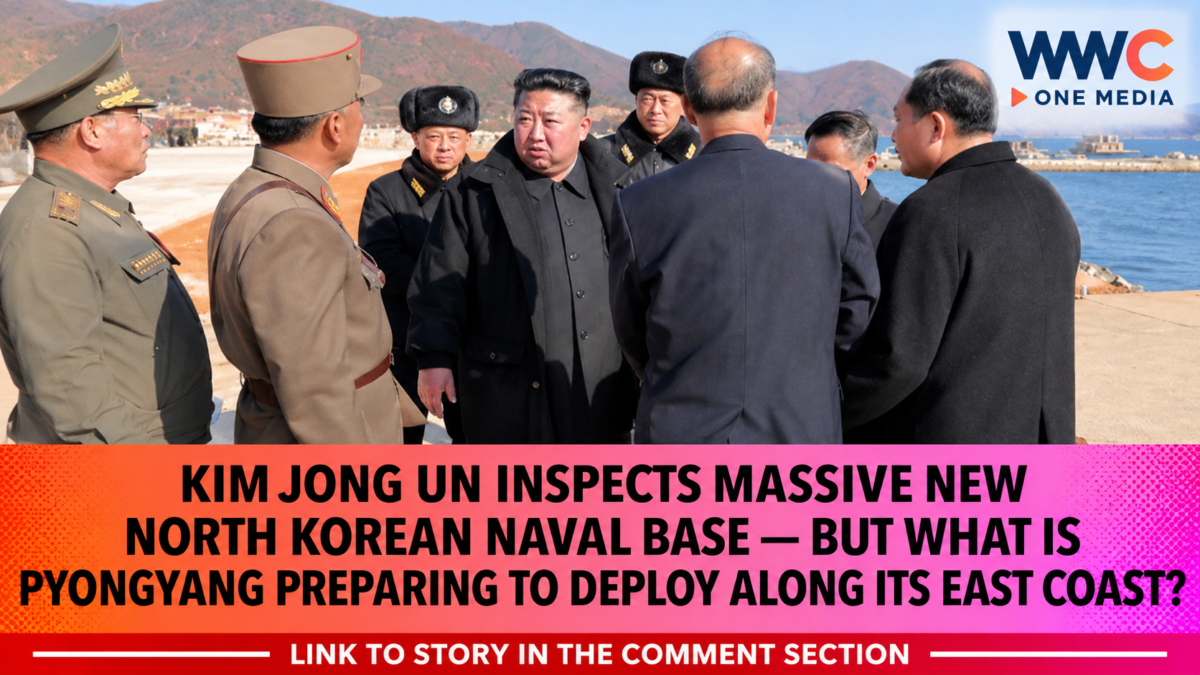
PYONGYANG / SEOUL — North Korean leader Kim Jong Un has inspected the construction of a major naval base on the country’s east coast, ordering officials to accelerate work on a facility that could become an important part of Pyongyang’s expanding military capabilities.
The inspection, conducted on November 11 and reported by North Korea’s state-run Korean Central News Agency (KCNA) on November 12, comes as the country pushes to modernise its navy with larger warships, advanced missile systems and a nuclear-powered submarine programme.
Kim described the naval base as essential to North Korea’s national security and maritime sovereignty. He called for the construction of a Korean-style naval command centre, facilities supporting naval operations and infrastructure intended to strengthen the country’s combat capabilities.
According to South Korean news agency Yonhap, Kim instructed officials to complete the project within the deadline established by the ruling Workers’ Party of Korea.
The exact location and full specifications of the facility have not been officially disclosed.
However, analysis by North Korea-focused publication NK News identified some of the inspection photographs as having been taken in Munchon, north of Wonsan, where construction of a naval facility has been under development for years.
The timing is significant.
North Korea has recently commissioned two 5,000-ton-class destroyers, revealed plans for a much larger cruiser and announced the development of an 8,700-ton-class nuclear-powered submarine.
The latest inspection therefore raises a major question: is Kim building the infrastructure needed to turn North Korea’s expanding naval weapons programme into a more capable operational force?
KIM ORDERS FASTER CONSTRUCTION OF A MAJOR EAST COAST NAVAL BASE
KCNA reported that Kim visited the construction site on November 11, where military commanders briefed him on the project’s progress.
He called for the rapid development of facilities that would support naval command, military culture and combat operations.
His instructions went beyond simply completing docks and buildings.
According to Yonhap, Kim wanted a modern naval command centre and supporting infrastructure capable of serving as the centre of the country’s naval operations.
He also directed officials to strengthen the construction leadership and workforce to ensure the project met the ruling party’s requirements.
Kim described the facility as a major undertaking directly connected to the country’s security and defence of its maritime sovereignty.
However, North Korea did not disclose a precise completion date, the full construction budget or the number and types of vessels expected to operate from the base.
That uncertainty is important.
A naval base is not simply a collection of docks. It requires maintenance facilities, fuel supplies, weapons storage, command systems, communications infrastructure and the ability to support vessels during extended operations.
If completed as envisioned, the facility could help North Korea address a major limitation in its expanding fleet: having sufficiently modern infrastructure to accommodate and maintain larger warships.
WHERE IS THE NEW NAVAL BASE BEING BUILT?
North Korea has described the project as a major naval base on its east coast, but has not publicly confirmed its exact location.
This has prompted considerable interest among military analysts.
NK News reported on November 12 that analysis of photographs released by KCNA placed some of the inspection images in Munchon, north of Wonsan.
The publication also reported that satellite imagery showed construction activity had resumed at the site in August 2026 after years of limited visible progress.
The facility has a much longer history than the latest inspection suggests.
According to earlier reporting by The Korea Herald, the Munchon naval base project had been under development for more than a decade. More than 10 piers and docking facilities capable of accommodating larger warships and submarines were constructed between 2015 and 2017.
A railway bridge connecting the facility to the national rail network was completed in 2018, but work subsequently slowed.
Kim visited the unfinished facility in September 2024 and described its completion as an urgent task.
The renewed construction therefore appears to be part of a longer-term effort rather than an entirely new military project.
There is also uncertainty about the relationship between the base and another location mentioned in North Korean reporting.
Kim separately inspected more than 1,000 newly built residential units in Tongchon County, Kangwon Province, on November 11. KCNA said the housing was intended for residents displaced by construction of a large naval base.
Yonhap reported that this visit prompted speculation about a possible connection with Jangjon Port.
However, a South Korean Unification Ministry official cautioned that the naval construction site appeared to be farther north than Jangjon Port and that more analysis was necessary.
The precise location should therefore not be treated as officially confirmed.
NORTH KOREA’S NEW DESTROYERS ARE CHANGING THE NAVAL EQUATION
The naval base construction is particularly significant because North Korea has been expanding its surface fleet.
Two 5,000-ton-class destroyers, the Choe Hyon and Kang Kon, have been presented by Pyongyang as major additions to its navy.
The Choe Hyon entered service in June 2026, while the Kang Kon was commissioned in September, according to North Korean state media.
Kim has described the Kang Kon as part of the country’s nuclear response system.
Both vessels represent a substantial step beyond the smaller warships traditionally associated with North Korea’s naval forces.
The destroyers have been showcased carrying a variety of weapons, including missile systems and naval guns.
North Korean state media has also reported cruise missile and anti-ship missile tests involving the vessels.
However, the actual operational readiness, reliability and full weapons capabilities of the ships remain difficult to independently verify.
The infrastructure problem is equally important.
A large destroyer requires more than a place to dock. It needs facilities capable of carrying out repairs, replenishing supplies, supporting its crew and maintaining its weapons systems.
The Korea Herald reported in August that North Korea’s lack of suitable bases for its newer, larger warships had become an obstacle to the country’s naval ambitions.
The east coast project could help address that weakness.
For a closer look at Pyongyang’s growing weapons capabilities, read WWC ONE MEDIA’s report, North Korea Tests New Combat Weapon as Kim Jong Un Warns Enemies of a ‘Cruel’ Blow.
A MUCH BIGGER WARSHIP IS ALSO UNDER CONSTRUCTION
The naval base is not the only major project receiving Kim’s attention.
On November 2, he visited the Nampho Shipyard on North Korea’s west coast, where he inspected another large warship under construction.
KCNA described the vessel as significantly larger than the destroyer built the previous year.
Based on photographs released by North Korean state media, analysts cited by KBS World and USNI News assessed that the vessel could be a roughly 10,000-ton-class cruiser.
That classification has not been independently confirmed by North Korea through a complete set of technical specifications.
The photographs showed a large hull under construction, but did not provide enough information to establish its full displacement, weapons configuration or operational capabilities.
Kim also ordered improvements at Nampho Shipyard, including greater automation, an additional dry dock and changes to the facility’s layout.
The purpose is to increase shipbuilding capacity and allow more vessels to be built and repaired.
The November 2 shipyard inspection and November 11 naval base inspection are separate activities, but together they illustrate a broader strategy: expanding both the ships themselves and the infrastructure needed to support them.
WWC ONE MEDIA has also examined North Korea’s wider nuclear military expansion in North Korea Says U.S.-Led Military Buildup Justifies More Nukes — But Its Nuclear Infrastructure Is Expanding Too.
NORTH KOREA’S NUCLEAR-POWERED SUBMARINE PROGRAMME ADDS ANOTHER LAYER OF CONCERN
Perhaps the most strategically significant part of North Korea’s naval ambitions is its nuclear-powered submarine programme.
Pyongyang has said it is developing an 8,700-ton-class nuclear-powered submarine.
Such a vessel, if successfully developed and deployed, could potentially remain at sea for much longer periods than a conventionally powered submarine.
It could also expand North Korea’s ability to operate underwater forces across a wider maritime area.
However, the announcement should not be mistaken for proof that North Korea already possesses a fully operational nuclear-powered submarine.
The country has released limited information about the programme, and independent assessments of its technical progress remain incomplete.
It is also important to distinguish between a nuclear-powered submarine and a nuclear-armed submarine.
Nuclear propulsion refers to the energy source used to operate the vessel. Nuclear armament refers to the weapons it carries.
A submarine could be nuclear-powered without carrying nuclear weapons, while a conventionally powered submarine could potentially carry nuclear-capable missiles.
North Korea has been pursuing both elements of its naval modernisation programme, but the precise operational status of its systems remains uncertain.
The International Atomic Energy Agency has also expressed concern about the country’s expanding nuclear infrastructure.
WWC ONE MEDIA previously reported on that development in North Korea Builds New Uranium Enrichment Facility at Yongbyon, IAEA Says.
The connection is strategically important because a larger nuclear programme could support ambitions to expand the range of delivery systems available to Pyongyang.
Nevertheless, the existence of additional nuclear infrastructure does not independently establish that every new naval platform is nuclear-capable.
WHY NORTH KOREA IS TURNING ITS ATTENTION TO THE SEA
North Korea has historically relied heavily on its land-based military forces and missile systems.
Its navy, by comparison, has operated with a large number of older vessels, many of which are smaller and less capable than the modern surface combatants operated by regional powers.
That balance now appears to be changing.
Kim has repeatedly called for stronger surface and underwater combat capabilities.
The country’s defence development plan for 2026–2030 reportedly includes ambitions to build two large surface warships annually, alongside additional escort and specialised vessels.
The strategy could give North Korea more flexibility to protect its maritime approaches, deploy missile systems at sea and strengthen its ability to operate beyond its immediate coastline.
A more capable navy could also complicate military planning for South Korea, Japan and the United States.
But building ships is only one part of the challenge.
North Korea must also develop reliable propulsion systems, sensors, weapons integration, crew training, maintenance infrastructure and logistics.
Even if the ships appear impressive in state media photographs, their true effectiveness will depend on whether they can operate consistently and safely under realistic conditions.
THE SOUTH KOREA-JAPAN-US SECURITY CALCULUS
North Korea’s naval expansion comes amid continuing tensions with South Korea, Japan and the United States.
Washington maintains a security alliance with Seoul and a separate alliance with Tokyo. The three countries also cooperate on missile warning, military exercises and regional security.
Pyongyang has repeatedly criticised those arrangements, describing them as hostile military pressure.
The three governments, meanwhile, characterise their cooperation as defensive.
The growing presence of larger North Korean warships and potentially nuclear-capable naval systems could create additional challenges for regional defence planning.
The East Sea, also known as the Sea of Japan, is strategically important because it borders North Korea, South Korea, Japan and Russia.
A stronger North Korean naval presence could complicate surveillance, maritime security and crisis management in the region.
However, it would be premature to conclude that the new base automatically gives Pyongyang the ability to challenge the combined naval strength of its neighbours.
The United States, Japan and South Korea possess substantially larger and more technologically advanced naval forces.
The significance of North Korea’s project is instead that it could improve the country’s ability to deploy and sustain its own strategic assets.
THE HUMAN COST AND THE DISPLACED RESIDENTS
The naval construction also has a civilian dimension.
KCNA reported that more than 1,000 newly built residential units in Tongchon County had been inspected by Kim on November 11.
According to the state media report, the homes were built to accommodate residents displaced by construction of the large naval base, with residents expected to move in soon.
Kim praised the new residential development but also criticised construction officials for focusing too heavily on appearance rather than the quality of housing and residents’ material well-being.
North Korean state media presented the project as part of the government’s wider Regional Development 20×10 Policy.
Independent verification of the housing conditions, the number of displaced households and the quality of the completed homes is not available.
The issue nevertheless highlights how major military infrastructure projects can affect communities living near construction sites.
WHAT HAPPENS NEXT?
The latest inspection suggests that North Korea is moving beyond announcements about a stronger navy and focusing on the infrastructure needed to support it.
The country has already presented two new destroyers, revealed a much larger warship under construction at Nampho and continued promoting its nuclear-powered submarine programme.
The east coast naval base could become a key part of that strategy if construction progresses as planned.
But several questions remain unanswered.
When will the base become operational? Which vessels will be stationed there? How much of the reported nuclear and missile capability can North Korea actually deploy at sea? And how will neighbouring countries respond if the country’s naval forces become more active in regional waters?
For now, Kim’s inspection is another indication that North Korea intends to strengthen its maritime military capabilities.
The project may not immediately change the balance of power in Northeast Asia.
But if the new base, destroyers, submarines and shipbuilding facilities become operational as Pyongyang intends, the region could face a more capable North Korean navy — and a more complicated security environment in the years ahead.