
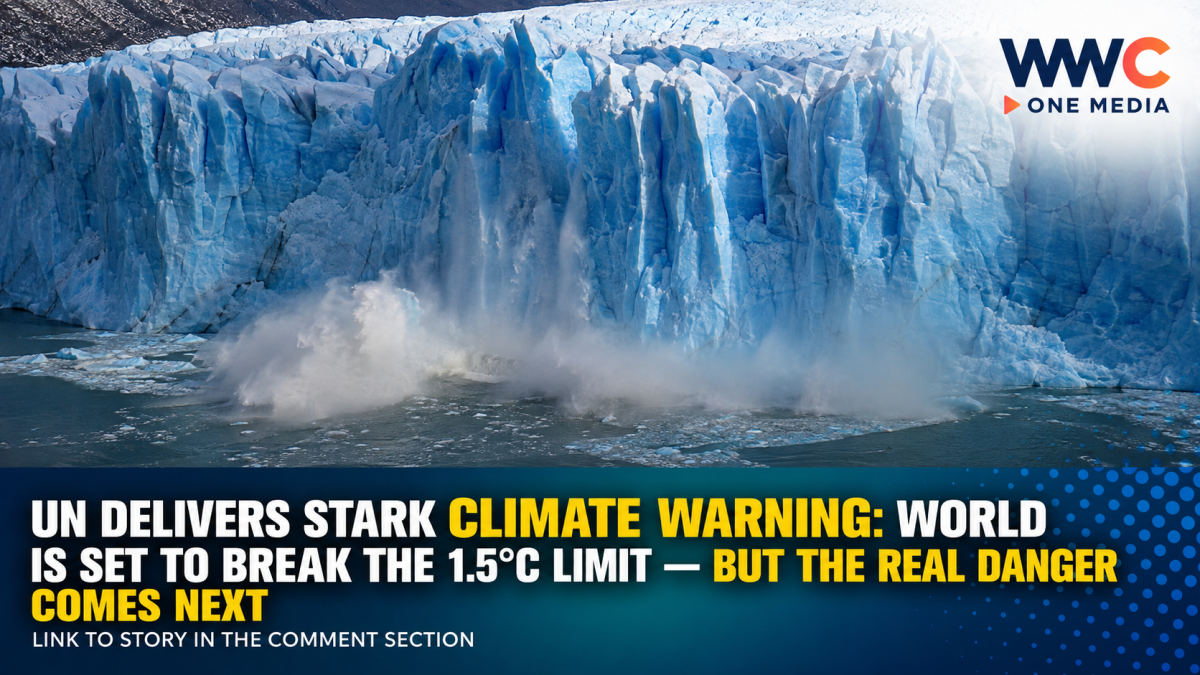
The world should prepare for the increasingly likely reality that global warming will temporarily exceed the 1.5°C threshold set under the Paris Agreement, the United Nations Environment Programme (UNEP) warned in a major new assessment.
The warning, reported by ABS-CBN through Agence France-Presse, comes as UNEP released its “Limiting Overshoot” report on September 2, outlining what scientists say may be the world’s best remaining strategy: allow warming to peak, limit how high it rises and how long it stays there, then work to bring global temperatures back down.
The report marks a significant shift in the climate debate. Rather than treating the 1.5°C threshold as something the world can still avoid under current trajectories, UNEP says crossing it is now widely assessed as unavoidable within the next few years.
But the report does not say the Paris Agreement target should be abandoned.
Instead, scientists are calling for an “overshoot, peak and decline” pathway—one that minimizes the amount and duration of warming above 1.5°C before eventually bringing temperatures back below the threshold.
Why 1.5°C matters
The 1.5°C figure refers to the increase in global average temperature compared with the pre-industrial period. Under the Paris Agreement, countries committed to holding warming well below 2°C while pursuing efforts to limit it to 1.5°C.
Scientists have repeatedly warned that every additional fraction of warming increases climate risks.
UNEP says warming beyond 1.5°C would intensify extreme heat, wildfires, floods, drought, ecosystem losses and threats to food and water security. The risks of potentially irreversible climate tipping points also increase as warming becomes higher and lasts longer.
The warning is especially serious for low-lying coastal communities and small island nations facing rising seas and other climate impacts.
The world has already crossed the threshold — temporarily
There is an important distinction between a single hot year and long-term global warming.
UNEP notes that 2024 became the first calendar year in which the global average temperature exceeded 1.5°C above the pre-industrial baseline. However, scientists assess the Paris Agreement temperature goal over a much longer period rather than declaring the target breached because of one year.
The World Meteorological Organization has also warned that the temperature trend is moving dangerously close to the long-term threshold.
Its 2026–2030 outlook estimates an 86% chance that at least one year during that period will be warmer than 2024, while there is a 75% chance that the five-year average itself will exceed 1.5°C.
That means the issue is no longer simply whether an individual year will briefly cross 1.5°C. The bigger question is how high temperatures will climb and how long the planet remains above the threshold.
Even the best-case pathway could reach 1.8°C
UNEP’s assessment presents a sobering best-case scenario.
Even under the most optimistic pathway described in the report, global warming could peak around 1.8°C above pre-industrial levels before temperatures potentially decline.
Under less ambitious pathways, peak warming could exceed 2°C. Other analyses cited in recent reporting put current-policy warming at considerably higher levels by the end of the century.
That does not mean 1.8°C is inevitable.
Rather, it illustrates how much harder the climate challenge has become after years of insufficient emissions reductions.
What happens after 1.5°C?
UNEP’s message is not that the world should simply accept a warmer planet.
The agency argues that the height of the temperature peak and the length of time spent above 1.5°C will determine how severe the consequences become.
A smaller and shorter overshoot would reduce climate risks and decrease the likelihood of crossing irreversible thresholds.
The strategy therefore has three broad stages:
Overshoot: Global temperatures move above 1.5°C.
Peak: Countries aggressively reduce emissions to keep warming from climbing toward even more dangerous levels.
Decline: Long-term net-negative emissions and carbon dioxide removal help bring global temperatures back down.
UNEP stresses that this pathway is not an excuse to delay action. The opposite is true: every year of delay can make the eventual overshoot higher and harder to reverse.
Carbon removal will become more important — but it is not a magic solution
Bringing temperatures back below 1.5°C would require more than simply reaching net-zero emissions.
UNEP says the world would eventually need net-negative emissions, meaning humanity would have to remove more greenhouse gases from the atmosphere than it releases.
Carbon dioxide removal could involve approaches such as reforestation, ecosystem restoration and technologies designed to extract carbon dioxide directly from the atmosphere.
But UNEP cautions that carbon removal cannot replace rapid emissions cuts. Some technologies remain expensive and technically challenging, while nature-based approaches face limitations involving land, drought, wildfires and the permanence of stored carbon.
The priority remains cutting emissions from fossil fuels and other sources as rapidly as possible.
The world now faces a two-front climate battle
The UNEP report says mitigation and adaptation must happen simultaneously.
Mitigation means reducing greenhouse-gas emissions to slow future warming.
Adaptation means preparing communities, cities, infrastructure, agriculture and economies for climate impacts that are already occurring or becoming increasingly difficult to avoid.
UNEP warns that adaptation itself has limits. As temperatures rise, some communities may eventually face impacts that cannot simply be engineered or financed away.
This is particularly significant for vulnerable coastal and island communities, where rising seas, extreme weather and ecosystem damage can threaten homes, livelihoods and long-term habitability.
The warning heading into COP31
The new UNEP assessment is also expected to shape the global climate conversation ahead of COP31, the UN climate conference scheduled in Türkiye later this year.
UNEP says the immediate objective should be to minimize the size and duration of the overshoot while accelerating emissions reductions, adaptation and climate resilience.
The WMO’s latest projections reinforce the urgency, showing that exceptionally warm years are likely to remain common over the next several years.
The message from the latest scientific assessments is therefore more complicated than simply saying the 1.5°C goal is “dead.”
The world may soon pass the threshold—but how far it goes beyond it, how long it stays there, and whether temperatures can eventually return below it are still influenced by decisions being made today.
UNEP’s warning is ultimately a race against the clock: the less warming humanity allows now, the less damage it will have to undo later.
WWC ONE MEDIA MJE




Leave a Reply