
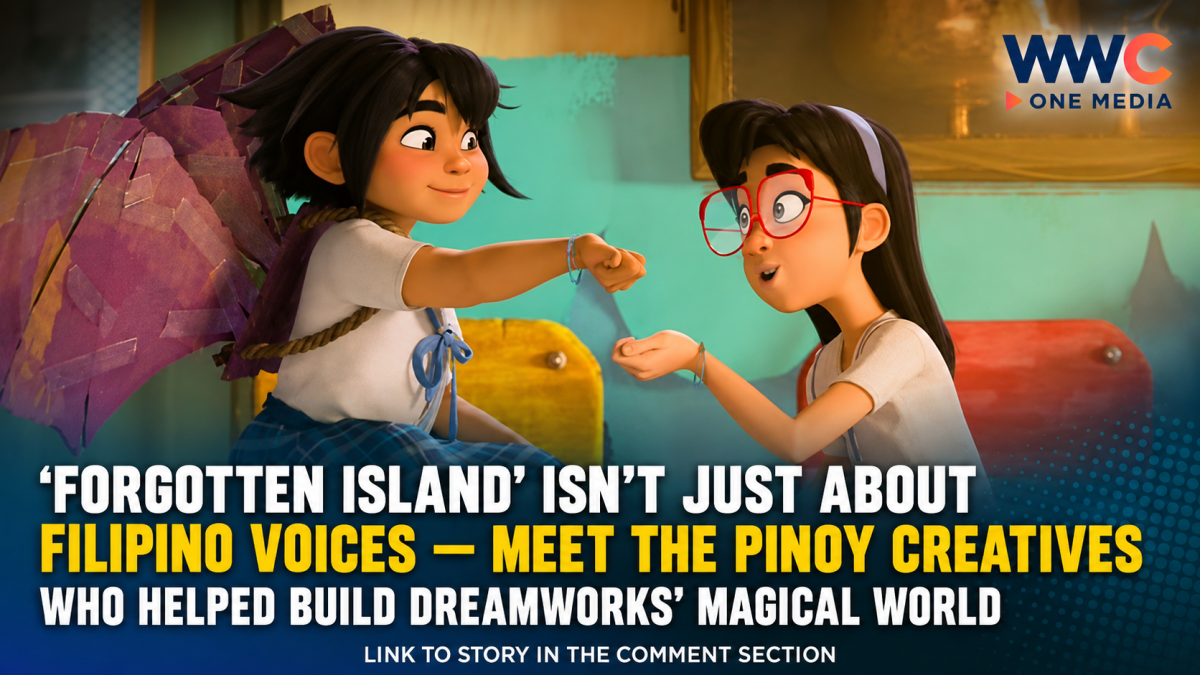
Filipino pride is taking center stage in DreamWorks Animation’s upcoming film “Forgotten Island,” but the country’s contribution to the highly anticipated animated adventure goes far beyond its star-studded voice cast.
While audiences already know that Liza Soberano, H.E.R., Lea Salonga, Manny Jacinto, Dolly de Leon and other Filipino and Filipino-American talents lend their voices to the movie, a much larger Filipino creative community helped shape the film behind the scenes.
At the heart of that effort is Filipino-American filmmaker Januel Mercado, who co-directs and co-writes “Forgotten Island” with Joel Crawford. The film grew from their long friendship and their desire to bring Philippine mythology and culture into a major Hollywood animated production.
According to Vogue Philippines, the project took about six years to develop and involved hundreds of artists across the Philippines and the United States. Filipino artists within DreamWorks and other collaborators also volunteered their expertise because they wanted the project to exist and to authentically celebrate Filipino culture.
A Filipino creative community behind the film
Among the creatives involved is Anthony Francisco, the Filipino-American artist known for designing major characters in the Marvel Cinematic Universe, including Baby Groot.
Francisco played an early role in the film’s world-building and reportedly pushed for the soundtrack to include a song by the late Filipino rapper Francis M to help capture the feel of the Philippines during the 1990s.
He also introduced Mercado and Crawford to Filipino-American composer Nathan Matthew David, whose music incorporates elements inspired by Philippine indigenous traditions.
The film’s musical world consequently goes beyond a conventional Hollywood score. Indigenous-inspired sounds, chanting, gongs, Filipino choir elements and the Las Piñas bamboo pipe organ were incorporated into the production, particularly in music associated with the mysterious Manang, voiced by Lea Salonga.
Filipino animators helped bring Nakali to life
The Philippine connection becomes even more striking in the animation itself.
Quezon City-based Snipple Animation Studios contributed hand-drawn 2D animation to “Forgotten Island.” This was particularly important because the film uses different animation styles to represent memories and perspectives from its characters.
The filmmakers used the 2D sequences to evoke the visual language of the 1990s. Some scenes draw inspiration from anime and other animation styles associated with the era, reinforcing the film’s nostalgic setting.
Mercado described his reaction to seeing an animation studio made up entirely of Filipino artists as deeply emotional and inspiring. Rather than simply functioning as an outsourcing operation, the Filipino animators became creative collaborators in bringing the world of Nakali to life.
The involvement of Filipino talent is extensive. Vogue Philippines highlighted a wider group of creatives connected to the production, including Michael James Baula, Paolo José de Guzman, Mac Lim, James Lojo, Ritchie Sacilioc, Dave Patrick Valera and others working alongside Mercado and the broader DreamWorks team.
Filipino music is another major part of the story
The Filipino influence does not stop with animation.
“Forgotten Island” features an unusually extensive lineup of Filipino and Filipino-American musicians.
BINI performs the original song “A Parallel World,” while SB19 contributes a new version of Francis M.’s “Mga Kababayan.” KATSEYE’s Filipino member Sophia Laforteza performs a reimagined version of INXS’ “Never Tear Us Apart,” while Ruby Ibarra and Carl Angelo collaborate on “Salbahe Ako.”
H.E.R. and Liza Soberano also contribute musically, while Lea Salonga appears on several soundtrack tracks alongside composer Nathan Matthew David.
The soundtrack’s 37-track lineup also incorporates references to Philippine mythology, including “Kapre,” “Sarimanok,” “Batiba” and “Ang Manananggal Suite.”
The story puts Filipino mythology front and center
“Forgotten Island” follows best friends Jo and Raissa, voiced by H.E.R. and Liza Soberano, who are transported to the mysterious island of Nakali.
There, they encounter fantastical beings inspired by Filipino folklore, including the kapre, tiyanak, duwende and manananggal.
But beneath the supernatural adventure is a story about friendship, growing up and memory.
Jo and Raissa are facing a major turning point in their lives, and their journey through Nakali forces them to confront what they are willing to sacrifice to return home. Their memories of their friendship ultimately become central to the story.
That emotional element is one reason the project has attracted attention beyond its cultural representation. The filmmakers have said the goal was not simply to introduce Filipino mythology to international audiences, but to make those stories emotionally universal.
Why ‘Forgotten Island’ could be a major Filipino Hollywood milestone
The significance of “Forgotten Island” lies in the sheer scale of Filipino involvement.
This is not simply a Hollywood movie that hired several Filipino actors.
It is a DreamWorks production shaped by Filipino and Filipino-American directors, artists, animators, musicians, cultural collaborators and performers.
That distinction matters.
Vogue Philippines reported that Filipino artists at DreamWorks and their friends actively wanted to help the project succeed, creating what the filmmakers described as a community around the production.
The film has also generated attention internationally for placing Philippine mythology and Filipino identity at the center of a mainstream animated feature. ABC News reported that observers see projects such as “Forgotten Island” as part of a broader opportunity for Filipino stories and creators to gain greater visibility in Hollywood.
And the timing could not be bigger.
“Forgotten Island” is scheduled to open in Philippine cinemas on September 23, 2026, ahead of its U.S. theatrical release on September 25.
For Filipino audiences, the film offers more than familiar voices on a Hollywood soundtrack.
It represents something much bigger: Filipino artists helping shape the story, the characters, the music and the visual world itself.
And when Jo and Raissa finally enter Nakali, audiences may discover that the most remarkable part of “Forgotten Island” is not simply the mythology on screen — but the Filipino creative force that helped build it.
WWC ONE MEDIA



Leave a Reply