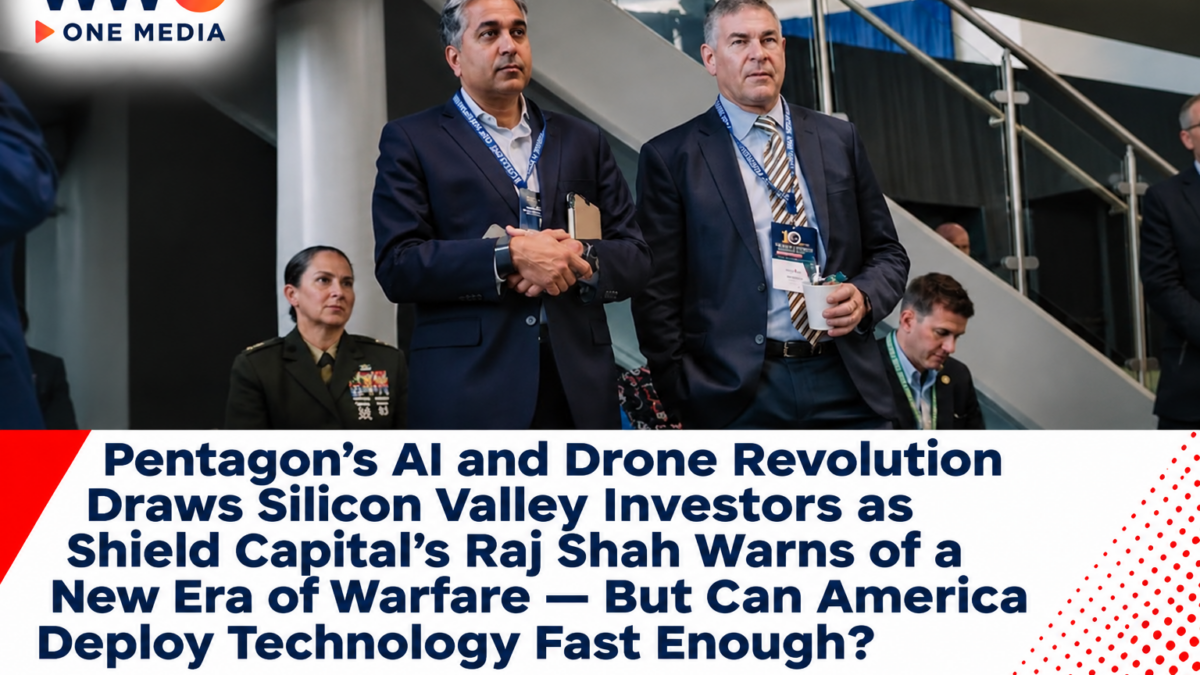
WASHINGTON, UNITED STATES — November 12, 2026 | WWC ONE MEDIA | Defense Technology, Artificial Intelligence, Cybersecurity, Military Innovation and Global Investment
The future of warfare is increasingly being shaped not only by defense contractors and government laboratories, but also by Silicon Valley startups developing artificial intelligence, autonomous drones, cybersecurity systems and space technology.
And investors are beginning to confront a major question: Can the United States transform groundbreaking commercial technology into reliable military capabilities before its strategic competitors move ahead?
The issue took center stage during a November 11 CNBC interview featuring Raj Shah, co-founder and managing partner of Shield Capital, who spoke with journalist Morgan Brennan about defense technology investment, the transformation of modern warfare, the National Defense Authorization Act and cybersecurity in the age of AI.
The interview comes as Washington considers how to accelerate military innovation while maintaining national security, accountability and effective oversight of emerging technologies.
For Shield Capital, the opportunity lies in connecting two worlds that have historically operated at different speeds: the rapid development cycles of commercial technology companies and the complex procurement processes of the US defense establishment.
Founded in 2021, Shield Capital invests in early-stage businesses working across artificial intelligence, autonomy, cybersecurity and space.
The firm reported managing more than $500 million in assets and investing in more than 70 companies in a November 2026 corporate announcement.
Those figures highlight growing private-sector interest in technologies that can serve both civilian and national security markets.
However, rapid investment does not automatically guarantee military success.
A technology that performs well during a demonstration must still prove that it can operate reliably under battlefield conditions, withstand electronic interference and integrate with existing military systems.
The challenge is not simply inventing the next generation of defense technology.
It is deploying that technology quickly, affordably and responsibly enough to make a difference.
Who Is Raj Shah, the Investor Connecting Silicon Valley and the Pentagon?
Raj Shah brings an unusual combination of military, technology and investment experience to the defense sector.
Before co-founding Shield Capital, he served as a US Air Force F-16 fighter pilot.
He later became a technology entrepreneur, helping establish cybersecurity startup Morta Security, which was acquired by Palo Alto Networks.
Shah also held a senior strategy role at Palo Alto Networks and served as managing partner of the Pentagon’s Defense Innovation Unit.
That organization was established to accelerate the adoption of commercial technologies for national security applications.
His background places him at the intersection of military operations, private-sector innovation and government procurement.
He also serves on the board of the NATO Innovation Fund, which supports technology development relevant to security and resilience.
For traditional defense manufacturers, developing sophisticated military systems can involve years of design, testing, procurement and production.
Commercial technology companies often work through much shorter development cycles.
They release products, collect performance data and improve their technology through repeated updates.
Bringing those approaches together has become an important objective for defense innovation initiatives.
But the process is not straightforward.
Government customers must consider reliability, security, legal requirements, long-term maintenance and operational effectiveness.
Startups must also understand how to secure contracts, meet technical standards and support products after deployment.
Shield Capital’s investment strategy focuses on helping companies bridge those gaps.
Ukraine’s Drone War Is Transforming Military Innovation
One of the clearest demonstrations of modern defense technology comes from the war in Ukraine.
Drones, automated systems, electronic warfare and rapidly evolving battlefield software have become integral parts of military operations.
Both Ukrainian and Russian forces have increasingly relied on unmanned systems for reconnaissance, logistics and attacks.
The conflict has also shown how quickly military technology can change.
Systems that prove effective during one phase of the war may become less useful as opponents develop electronic countermeasures or adapt their tactics.
This creates pressure to improve products continuously.
Commercially available technologies can sometimes be adapted more rapidly than conventional military platforms.
But their success depends on battlefield conditions, communications reliability, production capacity and operational support.
In separate public commentary about Ukraine, Shield Capital has emphasized that militaries increasingly need systems demonstrated under realistic conditions rather than relying exclusively on theoretical performance.
That principle reflects a broader lesson from the conflict: technological innovation must translate into operational capability.
As WWC ONE MEDIA reported in its coverage of Ukraine’s expanding use of unmanned ground vehicles, Ukrainian forces have deployed robots to transport ammunition, deliver supplies and evacuate wounded personnel.
Such systems can reduce the exposure of soldiers during dangerous missions.
However, they also face technical limitations.
Ground robots can become disabled, lose communications or struggle with difficult terrain.
The lesson for defense investors is that battlefield usefulness matters more than impressive demonstrations alone.
Why Silicon Valley Investors Are Turning Toward Defense Technology
Defense technology has become an increasingly important area of interest for venture capital.
Emerging companies are developing software, sensors, autonomous platforms and communications systems that could support military and civilian applications.
Several factors are driving interest.
First, national security agencies are increasingly concerned about technological competition.
Second, commercial advances in artificial intelligence and computing are creating new possibilities for defense systems.
Third, recent conflicts have demonstrated demand for relatively inexpensive, adaptable equipment alongside conventional military platforms.
Fourth, governments are seeking ways to strengthen industrial capacity and reduce dependence on vulnerable supply chains.
For investors, these developments create potential business opportunities.
Startups that secure government contracts may gain access to customers with long-term operational needs.
Some technologies may also have commercial applications involving logistics, infrastructure protection, aviation, telecommunications or cybersecurity.
But defense investing introduces substantial risks.
Government procurement can be slow and unpredictable.
Contracts may be delayed, reduced or canceled.
Companies may need to satisfy demanding technical and security standards before generating meaningful revenue.
Investors must also assess export restrictions and ethical concerns involving the technologies they support.
A growing market does not guarantee attractive returns for every startup.
Shield Capital’s Portfolio Shows Where Defense Investment Is Heading
Shield Capital concentrates on four principal technology areas: artificial intelligence, autonomous systems, cybersecurity and space.
These sectors frequently overlap.
AI software can assist in analyzing sensor information.
Autonomous systems can carry out specific tasks with reduced human involvement.
Space-based infrastructure can support communications and observation.
Cybersecurity systems help protect the networks connecting those capabilities.
According to Shield Capital’s November 6 corporate announcement, the firm had invested in more than 70 companies and managed over $500 million in assets.
Its portfolio includes companies developing technology relevant to defense and commercial markets.
For example, Shield Capital has backed cybersecurity and satellite-related businesses and announced an investment in Watchtower Labs, a company developing technology focused on cybersecurity.
In October, Watchtower emerged from stealth with $35 million in seed financing led by Shield Capital and Conviction, with participation from Founders Fund.
The investment illustrates the firm’s interest in securing digital infrastructure as technology becomes increasingly important to national security.
However, the $35 million financing should not be confused with a government procurement award or a guaranteed financial return.
It represents startup funding intended to support business development.
That distinction matters when evaluating venture capital activity.
AI Cybersecurity Could Become a Critical National Security Challenge
The growing use of AI creates both opportunities and risks for cybersecurity.
AI-assisted software can help security teams analyze large volumes of information, identify suspicious activity and prioritize potential threats.
It can also support faster investigation and incident response.
However, attackers may use similar technologies.
AI could help automate parts of phishing campaigns, generate deceptive communications or support malicious attempts to exploit software vulnerabilities.
As a result, cybersecurity professionals must prepare for an environment in which both defenders and adversaries can use advanced automation.
National security agencies face additional challenges because they manage sensitive systems and information.
The consequences of a successful intrusion can extend beyond financial losses.
Attacks may disrupt communications, government operations or infrastructure providing essential services.
Shield Capital identifies cybersecurity as one of its central investment areas.
The wider policy challenge is ensuring that AI systems used for security purposes remain accurate, accountable and resistant to manipulation.
Overreliance on automated analysis can introduce problems if systems produce false conclusions or fail to identify important threats.
This is especially concerning in high-stakes national security settings.
As WWC ONE MEDIA reported in its investigation of an AI-assisted intelligence error involving a Chinese vessel, inaccurate automated analysis can create serious operational risks if information is not independently verified.
The broader lesson is that AI can support decision-making, but critical intelligence and security decisions still require reliable evidence and appropriate human oversight.
The National Defense Authorization Act Could Shape the Next Wave of Innovation
The National Defense Authorization Act, commonly known as the NDAA, is one of Washington’s most important annual defense policy measures.
It establishes authorities and policy directions affecting US military programs.
The legislation can influence priorities involving research, technology acquisition, military organization and national security.
However, authorization legislation is not the same as an annual appropriations law.
Congress generally must also provide funding through the appropriations process.
For emerging defense technology businesses, congressional decisions can influence how quickly government agencies evaluate and acquire new capabilities.
Policy choices may affect procurement procedures, competition, cybersecurity requirements and the integration of commercial technology.
The challenge is maintaining effective oversight while reducing unnecessary delays.
Startups often lack the extensive administrative resources available to established defense contractors.
Complex contracting requirements can make it difficult for younger companies to compete.
At the same time, military systems must meet standards appropriate to their intended use.
Reducing delays should not mean eliminating safety, security or performance requirements.
The 2027 defense policy debate will therefore be important for companies seeking greater access to government customers.
CNBC identified the NDAA as one of the subjects discussed during Morgan Brennan’s interview with Shah.
However, the accessible interview description does not establish which specific NDAA provisions he endorsed or opposed.
The Pentagon’s Autonomous Warfare Plans Reflect a Broader Shift
The US Defense Department has been exploring new approaches to unmanned and autonomous systems.
In September 2026, Defense Secretary Pete Hegseth announced plans for an Autonomous Warfare Command alongside changes to the military’s senior leadership structure.
The proposed command would focus on technologies including drones, robotics, artificial intelligence and related military systems.
As WWC ONE MEDIA reported in its coverage of the proposed command, the announcement reflected Washington’s growing emphasis on integrating emerging technologies into military operations.
Such initiatives could create opportunities for companies developing navigation systems, secure communications, robotics and supporting software.
However, organizational announcements do not automatically establish that proposed commands are fully operational or that specific procurement programs have been funded.
Implementation depends on subsequent decisions, budgets and military requirements.
The larger challenge will be coordinating technology development with training, logistics and operational doctrine.
Advanced systems are only useful when personnel understand how to deploy, maintain and operate them effectively.
Space Technology Is Becoming Another Defense Investment Frontier
Space infrastructure has become increasingly important to communications, navigation and national security.
Satellites support services used by governments, businesses and consumers.
They also provide capabilities relevant to observation, communications and emergency response.
Commercial space companies have helped reduce some of the costs associated with manufacturing and deploying satellites.
That creates opportunities for smaller firms developing specialized spacecraft, components and software.
Shield Capital includes space technology among its core investment priorities.
Its portfolio activity reflects growing interest in satellite platforms and related infrastructure.
But space technology carries operational and financial risks.
Satellite development requires engineering expertise, regulatory approvals and access to launch services.
Equipment can fail during launch or after deployment.
Space debris, cybersecurity threats and geopolitical tensions add further challenges.
For governments, commercial space technology offers opportunities to acquire capabilities more flexibly.
For investors, commercial contracts and government demand can create potential revenue streams.
Yet profitability depends on successful execution and sustainable demand.
Could Defense Technology Become Wall Street’s Next Major Investment Theme?
The defense technology sector has attracted attention as investors reconsider the long-term implications of geopolitical competition.
Companies involved in drones, advanced batteries, satellites, cyber defense and military software may benefit if governments increase spending on emerging capabilities.
However, stock-market opportunities can be highly sensitive to policy decisions.
A company may experience strong interest based on expectations of future military contracts.
But its shares could decline if procurement is delayed or investors conclude that valuations have risen too far.
In related coverage, WWC ONE MEDIA examined five stock-market sectors that could benefit from changing US congressional priorities, including military drones and supporting technology.
The discussion highlighted how political developments can influence expectations for defense investment.
Still, government funding is not a guaranteed source of profit.
Competitive bidding, technical performance and execution remain critical.
For venture capital firms such as Shield Capital, the investment challenge is identifying companies that can become sustainable businesses rather than relying solely on growing national security concerns.
What Could This Mean for the Philippines and Other US Allies?
Although Shah’s CNBC interview focused on American defense technology, the issues also have implications for allied countries.
The Philippines faces security challenges involving maritime awareness, disaster response, cybersecurity and the protection of critical infrastructure.
Technologies developed for defense purposes can sometimes support civilian needs.
Satellite observation can assist with environmental monitoring and emergency planning.
Secure communications can strengthen infrastructure resilience.
Unmanned systems can support inspection, search and rescue, and other authorized operations.
However, military technology partnerships require careful consideration of costs, interoperability, export controls and sovereignty.
Not every emerging US defense product will be appropriate for Philippine requirements.
And importing sophisticated equipment without adequate training, maintenance or institutional capacity may produce limited long-term value.
For governments evaluating such technologies, practical performance and lifecycle costs are essential considerations.
The growing defense-tech sector could create opportunities for cooperation among allies, but those opportunities should be assessed against specific national needs.
What Happens Next? Four Tests for the Defense-Tech Boom
The coming years will help determine whether today’s investment enthusiasm produces a genuine transformation in military capability.
First, startups must prove their technology works outside controlled demonstrations. Reliable field performance is essential.
Second, defense agencies must improve the speed and effectiveness of procurement. Faster adoption matters, but not at the expense of adequate testing and oversight.
Third, cybersecurity must keep pace with wider AI deployment. More automation can create additional risks if systems are poorly protected.
Fourth, companies must demonstrate sustainable business economics. Government interest and investor funding do not necessarily guarantee long-term contracts or profitability.
These challenges are interconnected.
Breakthrough technology can fail commercially without reliable procurement and customer demand.
A well-funded program can also disappoint if systems do not perform as expected.
Successful defense innovation requires coordination across technology, manufacturing, government and operational users.
The Bigger Picture: America’s Next Military Advantage May Depend on How Fast It Can Innovate
Raj Shah’s interview with CNBC reflects a broader change in the relationship between Silicon Valley and national security.
Commercial technology is increasingly relevant to the challenges facing military organizations.
Artificial intelligence, autonomy, cybersecurity and space systems are no longer peripheral subjects.
They have become central to discussions about future military capabilities.
Shield Capital is among the investment firms attempting to connect emerging companies with those opportunities.
Its reported portfolio of more than 70 companies and over $500 million in managed assets demonstrates the growing institutional interest in the sector.
But the long-term success of defense technology will not be measured simply by venture capital investment, impressive prototypes or ambitious announcements.
It will depend on whether systems can be deployed reliably, maintained effectively and used responsibly under demanding conditions.
The Ukraine war has demonstrated how rapidly technology can change the battlefield. Now the United States and its allies face the challenge of converting commercial innovation into capabilities that can be produced and deployed at scale.
And as Silicon Valley investors increasingly back artificial intelligence, drones, cybersecurity and space systems, one question remains: Can the Pentagon move quickly enough to take advantage of the next generation of technology — or will the pace of military bureaucracy allow its competitors to gain the advantage?