WASHINGTON — A flawed intelligence assessment produced with the help of an artificial-intelligence chatbot reportedly brought the U.S. military close to boarding a Chinese vessel in the Middle East earlier this year, raising fresh questions about the risks of using AI in high-stakes military and intelligence decisions.
According to a CNN report cited by multiple outlets, the incident unfolded during the U.S. war with Iran in the spring of 2026. An intelligence assessment claimed that a Chinese ship was transporting components linked to a nuclear weapons programme.
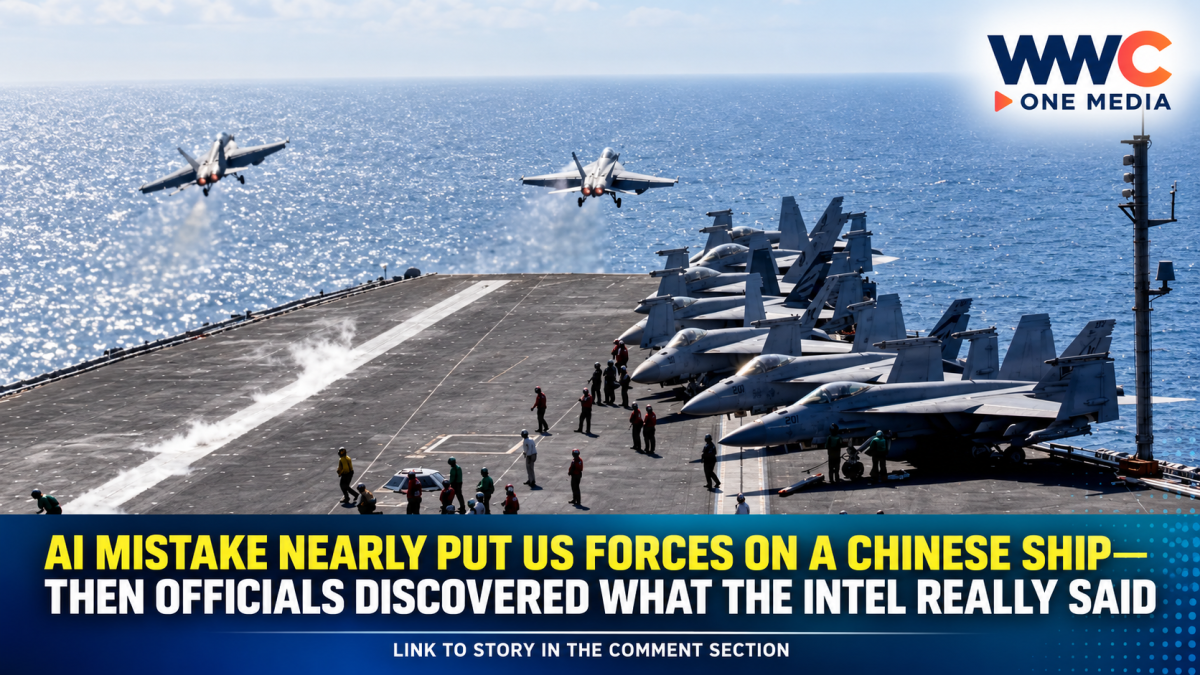
The report triggered preparations for an interception. Two sources told CNN that armed U.S. personnel were preparing to board the vessel, while military aircraft were already airborne as the operation was being considered.
The operation was ultimately stopped after officials took a closer look at the underlying intelligence and discovered that an AI chatbot had incorrectly identified the material aboard the ship.
The actual cargo has not been publicly disclosed.
One source familiar with the episode described the intelligence report as entirely false and said it had “almost started a war,” according to CNN’s reporting. The allegation has not been independently confirmed in public by the U.S. government.
How the AI-generated error entered the intelligence process
The reported chain of events is particularly significant because the AI system was not simply used to write or summarize an existing report.
According to CNN’s account, a U.S. Special Operations Command analyst working with intelligence concerning the ship’s manifest queried an AI chatbot. The system reportedly combined open-source information with classified signals intelligence available within government holdings.
The chatbot then incorrectly concluded that the vessel was carrying material associated with a nuclear weapons programme.
The analyst subsequently used AI again to package the findings into a conventional intelligence report, which was circulated to military officials.
That process meant an incorrect AI-generated assessment was reportedly transformed into the format of a familiar intelligence product before officials later identified the underlying error.
CNN was unable to establish what the ship was actually carrying or identify the AI chatbot involved.
The U.S. military’s Special Operations Command Pacific and the Pentagon did not immediately respond to requests for comment cited in the reports. U.S. Central Command also did not immediately respond to a request for comment reported by The Straits Times.
Why the incident matters beyond one mistaken report
The episode highlights a central problem with deploying generative AI in intelligence work: a system can produce an answer that appears coherent and authoritative while incorrectly interpreting the information it receives.
Ars Technica reported that the incident comes as the Pentagon accelerates the integration of AI across the U.S. military. The Department of Defense has been expanding access to generative-AI tools and has promoted broader use of AI across military data and operational systems.
TechCrunch likewise reported that military aircraft were already in the air when officials discovered the intelligence problem, describing the episode as an example of how AI-generated errors can move through decision-making structures before being challenged.
The reported incident therefore raises a broader question: how much human verification should be required before AI-assisted intelligence can contribute to decisions involving military force?
That question becomes even more consequential when the other country involved is a major military power such as China.
US-China AI concerns are already growing
The incident comes at a particularly sensitive moment in U.S.-China relations.
Just days before the report emerged, U.S. and Chinese security experts proposed nuclear-style safeguards for military AI, including restrictions on AI involvement in nuclear command systems, requirements for meaningful human control over consequential military cyber operations and a dedicated hotline for AI-related incidents.
The recommendations emerged from a dialogue involving the Brookings Institution and Tsinghua University’s Center for International Security and Strategy. The experts warned that AI-enabled military incidents could escalate faster than human decision-makers can respond.
Reuters also reported that AI is expected to be among the issues surrounding upcoming U.S.-China discussions, alongside trade, rare earths and broader strategic tensions.
A warning about speed versus verification
The reported Chinese-ship episode does not establish that AI independently made a military decision. Rather, the available reporting describes a human analyst using an AI system, after which the resulting information entered the military reporting process.
That distinction is important.
The concern is not simply whether an AI model can make a mistake. AI systems are known to produce inaccurate or unsupported outputs. The more serious issue is what can happen when an erroneous output is given the appearance of an authoritative intelligence assessment and reaches people making decisions under time pressure.
The incident also illustrates why human review remains critical when AI is used in national-security settings.
For the United States and China, the stakes are especially high because even an accidental confrontation involving military forces could carry consequences far beyond the original incident.
For now, many details remain unknown—including the identity of the ship, its actual cargo, the specific AI system involved and precisely how many officials reviewed the intelligence before the planned operation was halted.
But the reported near-miss has already added a striking real-world example to a debate that until now has often been framed around hypothetical risks:
What happens when an AI mistake reaches the military chain of command before a human catches it?