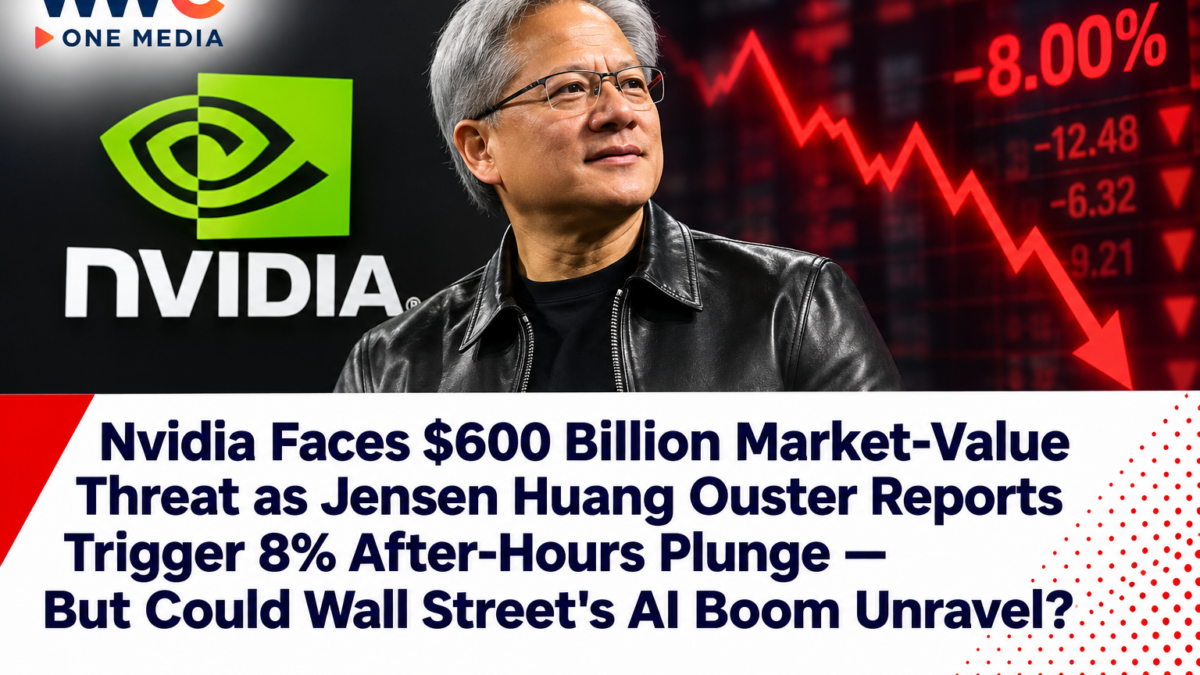
SANTA CLARA, CALIFORNIA / NEW YORK / MANILA, PHILIPPINES — November 12, 2026 — Wall Street is confronting one of the most unsettling leadership controversies in the history of the artificial intelligence boom as Nvidia shares plunged approximately 8% in after-hours trading following reports that the semiconductor giant’s board was considering removing its longtime chief executive, Jensen Huang.
The selloff followed an extraordinary reversal in investor sentiment.
Nvidia had finished regular trading on November 11 approximately 2.9% higher, recovering some of the losses suffered during the previous two sessions.
But the recovery unraveled after The Wall Street Journal reported that the company’s directors were preparing to consider Huang’s future.
Reuters reported that the board was meeting to decide whether to remove the executive who co-founded Nvidia in 1993 and transformed the company into a central supplier of advanced artificial intelligence processors.
The developments followed reports about Huang’s personal relationships, including one involving a businesswoman suspected by American intelligence officials of having ties to China.
Huang has acknowledged being unfaithful to his wife.
However, allegations of espionage and possible national-security breaches remain disputed. No publicly disclosed finding establishes that Huang knowingly participated in espionage or transferred confidential company information to a foreign government.
The controversy has already rattled investors, attracted congressional attention and prompted major Wall Street analysts to reconsider their recommendations.
The biggest question is no longer simply whether Nvidia can continue selling enormous quantities of AI chips. It is whether the company can maintain investor confidence if the founder who built its global empire is suddenly forced to leave.
Nvidia Stock Whipsaws as Leadership Crisis Deepens
The dramatic market reaction began earlier in the week.
On Monday, November 9, Nvidia shares fell approximately 4.3%.
The decline erased about US$190 billion in market capitalization.
On Tuesday, November 10, the stock fell another 5.47%.
Across the two sessions, Nvidia lost approximately US$430 billion in market value, according to financial market reporting.
The shares then rebounded on Wednesday.
Reuters reported a gain of approximately 2.9% during regular trading as enthusiasm surrounding artificial intelligence helped lift broader technology markets.
But the relief was short-lived.
After US markets closed, reports about the board’s consideration of Huang’s future sent Nvidia shares down approximately 8% in extended trading.
For a company valued at roughly US$4 trillion, such a move represents hundreds of billions of dollars in potential market-value changes.
However, after-hours prices can differ substantially from the following regular-session closing price.
The potential loss should not be described as an already completed full-session market-capitalization decline.
The rapid changes demonstrate how sensitive Nvidia has become to developments involving its founder.
Wall Street Journal Reports Nvidia Board Could Remove Jensen Huang
The latest escalation came when The Wall Street Journal reported that Nvidia’s directors were preparing to decide Huang’s future.
Reuters subsequently reported the development, while noting that it could not independently verify all details of the original report.
The possibility of removing Huang represents a major shift from Nvidia’s earlier public statements expressing support for its chief executive.
At the time of the reporting reviewed, no final board decision confirming his removal had been publicly established.
That distinction matters.
A report that directors are considering a leadership change does not mean the chief executive has already been dismissed.
The board may need to evaluate information from independent investigators, legal advisers and corporate governance specialists before taking action.
It must also consider whether a leadership change would create additional risks for shareholders, employees and customers.
Huang is not simply Nvidia’s chief executive.
He is one of the company’s founders, its most recognizable public representative and a central figure in the global artificial intelligence industry.
His possible departure would raise difficult succession questions.
As WWC ONE MEDIA reported in its examination of Nvidia’s US$190-billion stock decline and leadership uncertainty, investors are increasingly asking whether the company has a credible plan for a future without its longtime leader.
A Second Report About an Alleged Affair Adds Pressure
The leadership debate intensified after The New York Times published reporting about a separate alleged relationship between Huang and a Nvidia executive.
The report identified Kimberly Powell, Nvidia’s vice president of healthcare, and said she reported to Huang.
Reuters said it could not independently verify the allegations in that report.
Nvidia had not publicly provided a detailed response establishing the facts of the alleged relationship at the reporting cutoff.
The development is distinct from the earlier allegations involving Alice Huang, the former executive associated with Singapore-based technology company Megaspeed.
It is important not to conflate the two matters.
The first controversy concerns a reported relationship with a businesswoman suspected by American intelligence officials of connections to Chinese intelligence.
The second concerns allegations about a workplace relationship.
Both have generated questions about Huang’s judgment and the board’s oversight responsibilities.
But neither should be treated as proof of criminal wrongdoing.
The allegations require independent examination and an opportunity for the people involved to respond.
Nvidia’s Investigation Enters a Critical Stage
Nvidia’s independent directors previously announced an investigation into whether Huang had been targeted through a foreign intelligence operation.
The company retained prominent law firm Wachtell, Lipton, Rosen & Katz to assist with the inquiry.
Former federal prosecutor Joon Kim was also reported to be involved.
The investigation is intended to assess whether confidential information, company policies or national-security interests may have been compromised.
Nvidia has stated that it has no reason to believe its confidential information or American national security has been affected.
That statement reflects the company’s position at the time.
It does not predetermine the investigation’s final findings.
As WWC ONE MEDIA reported in its analysis of Nvidia’s board independence and corporate governance, the inquiry presents a difficult test for directors overseeing a company so closely associated with its founder.
They must protect shareholder interests while ensuring that any investigation is credible.
They must also avoid making premature decisions based solely on media reports or market pressure.
Bank of America Outlines Three Scenarios for Nvidia
Wall Street analysts are attempting to estimate how the controversy could affect Nvidia’s valuation.
According to CNBC’s November 11 reporting, Bank of America analyst Vivek Arya described three possible outcomes.
The first is a contained scenario in which Nvidia’s leadership remains stable and the controversy has limited long-term impact.
Under that outcome, investors could return their attention to the company’s financial results, AI processor demand and product development.
The second scenario involves an extended period of uncertainty.
Even without an immediate management change, continuing investigations or regulatory scrutiny could discourage investors from paying the same valuation multiples they previously assigned to Nvidia.
The third scenario is more serious.
Adverse findings, leadership disruption or tighter restrictions on technology exports could force analysts to reconsider earnings expectations.
These are hypothetical investment scenarios.
They are not predictions that any particular finding or leadership outcome will occur.
For investors, the framework highlights the difference between temporary uncertainty and a development that materially changes Nvidia’s future profits.
Baird Downgrades Nvidia to Neutral
The controversy has already influenced analyst recommendations.
On November 11, Baird analyst Tristan Gerra downgraded Nvidia from Outperform to Neutral.
The firm reduced its price target to US$200 from US$500.
The downgrade was not based solely on the allegations involving Huang.
Baird also cited limited visibility into future data center demand, supply constraints and uncertainty surrounding American export restrictions.
The analyst suggested that growth in AI capital spending among major cloud providers could moderate in 2027.
That would represent slower growth, not necessarily a collapse in spending.
The distinction matters because Nvidia’s earnings are closely tied to investment by companies building and operating AI infrastructure.
If those customers delay expansion plans, revenue expectations may need to change.
But if AI demand remains strong and infrastructure spending continues, Nvidia may still benefit from substantial demand for its processors.
A price target is an analyst’s estimate, not a guaranteed future share price.
Morgan Stanley Removes Nvidia From Its Top Pick List
Morgan Stanley also revised its view of Nvidia.
The investment bank removed the semiconductor company from its Top Pick list following the sharp decline in its shares.
However, Morgan Stanley maintained an Overweight rating.
That means the firm did not necessarily abandon its positive longer-term investment view.
Its decision reflected a combination of share-price performance, risk management considerations and uncertainty surrounding the company.
The distinction is important.
Removing a stock from a preferred list is not equivalent to declaring that the underlying business is failing.
Likewise, maintaining an Overweight rating does not eliminate short-term downside risks.
As the controversy unfolds, analysts must weigh two separate questions.
Can Nvidia continue generating strong demand for AI processors?
And can the company preserve the management stability and regulatory relationships that support its business?
The answers may not move in the same direction.
The $4 Trillion AI Empire Faces a Founder-Dependence Problem
Nvidia’s extraordinary growth has been closely associated with Jensen Huang.
Under his leadership, the company expanded from graphics technology into advanced computing, data centers and artificial intelligence.
Its processors and software platforms are widely used by major cloud providers and AI developers.
Huang has also become a prominent advocate for the economic potential of AI.
His presentations, product announcements and industry relationships have helped shape Nvidia’s public identity.
But that concentration of influence creates a potential governance vulnerability.
Companies dependent on a highly influential founder may face uncertainty when succession becomes an immediate issue.
As WWC ONE MEDIA reported in its broader analysis of Nvidia’s approximately US$4-trillion technology empire, a leadership transition at Nvidia could have implications beyond the company’s own stock price.
However, founder dependence should not be confused with the absence of other capable executives.
Nvidia has a large workforce and experienced leaders responsible for engineering, sales, finance and operations.
The challenge is whether a potential successor could maintain strategic continuity and investor confidence.
Could Colette Kress or Another Nvidia Executive Take Over?
Investor discussion has increasingly focused on possible successors.
Chief Financial Officer Colette Kress is one of the senior executives frequently mentioned because of her experience with the company’s financial operations and relationships with investors.
Other technology leaders, including executives responsible for data center computing and software strategy, may also attract attention.
Reuters reported that some market participants were considering Ian Buck, a senior figure associated with Nvidia’s accelerated computing technologies, as a possible candidate.
However, those discussions do not constitute an official succession announcement.
No candidate should be described as appointed unless Nvidia’s board confirms the decision.
The company’s directors would need to consider several factors.
A successor must understand Nvidia’s technology and manufacturing relationships.
They must also maintain confidence among major customers, employees, suppliers and regulators.
A leadership transition could be particularly challenging during a period of intense international competition over advanced semiconductor technology.
Nvidia’s China Business Becomes a Political Flashpoint
The controversy has also revived the debate over exporting advanced AI chips to China.
American policymakers have imposed restrictions on certain semiconductor technologies because of national-security concerns.
Those controls affect products used in advanced computing and AI development.
Nvidia has argued that maintaining a commercial presence in China can support American technological competitiveness.
Some lawmakers and national-security officials have taken a more restrictive view.
They argue that access to advanced AI processors could benefit Chinese organizations whose activities raise security concerns.
The allegations involving Alice Huang have intensified that disagreement.
US lawmakers have sought information about Nvidia’s business relationships and the allegations surrounding its chief executive.
As WWC ONE MEDIA reported in its coverage of congressional scrutiny of Nvidia’s China operations, lawmakers have requested explanations about corporate safeguards and potential national-security vulnerabilities.
However, congressional inquiries do not establish that Nvidia or Huang knowingly violated export-control laws.
Any legal consequences would depend on evidence and the applicable regulatory requirements.
Alleged Chinese Intelligence Links Remain Unproven in Public
One of the most sensitive aspects of the story involves Alice Huang, a businesswoman associated with Singapore-based Megaspeed International.
Reports have alleged that US intelligence officials suspected her of gathering information for Beijing.
China has rejected the accusations.
Nvidia has said it has no reason to believe its confidential information was compromised.
The allegations have not been established in a publicly disclosed criminal conviction or a definitive public investigative finding.
The distinction is essential for responsible reporting.
A reported intelligence assessment is not the same as a publicly tested finding in court.
Likewise, a personal relationship does not, by itself, establish that an executive knowingly assisted espionage.
The issue for investigators is whether any specific information was obtained, shared or misused.
Until those questions are resolved, the allegations should remain clearly attributed.
Why Nvidia’s Stock Matters to the Entire US Market
Nvidia’s large market capitalization means its share-price changes can influence major investment indexes.
The company is a significant component of the S&P 500 and the Nasdaq-100.
When its stock declines sharply, those indexes may experience downward pressure even when other companies perform well.
That can affect retirement portfolios, mutual funds and exchange-traded funds held by ordinary investors.
The November 11 market reaction demonstrated this connection.
Major US stock indexes ended the regular session higher, helped by gains in technology shares.
After reports about Nvidia’s board emerged, index futures weakened.
Reuters reported that S&P 500 futures fell approximately 0.4%, while Nasdaq-100 futures declined more sharply.
These futures movements reflected expectations for subsequent trading, not confirmed losses in the next regular session.
The episode illustrates how leadership uncertainty at one major company can affect sentiment across global markets.
Could Nvidia’s Problems Spread to Other AI Companies?
Nvidia is deeply connected to the broader AI infrastructure industry.
Cloud-computing companies purchase its processors.
Data center operators build facilities designed around its technology.
Software developers and researchers use its platforms to train and operate AI models.
As a result, unexpected changes in Nvidia’s strategy or operations could influence other companies.
But the extent of those effects depends on the nature of the disruption.
A temporary leadership controversy may have limited consequences if engineering, manufacturing and customer deliveries continue normally.
A major regulatory restriction or prolonged operational disruption could create more significant effects.
CoreWeave Chief Executive Michael Intrator has emphasized that Nvidia’s operations involve extensive collaboration among thousands of employees rather than dependence on one person alone.
That perspective suggests some industry participants believe the business can continue functioning through leadership uncertainty.
Nevertheless, investors remain concerned about the potential impact on strategic relationships and future growth.
Nvidia’s November 17 Earnings Report Becomes Even More Important
The company is scheduled to report quarterly earnings on November 17.
The financial results will offer investors an opportunity to examine Nvidia’s underlying performance separately from the leadership controversy.
Key areas of attention will include data center revenue, gross margins, demand for advanced processors and management’s expectations for future AI spending.
Investors will also examine any commentary about supply constraints and potential restrictions affecting China-related sales.
Strong earnings could support confidence in Nvidia’s core business.
However, strong financial results would not automatically resolve questions about corporate governance or succession.
Likewise, disappointing earnings could intensify concerns if investors believe demand is slowing while leadership uncertainty remains elevated.
No November 17 earnings results were available at the November 12 reporting cutoff.
The event remains upcoming.
What This Means for Asian Semiconductor Markets
Nvidia’s influence extends throughout Asia.
The company relies on an international semiconductor manufacturing and supply-chain ecosystem.
Taiwan plays an especially important role through advanced chip manufacturing and packaging.
Other Asian economies participate in electronic components, equipment, data centers and related infrastructure.
Investors in those markets often respond to developments involving Nvidia because the company’s growth has supported demand across multiple technology industries.
However, the controversy does not establish that Asian suppliers have experienced a corresponding decline in orders.
Share-price movements and actual changes in industrial demand are different measures.
A lasting disruption would require evidence of altered purchasing decisions, production schedules or investment plans.
For the Philippines and other Southeast Asian economies, the immediate significance is broader market sentiment and the outlook for technology investment.
The practical impact will depend on whether the dispute leads to concrete changes in business operations or export rules.
What Happens Next for Nvidia?
Several developments could determine the company’s direction.
The first is whether Nvidia’s board announces a formal decision about Jensen Huang’s future.
The second is whether the independent investigation produces findings concerning corporate policies, confidential information or national security.
The third is whether American authorities introduce additional restrictions affecting Nvidia’s international business.
The fourth is the reaction of customers and business partners to any leadership transition.
The fifth is the company’s November 17 earnings report.
These developments could occur on different schedules.
Investors should avoid treating reports of a potential board decision as confirmation that a final decision has been reached.
Likewise, an allegation investigated by company directors or government agencies should not be treated as proven misconduct.
The Bottom Line: Nvidia’s Biggest Risk May Be Uncertainty
Nvidia remains central to the global artificial intelligence industry.
Its technology continues to power major AI infrastructure investments around the world.
But its stock-market volatility shows that even a dominant technology company can face substantial investor pressure when uncertainty surrounds its leadership.
The latest episode has combined several sources of risk.
The company is investigating serious allegations involving its chief executive.
US lawmakers are examining potential national-security concerns.
Major analysts are reassessing its valuation and future demand outlook.
And reports that Nvidia’s board may remove Jensen Huang have raised urgent questions about succession.
Yet none of these developments proves that Nvidia’s underlying technology business has collapsed.
Nor has any publicly verified finding established that Huang knowingly engaged in espionage.
The central challenge is restoring confidence while determining what happened, protecting shareholders and ensuring that Nvidia’s operations continue without unnecessary disruption.
As Nvidia faces an 8% after-hours plunge, fresh analyst downgrades and speculation about Jensen Huang’s future, will the AI chipmaker emerge with its leadership and business intact—or could the next major Wall Street selloff begin with the company that helped power the artificial intelligence boom?