NEW YORK, UNITED STATES — November 12, 2026 | WWC ONE MEDIA | Global Financial Markets, Wall Street, Artificial Intelligence and Technology Stocks
Wall Street is heading into another potentially explosive trading session as Nvidia faces renewed leadership uncertainty, Apple attracts fresh investor attention, and some of the biggest names in artificial intelligence prepare to deliver earnings that could determine whether the technology sector’s latest recovery has staying power.
After weeks of turmoil involving AI valuations, rising borrowing costs and concerns about the enormous amounts of money being poured into data centers, investors are bracing for a series of developments that could reshape market sentiment.
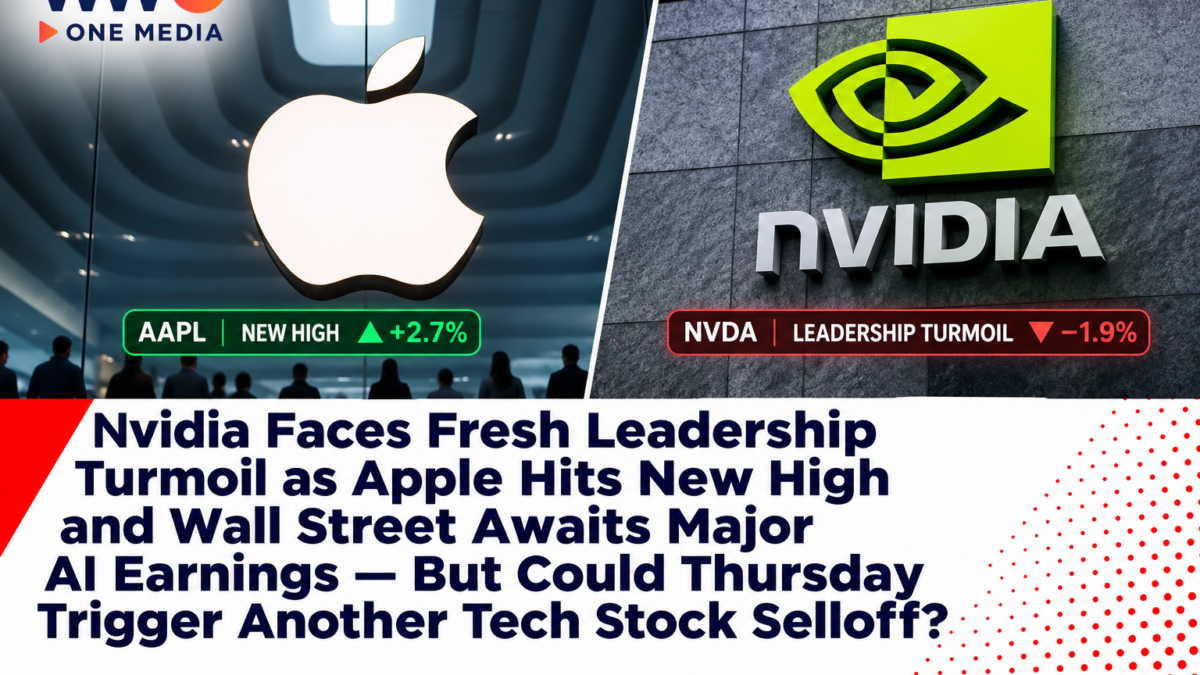
At the center of the uncertainty is Nvidia, the multitrillion-dollar chipmaker whose shares dropped approximately 8% in after-hours trading on Wednesday, following reports raising questions about the future of chief executive Jensen Huang.
Meanwhile, Apple has been approaching record territory, providing a sharp contrast to the instability affecting several other technology companies.
Investors are also preparing for earnings announcements from Cisco Systems, Applied Materials and Cerebras, three companies whose results could offer valuable clues about demand for networking equipment, semiconductor manufacturing systems and specialized AI processors.
According to CNBC’s November 11 Stocks @ Night market preview, these developments are among the major stories investors will be watching on Thursday, November 12.
The timing is particularly significant.
Wednesday’s US trading session delivered a broad technology rally after stronger-than-expected results from AI infrastructure company CoreWeave helped restore some confidence in the sector.
But Nvidia’s subsequent after-hours decline demonstrated how quickly sentiment can reverse.
The question confronting Wall Street is whether the AI recovery reflects genuine confidence in future earnings or merely a temporary rebound in a market still vulnerable to expensive valuations and unexpected shocks.
Nvidia Shares Tumble After Hours as Jensen Huang’s Future Faces Scrutiny
Nvidia has emerged as one of Wall Street’s most closely watched stocks following reports concerning CEO Jensen Huang and a suspected foreign intelligence operation.
The company’s board announced on November 8 that it had established an independent investigation after reports suggested Huang had been targeted by a foreign intelligence effort.
The board said independent directors and outside legal counsel would oversee the review.
Importantly, Nvidia stated that it had no reason to believe company secrets or US national-security information had been compromised.
It also expressed confidence in Huang and his leadership team.
However, uncertainty intensified on November 11 when The Wall Street Journal reported, citing people familiar with the matter, that Nvidia’s board was preparing to remove Huang.
That report triggered an approximately 8% decline in after-hours trading, according to Reuters.
At the time of the reporting, a formal leadership change had not been confirmed by Nvidia.
Investors should therefore distinguish between a reported board discussion and an officially announced executive departure.
The uncertainty is unusually consequential because Huang has been central to Nvidia’s transformation into the dominant supplier of advanced processors used in artificial intelligence.
Under his leadership, Nvidia expanded from gaming graphics technology into data-center computing, AI accelerators and software platforms used by major technology companies worldwide.
A sudden change in leadership could raise questions about business continuity, customer relationships and the company’s longer-term strategy.
As WWC ONE MEDIA reported in its coverage of Nvidia’s market-value losses and the leadership investigation, the company had already lost approximately $430 billion in stock-market value over two sessions before Wednesday’s recovery.
Those losses reflected changes in share valuation, not cash disappearing from Nvidia’s corporate accounts.
The latest developments add another layer of uncertainty to a stock that carries enormous influence over the broader market.
Wednesday’s AI Rally Was Strong — But Nvidia’s After-Hours Slide Raises New Questions
Before the latest Nvidia reports unsettled investors, Wall Street had enjoyed a strong Wednesday session.
According to Reuters and Associated Press, the S&P 500 rose approximately 1.3%, while the Nasdaq Composite advanced 1.6%.
The Dow Jones Industrial Average gained about 0.5%.
The rally was driven largely by technology stocks recovering from an earlier selloff.
<box> **November 11, 2026 — US stock-market closing performance**
| Index | Closing level | Daily change |
|---|---|---|
| S&P 500 | 7,619.38 | +1.3% |
| Nasdaq Composite | 25,466.19 | +1.6% |
| Dow Jones | 52,486.49 | +0.5% |
| Russell 2000 | 2,846.26 | +0.9% |
</box>
The recovery suggested that investors were willing to return to selected AI stocks after several difficult sessions.
But the strength of Wednesday’s closing performance did not eliminate the financial and regulatory concerns that caused the earlier downturn.
Technology companies continue spending heavily on data centers, networking infrastructure and advanced chips.
Investors increasingly want evidence that this investment can generate sufficient revenue and operating cash flow.
Nvidia’s after-hours volatility highlights another issue: large technology companies can influence global market sentiment even when their underlying financial results have not changed.
For highly valued stocks, uncertainty surrounding management or governance can become an important market-moving factor.
CoreWeave Surges Nearly 25% as AI Infrastructure Stocks Rebound
One of Wednesday’s biggest winners was CoreWeave, the specialized cloud-computing company that provides infrastructure for artificial intelligence applications.
CoreWeave shares surged approximately 24.7% during the regular session after its financial results helped ease concerns about demand and the sustainability of AI infrastructure spending.
The company reported strong revenue growth and outlined expectations of achieving adjusted profitability during the first half of 2028.
Management also highlighted customer commitments that could help support its financing needs.
The response from investors was immediate.
Other companies linked to AI infrastructure advanced, including Nebius, Applied Digital and Nvidia.
According to Reuters, Nebius gained approximately 15.4% during Wednesday’s session.
The rally suggests that investors remain interested in companies with exposure to AI computing demand.
However, high revenue growth does not necessarily guarantee profitability.
Data-center businesses require significant capital to acquire equipment, build facilities and secure electricity.
They may also depend on borrowing to fund expansion.
If operating returns fall short of expectations, highly leveraged companies can face pressure from interest expenses and refinancing obligations.
CoreWeave’s strong market reaction therefore provides evidence of improving sentiment, but it does not resolve every concern surrounding the economics of AI infrastructure.
Nebius Faces Another Major Earnings Test
Nebius is among the companies attracting particular attention as investors evaluate the financial prospects of specialized AI cloud providers.
The company’s shares have experienced significant volatility amid uncertainty over the cost of building AI computing infrastructure.
CNBC’s market preview highlighted the stock ahead of Thursday’s scheduled earnings.
Nebius operates in a fast-growing but capital-intensive segment.
Companies in this industry purchase high-performance computing equipment and develop data-center capacity that customers can rent to train and operate artificial intelligence models.
The opportunity is substantial because demand for computing resources continues expanding.
But the business also carries considerable risk.
Advanced processors can be expensive and may require replacement as newer technologies become available.
Electricity, cooling, networking and data-center construction introduce additional costs.
Companies must also secure enough customers and long-term contracts to support their financing commitments.
Investors will therefore be watching Nebius for evidence of demand, funding availability and progress toward sustainable profitability.
Potential surprises in those areas could influence other AI cloud stocks.
As WWC ONE MEDIA examined in its report on Morgan Stanley’s warning about increasingly difficult AI infrastructure financing, lenders are becoming more selective about backing heavily indebted technology projects.
That makes financial guidance as important as headline revenue growth.
Apple Defies the AI Selloff as Investors Focus on Product Demand
Apple is providing a contrasting story in the technology sector.
While several AI infrastructure stocks have experienced steep declines, Apple’s shares have demonstrated relative strength.
CNBC’s November 11 preview highlighted the iPhone maker after its stock reached new highs.
The report also pointed to investor attention surrounding Apple’s products, including its foldable iPhone offering and the expansion of Apple Intelligence capabilities.
Apple’s financial position differs significantly from that of smaller AI infrastructure companies.
Its business includes iPhones, Macs, iPads, wearables, services and a large global customer ecosystem.
Recurring services revenue and a substantial installed device base help diversify its operations.
However, Apple is not immune to market risks.
Investors continue examining the company’s growth prospects in China, competition from domestic smartphone manufacturers and the commercial success of its newer products.
Valuation is another important consideration.
According to CNBC’s preview, Apple was trading near 39 times earnings, suggesting investors were assigning a substantial premium to its expected future performance.
High valuations can be justified when earnings growth remains strong.
But they also create vulnerability if sales or profit forecasts disappoint.
For Apple, the challenge is demonstrating that its product innovations and services ecosystem can support the expectations already reflected in its share price.
Cisco Earnings Could Reveal Whether AI Networking Demand Is Accelerating
Cisco Systems is scheduled to report earnings after Thursday’s closing bell.
The networking equipment manufacturer plays an important role in the infrastructure supporting corporate computing and data-center operations.
As technology companies build increasingly sophisticated AI systems, demand for high-speed networking, switching and connectivity equipment may expand.
That creates opportunities for Cisco.
However, the company also operates in competitive markets where corporate technology spending can fluctuate.
Investors will be closely watching revenue growth, profit margins, order trends and management guidance.
Of particular interest will be Cisco’s commentary on AI-related infrastructure demand.
Strong orders could suggest that technology companies are continuing to invest in data-center networks despite concerns over financing.
Weaker guidance could reinforce fears that AI infrastructure spending is slowing or becoming more selective.
CNBC’s preview noted that Cisco shares had experienced a substantial decline from their earlier highs, increasing the importance of management’s outlook.
The company’s earnings could therefore become a major test of whether demand for AI networking equipment is translating into stronger financial performance.
Applied Materials Faces a Crucial Semiconductor Spending Test
Applied Materials is another major company scheduled to release earnings after Thursday’s close.
The company supplies equipment used to manufacture semiconductors.
Its performance provides insight into the investment plans of chipmakers worldwide.
Semiconductor manufacturing requires highly specialized technology and expensive fabrication facilities.
When chipmakers expand capacity or introduce more advanced production processes, companies such as Applied Materials can benefit from additional equipment orders.
However, the business is cyclical.
Demand can weaken when customers delay factory investments or adjust capital spending.
The AI boom has increased demand for advanced processors and memory chips, but not every semiconductor segment necessarily expands at the same pace.
Investors will be watching Applied Materials for indications of demand across logic, memory and advanced packaging technologies.
They will also examine the company’s outlook for customer spending.
According to CNBC’s preview, Applied Materials shares had suffered considerable declines from their previous highs.
That makes the earnings report particularly important for determining whether investors believe the stock’s valuation reflects improving fundamentals or continuing industry risks.
The broader implications could extend to companies such as Nvidia, AMD, Taiwan Semiconductor Manufacturing Company and major memory-chip producers.
Cerebras Earnings Could Test the Market’s Appetite for Nvidia Challengers
Cerebras, the AI computing company known for its specialized wafer-scale processors, is also scheduled to report financial results.
Its technology offers an alternative approach to the advanced computing systems used in artificial intelligence.
The company’s products compete in a market dominated by Nvidia’s ecosystem.
Investors are interested in whether specialized processors can secure larger commercial roles as AI demand expands.
However, developing advanced chips requires substantial investment in engineering, manufacturing relationships and software.
Commercial success depends on winning customers and demonstrating that the technology can deliver performance and economic advantages.
Cerebras shares have experienced sharp volatility, according to CNBC’s preview.
The upcoming earnings report could therefore influence expectations for smaller companies challenging established chipmakers.
Investors will be monitoring revenue growth, customer concentration, profitability and future guidance.
Strong results could support the argument that AI computing demand is creating room for multiple suppliers.
Disappointing performance could reinforce concerns that smaller chip companies face substantial financial and competitive obstacles.
Burberry Adds a Luxury Consumer Spending Test
Not every important stock-market catalyst on Thursday involves artificial intelligence.
British luxury fashion house Burberry is also expected to report results.
The company’s performance will offer another indication of demand for luxury products, particularly among wealthy consumers in major international markets.
Luxury retailers have faced changing consumer spending patterns, weaker demand in certain regions and pressure to refresh their product offerings.
Investors will be interested in sales trends, margins and progress under management’s strategy.
China remains particularly important because of its influence on global luxury consumption.
A stronger-than-expected recovery could improve sentiment toward other high-end retail companies.
But weak results could suggest that affluent consumers remain cautious.
Burberry’s report provides a reminder that even as artificial intelligence dominates market headlines, traditional consumer spending remains an important driver of global corporate earnings.
Inflation and Federal Reserve Rate Fears Threaten the Market Recovery
The upcoming earnings reports are arriving against a challenging monetary-policy backdrop.
US inflation data released on November 10 came in above economists’ expectations.
The October Consumer Price Index rose 0.4% month on month, compared with a consensus forecast of 0.3%.
Core inflation also exceeded expectations.
The data revived concerns that the Federal Reserve may need to maintain restrictive monetary policy or raise interest rates further.
Higher borrowing costs can be particularly difficult for technology companies whose business models depend on large upfront investments.
They can also place pressure on stock valuations by increasing the discount rate used to calculate the present value of future earnings.
AI infrastructure companies may be exposed through both channels.
They require financing for expensive equipment while investors value them partly on projected profits years into the future.
The market is therefore facing a difficult combination of strong technology demand and rising financial costs.
In related coverage, WWC ONE MEDIA examined the Federal Reserve’s warning that disappointing returns on AI investments could trigger a major stock-market correction.
The concern is not that artificial intelligence lacks economic potential.
It is whether current stock prices and borrowing arrangements already assume future financial success that may take longer to achieve.
Hedge Funds Are Cutting Risk as Wall Street Becomes More Volatile
The sharp market movements are also affecting professional investors.
Morgan Stanley’s prime-brokerage figures indicate that equity hedge funds have been reducing their exposure to stocks at an unusually rapid pace.
According to Bloomberg reporting cited by WWC ONE MEDIA, equity long-short hedge funds reduced active gross exposure by the equivalent of 10.7% of their late-June gross market value.
The decline was described as the largest such reduction in at least a decade.
Gross exposure measures the combined size of long and short positions, rather than simply the amount of money an investor has lost.
A decline in exposure may reflect risk reduction, position closures or lower leverage.
As WWC ONE MEDIA reported in its analysis of the hedge-fund retreat, the shift reflects growing caution among sophisticated investors following the technology selloff.
Such positioning can affect market volatility.
When funds reduce leverage or close large positions, individual stocks may experience sharp price movements.
But hedge-fund selling does not automatically predict a stock-market crash.
It is one indicator of changing investor appetite for risk.
What the Latest Wall Street Turmoil Means for Asian Markets
The developments could influence stock markets across Asia.
Nvidia is a major customer for semiconductor manufacturers and technology suppliers operating internationally.
Changes in investor expectations for Nvidia and AI infrastructure spending can affect sentiment toward companies involved in semiconductor fabrication, memory chips, electronics and data-center development.
Taiwan and South Korea are particularly exposed because of their important roles in the global technology supply chain.
However, not every Asian technology company has the same exposure to AI-related demand.
Some manufacturers focus on consumer electronics, automotive chips or industrial applications.
Others supply specialized components used in advanced computing infrastructure.
Investors must therefore examine individual business models rather than assuming all technology stocks will respond identically.
For the Philippines, volatility in US equities may also influence global capital flows and investor confidence.
Higher US interest rates can make dollar-denominated investments more attractive, potentially affecting emerging-market currencies and financial assets.
Nevertheless, the Philippine stock market has its own domestic drivers, including corporate earnings, inflation, interest rates and economic growth.
A decline in Nvidia or the Nasdaq does not automatically mean Philippine equities will fall by the same amount.
Thursday’s Five Major Market Catalysts
The November 12 trading session will focus on several interconnected developments.
1. Nvidia’s leadership uncertainty
Investors will watch for official statements or developments concerning the company’s independent investigation and reported board discussions.
2. Nebius earnings
The company’s results could influence sentiment toward specialized AI cloud providers and the financing of data-center expansion.
3. Cisco Systems earnings
Cisco’s outlook could reveal whether demand for corporate networking and AI infrastructure equipment remains resilient.
4. Applied Materials and Cerebras earnings
Their results may provide important information about semiconductor capital spending and competition in advanced AI computing.
5. Apple and the wider technology market
Investors will assess whether Apple’s relative strength and Wednesday’s broader AI recovery can withstand renewed volatility.
Additional economic data, including US existing-home sales, may also influence expectations about the economy and interest rates.
These are potential catalysts, not guarantees that particular stocks will rise or fall.
The Bigger Picture: Wall Street’s AI Boom Faces a Test of Confidence
Wall Street’s latest market preview illustrates the changing nature of the artificial intelligence investment boom.
For much of the sector’s expansion, investors rewarded companies for announcing larger investments, new data centers and ambitious growth forecasts.
Now, the market is becoming more demanding.
Investors want evidence that spending will produce sustainable profits.
They want to know whether heavily indebted companies can finance expansion without weakening their balance sheets.
They are also paying closer attention to governance, leadership stability and the consequences of higher interest rates.
Wednesday’s rally showed that enthusiasm for artificial intelligence remains substantial.
CoreWeave’s results helped restore confidence, and several technology stocks rebounded strongly.
But Nvidia’s after-hours decline demonstrated that the recovery remains vulnerable.
Thursday’s earnings announcements could help clarify which companies have the financial strength and commercial demand needed to support their valuations.
For investors, the most important distinction may be between businesses benefiting from genuine growth in AI demand and those whose stock prices depend on increasingly optimistic assumptions.
Wall Street has not abandoned the artificial intelligence boom. But investors are beginning to demand stronger proof that the billions flowing into advanced chips, cloud computing and data centers will eventually produce returns.
And as Nvidia faces renewed uncertainty while another wave of major technology earnings approaches, could Thursday’s trading session confirm the beginning of a lasting recovery — or expose the next weakness in Wall Street’s multitrillion-dollar AI rally?