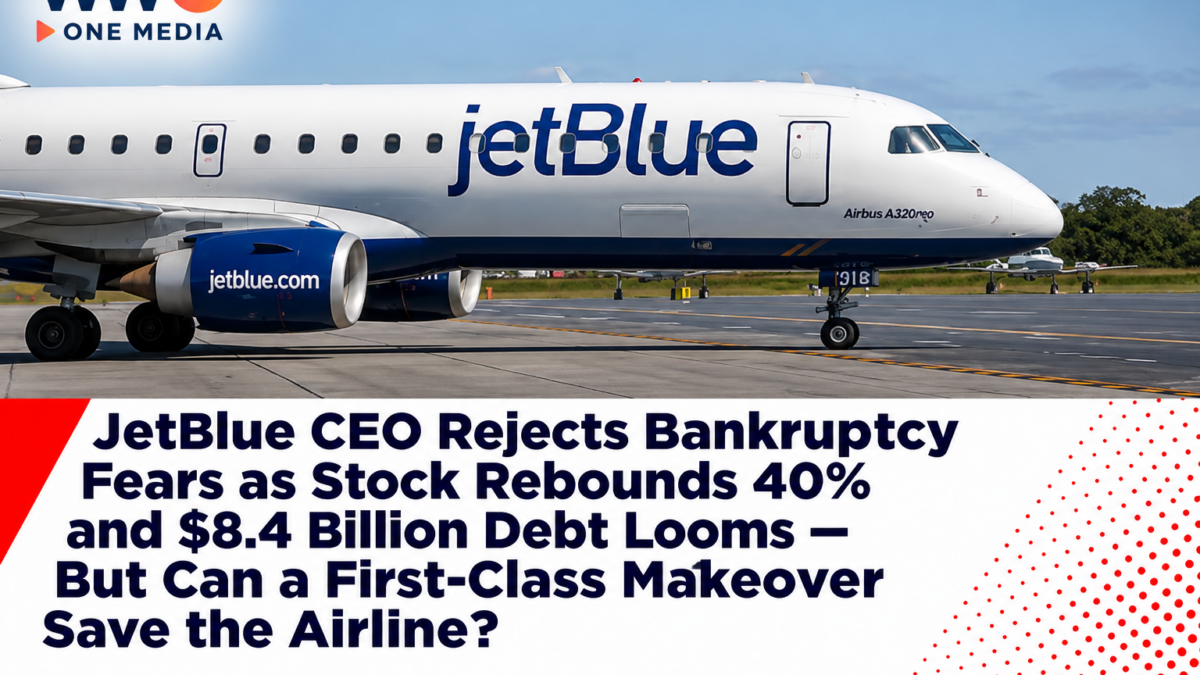
NEW YORK / MANILA, PHILIPPINES — November 12, 2026 — JetBlue Airways is betting its financial recovery on a major shift toward premium travel as Chief Executive Officer Joanna Geraghty confronts bankruptcy speculation, billions of dollars in debt and rising fuel costs that have kept the American airline from returning to sustained profitability.
The New York-based carrier unveiled its new domestic first-class cabin, BlueFirst, at John F. Kennedy International Airport on November 11, marking an important milestone in a turnaround strategy designed to attract travelers willing to pay more for comfort.
But the launch comes during an unusually difficult financial period.
JetBlue has approximately US$8.4 billion in debt and finance lease obligations, has not reported an annual profit since 2019 and recorded a third-quarter net loss of approximately US$257 million.
Its shares also came under intense pressure after reports that some bondholders had hired restructuring advisers, fueling speculation about the company’s financial future.
Geraghty has strongly rejected suggestions that the airline is preparing to seek bankruptcy protection.
In an interview with CNBC, she said the company had no plans to file for bankruptcy and was not working with a restructuring adviser.
Investors have responded to signs of progress.
JetBlue’s shares rebounded approximately 40% during November through the close of trading on November 10, although they remained about 12% lower for the year.
The airline is now wagering that more expensive seating, stronger loyalty benefits and higher revenue from each passenger can help reverse years of financial losses.
The central question is whether JetBlue can earn enough from premium travelers to offset its debt burden and soaring operating costs—or whether its turnaround will face another major setback.
JetBlue CEO Joanna Geraghty Pushes Back Against Bankruptcy Fears
The controversy surrounding JetBlue’s financial position intensified when reports emerged that bondholders had engaged restructuring advisers.
Such developments can create uncertainty because creditors may seek specialist advice when they are concerned about the value or repayment prospects of their investments.
However, hiring advisers does not mean a company has filed for bankruptcy or that a restructuring has been agreed upon.
Geraghty has attempted to make that distinction clear.
Speaking to CNBC in October, the chief executive rejected the suggestion that JetBlue was preparing for Chapter 11 bankruptcy protection.
The company has also challenged what management considers a disconnect between its actual operating performance and negative interpretations circulating in the bond market.
As WWC ONE MEDIA previously reported in its coverage of JetBlue’s bankruptcy rumors and $8.4-billion debt burden, Chief Financial Officer Ursula Hurley has also sought to reassure employees and investors.
Management maintains that JetBlue has sufficient financial resources to continue operating and execute its recovery plan.
Nevertheless, the concerns have not disappeared.
The airline must demonstrate that improved revenue can eventually produce sustainable profits and positive cash flow.
JetBlue’s New BlueFirst Cabin Could Change Its Business Model
At the center of the airline’s turnaround is BlueFirst, a dedicated domestic first-class cabin designed for passengers who want additional comfort without necessarily purchasing a traditional long-haul business-class ticket.
JetBlue demonstrated the new product at its JFK hub on November 11.
The first scheduled revenue flight is set for December 8, 2026, between Boston Logan International Airport and Fort Lauderdale-Hollywood International Airport.
Reservations have already opened on more than 30 routes.
The rollout will expand gradually as the airline modifies its aircraft.
BlueFirst will primarily serve markets where JetBlue does not already operate its Mint premium product.
Mint offers lie-flat seating on selected longer-distance routes, while BlueFirst is designed around conventional reclining first-class seats.
The difference is important.
BlueFirst is not simply a cheaper version of a lie-flat business-class suite.
It is a separate product intended to compete with domestic first-class offerings from larger American airlines.
As WWC ONE MEDIA reported in its earlier coverage of JetBlue’s introductory BlueFirst fares, select promotional tickets were initially advertised from US$249 one-way.
Those limited introductory fares were not permanent prices across the carrier’s network.
Actual fares vary according to route, travel date, availability and ticket conditions.
Inside BlueFirst: Wider Seats, Bigger Screens and Premium Services
JetBlue is trying to differentiate its new cabin through a combination of comfort, technology and service.
BlueFirst seats are arranged in a two-by-two configuration.
They use specially designed cushioning developed with Tuft & Needle and offer up to seven additional inches of legroom compared with the airline’s standard Main cabin.
Each seat also includes a 13.3-inch entertainment screen with Bluetooth connectivity.
Passengers can connect compatible wireless headphones and use the airline’s onboard entertainment system.
JetBlue is introducing seatback food and beverage ordering, allowing customers to make selections through the screen.
Other features include priority boarding, dedicated overhead storage, premium refreshments and enhanced baggage benefits depending on the purchased fare.
On qualifying flights of at least 899 miles, BlueFirst passengers are offered the airline’s FirstFare meal service.
The product is designed to appeal to travelers who may be willing to spend more for additional space and convenience.
However, JetBlue must demonstrate that the higher revenue from premium passengers exceeds the additional cost of providing the service.
Why Premium Travelers Are Becoming So Important
The airline industry’s business model is changing.
For years, much of the competition focused on lower fares and attracting more passengers.
Now, major airlines are increasingly emphasizing higher-value travel products.
Some passengers remain highly price-sensitive.
Others are prepared to pay substantially more for comfort, flexibility, airport privileges and loyalty benefits.
By offering different products to different customer groups, airlines can potentially increase revenue without dramatically expanding the number of flights they operate.
JetBlue believes BlueFirst can contribute nearly five percentage points of improvement in revenue per available seat mile as the program matures.
That is a management expectation, not an improvement already achieved.
The company is particularly focused on markets with strong demand for premium travel, including Boston and New York.
Early BlueFirst bookings have reportedly been encouraging, especially among members of JetBlue’s TrueBlue loyalty program.
But encouraging early sales do not guarantee long-term profitability.
Investors will need to see whether demand continues after introductory promotions end.
American Airlines Shows Why Premium Seats Matter
JetBlue’s decision reflects a broader industry trend.
Major carriers are investing heavily in products aimed at higher-spending travelers.
American Airlines has said that approximately 30% of its seats generate around 50% of its passenger revenue.
As WWC ONE MEDIA reported in its analysis of American Airlines’ expanding premium-seat strategy, the carrier is reconfiguring aircraft to increase the number of seats that attract higher fares.
The revenue imbalance helps explain why premium cabins are becoming such a major priority.
A relatively small portion of the aircraft can contribute a disproportionate share of ticket revenue.
But JetBlue faces a difficult competitive challenge.
American, Delta and United already have extensive loyalty programs, international networks and established premium offerings.
JetBlue must persuade customers that its service offers enough value to justify choosing it over larger competitors.
Delta Also Faces a Massive Fuel-Cost Challenge
Even airlines with established premium businesses are struggling with expensive fuel.
Delta Air Lines reported record third-quarter adjusted revenue in 2026 but reduced its annual earnings outlook after fuel costs surged.
As WWC ONE MEDIA documented in its report on Delta’s record $17.6-billion adjusted revenue and higher fuel expenses, strong passenger demand has not completely insulated major airlines from the global energy-price shock.
For JetBlue, the situation is particularly difficult because the company is still trying to restore profitability.
Fuel is one of the largest expenses in aviation.
When its price rises sharply, airlines must either generate more revenue, improve efficiency, reduce costs or accept weaker margins.
JetBlue hopes premium seating will help increase revenue per passenger.
But there is a limit to how much customers will pay before they begin comparing alternatives or postponing travel.
The company’s strategy therefore depends on balancing pricing power with sustained demand.
JetBlue’s Third-Quarter Loss Widens to $257 Million
The airline’s latest financial figures explain the urgency of its premium push.
For the third quarter ended September 30, JetBlue reported operating revenue of approximately US$2.8 billion, up 21.1% from the previous year.
Revenue per available seat mile increased 18.4%.
Those figures suggest that JetBlue has become more effective at generating revenue from its flying capacity.
However, operating expenses also increased.
Unit operating costs rose 19.4%, partly because fuel became significantly more expensive.
JetBlue’s average fuel price reached US$3.91 per gallon during the quarter, a 57% increase from a year earlier.
The carrier reported a net loss of approximately US$257 million, compared with US$143 million in the third quarter of 2025.
These results reveal the company’s central problem.
Revenue growth is improving, but operating costs remain high enough to prevent an overall profit.
The airline said it recaptured approximately 87% of the higher fuel costs through stronger revenue performance.
That is meaningful progress, but it still leaves the company exposed to rising expenses.
$8.4 Billion in Debt Remains a Major Investor Concern
JetBlue’s debt burden is another central issue.
The airline reported approximately US$8.4 billion in debt and finance lease obligations at the end of September.
Such obligations require ongoing financing and repayment.
When a company is profitable and generates reliable cash flow, debt may be manageable.
But persistent operating losses can make a large debt burden more difficult to support.
That helps explain why some investors and creditors have become concerned.
Nevertheless, the company also has significant financial resources.
JetBlue ended the third quarter with approximately US$2.2 billion in available liquidity.
That figure includes a US$600-million undrawn credit facility.
The company also reported an unencumbered asset base of approximately US$7 billion, including US$2.8 billion in aircraft and engines.
These assets may provide additional financing flexibility.
However, available liquidity, unencumbered assets and immediate cash holdings are not interchangeable figures.
Assets may need to be financed or sold before they can generate additional cash.
Similarly, an undrawn credit facility is a borrowing resource rather than cash already held in the bank.
Investors will watch how effectively JetBlue manages these resources while pursuing its turnaround.
Could JetBlue Return to Profitability in 2027?
Management has outlined a multiyear recovery strategy under its JetForward program.
The company is targeting sustainable operating profitability in 2027.
For 2028, it aims to generate positive free cash flow and at least US$1 in adjusted earnings per share.
These targets depend on several factors.
Premium bookings must remain strong.
Revenue-management improvements must continue delivering results.
The airline must control operating costs.
Fuel prices must remain manageable enough for the company to operate profitably.
Debt and financing obligations must also be managed carefully.
JetBlue believes its broader premium and loyalty initiatives can support the recovery.
These include BlueFirst, Mint, airport lounges, TrueBlue loyalty enhancements and its commercial partnership with United Airlines.
But the company’s targets remain forecasts.
No available evidence establishes that JetBlue has already returned to annual profitability.
JetBlue’s Stock Rebound Shows Investor Sentiment Can Change Quickly
The carrier’s recent share-price performance has been dramatic.
According to CNBC, JetBlue’s shares gained approximately 40% during November through the November 10 closing session.
The rebound followed a period of significant pressure associated with bond-market concerns and restructuring speculation.
However, the share-price recovery should not be interpreted as proof that the airline’s underlying financial problems have been solved.
Stock prices can move sharply when investor expectations change.
A positive analyst rating, stronger demand projections or reduced concern about bankruptcy can support a rally.
But longer-term performance still depends on earnings and cash flow.
CNBC reported that JetBlue remained down approximately 12% for 2026 at the same reporting cutoff.
Deutsche Bank also recently upgraded the airline, citing a more disciplined approach to flight capacity and revenue.
The contrasting figures demonstrate that a strong short-term rebound can occur even while broader financial uncertainty remains.
Can First Class Really Save JetBlue?
JetBlue’s decision to expand premium seating is a bet on changing customer behavior.
The company believes demand for additional comfort is sufficiently strong to support higher fares.
Its strategy could work particularly well on routes where passengers already have a willingness to pay for upgrades.
But the approach also carries risks.
Aircraft retrofits cost money.
Premium seating occupies space that could otherwise be used for additional economy seats.
Higher-end food, beverage and ground-service offerings create additional expenses.
And competitors are pursuing similar strategies.
Frontier has introduced its own first-class product, while Allegiant plans to offer premium seating on selected aircraft beginning in 2027.
The result is an increasingly crowded market for higher-spending travelers.
If the number of premium seats grows faster than demand, airlines could face pressure to discount those tickets.
For JetBlue, that would weaken the financial benefits it expects from BlueFirst.
What Happens Next for JetBlue?
Several milestones will determine whether the airline’s turnaround gains traction.
The first is BlueFirst’s December 8 inaugural flight.
The second is the broader rollout of premium seating across JetBlue’s Airbus A320 and A220 fleets.
The company expects the program to cover a majority of applicable aircraft by the end of 2027, with full completion planned in 2028.
The third is the airline’s financial performance during the fourth quarter and throughout 2027.
Investors will look for evidence of improving operating margins and reduced losses.
They will also monitor liquidity, debt obligations and fuel expenses.
Finally, customer response will be critical.
Strong early bookings are encouraging, but the airline must demonstrate that travelers continue purchasing premium seats at financially sustainable prices.
The Bottom Line: JetBlue’s Comeback Depends on More Than Comfortable Seats
JetBlue is entering an important stage of its recovery effort.
The company is confronting US$8.4 billion in debt and finance lease obligations, significant operating costs and years without an annual profit.
Its chief executive has rejected bankruptcy speculation and insists the airline remains focused on executing its turnaround plan.
The introduction of BlueFirst gives JetBlue a new opportunity to attract higher-paying passengers and strengthen its competitive position.
But premium seating alone cannot eliminate a large debt burden or guarantee profitability.
The strategy must generate enough additional revenue to overcome its implementation costs, fuel expenses and other operating pressures.
JetBlue has demonstrated that it can improve passenger revenue. The next challenge is proving that stronger revenue can produce sustainable profits.
As JetBlue’s shares recover and its new first-class cabin prepares for takeoff, can Joanna Geraghty’s premium-travel gamble finally return the airline to profitability—or will rising costs and billions in debt overwhelm the comeback before it gets off the ground?