LIMA, Peru — November 12, 2026
Millions of people have welcomed Pope Leo XIV back to Peru in an emotional homecoming that has transformed the country’s capital into the center of one of the most closely watched religious events of the year.
The pontiff arrived in Lima on Wednesday, November 11, beginning the final leg of his 12-day South American journey after visits to Uruguay and Argentina.
For Peruvians, however, this is much more than another international papal visit.
It is a return to a country where Pope Leo spent more than two decades serving as a missionary priest and bishop before becoming the leader of the Roman Catholic Church.
According to Reuters, citing a Vatican statement based on local officials’ estimates, approximately 3 million people welcomed the Pope during his arrival in Peru. Crowds lined the streets, waved flags and balloons, and chanted his name as he travelled through Lima in an open-air popemobile.
The Pope described Peru as his homeland, reflecting on the friendships, experiences and religious service that shaped his life there.
The welcome also carries special significance because Leo, born Robert Francis Prevost in Chicago, is the first US-born pope and holds Peruvian citizenship.
But his return is not only about celebration.
During his first address in Peru, Leo also delivered a message about national reconciliation, political responsibility and the importance of rebuilding public trust.
As his journey continues through Lima, Chiclayo, Cusco and Pucallpa, attention is turning to what the Pope may say about the country’s political divisions, poverty and other challenges.
A Homecoming More Than 20 Years in the Making
Pope Leo XIV’s connection with Peru began long before his election as pontiff.
Born in Chicago, Illinois, in 1955, Robert Francis Prevost first arrived in Peru as an Augustinian missionary in 1985.
He spent years working with religious communities and serving people in different parts of the country.
His connection with northern Peru became especially important when he was appointed Bishop of Chiclayo, serving from 2015 until 2023.
The experience helped shape his pastoral approach and gave him a close understanding of the challenges facing ordinary Peruvians.
His relationship with the country was already visible during his first public appearance as Pope in May 2025, when he specifically mentioned the Diocese of Chiclayo and thanked the people who had accompanied him during his years of service.
Now, his return as head of the Catholic Church has created an extraordinary atmosphere in communities that remember him not simply as a religious leader but as someone who once lived and worked among them.
The Associated Press described Peru as the Pope’s second home, highlighting the more than two decades he spent there as a missionary priest and bishop.
For many residents, the visit represents the return of a familiar religious figure whose personal history is closely connected to their communities.
Millions Fill Lima as Pope Leo Arrives
The welcome began at Callao Air Base, where the papal aircraft landed on Wednesday.
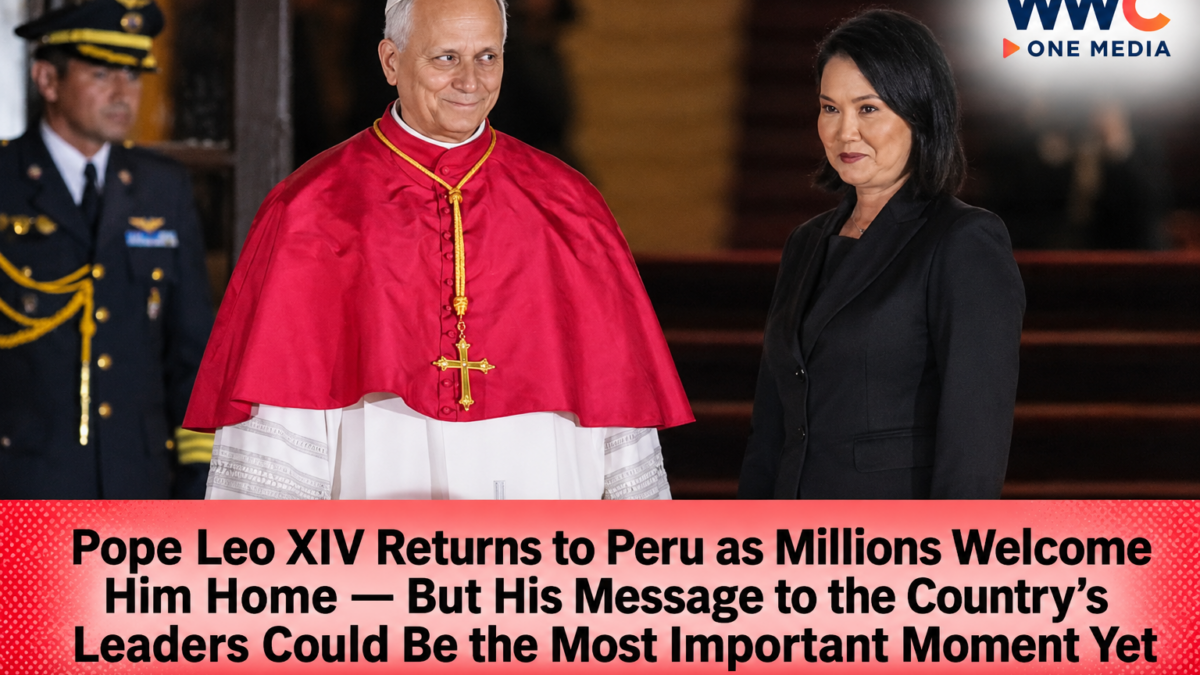
Peruvian President Keiko Fujimori and Foreign Minister Carlos Espá were among the officials who received the pontiff.
Two children presented him with flowers, while a children’s choir performed during the welcoming ceremony.
The Pope also stopped to greet people with disabilities, bless babies and acknowledge members of the crowd who had waited to see him.
From Callao, he travelled toward Lima for the official welcome ceremony at the Government Palace and a private meeting with President Fujimori.
The streets became crowded with people hoping to catch a glimpse of the papal motorcade.
Reuters reported that the crowd estimate for the welcome reached approximately 3 million, based on figures from local officials cited by the Vatican.
That would make it the largest crowd of Leo’s pontificate so far, surpassing the estimated 2.5 million people who attended an outdoor Mass in Buenos Aires earlier in the tour.
The figure is an official estimate rather than an independently verified headcount, but it demonstrates the extraordinary scale of the welcome.
The excitement has extended beyond religious gatherings.
Pope-themed shirts, souvenirs, statues and other products have appeared throughout the country, while businesses prepare for an increase in visitors attending the events.
The 14-Meter Statue That Shows Peru’s Excitement
One of the most striking symbols of the Pope’s return is a massive statue depicting Leo XIV with his arms outstretched.
The monument stands approximately 14 meters tall near the coast in Callao, the port city adjoining Lima.
The statue was installed ahead of the Pope’s arrival and has become one of the most visible reminders of his connection with Peru.
Reuters reported that merchants have been selling Pope-themed clothing and souvenirs, while inmates at the country’s largest women’s prison have also been producing velvet dolls bearing his likeness.
The celebrations reflect the enthusiasm surrounding a pontiff whose personal history is deeply connected to the country.
WWC ONE MEDIA previously covered the installation of the monument in its report, “From a Deadly Poland Shooting to a Pope’s Giant Statue: 9 Powerful AP Photos Capture a World Full of Contrasts.”
The statue is more than a tourist attraction. It represents the affection many Peruvians feel for a religious leader who spent years serving their communities before rising to one of the most influential positions in the world.
Pope Leo Delivers a Message About Peru’s Political Past
While the crowds have made the visit a national celebration, the Pope’s first address also demonstrated that his role extends beyond religious ceremonies.
During his meeting with President Keiko Fujimori, Leo urged Peru’s leaders to rebuild confidence among citizens and address the country’s historical wounds with justice and sensitivity.
His remarks came against the background of Peru’s turbulent political history and the controversial legacy of Fujimori’s father, former President Alberto Fujimori.
Alberto Fujimori governed Peru from 1990 to 2000. He was later convicted of human rights abuses and spent years in prison before his death in 2024.
His government remains a deeply divisive subject in Peruvian politics, particularly because of the human rights violations committed during the state’s conflict with the Shining Path insurgency.
Pope Leo did not directly name the former president in the remarks reported by Reuters.
Instead, he called for the past to be addressed with justice and sensitivity, while encouraging Peruvians to develop honesty, integrity and a willingness to engage with people holding different views.
President Keiko Fujimori described the visit as an invitation to continue the country’s unfinished work of national reconciliation.
The exchange is significant because the Pope has previously criticized the 2017 pardon granted to Alberto Fujimori, arguing at the time that genuine reconciliation required an acknowledgment of the suffering experienced by victims.
His latest remarks therefore carry particular weight.
They suggest that the Pope intends to use his personal connection with Peru to encourage reflection on the country’s past while emphasizing the need for stronger public trust.
Poverty, Inequality and Violence Remain Major Concerns
The Pope’s visit also comes at a difficult moment for Peru.
The country continues to face problems involving poverty, inequality, crime and political instability.
The Associated Press reported that more than one-quarter of Peru’s population lived in monetary poverty in 2025.
Reuters has also highlighted concerns about rising homicide and extortion, alongside the country’s repeated changes in political leadership.
Peru has experienced nine presidents since 2016, reflecting years of political turmoil and institutional instability.
These problems are part of the wider environment in which Leo is conducting his visit.
The Catholic Church has traditionally played an important role in social assistance, education and community support throughout Latin America.
The Pope’s years in Peru gave him direct experience with communities facing economic hardship and limited access to essential services.
His message about social responsibility and national reconciliation could therefore resonate beyond the religious gatherings.
For many Peruvians, the visit is an opportunity to hear a leader who understands the country’s history and has personal connections to its people.
From Lima to Chiclayo, Cusco and the Amazon
The Peru visit is scheduled to continue until November 16, with several major events planned across the country.
According to the Vatican’s official itinerary, the Pope’s engagements include:
Lima — November 12
Leo is scheduled to meet with Peru’s bishops, lead prayer at the Cathedral Basilica of St. John the Apostle and Evangelist, and address the challenges and hopes of the Peruvian people. He is also scheduled to meet young people and university students at the National Stadium.
Chiclayo — November 13–14
The northern city holds special significance because Leo served as its bishop from 2015 to 2023. His program includes meetings with local communities and a large outdoor Mass.
Cusco and Pucallpa — November 15
The Pope is scheduled to visit Cusco, meet faithful and representatives of popular devotion at the Saqsaywaman archaeological park, and pray the Angelus near the city’s cathedral.
He will then travel to Pucallpa, where he is expected to meet missionaries and representatives of Amazonian peoples before celebrating Mass.
Lima and Callao — November 16
The final day of the Peru visit includes a visit to residents and staff at a shelter for elderly people, followed by a Mass at Las Palmas Air Base and a farewell ceremony before his departure for Rome.
The Vatican’s published schedule identifies November 16 as the end of the Peru leg, with the Pope scheduled to arrive back in Rome on November 17.
The itinerary demonstrates that the visit is not limited to the capital.
It will take the pontiff from the coastal city of Lima to the Andes and the Amazon region, allowing him to reconnect with communities across different parts of the country.
Peru’s Tourism Industry Is Also Feeling the Papal Effect
The Pope’s arrival is generating economic activity beyond the Church.
Hotels, restaurants, transport operators and souvenir businesses are preparing for an influx of visitors.
Reuters reported that Peru expected approximately 850,000 domestic travellers and another 50,000 international visitors during the six-day papal visit, according to Tourism Minister Rogers Valencia.
Flights were reported to be fully booked as pilgrims and tourists prepared to attend the events.
The government has also promoted a tourism route known as the “Paths of Pope Leo XIV,” which connects locations associated with the pontiff’s missionary and pastoral work in northern Peru.
According to figures cited by Reuters from state tourism agency PromPerú, the route had attracted more than one million visitors since Leo’s election in May 2025 and generated approximately 450 million soles, or about $125 million, during its first year.
The visit is therefore an important opportunity for Peru’s tourism sector, particularly in locations connected to the Pope’s personal history.
It also demonstrates how a major religious event can generate economic benefits for local businesses and communities.
The Church’s Wider Challenges Are Also in Focus
Although the Peru visit has generated widespread enthusiasm, it is also taking place amid difficult questions about the Catholic Church’s accountability.
Before the Pope’s arrival, Reuters reported that a US-based clergy abuse watchdog had called for a truth commission to investigate abuse cases in Peru.
The group urged Leo to address accountability within Church leadership and support survivors.
The issue is particularly sensitive because Peru has faced major scandals involving allegations of sexual and psychological abuse connected to religious organizations.
One prominent case involved Sodalitium Christianae Vitae, a Peru-founded Catholic organization dissolved by Pope Francis in 2025 following a Vatican investigation.
The watchdog’s call for further investigation adds another dimension to the Pope’s visit.
For some observers, his return is an opportunity not only to celebrate his relationship with Peru but also to address difficult questions about justice, institutional responsibility and the protection of vulnerable people.
The Vatican’s broader message during the tour has included concern for people living in poverty, those facing discrimination and communities affected by violence.
Whether the Pope addresses the abuse-accountability issue directly during his remaining engagements remains to be seen.
A South American Tour Marked by Record Crowds
Peru is the final country on Pope Leo XIV’s three-nation South American journey, which began in Uruguay on November 6.
The itinerary also included Argentina, where the pontiff attracted enormous crowds.
Reuters reported that an estimated 2.5 million people attended an outdoor Mass in Buenos Aires earlier in the journey, while approximately 2 million gathered near the Shrine of Our Lady of Luján for another major Mass.
His visit to Argentina also included a stop at a large penitentiary, where he met inmates and urged prison officials to treat detainees humanely.
The journey has been one of the most demanding overseas trips by a pope in decades, with numerous public engagements, flights and speeches.
The tour has also attracted attention because Leo underwent lung cancer surgery less than a month before travelling.
Reuters reported that he appeared in good form throughout the journey, delivering speeches in a clear and firm voice.
His ability to maintain the demanding schedule has therefore become another point of interest during the visit.
For the Catholic Church, the enormous gatherings also demonstrate the continued ability of the Pope to attract large crowds across different countries and cultures.
What Happens After Pope Leo Leaves Peru?
The Pope is scheduled to depart Peru on November 16 and return to Rome on November 17.
But the significance of the visit will extend beyond the final Mass and farewell ceremony.
His return has highlighted the personal relationship between the pontiff and a country where he spent a substantial part of his religious life.
It has also brought renewed attention to Peru’s political divisions, economic challenges and social concerns.
For President Keiko Fujimori, the visit provides an opportunity to present a message of reconciliation and national unity.
For the Catholic Church, it is a chance to strengthen connections with communities across Latin America.
And for ordinary Peruvians, it is the return of a religious leader many consider one of their own.
The crowds have already made the homecoming extraordinary.
But the lasting impact may depend on whether the Pope’s messages about justice, reconciliation, poverty and public responsibility inspire action after the celebrations end.