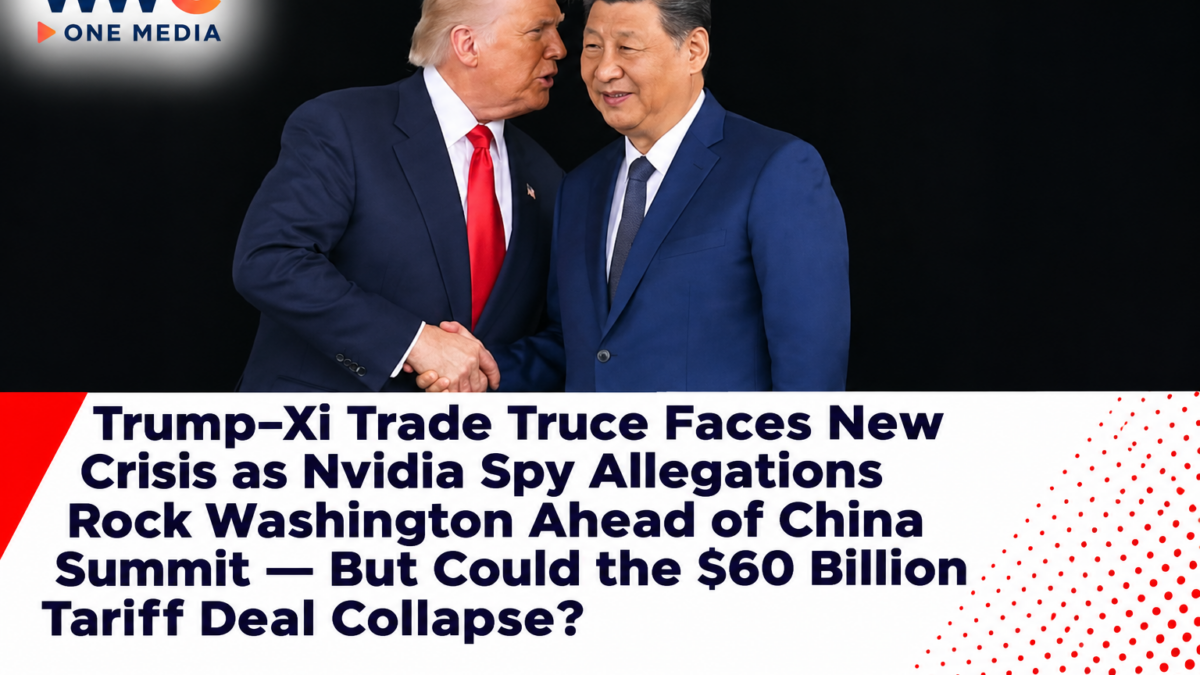
BEIJING / WASHINGTON / MANILA, Philippines — November 12, 2026 — The fragile trade peace between the United States and China is facing a major diplomatic test as President Donald Trump prepares to meet Chinese President Xi Jinping in Shenzhen, with an escalating controversy surrounding Nvidia chief executive Jensen Huang threatening to turn artificial intelligence and semiconductor exports into another flashpoint between the world’s two largest economies.
The expected meeting comes during China’s hosting of the Asia-Pacific Economic Cooperation summit, where Washington and Beijing are hoping to maintain a trade truce that has temporarily restrained their escalating tariff conflict.
But the diplomatic atmosphere has changed dramatically.
US officials are examining allegations that Huang had a personal relationship with a businesswoman whom American intelligence authorities reportedly suspected of working on behalf of Chinese intelligence.
The Nvidia chief executive has acknowledged an extramarital relationship and apologized to his family and colleagues. However, no publicly disclosed finding establishes that he knowingly participated in espionage or transferred confidential technology to Beijing.
The controversy has nevertheless intensified questions about US restrictions on advanced artificial intelligence chips, China’s access to American computing technology and the Trump administration’s relationship with Nvidia.
According to Reuters, the US government has also been divided over whether to strengthen enforcement against companies suspected of diverting restricted Nvidia processors to China.
The allegations arrive just as both governments attempt to preserve a temporary trade agreement that now extends into January 2027.
The central question is whether Trump and Xi can prevent a corporate national-security controversy from undermining broader economic cooperation—or whether renewed disagreements over AI chips, tariffs and critical minerals will trigger another escalation in their trade conflict.
Trump and Xi Prepare for High-Stakes Talks in Shenzhen
President Trump is expected to meet Xi during the November APEC leaders’ gathering in Shenzhen, China.
The meeting follows Xi’s September visit to Washington, during which the leaders agreed to continue efforts to stabilize bilateral relations.
Their discussions covered economic relations, artificial intelligence, military communication and international security.
The September summit produced commitments to establish a mechanism for discussing AI-related incidents and continue negotiations on trade.
But those arrangements did not resolve the fundamental disagreements between Washington and Beijing.
The United States continues to restrict access to certain advanced semiconductor technologies.
China maintains controls affecting strategically important minerals and industrial materials.
Both countries also disagree about market access, tariffs and the implementation of existing trade commitments.
A November 11 telephone conversation between US Secretary of State Marco Rubio and Chinese Foreign Minister Wang Yi was described as positive and constructive.
The diplomatic outreach suggests that both governments want to keep negotiations moving.
However, the Nvidia controversy introduces a politically sensitive issue that may be difficult to separate from wider technology discussions.
Nvidia Espionage Allegations Complicate the Diplomatic Agenda
The latest tension stems from reporting about Nvidia chief executive Jensen Huang and a Chinese businesswoman identified as Alice Huang, also known as Huang Le.
According to reporting by The New York Times and subsequent coverage by Reuters and the Associated Press, US intelligence officials suspected that the businesswoman gathered information for Beijing.
The allegations involve her reported relationship with Jensen Huang and her previous association with Singapore-based technology company Megaspeed International.
Megaspeed operates in the data center and cloud-computing industry and has had commercial relationships involving Nvidia technology.
The company has faced questions about whether advanced processors were improperly obtained or diverted to customers in China.
However, the intelligence allegations remain disputed.
China has rejected accusations that it carried out the reported spying operation.
Nvidia says it has no reason to believe its confidential information or American national security was compromised.
The company’s board has launched an independent investigation.
The existence of that investigation does not establish misconduct.
As WWC ONE MEDIA reported in its coverage of China’s rejection of the allegations involving Jensen Huang, Beijing has characterized the espionage claims as unsubstantiated.
The dispute is particularly sensitive because Nvidia is a major supplier of technology used to build advanced AI systems.
Trump’s Close Relationship With Jensen Huang Comes Under Scrutiny
The controversy is also drawing attention to President Trump’s relationship with Nvidia’s chief executive.
Huang has repeatedly met with Trump and senior administration officials as Nvidia sought greater access to the Chinese market.
Reuters reported on November 12 that Huang had participated in official international visits and had been appointed to the president’s science and technology advisory council.
The executive has argued that American semiconductor companies should be able to compete in China under appropriate rules.
His position reflects a broader commercial concern: restrictions on American technology may encourage Chinese companies to develop alternative processors and software.
Trump has expressed support for Huang during the investigation.
On November 9, he said he had spoken directly with the Nvidia chief executive about the allegations.
According to Trump, Huang denied knowing that the woman was allegedly involved in espionage.
The president said he believed Huang’s explanation.
But Trump’s personal confidence in the executive is separate from the investigations being conducted by Nvidia and US authorities.
Those investigations must establish relevant facts independently.
The controversy could make it politically more difficult for the administration to argue for expanded Nvidia chip exports to China.
US Officials Clash Over Tougher Restrictions on Nvidia Chips
The semiconductor dispute has become increasingly contentious inside Washington.
Reuters reported on November 11 that Commerce Secretary Howard Lutnick had allegedly delayed efforts to strengthen enforcement against companies suspected of diverting Nvidia processors to China.
The report cited an Axios investigation.
According to that account, Trump had authorized additional enforcement action, but disagreements persisted among senior officials.
Treasury Secretary Scott Bessent reportedly challenged the Commerce Department’s reluctance to move forward.
The White House and Lutnick’s representatives had not immediately commented on the allegations in the Reuters account.
The reporting is significant because the United States has spent years attempting to control Chinese access to advanced AI computing technology.
Some national-security officials argue that restrictions are necessary to prevent sensitive technology from supporting China’s military and intelligence capabilities.
Others argue that excessive restrictions can damage American companies, reduce their international competitiveness and encourage foreign customers to seek alternatives.
The Nvidia controversy has intensified that longstanding policy disagreement.
It remains unclear what additional restrictions, if any, Washington will formally introduce.
Nvidia’s Board Faces a Critical Governance Test
The dispute has also raised questions about how Nvidia’s directors oversee their longtime chief executive.
Huang co-founded Nvidia in 1993 and has led the company throughout its rise into one of the world’s most influential semiconductor businesses.
His role in Nvidia’s technology strategy and relationships with major customers has made him central to the company’s identity.
But the intelligence allegations have created an unusual test for corporate governance.
Directors must examine whether the reported circumstances exposed Nvidia to security, compliance or reputational risks.
They must also assess whether company policies and internal controls were adequate.
As WWC ONE MEDIA reported in its examination of Nvidia’s board independence and corporate oversight, the directors are under pressure to demonstrate that they can conduct a credible investigation involving the company’s founder.
Nvidia’s announcement of an independent inquiry is an important procedural step.
But its ultimate significance will depend on what the review establishes and how the board responds.
No publicly verified finding has established that Huang knowingly provided confidential information to a foreign intelligence service.
China’s Trade Truce With the United States Gets Another Extension
While the technology controversy escalates, Washington and Beijing have been trying to prevent their trade dispute from worsening.
On November 9, China’s government announced that it would extend suspensions of certain trade measures for another two months.
The decision followed earlier agreements reached during the September Trump–Xi summit.
The extension keeps important elements of the trade truce in place until January 2027.
It provides additional time for negotiators to discuss tariffs, market access and other trade-related issues.
But the arrangement is temporary.
It does not amount to a comprehensive settlement of the trade conflict.
As WWC ONE MEDIA reported in its coverage of the US–China trade truce extension, the two governments have made progress in preventing immediate escalation while leaving major economic disagreements unresolved.
The distinction matters for global businesses.
A temporary suspension of additional restrictions can provide near-term certainty.
But companies making long-term investment decisions still face uncertainty about future trade rules.
The Proposed $60 Billion Tariff Package Remains Unfinished
One major component of the negotiations involves reciprocal tariff reductions.
The two sides have discussed a package covering approximately US$60 billion in goods, based on around US$30 billion on each side.
The proposal was associated with discussions during Xi’s September visit to Washington.
But the wider arrangement has not been fully finalized.
The potential reductions should not be interpreted as a completed US$60-billion transfer of money or an immediate increase in trade revenue.
They describe the approximate value of goods that could be covered by negotiated measures.
For American exporters, improved access to Chinese customers could support sales.
For Chinese manufacturers, tariff reductions could ease some of the costs associated with selling products into the United States.
However, negotiations remain vulnerable to disagreements over technology security, agricultural purchases and critical minerals.
A deterioration in relations could delay or complicate implementation.
Rare Earths Remain Another Major Source of Tension
Technology controls are only one part of the US–China dispute.
Critical minerals have become another major negotiating issue.
China occupies an important position in the processing and supply of rare-earth materials used in industrial equipment, electronics, electric vehicles and defense technologies.
American officials have complained that Beijing has not fully met commitments involving exports of certain critical minerals.
The issue has become particularly sensitive because some materials are difficult to replace quickly.
A shortage can disrupt manufacturing operations even when demand for finished products remains strong.
The Financial Times reported that US officials recently pressed China to fulfill commitments involving rare-earth exports and other trade arrangements.
Beijing rejects accusations that it has failed to cooperate appropriately.
These disagreements could complicate the upcoming leaders’ meeting.
Washington wants reliable access to materials needed by American manufacturers.
China wants assurances that US restrictions will not continue expanding against its technology sector.
The Nvidia controversy adds another potentially contentious subject to those negotiations.
American Soybean Purchases Are Also Under Pressure
Agricultural trade is another unresolved issue.
The United States has urged China to meet commitments involving purchases of American farm products.
The discussions include soybeans and other agricultural commodities.
American farmers can be particularly exposed to changes in Chinese purchasing patterns because China has historically been a major importer of US agricultural goods.
Trade disputes can reduce demand, create uncertainty over prices and encourage importers to seek alternative suppliers.
According to US reporting, Chinese purchases have met some commitments but fallen short in other categories.
The disagreement is politically important because agricultural states represent a significant domestic constituency for American policymakers.
As WWC ONE MEDIA reported in its coverage of Trump’s pressure on Xi over soybean purchases and rare-earth supplies, Washington wants evidence that Beijing is implementing previously negotiated arrangements.
The Nvidia controversy could make progress more difficult if technology disputes begin dominating the diplomatic agenda.
China Extends Suspension of Port Fees on US-Linked Ships
There have also been signs of practical cooperation.
China recently extended its suspension of special port fees imposed on vessels associated with the United States.
The suspension now runs until January 10, 2027.
Beijing also extended a related pause affecting investigations into shipping and shipbuilding supply chains.
The measures provide temporary relief for businesses involved in international maritime trade.
Additional port charges can increase transportation costs and complicate shipping schedules.
Their suspension reduces one source of uncertainty.
As WWC ONE MEDIA reported in its coverage of China’s November 9 port-fee decision, the extension illustrates how both countries are attempting to manage individual trade disputes even without resolving their larger disagreements.
The decision is also a reminder that the trade truce extends beyond tariffs.
It affects shipping, industrial supply chains and other commercial activities.
Could the Nvidia Controversy Derail the Trade Agreement?
The most immediate risk is that political pressure in Washington could lead to tougher semiconductor restrictions.
Nvidia’s products are central to the development and operation of advanced artificial intelligence models.
Restrictions on its most powerful processors have therefore become a major issue in US–China technology relations.
If American lawmakers demand stricter enforcement, the administration may face pressure to reduce exemptions or tighten export approvals.
China could interpret additional controls as an escalation of the technology dispute.
That could complicate negotiations on tariffs, agricultural goods or critical minerals.
However, these outcomes are not inevitable.
Both governments have economic reasons to prevent a broader confrontation.
American exporters benefit from access to Chinese customers.
Chinese businesses benefit from access to the US market and international technology supply chains.
A compromise may involve maintaining certain commercial arrangements while strengthening security-related oversight.
The challenge is finding a policy that satisfies national-security concerns without triggering another cycle of retaliation.
Could Nvidia’s Troubles Affect the Global AI Boom?
Nvidia is a major supplier of advanced processors used by data centers, cloud-computing companies and AI developers.
Its technology plays an important role in the infrastructure supporting modern artificial intelligence.
Uncertainty surrounding its leadership and international business relationships can therefore influence investor sentiment.
But there is an important distinction between reputational controversy and operational disruption.
An investigation does not automatically mean Nvidia’s existing chip orders will disappear.
Nor does it establish that its products have become less competitive.
The longer-term impact will depend on whether the inquiry produces findings that affect management, compliance obligations or international market access.
Stricter export rules could limit some potential sales to China.
On the other hand, Nvidia could continue benefiting from demand for AI computing elsewhere.
The global consequences will depend on specific policy decisions rather than speculation alone.
The Philippines and Southeast Asia Have a Stake in the Outcome
The US–China technology and trade relationship matters well beyond Washington and Beijing.
Southeast Asian economies are closely connected to international manufacturing, electronics production and shipping networks.
The Philippines is part of regional semiconductor and electronics supply chains.
Singapore has become an important center for data centers and international technology services.
Malaysia and Vietnam also play substantial roles in electronics manufacturing and investment.
A more restrictive technology environment could alter how companies structure production, distribution and computing operations.
At the same time, a stable trade relationship could support confidence in regional investment.
However, the available reporting does not establish that Nvidia’s controversy has caused a specific decline in Philippine exports, employment or semiconductor investment.
Any such effect would require separate economic evidence.
For regional governments, the wider issue is the need to maintain reliable commercial relationships while adapting to increasingly complex technology-security rules.
The Upcoming APEC Summit Could Become a Test of Diplomatic Stability
The Shenzhen summit gives Trump and Xi an opportunity to demonstrate that they remain committed to dialogue despite the latest dispute.
The two leaders are expected to meet again at the G20 summit in Florida in December.
These meetings could help establish a negotiating timetable ahead of the January trade-truce deadline.
But expectations should remain realistic.
Previous summits have produced agreements on communication channels, limited tariff measures and continued negotiations.
They have not eliminated the structural rivalry between the two countries.
The Nvidia controversy may increase attention to AI security and chip exports.
Agriculture, rare-earth materials and market access will also remain central.
A successful summit may therefore be measured less by a sweeping new trade agreement than by whether both governments avoid another escalation.
What Happens Next?
Several developments will determine the direction of US–China relations.
The first is whether Nvidia’s investigation establishes any breach of corporate security or applicable laws.
The second is whether the Trump administration introduces additional export restrictions or enforcement measures affecting advanced processors.
The third is whether China and the United States make measurable progress on existing agricultural and critical-mineral commitments.
The fourth is whether the Shenzhen summit produces new agreements or merely confirms the continuation of dialogue.
Finally, the January 2027 deadline will determine whether both governments extend their current trade arrangements again or face a renewed period of uncertainty.
Until those questions are resolved, investors and businesses should expect continued political and market sensitivity to developments involving AI chips and US–China trade.
The Bottom Line: One Corporate Scandal Tests a Fragile Superpower Truce
The Nvidia controversy has arrived at one of the most sensitive moments in the US–China economic relationship.
Trump and Xi are preparing to meet after extending a fragile trade arrangement intended to prevent another escalation in tariffs and other restrictions.
But allegations involving Nvidia’s chief executive have intensified scrutiny of technology security and Washington’s decisions about exporting advanced AI processors.
China denies the espionage allegations.
Nvidia says there is no reason to believe its secrets or US national security were compromised.
The relevant investigations remain ongoing.
At the same time, both governments continue disagreeing over rare-earth exports, agricultural purchases and the implementation of their existing trade commitments.
The latest dispute does not mean the trade truce has collapsed. It does mean the political cost of maintaining cooperation could be rising.
As Xi prepares to welcome Trump to Shenzhen and Washington debates whether Nvidia’s AI chips should face tougher restrictions, can the two leaders preserve their fragile economic truce—or will the controversy ignite the next chapter of the US–China technology war?