
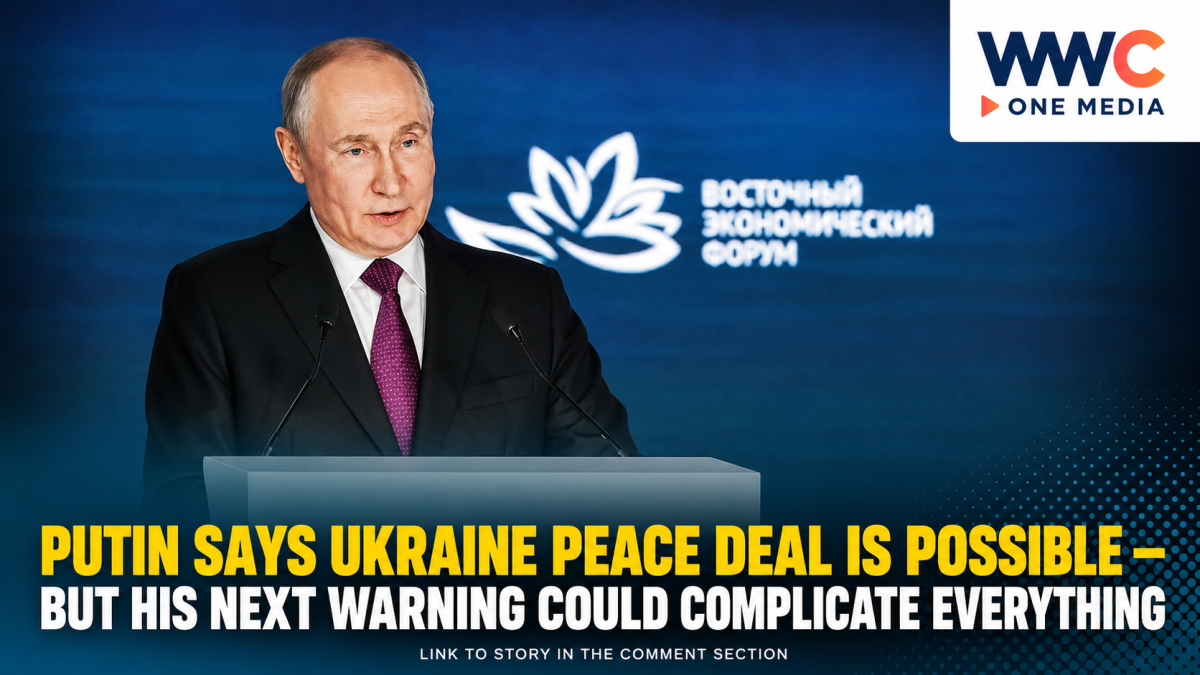
VLADIVOSTOK, Russia — After more than four years of war, Vladimir Putin has publicly acknowledged that a peace agreement with Ukraine may still be possible — a rare note of optimism from the Kremlin as fighting between Russian and Ukrainian forces continues to intensify.
Speaking Thursday at the Eastern Economic Forum in Russia’s Far East, the Russian president said there was a chance of reaching an agreement to end the war and pointed to the willingness of countries including the United States and China to support a potential settlement.
But Putin also stressed that the final agreement would have to come from Russia and Ukraine themselves.
“We are grateful to everyone attempting to contribute to a settlement,” Putin said, adding that, in his view, there was a chance for peace.
His comments immediately stood out because they came at a moment when the battlefield is moving in the opposite direction: Russia and Ukraine have continued exchanging long-range strikes, while diplomatic efforts have struggled to produce a breakthrough.
Kyiv also sees a possible opening
Ukraine’s Foreign Minister Andrii Sybiha offered a similarly cautious assessment, saying he expects a “new dynamic” in peace efforts as diplomatic activity resumes across several capitals.
Sybiha did not provide details about a new agreement or announce a scheduled summit, instead urging reporters to watch for further developments.
The cautious optimism comes after months of negotiations that have failed to bridge the fundamental differences between Moscow and Kyiv.
Contacts between Russia and Ukraine have nevertheless continued, according to Putin, primarily through intelligence and security channels.
The battlefield tells a different story
Despite the new diplomatic language, the war itself shows little sign of slowing.
AP reported that Russian aerial attacks recently killed civilians in Ukraine, while Kyiv and Moscow have continued trading increasingly long-range strikes. Ukrainian officials say Russia launched 174 attack drones and several missiles in one recent barrage, while Russia reported intercepting more than 100 Ukrainian drones overnight.
The attacks have also increasingly affected life inside Russia.
According to AP, more than 43,300 Ukrainian drones were reported intercepted over Russia and Russian-occupied Crimea between June and August — dramatically higher than the number reported during the same period last year. Drone attacks have disrupted airports, struck energy facilities and contributed to fuel shortages in parts of Russia.
That pressure is occurring as Russia approaches parliamentary elections later this month, adding another political dimension to the Kremlin’s handling of the war.
Putin blames Ukrainian attacks for making peace harder
Putin’s optimism was also accompanied by a sharp warning.
He accused Ukraine of actions that he described as “state terrorism,” including attacks involving civilian shipping and alleged threats to civilian aviation. He said such actions could complicate the prospects for bilateral negotiations.
Ukraine, however, has argued that its long-range attacks are intended to pressure Russia militarily and economically and force Moscow toward negotiations.
Ukrainian President Volodymyr Zelenskyy has also warned airlines and insurers about the dangers of operating in Russian airspace as Ukrainian drone operations expand. Kyiv says its targets are Russian military facilities rather than civilian aircraft.
Trump signals he wants another summit — but only at the right moment
The diplomatic picture is also being watched closely in Washington.
U.S. President Donald Trump said he remains willing to meet Putin again, but indicated he wants another summit to happen when there is a realistic prospect of reaching a peace agreement rather than simply holding another high-level meeting.
That distinction could prove important.
A summit between major leaders could create momentum, but previous high-level meetings have not produced a lasting ceasefire. The central disputes over territory, security guarantees, military forces and the future relationship between Ukraine and Russia remain unresolved.
India offers to help
India is also positioning itself as a potential diplomatic participant.
Indian Foreign Minister S. Jaishankar said New Delhi is willing to assist “in any manner,” following Prime Minister Narendra Modi’s recent message to Putin that the war needs to end for humanitarian reasons.
China has likewise remained an important diplomatic player because of its relationship with Moscow and its broader role in international efforts surrounding the conflict.
So, is peace actually closer?
Not necessarily — at least not yet.
Putin’s statement represents a notable change in tone, and Kyiv’s reference to a “new dynamic” suggests that diplomatic channels may be becoming more active.
But neither side has announced a ceasefire, a framework for a peace treaty, or agreement on the core issues separating them. At the same time, fighting remains intense, civilian areas continue to come under attack, and both Russia and Ukraine are increasing pressure on each other’s territory.
For now, the biggest question is not whether Putin believes a peace deal is possible.
It is what Moscow and Kyiv would actually have to concede to make one possible — and whether either side is ready to do it.
WWC ONE MEDIA MJE




Leave a Reply