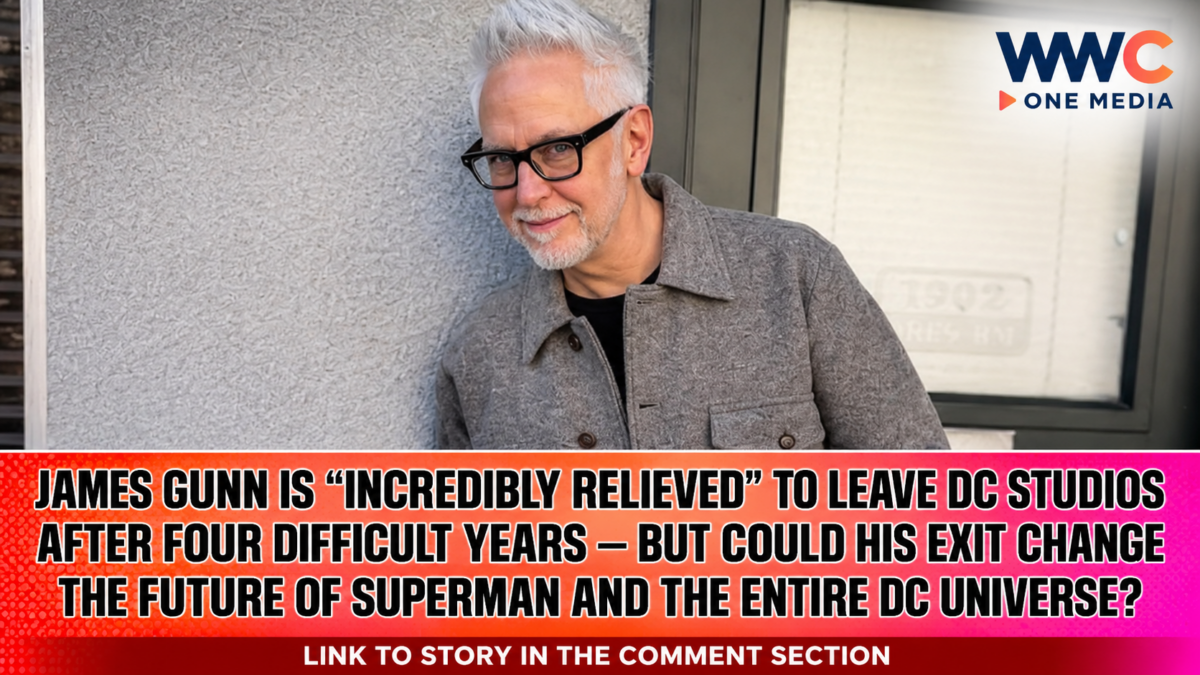
LOS ANGELES — James Gunn is ready to put the corporate responsibilities of DC Studios behind him.
The filmmaker behind Guardians of the Galaxy and the latest Superman reboot has admitted that his four years as co-chief of DC Studios were considerably more difficult than many fans realized. Following the announcement that he and longtime producing partner Peter Safran will step down from their leadership positions, Gunn says he is “incredibly relieved” to return to filmmaking.
The leadership change, announced by Skydance Motion Picture Group on November 9, 2026, marks another major turning point for DC’s film and television operations. Marvel veteran Jeremy Latcham has been appointed the studio’s new president and chief creative officer, with the transition taking effect on December 1.
But Gunn is not simply walking away from the superhero business.
He and Safran are expected to continue working on projects already in development, including Man of Tomorrow, the next chapter of Gunn’s Superman story. Gunn also revealed that he has been involved in another DC project that he is writing, although he has not disclosed its details.
The departure raises a bigger question for fans: Is DC preparing for another creative reset, or will the studio preserve the direction Gunn and Safran spent four years building?
JAMES GUNN ADMITS DC STUDIOS JOB WAS “TRYING” — AND SAYS HE IS READY TO MOVE ON
Gunn addressed his departure in a lengthy social media statement following the announcement.
While expressing gratitude to the people he worked with, the filmmaker acknowledged that running DC Studios demanded more than directing movies and developing stories.
He described the corporate nature of the position as difficult and explained that balancing projects he was passionate about with executive responsibilities had become increasingly challenging.
Gunn also said the workload had taken away time he previously used to rest and spend with his loved ones.
His comments offered a rare glimpse into the pressure of managing a major entertainment studio while continuing to work as a filmmaker.
He specifically praised Safran, describing him as an exceptionally capable partner who handled much of the corporate side of their responsibilities.
Despite the difficulties, Gunn emphasized that he was glad he accepted the position.
He recalled growing up in Manchester, Missouri, creating his own comic books featuring DC characters. Having the opportunity to work directly with those characters, he said, had been a dream come true.
His statement was therefore not simply an expression of frustration. It was also a farewell to a major chapter of his professional career.
Variety, TheWrap and The Independent independently reported his comments, including his criticism of the corporate workload and his enthusiasm about returning to filmmaking.
WHY JAMES GUNN AND PETER SAFRAN ARE LEAVING DC STUDIOS
Gunn and Safran took charge of DC Studios in 2022, when Warner Bros. Discovery sought to establish a more unified creative direction for its superhero properties.
Their appointment followed years of changes involving DC’s cinematic universe, with different filmmakers, competing creative plans and uncertainty about how individual productions would fit together.
The pair were tasked with developing a coordinated slate covering theatrical movies, television and animation.
Gunn brought experience as a filmmaker, having directed projects such as The Suicide Squad and Marvel’s Guardians of the Galaxy films. Safran brought extensive experience as a producer, with credits across superhero and horror productions.
Under their leadership, DC introduced a new slate that included Superman, Supergirl, Clayface, Peacemaker, Creature Commandos and Lanterns.
However, their departure comes at a particularly sensitive time.
Skydance has recently completed its acquisition of Warner Bros. Discovery, placing DC Studios under a new corporate structure. The company is now making major decisions about its leadership and the future of its entertainment operations.
Skydance praised Gunn and Safran for rebuilding the studio’s creative foundation and said it looked forward to working with Latcham to develop the next generation of DC storytelling.
Importantly, the company has not publicly identified a specific financial dispute or personal disagreement as the reason for their departure.
The official announcement describes the move as a transition out of leadership roles, with both men returning to full-time creative work.
WHO IS JEREMY LATCHAM? THE MARVEL VETERAN NOW TAKING OVER DC
<PRIVATE_PERSON> Jeremy Latcham is not a newcomer to superhero filmmaking.
He joined Marvel Studios in 2004 and became part of the team that helped develop the Marvel Cinematic Universe during its formative years.
His credits include major productions such as:
- Iron Man
- Iron Man 2
- The Avengers
- Guardians of the Galaxy
- Avengers: Age of Ultron
- Spider-Man: Homecoming
Latcham worked closely with Marvel president Kevin Feige and later established his own production company after leaving Marvel in 2017.
His other producing credits include Bad Times at the El Royale and Dungeons & Dragons: Honor Among Thieves.
Beginning December 1, Latcham will oversee DC Studios’ creative development, production, talent and strategy across film, television and animation.
He will report to Dana Goldberg and Josh Greenstein, co-chairs of Skydance Motion Picture Group.
The appointment is significant because Latcham has experience working on both individual superhero productions and a larger interconnected franchise.
However, his Marvel background does not guarantee that DC will automatically reproduce Marvel’s success.
DC has its own characters, storytelling traditions and audience expectations. The challenge will be to build a sustainable creative identity without simply copying its biggest competitor.
WWC ONE MEDIA has also examined Latcham’s appointment and the possibility of another major creative transition in its report, Marvel Helped Build Jeremy Latcham’s Career, but Can He Save DC From Another Superhero Universe Reset?.
SUPERMAN WAS A MAJOR SUCCESS — BUT DC’S RESULTS WERE MIXED
One of the defining achievements of the Gunn-Safran era was the 2025 release of Superman, starring David Corenswet as Clark Kent.
The film generated approximately US$618.7 million worldwide, according to figures reported by the Associated Press.
It introduced a new cinematic interpretation of Superman and helped establish the direction of the DC universe under Gunn and Safran.
The movie combined traditional superhero action with humor, emotional storytelling and a wider collection of DC characters.
Its box-office performance provided a significant boost to the studio’s rebuilding efforts.
But one successful film did not guarantee that every subsequent release would attract the same audience.
Supergirl, released in 2026, generated approximately US$126.5 million worldwide, according to industry reporting. The result was a major commercial disappointment relative to its reported production budget.
Meanwhile, Clayface offered a different approach, leaning toward body horror rather than a conventional superhero blockbuster. The Associated Press reported that the film had generated approximately US$109 million worldwide by November 9.
These results illustrate the commercial uncertainty facing DC.
A recognizable character, an established franchise and a large production budget do not automatically translate into a box-office hit.
The studio must balance creative ambition with production costs, marketing expenses and audience demand.
WHAT HAPPENS TO SUPERMAN: MAN OF TOMORROW?
One of the biggest questions following Gunn’s departure concerns Man of Tomorrow.
The upcoming film is scheduled to arrive in theaters on July 9, 2027.
Gunn is writing and directing the project, with Gunn and Safran serving as producers. The film is currently in post-production and will continue the story of Clark Kent and Lex Luthor.
This is important for fans because Gunn’s departure from the executive position does not mean he is abandoning the Superman storyline.
The project is already well advanced, and Skydance has identified it as part of the upcoming DC slate.
Gunn also said that he and Safran are not immediately finished with DC or superhero storytelling.
He revealed that they have been involved in another DC project that he is writing, although he did not provide further details.
For now, the future of the Superman storyline appears to remain intact.
The bigger uncertainty concerns what happens after the existing productions are completed and Latcham begins making longer-term creative decisions.
THE BATMAN PART II AND DC’S OTHER PROJECTS WILL ALSO CARRY THEIR INFLUENCE
Another major production moving forward is The Batman Part II, starring Robert Pattinson.
Gunn and Safran are attached as producers, with the film progressing under its existing production arrangements.
The Batman franchise also presents a different creative challenge because Pattinson’s version of the character operates separately from the central DC Universe established by Gunn.
That distinction allows DC to explore different interpretations of its characters without forcing every production into a single interconnected storyline.
Other projects include The People v. Gorilla Grodd, an eight-episode HBO Max series expected in 2027. Skydance said filming has been completed, with Gunn and Safran serving as executive producers.
Their previous leadership also oversaw productions such as Peacemaker, Creature Commandos and Lanterns.
The studio’s challenge will be maintaining consistency across these different formats while allowing individual productions to retain their own creative identities.
WHY THE DC LEADERSHIP CHANGE MATTERS TO HOLLYWOOD
Gunn and Safran’s departure is taking place during a much larger transformation of the entertainment industry.
Skydance completed its acquisition of Warner Bros. Discovery in October 2026, bringing major entertainment properties under a new corporate structure that includes Warner Bros., Paramount Pictures, HBO and Paramount+.
The combination has created a major entertainment group with extensive film, television, streaming and media operations.
But integrating two large businesses also brings financial and organizational challenges.
Skydance has outlined a plan targeting at least US$6 billion in annual recurring cost savings over three years. The strategy includes consolidating corporate operations, technology systems, marketing activities and outside suppliers.
The company’s restructuring plans do not prove that cost-cutting directly caused Gunn and Safran’s departure. No official announcement has established that connection.
Nevertheless, the wider corporate changes provide important context for understanding why DC Studios is entering a new management era.
WWC ONE MEDIA previously examined the financial implications in Skydance Targets $6 Billion in Annual Cost Cuts After Warner Bros. Takeover as AI and Layoffs Loom — But Can Hollywood Survive the Shake-Up?.
The merger itself followed a major legal and regulatory process. In an earlier report, WWC ONE MEDIA covered the court decision that cleared the way for the transaction: Paramount-Warner Merger Cleared by Judge, Deal Set to Close Next Week.
The timing matters because DC Studios is no longer operating under precisely the same corporate environment in which Gunn and Safran began their leadership.
CAN A MARVEL EXECUTIVE FINALLY GIVE DC A STABLE CREATIVE DIRECTION?
Latcham’s appointment creates an unusual situation for Hollywood: a former Marvel executive is now responsible for one of Marvel’s biggest competitors.
His experience includes some of the films that helped establish the modern superhero blockbuster.
Marvel demonstrated how individual characters could be developed through separate movies before eventually converging into major crossover events such as The Avengers.
DC has attempted interconnected storytelling before, but its cinematic history has involved several changes in leadership and creative direction.
Latcham will have to decide how much of Gunn and Safran’s existing plan should remain intact and where the studio needs to make adjustments.
There are several major challenges ahead:
- Franchise consistency: DC must give audiences a clearer sense of how its films and television productions fit together.
- Financial discipline: The studio must manage production and marketing costs without sacrificing quality.
- Audience confidence: Fans need a reason to believe that upcoming projects will deliver a coherent long-term direction.
- Creative flexibility: Different characters may benefit from different genres and filmmaking approaches rather than a single formula.
The new executive will also need to work with filmmakers, actors, producers and the existing DC Studios team.
His Marvel experience could be an advantage, but it will be his decisions at DC that ultimately determine whether the appointment succeeds.
WHAT GUNN’S EXIT MEANS FOR DC FANS
For audiences, the immediate impact may be limited because several major productions are already moving forward.
Man of Tomorrow remains scheduled for July 2027, while The Batman Part II and other television projects are also progressing.
However, the future of projects that have not yet entered production could be more uncertain.
Latcham will have to evaluate the existing slate, determine which projects deserve continued investment and decide how DC’s characters should be developed over the coming years.
Fans will also be watching whether Gunn continues to have significant creative influence despite leaving the executive position.
His continued involvement in Man of Tomorrow and another project he is writing suggests that his relationship with DC is not necessarily over.
But the final direction of the studio will increasingly depend on the new leadership.
THE BIGGER QUESTION: IS DC FINALLY MOVING FORWARD OR PREPARING FOR ANOTHER RESET?
James Gunn and Peter Safran’s departure marks the end of an important chapter for DC Studios.
Their four-year tenure brought a new Superman, expanded television and animation projects, and a more varied approach to comic-book storytelling.
The results were mixed. Superman delivered a major theatrical success, while other releases highlighted the financial risks of increasingly expensive superhero productions.
Now Jeremy Latcham faces the responsibility of guiding DC’s next generation of films and television projects.
His experience at Marvel gives him a strong background in blockbuster production and franchise development. But DC’s future will depend on more than his previous credits.
He must maintain audience confidence, manage production costs and establish a creative direction that makes Superman, Batman and the wider DC Universe commercially sustainable.
For Gunn, the change offers an opportunity to concentrate on the work he says he loves most: making films.
For DC, it is another test of whether the company can maintain a consistent creative vision through a leadership transition.
The biggest question is no longer whether James Gunn will remain DC Studios’ co-chief. That chapter is ending.
The question now is whether Jeremy Latcham can build on what Gunn and Safran created—or whether DC fans are about to witness another major transformation of the superhero universe.