AMSTERDAM, Netherlands — One of the world’s most famous paintings has a hidden population that visitors could never see with the naked eye.
Scientists studying Rembrandt van Rijn’s 1642 masterpiece The Night Watch have identified a surprising range of microorganisms living on its surface, including bacteria commonly associated with human skin, soil and plant roots. One particularly unusual discovery is a bacterial species first identified at a Japanese sugar refinery.
The findings are now being presented to the public through a new exhibition, The Night Watch Lives, a collaboration between Amsterdam’s Rijksmuseum and ARTIS-Micropia, a museum dedicated to the world of microorganisms.
The exhibition opened on November 11, 2026, inviting visitors to look beyond the painting’s famous figures, dramatic lighting and military procession—and explore the microscopic life surrounding one of art history’s most celebrated works.
But the discovery raises a fascinating question: How did a bacterium associated with a Japanese industrial environment end up on a 17th-century Dutch painting?
Researchers have identified the organism, but its journey to the artwork remains a mystery.
A Masterpiece With an Invisible Ecosystem
For centuries, millions of people have admired The Night Watch for its dramatic use of light and shadow, its moving figures and its unusually dynamic portrayal of a civic militia.
Now, scientists are revealing another dimension of the painting: the microorganisms that inhabit its surface.
The research is being conducted by conservators from the Rijksmuseum and microbiologists from ARTIS-Micropia. Over a period of six months, teams collected samples from approximately 60 locations across the painting.
The samples were examined in laboratories, where microorganisms were cultivated into visible colonies. These colonies are now displayed in Petri dishes alongside a life-size reproduction of Rembrandt’s masterpiece.
Rather than presenting the painting only as an artistic achievement, the installation allows visitors to consider it as a surface that has interacted with its surrounding environment and the people who have encountered it.
The exhibition also demonstrates how scientific research can uncover details that traditional art appreciation cannot reveal.
The Japanese Bacterium That Surprised Researchers
Among the discoveries, one microorganism has attracted particular attention: Microbacterium saccharophilum.
According to ARTIS-Micropia and AFP, this bacterial species was first identified in 2013 at a Japanese sugar refinery. Researchers detected it in an area of The Night Watch where the varnish had been removed.
Its presence is intriguing because it raises questions about how microorganisms move through different environments and how they become associated with objects that have existed for centuries.
However, the discovery does not mean the bacterium originated in Japan and then travelled directly to Amsterdam. Its first identification at a Japanese facility does not establish where the individual organism found on the painting came from.
The researchers have not yet determined how it reached the artwork.
For microbiologists, that uncertainty is part of the scientific appeal. A single discovery can lead to many new questions about environmental exposure, microbial movement and the history of the objects people preserve.
Are There Bacteria From Rembrandt’s Own Time?
Perhaps the most fascinating possibility is whether any microorganisms found on the painting could have been present during Rembrandt’s lifetime.
The artist completed The Night Watch in 1642. That means the artwork has existed for nearly four centuries, passing through different environments, conservation treatments and generations of visitors.
Could some of the bacteria have been there since the 17th century?
Researchers say they cannot establish that from the available evidence.
ARTIS-Micropia microbiologist Eline van Bloois explained to AFP that identifying a microorganism does not reveal how long it has been on the painting. A bacterium could have been present for hundreds of years—or could have arrived much more recently.
That distinction is important.
The findings are evidence of microbial presence, not proof of surviving biological traces from Rembrandt himself.
The possibility of finding a direct connection to the artist would be scientifically remarkable, but researchers have not made such a claim.
Not All Microbes Are Dangerous to Art
The word bacteria often creates immediate concern, especially when it involves an irreplaceable painting.
But the discovery does not mean that The Night Watch is being damaged by an outbreak of harmful microorganisms.
Van Bloois told AFP that the microbes identified in the study are not harmful to the painting itself.
The initial findings include microorganisms commonly found on human skin, such as Staphylococcus epidermidis and Micrococcus luteus, as well as bacteria associated with soil and plant roots.
Microorganisms are part of the natural environment. Their presence alone does not mean an object is deteriorating or that a conservation emergency exists.
For museum specialists, the challenge is understanding how these organisms interact with the materials of an artwork and whether any of them could contribute to long-term deterioration.
That is why the collaboration between microbiologists and art conservators is important: it adds another scientific perspective to the work of protecting cultural heritage.
What Is ‘The Night Watch Lives’ Exhibition?
The new installation presents the microorganisms collected from Rembrandt’s painting in a format that visitors can observe.
Instead of showing only laboratory data or microscopic images, the exhibition displays cultivated microbial colonies in Petri dishes beside a life-size reproduction of the artwork.
This approach makes an invisible subject more accessible.
Visitors can see how different microorganisms form colonies and learn that the surfaces of familiar objects—including museum masterpieces—can host complex microscopic communities.
The project also aims to encourage greater curiosity about microbes, which are often associated only with disease and contamination.
The exhibition is now open at ARTIS-Micropia in Amsterdam and is scheduled to remain on display until the end of May 2027. Researchers will continue analysing new samples, with additional findings expected to be incorporated into the installation.
The Discovery Is Part of a Much Bigger Restoration Project
The microbial investigation is connected to Operation Night Watch, the Rijksmuseum’s major research and conservation programme dedicated to preserving Rembrandt’s masterpiece.
Launched in 2019, the project brings together conservators, scientists, art historians and technical specialists to examine the painting using advanced imaging, scientific analysis and other research methods.
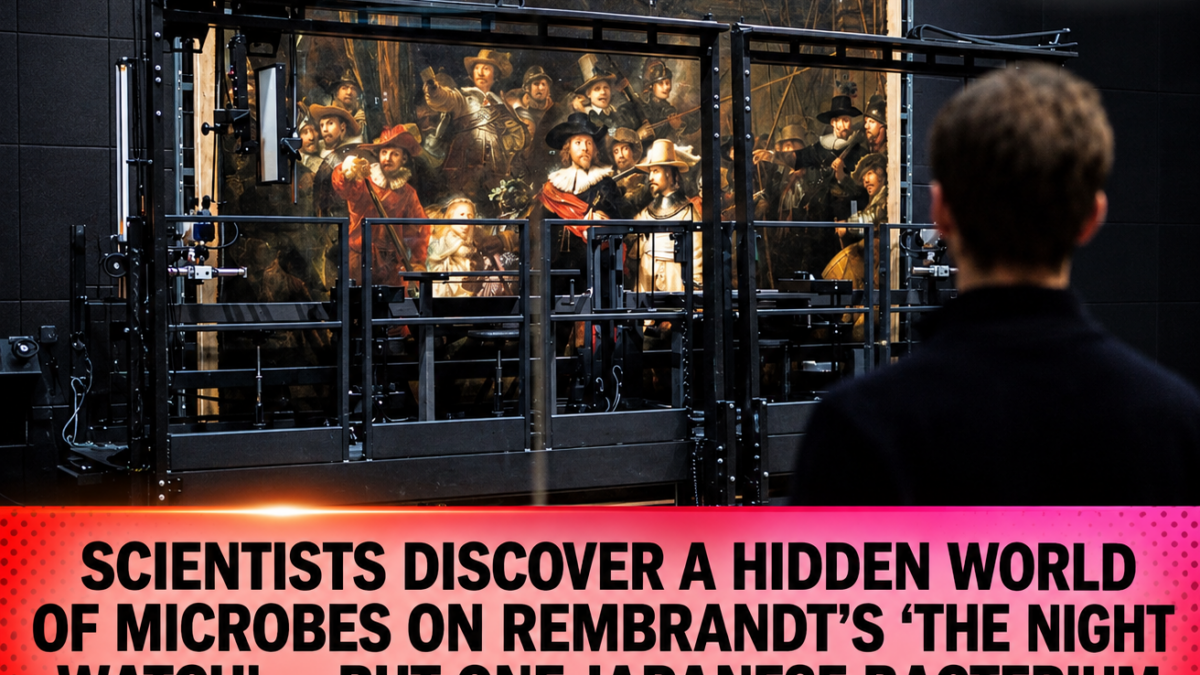
The work is being carried out in a specially designed glass chamber inside the Rijksmuseum, allowing visitors to observe parts of the conservation process.
In November 2024, the museum began a major phase of restoration that involved carefully removing old varnish layers.
Conservators used specially prepared tissue and solvents to soften and absorb varnish applied during earlier restoration work. They then used microscopes and cotton swabs to remove remaining material with extreme precision.
The goal is to preserve the original painting while improving understanding of its condition and the materials used by Rembrandt.
The research has already produced important findings about the artist’s techniques, pigments and the physical condition of the canvas.
The microbial project adds another layer to that investigation by examining the biological material present on the painting’s surface.
Why Rembrandt’s ‘The Night Watch’ Is So Important
Completed in 1642, The Night Watch is one of Rembrandt’s most celebrated works and one of the defining masterpieces of the Dutch Golden Age.
Its official title is The Night Watch Militia Company of District II under the Command of Captain Frans Banninck Cocq. The shorter name became widely used much later.
The painting depicts Captain Frans Banninck Cocq and his lieutenant, Willem van Ruytenburch, leading a group of civic guardsmen into formation.
Unlike conventional group portraits in which subjects simply pose for the artist, Rembrandt gave the figures movement and a sense of action.
The Rijksmuseum identifies it as Rembrandt’s largest and most famous canvas. It measures approximately 379.5 by 453.5 centimetres and is painted in oil on canvas.
Its dramatic composition, use of light and careful arrangement of figures helped establish its place in art history.
The painting has also experienced a difficult physical history. It was attacked with a knife in 1911 and again in 1975, when 12 cuts were made in the canvas. In 1990, a visitor sprayed acid onto it, damaging the varnish.
The artwork survived those incidents through conservation and restoration efforts.
That history helps explain why the Rijksmuseum continues to invest in detailed research: preserving a masterpiece requires understanding not only its artistic significance but also the materials and environmental factors affecting it.
When Art and Science Meet
The discovery of microorganisms on The Night Watch illustrates how modern scientific methods are changing the way museums study and preserve historic artworks.
Traditional art history focuses on the artist, the subject, the historical period and the techniques used to create a painting.
Conservation science adds questions about pigments, varnishes, canvas structure, environmental exposure and the chemical changes that occur over time.
Microbiology now offers another perspective by investigating the organisms that interact with an artwork’s surface.
The collaboration also connects with a broader international interest in how museums present art and cultural heritage to the public.
WWC One Media has covered several major developments in the global art world, including Yayoi Kusama’s major Amsterdam retrospective, which brought together more than 300 works.
In South Korea, Damien Hirst’s planned donation of two artworks to the National Museum of Modern and Contemporary Art highlighted the role of museums in preserving contemporary art for future generations.
The question of cultural ownership and preservation is also central to the debate surrounding Singapore’s interest in acquiring a rare painting by Filipino National Artist Carlos “Botong” Francisco.
And in the Philippines, artist Pope Bacay’s exhibition exploring memory, architecture and everyday objects shows how artworks can reveal meanings that are not immediately visible to their audiences.
Together, these stories demonstrate that art is not simply something to look at. It is also something societies study, protect, interpret and pass on.
What Comes Next for the Hidden World of ‘The Night Watch’?
The researchers behind The Night Watch Lives are not treating the current findings as the final word.
Sampling and analysis will continue, and additional microorganisms may be identified as the project develops.
For now, the discovery of skin bacteria, soil-associated organisms and the unusual Microbacterium saccharophilum offers a new way to understand the environment surrounding one of the world’s most famous paintings.
It also reminds visitors that even objects that appear motionless and unchanged are part of a living world.
Rembrandt’s masterpiece has survived wars, attacks, restoration treatments and centuries of public admiration. Now, scientists are examining another part of its history—one that exists on a scale invisible to the human eye.