
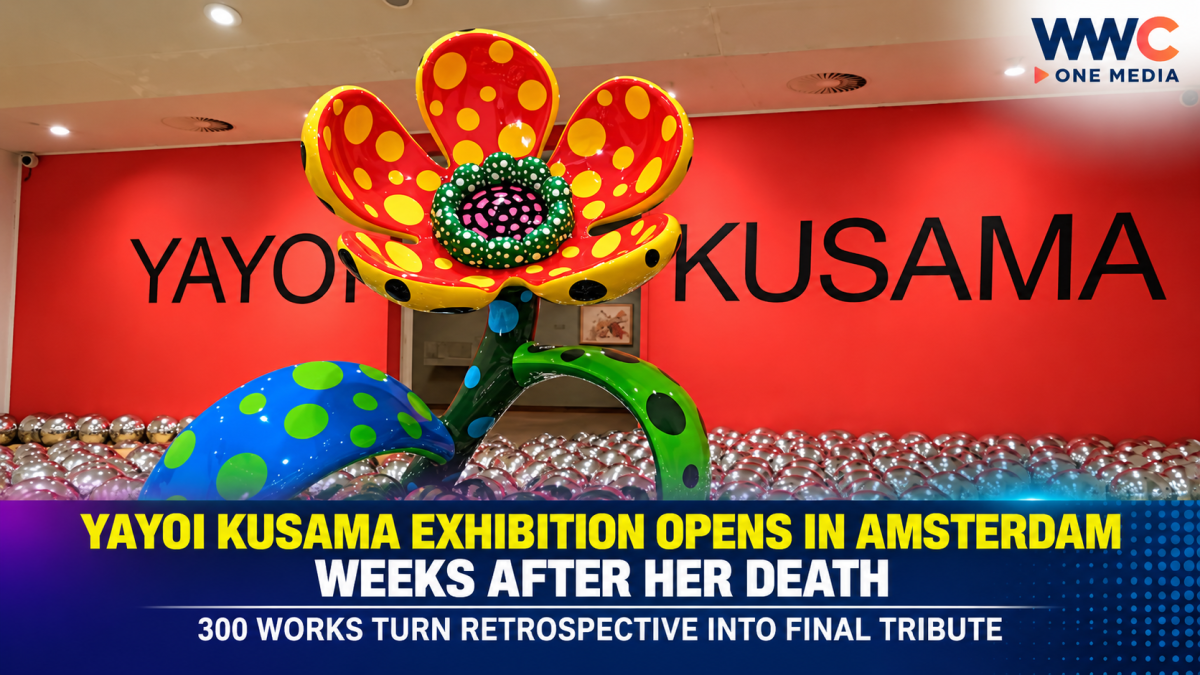
AMSTERDAM — A major Yayoi Kusama retrospective has opened at Amsterdam’s Stedelijk Museum just weeks after the death of the Japanese art icon, transforming what was planned as a celebration of her extraordinary career into an emotional posthumous tribute.
Kusama, one of the world’s most recognisable contemporary artists, died on Aug. 14, 2026, at the age of 97. Her death came less than a month before the Stedelijk exhibition opened on Sept. 11.
The exhibition brings together more than 300 works spanning more than seven decades of Kusama’s career, from paintings, drawings and sculptures to installations, ceramics, fashion-related works and documentation of her performances. Around 50 works had never previously been exhibited, according to reporting surrounding the show.
What makes the timing especially poignant is that the exhibition was not originally conceived as a memorial. It had been planned as a landmark retrospective of Kusama’s career before her death. After she died, however, the exhibition inevitably took on a different meaning.
“It was supposed to be a celebration,” curator Leontine Coelewij said, describing how the circumstances have transformed the presentation into something closer to a farewell to the artist.
A new Infinity Mirror Room takes centre stage
Among the exhibition’s highlights is a newly created immersive installation titled “Infinity Mirrored Room — The Hope of the Polka Dots Buried in Infinity Will Eternally Cover the Universe.”
The work surrounds visitors with mirrors, reflective surfaces and Kusama’s instantly recognisable repetitive forms, creating the illusion of an endless environment.
Another striking feature is the presence of her famous pumpkin imagery and polka-dot works — visual signatures that helped make Kusama one of the most widely recognised contemporary artists in the world.
The Stedelijk has described the exhibition as a landmark presentation covering more than 70 years of Kusama’s artistic development, allowing visitors to see how her ideas evolved across different periods and media.
From avant-garde outsider to global icon
Kusama’s career stretched from the experimental art scene of postwar Japan and New York to the global contemporary-art world.
She became known for her obsessive use of dots, repetition, mirrors and infinity, developing visual environments that could feel simultaneously playful, overwhelming and psychologically intense.
Her artistic vocabulary was deeply connected to her personal experiences. Kusama had spoken openly about experiencing hallucinations from childhood and using art as a way of confronting those visions.
After moving to New York in 1957, she became involved in the city’s avant-garde scene and created experimental paintings, sculptures, happenings and installations. She returned to Japan in 1973 and later lived voluntarily in a psychiatric hospital in Tokyo while continuing to work from a nearby studio.
Her work eventually reached an enormous international audience, with major museum exhibitions and collaborations extending her influence well beyond the traditional art world.
She also became a cultural phenomenon through fashion collaborations, including her highly visible partnership with Louis Vuitton, helping introduce her distinctive dots and mirrored worlds to a new generation.
Kusama had a special connection with the Netherlands
The Amsterdam exhibition also carries particular significance because Kusama had an important relationship with the Netherlands and its experimental art scene.
Her work intersected with the European avant-garde and the ZERO movement, and her connections to Dutch artists and the country’s counterculture formed an important part of her early international career.
The Stedelijk itself has a long history with Kusama. The museum has previously presented her work, making Amsterdam a particularly fitting location for a retrospective covering her artistic journey.
Dutch media have described the new presentation as the museum’s biggest Kusama exhibition yet, with the institution’s modern extension filled with her work and elements of her signature visual language extending beyond the conventional gallery setting.
A farewell that Kusama never got to see
Perhaps the most striking element of the exhibition is that Kusama herself will not be there to see it.
The retrospective was developed while she was still alive, making its opening only weeks after her death an unexpectedly powerful moment for the museum, her collaborators and audiences who have followed her career.
Instead of simply presenting the past, the exhibition now functions as a reminder of the enormous artistic legacy Kusama leaves behind — one built around repetition, infinity and the idea that art could transform deeply personal experiences into something shared by millions.
The Stedelijk Museum’s retrospective runs from Sept. 11, 2026, through Jan. 17, 2027.
For an artist whose work was so often about infinity, the timing is striking: Kusama’s final major Amsterdam retrospective has become a celebration of a career that may have ended, but whose influence shows no sign of disappearing.




Leave a Reply