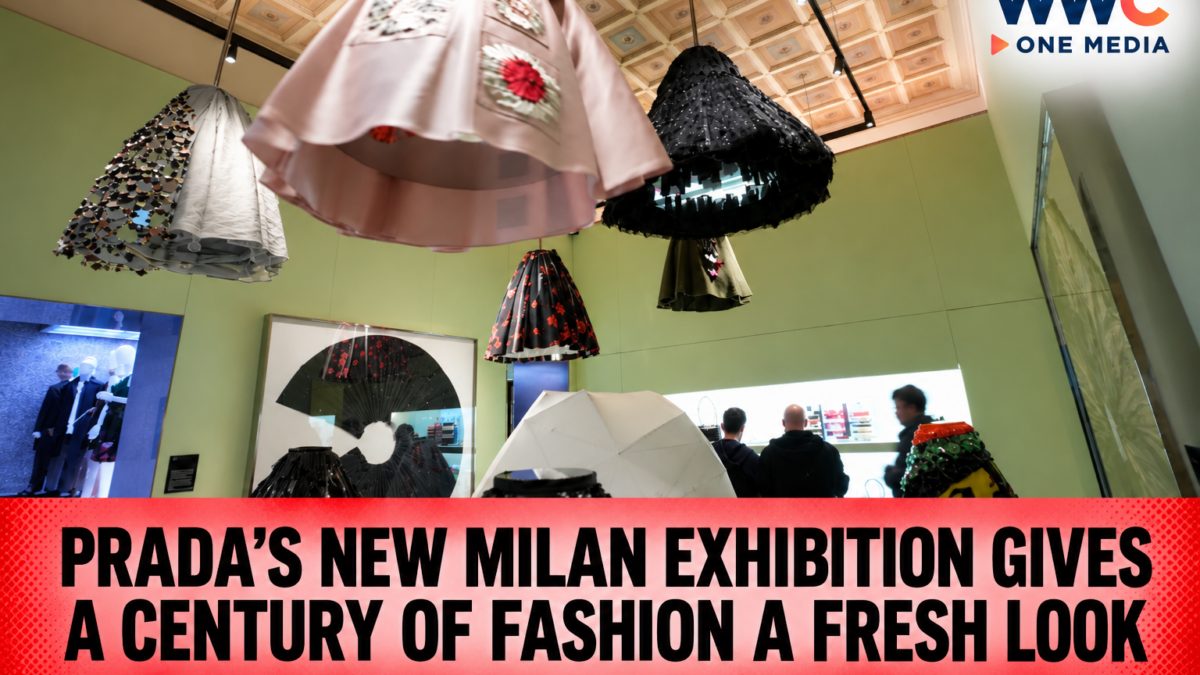
Prada Opens a Stunning Milan Fashion Exhibition Featuring 113 Years of Fashion History — But Its Moon-Bound Spacesuit Steals the Spotlight
MILAN, Italy, November 11, 2026 — Prada is turning more than a century of fashion history into one of Milan’s most ambitious luxury retail experiences, bringing together historic designs, iconic runway creations, artistic collaborations and even a prototype spacesuit developed for a future NASA moon mission.
The Italian luxury fashion house has opened Pradasphere, a permanent, appointment-only exhibition inside its expanded Prada Galleria complex at the historic Galleria Vittorio Emanuele II in Milan.
The exhibition traces the evolution of Prada from its founding in 1913 to its modern position as one of the world’s most influential luxury brands.
But this is not simply a collection of expensive handbags and archived clothing.
Visitors move through eight exhibition spaces featuring the company’s early designs, Miuccia Prada’s influential nylon creations, memorable runway pieces and connections to architecture, cinema, art and sport.
The experience concludes with something few visitors would expect from a traditional fashion exhibition: a prototype spacesuit developed by Prada in collaboration with Axiom Space for NASA’s planned Artemis IV moon mission.
The ambitious project also carries a major commercial objective.
Prada executives estimate that Pradasphere could generate approximately €100 million in additional annual revenue, with the possibility of exceeding that target.
According to the Associated Press, reservations are already fully booked into the new year, suggesting that the exhibition is attracting substantial interest even before its long-term commercial impact can be measured.
The development raises an interesting question for the luxury industry: Can a fashion house turn its own history into a powerful new business while convincing a younger generation that its greatest designs still belong to the future?
Prada Pradasphere Opens in Milan With Eight Exhibition Spaces
Pradasphere occupies a central position inside the expanded Prada Galleria, connecting more than a century of company history with the brand’s contemporary retail strategy.
Located within Milan’s famous Galleria Vittorio Emanuele II shopping arcade, the exhibition provides a carefully curated journey through Prada’s creative development.
The eight spaces feature different chapters of the fashion house’s history.
Visitors encounter early creations associated with the company’s founders, Mario and Martino Prada, alongside designs that helped establish the modern Prada identity.
The displays also highlight the creative direction of Miuccia Prada, whose approach to fashion transformed the company into a major international luxury label.
Rather than presenting the exhibition as a conventional chronological museum, Prada combines fashion with its wider cultural interests.
Art, architecture, cinema and sport are presented as important influences in the company’s development.
According to Prada Group’s September announcement, the broader Galleria project was designed to connect these different interests within a single destination.
The exhibition is permanent but designed to evolve, allowing the company to introduce new discoveries and interpretations of its history over time.
Access is appointment-only, with approximately 20 visitors admitted each hour.
That limited capacity helps create a more personal experience while maintaining an exclusive atmosphere consistent with the brand’s luxury positioning.
From a Small Milan Business to a Global Luxury Fashion Empire
Prada’s story began in 1913 when brothers Mario and Martino Prada established Fratelli Prada in Milan.
The original business specialized in luxury leather goods, luggage and accessories, eventually becoming associated with sophisticated craftsmanship and high-end Italian design.
Its early history is closely connected to the Galleria Vittorio Emanuele II, the same historic shopping arcade that now houses the Pradasphere exhibition.
One interesting detail highlighted by the exhibition is that the founders also designed the company’s recognizable inverted-triangle logo.
However, the Prada identity familiar to modern fashion consumers developed significantly under the leadership of Miuccia Prada.
Her involvement brought a different approach to the family business, combining traditional luxury craftsmanship with unconventional materials, experimental silhouettes and unexpected cultural references.
The introduction of nylon handbags became particularly important.
Instead of relying exclusively on traditional luxury materials, Prada transformed an industrial synthetic fabric into a recognizable luxury fashion statement.
That contrast between practicality and sophistication became one of the defining characteristics of the brand.
The Pradasphere exhibition allows visitors to see how these ideas developed rather than simply presenting the finished products as expensive fashion collectibles.
Miuccia Prada’s First Runway Collection and the Rise of Nylon
One of the exhibition’s most important sections focuses on Miuccia Prada’s early influence on the company.
Her first ready-to-wear runway collection was presented in 1988, marking an important transition in Prada’s development.
The exhibition includes a chocolate-brown opera coat from that collection, helping illustrate the beginning of the designer’s influence on modern luxury fashion.
It also highlights the nylon bags that became central to Prada’s design identity.
These creations challenged traditional expectations about what luxury handbags should look and feel like.
Their appeal came partly from the contrast between the material’s industrial origins and the sophistication associated with the Prada name.
The exhibition also revisits some of the fashion house’s most recognizable runway experiments.
Among them are the Flame heels from 2012 and the distinctive Formica-inspired prints that contributed to Prada’s reputation for unconventional, sometimes deliberately challenging design.
These pieces demonstrate how Prada repeatedly used fashion to question established ideas about beauty, elegance and luxury.
For longtime customers, the exhibition offers an opportunity to revisit important collections.
For younger visitors, it provides a deeper explanation of why Prada’s creative identity has remained influential across generations.
The Prada Spacesuit: How Fashion Meets NASA’s Moon Exploration Plans
Perhaps the most surprising attraction inside Pradasphere is the prototype spacesuit developed through Prada’s collaboration with Axiom Space.
The partnership connects luxury fashion with advanced engineering and the future of human space exploration.
Prada contributed to the spacesuit’s outer layer, which is designed to withstand the extreme thermal conditions associated with the lunar environment.
The company also worked on aspects of the high-performance inner layer, with attention to thermal regulation and astronaut comfort.
The design draws on technical expertise developed through Prada’s involvement in competitive sailing, particularly its Luna Rossa America’s Cup program.
That connection is important.
Competitive sailing requires materials and engineering capable of performing under demanding environmental conditions.
Experience gained through lightweight materials, protective fabrics and technical design can offer useful knowledge beyond the fashion industry.
The collaboration with Axiom Space demonstrates how that expertise can be applied to a completely different environment.
The prototype displayed in Milan is intended for NASA’s Artemis IV mission, which is targeted for 2028.
The mission is part of NASA’s broader Artemis program to expand human exploration of the Moon.
However, the exhibition piece should not be confused with a complete guarantee of the final operational suit configuration or mission schedule.
Its presence nevertheless offers a striking example of how a luxury fashion company can participate in technological development beyond conventional clothing and accessories.
For Prada, the spacesuit is more than an unusual exhibition object.
It reinforces the brand’s long-standing message that experimentation and curiosity are central to its identity.
Prada’s €100 Million Revenue Ambition: Why the Exhibition Is Also a Business Strategy
Behind the artistic presentation is a significant commercial ambition.
Prada expects Pradasphere to contribute approximately €100 million in annual revenue to the wider Galleria project.
According to AP reporting, Prada Group Chief Group Marketing Officer Lorenzo Bertelli believes that the target could potentially be exceeded.
The business strategy is based on a simple idea: customers who understand a luxury brand’s history may develop a stronger connection to its products.
Bertelli told the Associated Press that visitors who experience the exhibition often browse the boutiques with a different perspective.
Some customers reportedly return to make additional purchases after completing the exhibition.
This approach creates a commercial opportunity beyond traditional retail advertising.
Rather than simply encouraging visitors to purchase a handbag or clothing item, Prada gives them an immersive experience designed to strengthen their understanding of the company’s creative identity.
The strategy also allows the company to attract visitors who may initially be interested in architecture, art, design or fashion history rather than shopping.
Once inside the complex, those visitors become potential customers.
The exhibition’s fully booked appointments into the new year provide an encouraging early indicator of demand.
However, the €100 million figure remains a company projection, not an independently verified annual revenue result.
Whether the project reaches or exceeds that target will depend on visitor numbers, purchasing behavior and the long-term performance of the expanded retail complex.
Prada Galleria Is Becoming More Than a Luxury Shopping Destination
Pradasphere is only one component of Prada’s broader expansion inside the Galleria Vittorio Emanuele II.
The company’s presence now spans eight floors, combining several different activities under one roof.
These include:
1. Prada Donna and Prada Uomo boutiques
The expanded womenswear and menswear stores provide the traditional luxury shopping experience while connecting visitors to the brand’s historic Milan location.
2. Marchesi 1824
The historic pastry business adds a hospitality component to the complex, offering visitors another reason to spend time inside the property.
3. Osservatorio Fondazione Prada
The contemporary art space reinforces the company’s relationship with artistic experimentation and cultural programming.
4. Private shopping facilities
An invitation-only salon provides a more personalized environment for selected customers.
5. Private hospitality and accommodation
An apartment and additional hospitality facilities allow Prada to host private dinners and special events.
6. The underground passage
A newly developed subterranean connection between the menswear and womenswear boutiques provides another exhibition area featuring lesser-known elements of Prada’s history.
The passage includes silver-plated handbags reworked by British artist Damien Hirst and a chandelier dress created for Baz Luhrmann’s film adaptation of The Great Gatsby.
This combination of retail, hospitality, art and fashion history reflects a wider shift in luxury retail.
Major fashion houses are increasingly interested in creating destinations where customers spend time rather than simply visiting a store to purchase a particular product.
Why Prada’s Strategy Matters for the Global Luxury Fashion Industry
Prada’s Milan expansion arrives at a time when luxury brands are competing for more than consumer spending.
They are also competing for attention, cultural relevance and long-term customer loyalty.
Traditional retail models depend heavily on product launches, fashion campaigns, celebrity endorsements and physical store locations.
However, immersive experiences provide another way to build relationships with consumers.
Pradasphere demonstrates how a brand can use its archives as a commercial and cultural asset.
Its history becomes part of the customer experience, while the exhibition provides an additional reason to visit the flagship location.
The approach also highlights the importance of storytelling in luxury marketing.
A handbag becomes more than a product when customers understand the design decisions and creative history behind it.
A runway collection becomes more meaningful when visitors can examine its cultural influences and artistic references.
And a spacesuit developed for a future lunar mission creates a memorable connection between a traditional fashion house and advanced engineering.
Other fashion brands are also navigating similar questions about identity, heritage and retail expansion.
For additional coverage of the changing luxury fashion landscape, WWC One Media has examined several important industry developments, including the latest creative leadership changes at major European fashion houses.
What Pradasphere Could Mean for Prada’s Future
Prada’s new exhibition is an ambitious attempt to connect its past with its commercial future.
The company is using more than a century of fashion history to attract visitors, strengthen its luxury identity and encourage customers to spend more time inside its Milan flagship complex.
Its strategy combines several important elements:
- Historical preservation through the display of early designs and iconic collections.
- Cultural engagement through connections with art, architecture, film and sport.
- Technological experimentation through the Axiom Space collaboration.
- Luxury retail expansion through additional shopping and hospitality facilities.
- Commercial growth through an immersive customer experience.
The biggest challenge will be maintaining visitor interest after the initial excitement surrounding the opening.
Because Pradasphere is designed to evolve, Prada has an opportunity to keep the exhibition relevant through changing displays and new interpretations of its archives.
Its long-term success will also depend on whether the broader Galleria complex can convert cultural interest into sustainable commercial performance.
The Bottom Line: Prada Is Selling More Than Fashion — It Is Selling Its History
Pradasphere represents a different approach to luxury retail.
Instead of relying solely on new collections and exclusive products, Prada is turning its history into an attraction that connects fashion, culture, technology and commerce.
From the company’s founding in 1913 to Miuccia Prada’s influential runway designs and the spacesuit prototype developed for NASA’s Artemis program, the exhibition tells a story that stretches far beyond conventional fashion.
Its €100 million annual revenue ambition also reveals the commercial importance of the project.
The company is betting that visitors who understand its heritage will become more connected to its products and more willing to spend within its expanded Milan destination.
Early demand is encouraging, with appointments reportedly booked into the new year.
But the real test will come later.