LONDON, UNITED KINGDOM — November 11, 2026 | WWC ONE MEDIA | Global Business, UK Retail, Corporate Restructuring and Employment
One of Britain’s best-known discount retailers is fighting for survival as its American owner faces mounting political pressure, employee protests and accusations that its financial decisions could push the struggling chain toward collapse despite signs of an operating turnaround.
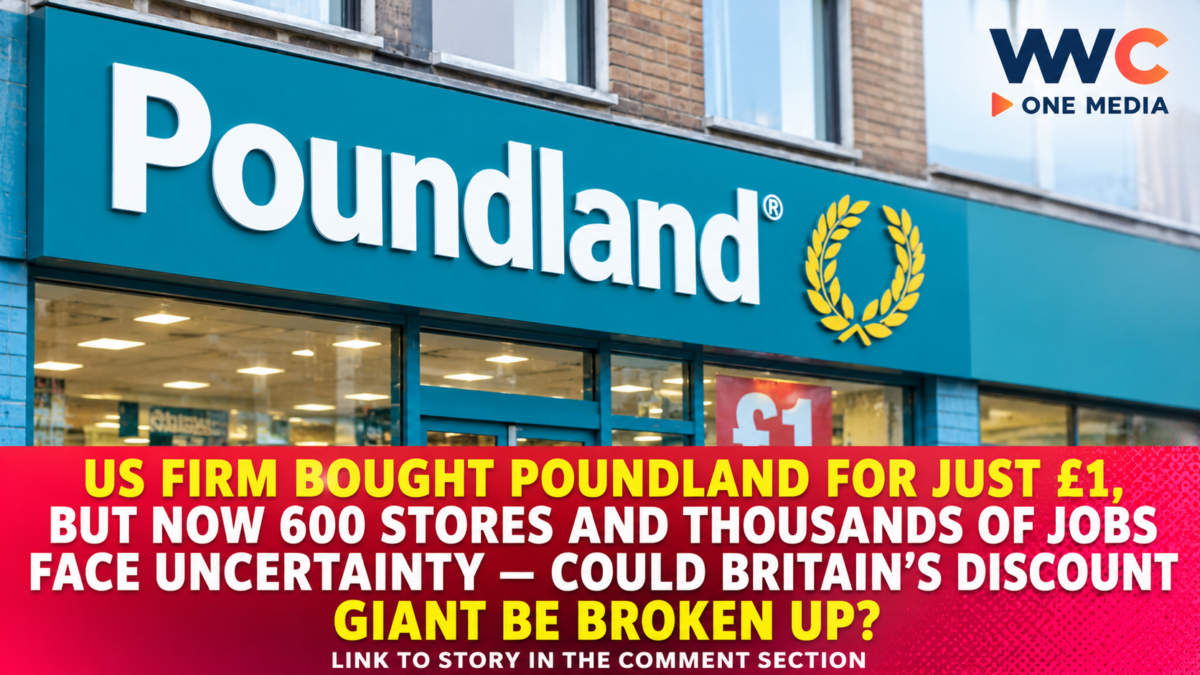
Poundland, acquired by US restructuring specialist Gordon Brothers for a nominal £1 in June 2025, is now racing to secure a rescue agreement that could determine the future of more than 600 stores and thousands of retail workers.
The crisis has become increasingly contentious after reports that Gordon Brothers restricted the retailer’s access to funding needed to replenish store shelves and pay suppliers.
Poundland filed a notice of intention to appoint administrators on October 29, giving the company temporary protection from creditor action while negotiations continue.
But a new development has created hope.
On November 10, Sky News reported that Gordon Brothers agreed to release approximately £10 million held within Poundland’s financial arrangements to help pay suppliers.
The decision came shortly before the firm’s European executive was scheduled to face questioning from British lawmakers.
The retailer’s management argues that Poundland has made significant progress restoring operating profitability.
Gordon Brothers maintains that the business remains financially vulnerable and requires a sustainable rescue solution.
As the battle between Poundland’s owner, management, workers and potential buyers intensifies, will Britain’s discount giant survive under new ownership—or could hundreds of shops disappear from high streets across the country?
Poundland Faces a Financial Crisis Just 17 Months After Its £1 Rescue
Gordon Brothers acquired Poundland from European retail group Pepco in June 2025.
The sale involved a nominal purchase price of approximately £1, reflecting the company’s difficult financial position and substantial restructuring requirements.
But that headline price did not represent the full economic cost of the acquisition.
The transaction was accompanied by financial arrangements, liabilities and commitments intended to support the troubled business.
Gordon Brothers subsequently implemented a restructuring program involving store closures and operational changes.
The goal was to reduce costs and restore profitability.
However, by September 2026, the American investment firm had begun seeking potential buyers.
A month later, the situation became increasingly urgent.
On October 29, Poundland filed a notice of intention to appoint administrators.
That filing provided a temporary period of protection while the company attempted to secure a rescue.
Poundland had not been confirmed as having completed entry into administration at the time of the reporting reviewed for November 11.
The distinction is important because a company seeking protection while negotiating a sale may still avoid a formal insolvency appointment.
Why Gordon Brothers Is Facing a Growing Backlash
The controversy centers on whether Poundland’s financial difficulties justify a break-up of the business or whether a rescue preserving the entire chain remains possible.
Poundland’s managing director, Barry Williams, has argued that the retailer’s performance improved substantially during the past financial year.
In a communication to staff reported by ITV News, Williams said the business had moved from an EBITDA loss of £68.1 million in the year to September 2025 to an EBITDA profit of £18.1 million in the year to September 2026.
That represents an improvement of approximately £86.2 million.
EBITDA measures earnings before interest, tax, depreciation and amortization.
It is a useful indicator of certain operating trends.
But positive EBITDA does not necessarily mean a company has sufficient cash to meet all its obligations.
Debt repayments, interest expenses, lease costs, working-capital requirements and restructuring expenses can still create financial pressure.
Gordon Brothers argues that Poundland remains vulnerable despite its operating improvements.
Management and critics of the owner contend that the turnaround demonstrates the business deserves more time and financial support.
The disagreement has become central to the debate over whether the company should be sold as a whole or broken into smaller parts.
Poundland Reportedly Blocked From Restocking Its Shelves
One of the most serious concerns involves access to working capital.
ITV News reported that Poundland had been unable to pay suppliers for new stock since October 27 because Gordon Brothers restricted access to certain funding and cash arrangements.
The BBC subsequently reported that approximately £50 million had been restricted, although figures cited by different outlets reflected different dates and scopes of funding.
The reported restrictions created an immediate operational problem.
A discount retailer depends on continuously replenishing merchandise.
If suppliers cannot be paid, deliveries may be delayed or suspended.
Stores may then sell through their existing inventory without being able to replace popular products.
That becomes especially dangerous ahead of Christmas, one of the retail industry’s busiest trading periods.
Reduced stock availability can cause customers to shop elsewhere.
Lower sales can then weaken the company’s financial position further.
However, the precise legal and contractual reasons for the restrictions remain disputed.
Sky News reported that Gordon Brothers had raised concerns involving the terms of an asset-based lending facility.
The reported restrictions should therefore not be presented as an established finding of deliberate wrongdoing.
£10 Million Funding Release Offers a Potential Lifeline
On November 10, the crisis took another turn.
Sky News reported that Gordon Brothers had agreed to release approximately £10 million in funding to facilitate payments to Poundland suppliers.
City AM independently reported the development.
The money was described as the beginning of a possible series of funding releases.
For Poundland’s management, the immediate priority is restoring the normal flow of merchandise into stores.
The funding could allow the retailer to pay suppliers and begin rebuilding inventories.
It could also create additional time for prospective buyers to negotiate.
However, the £10 million release does not establish that Poundland has been permanently rescued.
The company still needs a viable financial structure and an agreement capable of supporting ongoing operations.
Suppliers may also require reassurance about payment arrangements before restoring normal deliveries.
As a result, the practical effect of the funding will depend on how quickly it becomes available and whether it supports a sustainable transaction.
British Lawmakers Demand Answers From Gordon Brothers
Poundland’s future has become a major political issue.
The British government has expressed concern about the impact of a possible collapse on employees, suppliers and local communities.
Prime Minister Andy Burnham has urged the parties to find a practical solution that protects jobs and keeps viable stores open.
Business Secretary Jonathan Reynolds has also engaged with company representatives.
Meanwhile, Parliament’s business committee summoned Gordon Brothers’ European executive, Mark Newton-Jones, for questioning scheduled on November 11.
Newton-Jones previously served as chief executive of British retailer Mothercare.
The parliamentary scrutiny reflects growing concern over how distressed retail businesses are managed by investment firms.
Lawmakers are expected to examine Gordon Brothers’ strategy, its financing decisions and the possibility of preserving Poundland as an operating business.
According to Sky News, the firm sought a private evidence session to avoid disrupting ongoing commercial negotiations.
The scheduled hearing should not be described as having produced a particular finding before its proceedings and conclusions are confirmed.
Did Gordon Brothers Receive £18.3 Million From Poundland?
Another major controversy concerns payments reportedly received by Gordon Brothers during its ownership.
On November 7, Sky News reported that Gordon Brothers had received approximately £18.3 million in interest, fees and other charges connected to Poundland.
The reported breakdown included:
- £8.6 million in interest payments.
- £3.8 million in store-closure fees.
- £2.6 million in debt-arrangement fees.
- Additional miscellaneous fees and charges.
The figures were attributed to information presented to British government officials.
Gordon Brothers said it had not publicly disclosed detailed financial information because the sale process and potential administration proceedings were ongoing.
These payments have attracted criticism because Poundland remains at risk of insolvency.
However, fees and interest received under contractual financial arrangements are not automatically equivalent to accounting profit.
The economic outcome for Gordon Brothers would also depend on financing provided, acquisition-related obligations, investment costs and any eventual recoveries.
The reported payments warrant scrutiny, but they should not be described as proven illegal distributions or as a verified £18.3-million net profit.
A £30 Million Loan Has Become a Major Obstacle
Negotiations over Poundland’s future have reportedly been complicated by a £30 million shareholder loan.
According to Sky News, approximately £22.5 million was owed to Gordon Brothers and £7.5 million to former owner Pepco.
The loan has become a point of disagreement between the current owner and prospective buyers.
A bidder acquiring Poundland as a going concern would need to negotiate the treatment of existing debt and other financial obligations.
Sky News reported that Pepco had indicated willingness to defer repayment of its portion under a suitable rescue agreement.
The dispute matters because a buyer may be willing to fund the retailer’s ongoing operations but unwilling to meet all existing financial demands immediately.
A disagreement over debt repayment could therefore prevent a transaction even when parties believe the underlying retail business has value.
The issue remains part of ongoing negotiations.
No final settlement of the shareholder loan was confirmed in the reporting reviewed.
Rival Buyers Want Poundland’s Stores and Assets
Several parties have expressed interest in acquiring Poundland or parts of its business.
Martin Property Group, based in Northern Ireland, has pursued a potential acquisition intended to preserve the retailer as a going concern.
Sky News reported that the group had made proposals to retain the existing store network and workforce.
Another interested party, Xyra Group Holdings, proposed paying £12.5 million upfront toward the shareholder loan.
ITV News reported that Xyra wanted to acquire the business, retain management and explore international growth.
Other retailers have reportedly considered purchasing selected store locations.
These include established businesses interested in expanding their own retail footprints.
A sale of individual stores could preserve some employment and keep certain locations open.
But it could also result in Poundland’s existing national business being dismantled.
At the time of the reporting reviewed, no completed transaction had established that a buyer would preserve all Poundland stores and jobs.
Why Workers Fear a Break-Up
The prospect of administration has created significant anxiety among Poundland employees.
The retailer has been reported as employing between approximately 10,500 and 12,000 workers, depending on the reporting date and which operations are included.
The company also supports jobs through suppliers, logistics providers and related businesses.
Employees staged a protest outside Poundland’s headquarters in Walsall on October 29.
Workers expressed frustration that their jobs remained in danger despite management’s reported operating turnaround.
The Usdaw trade union has called for greater efforts to protect employees.
For workers, a break-up could mean store closures, changes in employment arrangements or redundancy.
However, an insolvency process does not automatically mean every employee will lose their job.
Some stores could be acquired by other retailers or continue operating under new ownership.
The final employment impact will depend on the structure and outcome of any transaction.
Poundland’s Crisis Reflects a Wider Retail Industry Shake-Up
Poundland’s difficulties are part of a broader challenge facing traditional retailers.
Physical store chains must manage rent, staffing, inventory, distribution and other operating costs while competing with supermarkets, specialist discount operators and online merchants.
For some businesses, financial pressure has resulted in insolvency proceedings.
In related coverage, WWC ONE MEDIA examined the collapse of Australia’s 188-year-old David Jones department store chain and the uncertainty facing approximately 6,000 employees.
David Jones’ situation involves a different company, ownership structure and insolvency framework.
But both cases illustrate how established brands can face severe liquidity and financing problems.
A retailer may retain customer recognition and commercially attractive locations while struggling to meet its financial obligations.
The ability to keep stores stocked, pay suppliers and maintain access to financing becomes critical during a turnaround.
Children’s Place Shows How Retail Restructuring Can Threaten Hundreds of Stores
The financial challenges extend beyond Britain.
In the United States, The Children’s Place filed for Chapter 11 bankruptcy protection in November 2026.
The company entered the process while seeking a buyer for its business.
The American bankruptcy process differs substantially from British administration procedures.
But the commercial questions are similar.
Can a buyer acquire enough of the business to preserve its operations?
Will existing lenders support a restructuring?
And how many employees and stores can remain under a new ownership arrangement?
In another article, WWC ONE MEDIA examined potential liquidation scenarios for The Children’s Place and the role of distressed-asset specialists, including Gordon Brothers, in evaluating retail assets.
That separate case helps explain the business model of firms specializing in troubled retailers.
However, involvement in distressed retail transactions does not by itself establish misconduct.
Some restructurings preserve substantial portions of a business, while others result in store closures and asset sales.
Not Every Store Closure Means Bankruptcy
The wider retail industry also offers examples of companies closing stores as part of planned restructurings.
Starbucks, for instance, announced another round of approximately 250 North American store closures in September 2026.
Starbucks’ operational restructuring is different from Poundland’s potential insolvency.
The distinction is important.
Closing underperforming stores can be part of a company’s ordinary business strategy.
Entering administration involves a legal process addressing financial distress and creditor interests.
Poundland is facing the possibility of both restructuring and a change of ownership.
That makes the outcome more uncertain than a routine store-network review.
Singapore’s Retail and Restaurant Closures Highlight Similar Employment Risks
Store and outlet closures are also affecting retail and hospitality businesses in Asia.
In Singapore, restaurant group Crystal Jade closed several outlets and issued termination notices to affected employees during a restructuring.
The company operated in a different sector and under separate financial arrangements.
Nevertheless, the case illustrates how corporate restructuring can affect workers even when some business operations continue.
For Poundland employees, the uncertainty is especially difficult because the possible outcomes range from a full-chain rescue to the sale of selected stores.
Until negotiations conclude, workers cannot know how many existing jobs and locations will remain.
Why Poundland’s Christmas Trading Season Matters
The timing of the crisis is particularly significant.
Retailers generally prepare inventory in advance of busy shopping periods.
For a discount chain, maintaining the availability of affordable everyday products is central to attracting customers.
If stores cannot replenish stock, shoppers may switch to competitors.
The effect can become self-reinforcing.
Lower sales weaken cash generation, while reduced cash availability makes it harder to restore inventories.
A prospective buyer may then need to commit additional money to rebuild supplier relationships and stock levels.
According to Sky News, Martin Property Group believed that restoring normal inventory could take several weeks even if a suitable rescue agreement were reached.
That means the timing of the negotiations could influence the cost and feasibility of a transaction.
The £10 million funding release may provide immediate relief.
But the retailer will need a longer-term solution to maintain normal trading through Christmas and beyond.
What Happens If Poundland Enters Administration?
Administration is a formal insolvency procedure under UK law.
It is generally intended to rescue a company where possible, achieve a better outcome for creditors than an immediate winding-up or realize assets to meet creditor claims.
An administrator may continue operations while exploring possible sales.
Alternatively, parts of the business may be closed or sold.
The final outcome depends on available financing, buyer interest and the company’s financial condition.
Poundland’s October 29 notice of intention provided temporary protection while a rescue was pursued.
The company subsequently faced an approaching deadline to secure an acceptable solution.
Reports on November 10 suggested that additional time might become available following the decision to release funding.
However, no confirmed final rescue agreement had been established in the reporting reviewed.
Customers should not assume that every store is closing immediately.
Likewise, they should not assume that the £10 million funding release guarantees the survival of the entire business.
Five Questions That Could Decide Poundland’s Future
1. Will Gordon Brothers agree to a whole-business sale?
A sale preserving the existing chain could protect more jobs, but the parties must agree on financing and existing obligations.
2. Is £10 million enough to restore supplier confidence?
The funding may help pay suppliers, but sustained trading requires adequate working capital.
3. Can the £30 million loan dispute be resolved?
The treatment of shareholder debt remains a major issue in rescue negotiations.
4. Will the retailer avoid formal administration?
The company has filed a notice of intention, but a completed rescue or insolvency appointment remains a separate event.
5. How many stores and employees can be protected?
The answer will depend on whether the chain is acquired as a going concern or its locations are sold separately.
The Bottom Line: Poundland’s Fate Now Depends on More Than Sales
Poundland’s crisis has become one of Britain’s most contentious retail restructuring battles.
The discount chain was acquired by Gordon Brothers for a nominal £1 in 2025.
After a difficult restructuring period, management reported a substantial improvement in EBITDA during the following financial year.
But disagreements over financing, access to cash, supplier payments and the terms of a potential sale have pushed the retailer toward possible administration.
The reported £10 million funding release provides an opportunity to stabilize operations.
Yet thousands of workers remain uncertain about their jobs, and prospective buyers are still competing over the future of the store network.
British lawmakers are now scrutinizing Gordon Brothers’ handling of the business.
The central question is whether Poundland can secure a workable agreement that preserves its operations or whether a break-up will become the outcome.
An American investment firm bought Poundland for just £1, but its attempt to rescue Britain’s discount giant has turned into a confrontation involving workers, politicians, lenders and prospective buyers. With more than 600 stores at stake, reported owner-related payments under scrutiny and emergency funding arriving just before a critical deadline, will a last-minute deal save Poundland—or could one of Britain’s most recognizable retail chains be dismantled?