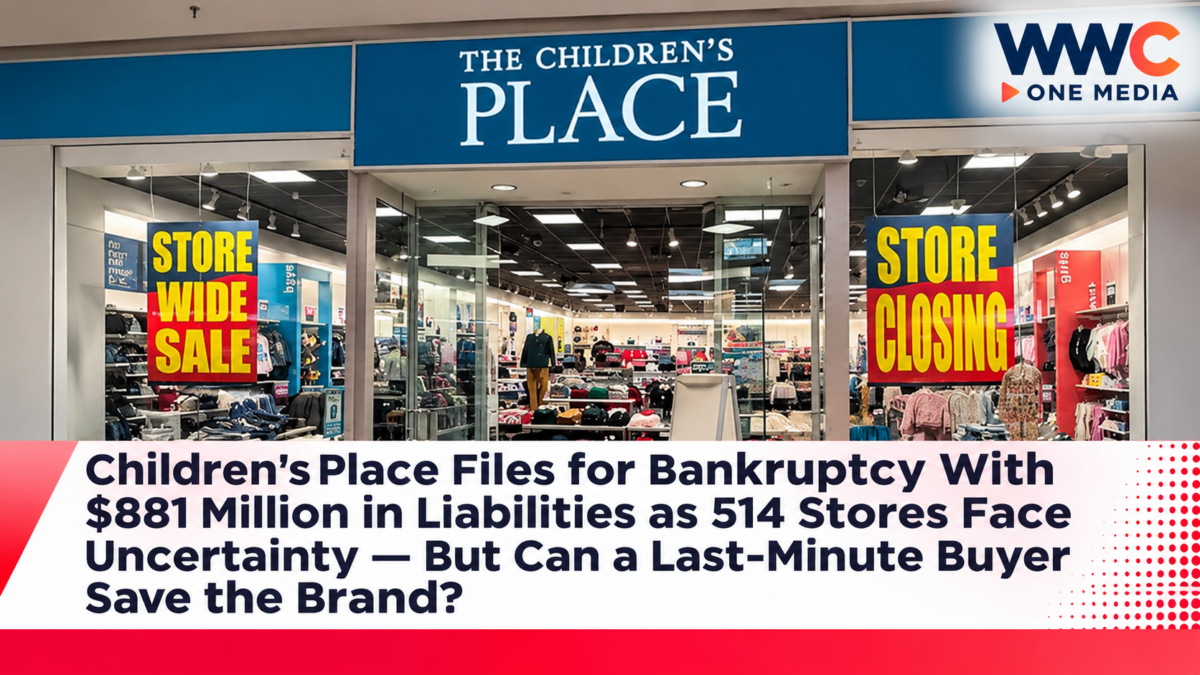
SECAUCUS, NEW JERSEY — November 10, 2026 — One of America’s most recognizable children’s clothing retailers has officially filed for bankruptcy protection, putting hundreds of stores, thousands of retail jobs and the future of two well-known children’s fashion brands at the center of a high-stakes race to find a buyer before the end of the year.
The Children’s Place Inc., the company behind The Children’s Place and Gymboree brands, voluntarily filed for Chapter 11 protection on November 8 in the US Bankruptcy Court for the District of New Jersey.
The filing came after plunging sales, mounting losses, intense competition and deteriorating liquidity pushed the retailer toward a financial crisis.
According to Reuters, the company reported approximately $881.3 million in liabilities against $742.3 million in assets as of August 1, 2026.
The retailer operates approximately 514 stores across the United States and Canada, along with e-commerce operations and international franchise relationships.
But management is not surrendering the business without a fight.
The company is pursuing a court-supervised sale designed to find an investor willing to acquire substantially all its assets and potentially continue operating the company.
Interested buyers are being asked to submit bids by December 9, 2026, with a proposed timetable to complete the sale process before the end of December.
Meanwhile, deep-discount inventory sales are already underway.
With creditors demanding repayment, shoppers rushing toward discounted merchandise and potential buyers evaluating its remaining assets, can The Children’s Place survive under new ownership—or is one of America’s best-known children’s apparel chains approaching its final holiday shopping season?
Children’s Place Officially Enters Chapter 11 Bankruptcy
The company and 13 affiliated entities entered bankruptcy protection on November 8, according to court filings and Reuters.
The lead proceeding is being administered in New Jersey under Case No. 26-22682, before Bankruptcy Judge Stacey L. Meisel.
The filing represents a decisive escalation of the financial problems that have troubled the retailer for several years.
In its official announcement, The Children’s Place explained that the bankruptcy process is intended to facilitate a sale of substantially all its assets.
The objective is to attract the highest or otherwise best offer and preserve the company’s business and brand value where possible.
Chapter 11 allows a qualifying company to continue operating under court supervision while addressing financial obligations and pursuing restructuring or asset sales.
It does not automatically mean every store must immediately shut down.
The Children’s Place specifically confirmed that its stores and e-commerce sites remained open at the time of the announcement.
However, the company also acknowledged that some locations would have to close during the restructuring.
The final number and identity of affected stores have not been confirmed.
$881 Million in Liabilities Reveals the Scale of the Financial Crisis
The retailer’s financial position helps explain why bankruptcy became necessary.
According to Reuters, The Children’s Place reported approximately:
- $742.3 million in assets as of August 1.
- $881.3 million in liabilities at the same date.
- A $31 million net loss in its most recently reported fiscal quarter.
- A 19% year-on-year decline in quarterly net sales.
- A 17% decline in comparable-store sales, rounded from the company’s reported results.
The gap between reported liabilities and assets was approximately $139 million.
However, that accounting difference should not be confused with the exact amount creditors will recover or lose through bankruptcy.
Asset-sale proceeds can differ substantially from the carrying values appearing on a company’s balance sheet.
Some assets may be subject to secured claims, while legal and administrative costs can also affect recoveries.
The financial figures nevertheless demonstrate the seriousness of the retailer’s position.
The company has struggled to generate enough revenue and cash to support its operations and obligations.
Sales Collapse Nearly 19% as Customers Pull Back
For the fiscal quarter ended August 1, The Children’s Place reported net sales of approximately $241.8 million, compared with about $298 million one year earlier.
The 18.9% decline reflected sustained pressure on consumer demand.
Comparable retail sales dropped approximately 16.7%.
That second measure is especially important.
It indicates weakness in comparable operations rather than a decline explained solely by closing stores.
The retailer has faced increasingly aggressive competition from online platforms, discount chains and other children’s apparel sellers.
Families are also more sensitive to clothing prices when household budgets are strained by inflation and other living expenses.
The company’s own filings identify promotional competition, rising costs, trade-policy changes and reduced consumer spending as significant risks.
But these factors should not be treated as the sole explanation for the bankruptcy.
Operational difficulties, debt burdens and liquidity constraints also contributed to the company’s predicament.
A $31-Million Quarterly Loss Deepened the Pressure
The Children’s Place recorded a net loss of approximately $31 million in its fiscal second quarter.
That compared with a loss of about $5.4 million during the equivalent period a year earlier.
The deterioration meant that the company’s losses increased even as sales were shrinking.
Retailers need sufficient gross profit to cover merchandise expenses, store occupancy, employee wages, distribution and corporate overhead.
When revenue falls, those fixed and semi-fixed expenses can become increasingly difficult to support.
Discounts can help sell merchandise and bring in cash.
But aggressive promotions may also reduce margins.
For The Children’s Place, balancing those competing priorities has become particularly difficult.
The company must continue serving customers while trying to conserve enough liquidity to complete the restructuring process.
The Bankruptcy Was Expected—But the Filing Changes Everything
The warning signs were visible before the Chapter 11 filing.
On November 3, WWC ONE MEDIA reported that The Children’s Place was considering bankruptcy after a severe deterioration in its financial results.
That earlier report examined the company’s falling sales, dwindling cash, possible buyers and the threat of liquidation.
At the time, bankruptcy had not yet been confirmed.
That distinction has now changed.
The November 8 court filing makes the restructuring official.
Related WWC ONE MEDIA coverage: Children’s Place Faces Possible Liquidation as Sales Plunge 19% and Cash Falls to $7.2 Million — But Can a Last-Minute Buyer Save 514 Stores?
The earlier financial warnings have developed into an active court-supervised process.
The question is no longer whether the retailer might seek bankruptcy protection.
It is whether a buyer can preserve a viable business before creditors and liquidation alternatives determine the outcome.
December 9 Becomes the Critical Deadline
The company has proposed an accelerated sale timetable.
Under its announced plan, interested parties are being asked to submit bids by December 9, 2026.
Management expects the sale process to conclude by the end of December, subject to court approval and the availability of a suitable transaction.
The sale would be conducted under Section 363 of the US Bankruptcy Code.
That framework allows a bankruptcy debtor to seek court approval for the sale of significant business assets.
Potential buyers may be interested in the company’s recognizable brands, online platforms, inventory, store operations and other intellectual property.
But a buyer’s willingness to express interest does not mean an acquisition is guaranteed.
Reuters reported that the company had received nine proposals involving some or all of its assets.
Those expressions of interest may lead to negotiations or formal bids, but their existence does not establish that any bidder has committed to purchase and operate the entire company.
The outcome will depend on the offers, financing arrangements, creditor positions and court decisions.
Nine Proposals Could Offer Hope for a Rescue
The reported nine proposals show that at least some investors see potential value in The Children’s Place.
A buyer could seek to operate a smaller network of profitable stores.
Another might focus on the online business.
A third could be interested primarily in brand rights, customer relationships or inventory.
The Children’s Place and Gymboree names still carry recognition among generations of American families.
That brand equity may be valuable even if the current company cannot support its existing operating structure.
However, there is an important difference between acquiring a brand and saving the entire business.
An investor could purchase intellectual property without assuming all store leases or maintaining current employment levels.
A transaction that preserves the brand might therefore involve significant changes to stores, employees and suppliers.
Until a winning proposal is approved, the extent of any rescue remains uncertain.
Inventory Sales Begin as Liquidation Remains an Alternative
The company has already begun selling inventory at deep discounts.
According to Reuters, liquidation-related inventory sales began on November 6, two days before the bankruptcy filing.
The Children’s Place entered a consulting arrangement with a venture involving GA Group, Tiger Group and SB360 Capital Partners to support inventory sales.
These firms have experience managing distressed retail merchandise and store-closing programs.
However, the presence of liquidation specialists does not prove that all stores are permanently closing.
The company’s own explanation is that the sales can generate cash while it seeks a going-concern buyer.
Management has also prepared for the possibility that a suitable rescue transaction will not materialize.
If that happens, a broader liquidation could become necessary.
The company is simultaneously pursuing a rescue and preparing for a less favorable outcome.
Both possibilities must be reported accurately.
Are All 514 Children’s Place Stores Closing?
No company announcement establishes that all 514 locations have been permanently ordered to close.
The Children’s Place said all stores and e-commerce sites remained open at the time of its bankruptcy announcement.
It also confirmed that certain closures will be necessary.
The company is reviewing its store network to concentrate resources on locations with stronger long-term prospects.
This could mean closing weaker stores while preserving others under new ownership.
But the final footprint depends on the sale process.
A complete store-by-store closure list was not available in the November 9 reporting reviewed.
Customers should therefore avoid assuming that every location will immediately disappear.
At the same time, they should recognize that operating status may change as the bankruptcy progresses.
What Happens to Employees and Store Workers?
The restructuring creates significant uncertainty for employees.
The retailer’s North American operations encompass hundreds of stores, distribution functions, customer service and corporate departments.
Store closures or asset sales could affect staffing needs.
However, the total number of potential job losses has not been officially established.
The company has filed customary requests with the bankruptcy court seeking permission to continue paying employee wages and benefits.
These motions are intended to maintain essential operations during the proceedings.
Court approval and sufficient financing remain important.
Some employees may retain their positions if a buyer continues operating the business.
Others could face job losses if stores close or corporate functions are eliminated.
It would be inaccurate to claim that the filing automatically dismissed the entire workforce.
Saudi Investor Mithaq Capital Could Face Major Losses
One of the most important investors in The Children’s Place is Mithaq Capital, a Saudi family office associated with the Al Rajhi family.
The investment group became the retailer’s controlling shareholder in 2024.
Reuters reported that Mithaq held approximately 61.1% of the company at the time of the latest bankruptcy reporting.
The group had previously provided financial assistance as The Children’s Place attempted to stabilize its business.
The Wall Street Journal reported that the retailer had refinanced debt, reduced costs and introduced operational changes, but sales and profitability continued to weaken.
The bankruptcy now raises significant questions about the value of Mithaq’s equity investment.
In Chapter 11, shareholders generally rank behind creditors.
If the company does not generate sufficient value to satisfy higher-priority claims, existing equity holders may receive little or no recovery.
However, the precise outcome for Mithaq and other shareholders has not yet been established by a completed sale or confirmed restructuring plan.
Shareholders Face a Risk of Losing Their Investment
The Children’s Place trades under the Nasdaq ticker PLCE.
The bankruptcy announcement sent the company’s already-depressed shares lower in premarket trading.
The Wall Street Journal reported a roughly 38% decline to approximately 20 US cents per share during premarket trading on November 9.
The market reaction reflects concerns that existing shareholders may receive minimal value after creditor claims are addressed.
But a falling stock price is not the same as an approved cancellation of shares.
The value of existing equity will depend on the eventual bankruptcy outcome.
Investors also face the risk that the company’s shares may experience additional trading restrictions or changes connected with its financial condition.
Any such developments must be confirmed through official exchange or corporate disclosures.
Why Chapter 11 Does Not Automatically Mean a Retail Chain Is Finished
Chapter 11 protection can allow a distressed business to continue operating while addressing its liabilities.
The legal process differs from an immediate shutdown.
A company may restructure debt, negotiate financing, sell assets or seek a buyer willing to continue operations.
The Children’s Place has chosen to pursue a court-supervised sale.
A comparable distinction appeared in another US retail-related bankruptcy covered by WWC ONE MEDIA.
In September, Meritage Hospitality Group, a major Wendy’s franchise operator, entered Chapter 11 while attempting to maintain restaurant operations.
Related WWC ONE MEDIA coverage: Wendy’s Franchise Operator Behind 314 US Restaurants Files for Bankruptcy — What Happens to the Stores Next?
The Wendy’s franchise case is unrelated to The Children’s Place.
But it illustrates why bankruptcy protection should not be equated with an immediate closure of every operating location.
Each case depends on financing, creditors, contracts and the feasibility of the proposed restructuring.
Another 2026 Bankruptcy Reveals the Risks of Debt and Tariffs
The Children’s Place is not the only consumer-focused business facing financial distress.
On November 5, WWC ONE MEDIA reported that fitness company FitLab had entered Chapter 11 with reported liabilities of up to $500 million.
That business also faced pressure from supply-chain difficulties, financing needs and trade costs.
Related WWC ONE MEDIA coverage: Nike’s $20-Million Fitness Bet Unravels as FitLab Files Bankruptcy With Up to $500 Million in Debt — But Could Trump’s Tariffs Push More Fitness Brands to the Brink?
The companies operate in different industries and their bankruptcy cases are not connected.
However, they demonstrate how high costs, weak demand and limited liquidity can create serious difficulties even for recognizable consumer brands.
Tariffs may add pressure to businesses that rely on imported merchandise, but their specific impact must be evaluated alongside other financial and operational factors.
Store Closures Are Not Always a Sign of Bankruptcy
The challenges facing The Children’s Place also provide a contrast with retailers undertaking voluntary turnarounds outside bankruptcy.
Starbucks, for example, announced plans in September 2026 to close approximately 250 North American coffeehouses while investing in stronger locations.
The coffee chain’s program was a strategic restructuring rather than a Chapter 11 case.
As WWC ONE MEDIA reported, Starbucks planned to improve operating efficiency by closing locations that did not meet its performance expectations.
Related WWC ONE MEDIA coverage: Starbucks to Close 250 North American Stores in Second Major Wave of Closures
The distinction matters.
Companies can close stores for many reasons, including changing customer traffic, lease economics and operational priorities.
For The Children’s Place, the problem is more severe because it has already sought legal protection from creditors.
Its future store network will now be shaped by bankruptcy proceedings and any approved buyer.
What Happens to Children’s Place and Gymboree Gift Cards?
Customers may be concerned about gift cards, loyalty rewards and online purchases.
The company has sought permission to maintain certain customer programs during the bankruptcy proceedings.
ABC News reported that customers were being encouraged to redeem gift cards and My Place Rewards while they remained valid.
However, customers should not assume that all policies will remain unchanged throughout the sale process.
Gift-card treatment, returns and loyalty benefits may depend on court orders and future operating decisions.
Shoppers should consult the company’s official website and published policies before making purchases or relying on existing balances.
The filing also does not establish that every online order has been canceled.
The company specifically stated that its e-commerce sites remained operational.
Can the Business Obtain Financing During Bankruptcy?
The Children’s Place plans to obtain debtor-in-possession financing from existing secured lenders.
This type of financing can support a business while it operates under bankruptcy court supervision.
It may be used to maintain essential activities such as paying employees, purchasing goods and supporting distribution.
The company’s official announcement describes financing arrangements being pursued, subject to the relevant agreements and court approvals.
That should not be confused with an unconditional commitment that all necessary funds have already been received.
Financing conditions and court decisions will be crucial to whether the retailer can operate through the proposed December sale.
Without sufficient liquidity, even a business with interested buyers may struggle to preserve operations.
The Holiday Shopping Season Adds Urgency
The timing of the bankruptcy is particularly important.
November and December are critical periods for many US retailers.
Children’s clothing businesses can experience seasonal demand as families shop for winter wear, holiday outfits and gifts.
The Children’s Place is now attempting to sell inventory while simultaneously marketing itself to prospective buyers.
Those activities can work together if the sales generate cash without destroying the value of the business.
But deep discounts can also reduce profit margins and leave less merchandise available for future operations.
Prospective buyers will need to assess the company’s remaining inventory, customer base, leases, technology systems and financial liabilities.
With a proposed bid deadline of December 9, negotiations are taking place during one of the busiest retail periods of the year.
That adds pressure on management, lenders and employees.
What Will Happen Before December 31?
The company’s proposed restructuring timetable identifies several important stages.
First, the bankruptcy court must consider requests allowing the company to maintain essential operations.
Second, management must secure financing arrangements sufficient to support the sale process.
Third, prospective buyers must evaluate the business and submit offers.
Fourth, the company and relevant stakeholders must determine which proposal provides the best available outcome.
Finally, any transaction requiring court approval must satisfy the applicable legal requirements.
The company wants to complete its sale process by the end of December 2026.
But that is a target rather than a guaranteed closing date.
A sale could preserve some or much of the business.
Alternatively, insufficient offers or financing problems could lead to a broader wind-down.
No final buyer or completed rescue has been announced.
The Bigger Picture: Can an American Retail Institution Survive Bankruptcy?
The Children’s Place has spent decades selling clothing to American families.
Founded in 1969, the retailer built a recognizable presence in shopping malls and online shopping.
Its acquisition of the Gymboree brand expanded its reach into another segment of children’s apparel.
But the business has struggled to adapt to mounting financial and competitive pressure.
Sales have declined sharply.
Losses have increased.
Liquidity has tightened.
And repeated financing efforts have failed to produce a lasting recovery.
Now, with approximately $881 million in reported liabilities, hundreds of locations and multiple potential buyers, the company is fighting for a future under Chapter 11 protection.
The bankruptcy does not automatically end the brand.
But neither does a court-supervised sale guarantee that stores, jobs or shareholder investments will be preserved.
The company’s survival will depend on whether an investor believes its brands, customers and operations can support a sustainable business after the restructuring.
And as The Children’s Place races toward its December 9 bidding deadline, one question remains: Will a last-minute buyer rescue the 57-year-old retailer—or could the 2026 holiday season become the final chapter for hundreds of its stores?