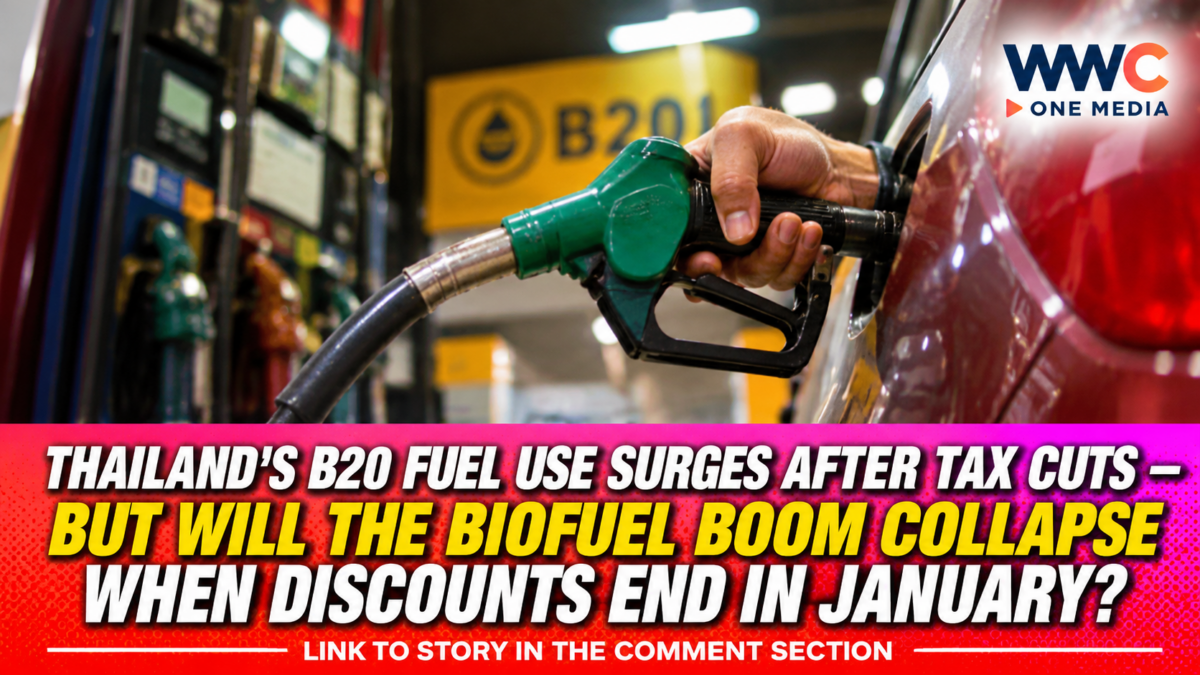
Thailand’s decision to slash excise taxes on selected biofuels is beginning to change fuel-buying behaviour, with daily consumption of B20 biodiesel reportedly climbing sharply after the government made it almost 10 baht per litre cheaper than conventional diesel.
Prime Minister Anutin Charnvirakul said B20 consumption increased from around 5–6 million litres a day to approximately 9 million litres following the tax reduction introduced on October 28. Other reported figures from the Energy Ministry showed consumption reaching 10 million litres a day by October 30.
The increase is an early sign that lower prices can encourage motorists and transport operators to switch to alternative fuels. But the policy’s wider success remains uncertain: conventional B7 diesel still dominates Thailand’s market, many transport operators do not regularly use B20, and oil-palm farmers say the higher demand has yet to translate into clear improvements in the prices they receive.
The three-month tax relief, which also covers E20 gasohol, is part of the government’s effort to reduce energy costs, encourage domestic agricultural production and lessen Thailand’s exposure to imported petroleum.
Government Cuts B20 and E20 Excise Taxes for Three Months
Thailand’s Cabinet approved the temporary tax reductions on October 27, with the measure taking effect on October 28, 2026, and scheduled to run until January 27, 2027.
Under the revised rates:
- B20 biodiesel: Excise tax reduced from 5.953 baht to 0.431 baht per litre.
- E20 gasohol: Excise tax reduced from 6 baht to 0.358 baht per litre.
The reductions translate into tax relief of approximately 5.50 baht per litre for B20 and 5.60 baht per litre for E20.
The government deliberately targeted these two fuel blends rather than cutting taxes across all petrol and diesel products. Officials say the approach is intended to encourage consumers to use fuels containing agricultural ingredients produced in Thailand.
B20 contains 20% biodiesel, which is derived primarily from palm oil, while E20 contains 20% ethanol, generally produced from crops such as sugar cane and cassava.
The Finance Ministry says the measure is intended to ease household energy expenses, reduce transportation and business costs, and create stronger demand for agricultural products.
The official announcement is available here:
B20 Consumption Climbs as the Price Gap Widens
The biggest immediate impact has been recorded in B20 sales.
According to figures reported by the Bangkok Post, daily B20 consumption rose from approximately 6 million litres to 9 million litres on October 28 and 29, before reaching around 10 million litres on October 30.
Anutin separately reported that consumption had increased from approximately 5–6 million litres to 9 million litres a day.
The government says the tax reduction made B20 almost 10 baht per litre cheaper than conventional B7 diesel, creating a stronger financial incentive for drivers to switch.
However, the increase needs to be viewed against the size of Thailand’s overall diesel market.
Daily B7 consumption was approximately 52 million litres, compared with around 6 million litres for B20 before the tax reduction. Even after the reported increase, conventional B7 remained the dominant diesel product.
The figures suggest that the price incentive is encouraging some fuel switching, but B20 has not yet displaced conventional diesel on a large scale.
Thailand Hopes to Increase B20 Use to 20 Million Litres a Day
The government has a much bigger target in mind.
Anutin has discussed increasing daily consumption of B20 to approximately 20 million litres, more than twice the level reported after the tax reduction.
The Prime Minister argues that greater use of palm-based biodiesel could reduce Thailand’s dependence on imported crude oil and keep more energy spending within the domestic economy.
He has estimated that reaching the proposed consumption level could reduce crude-oil imports by approximately 4 million litres a day and generate annual savings approaching 100 billion baht.
These figures are government projections, not confirmed savings already achieved. The actual outcome would depend on sustained consumer demand, available agricultural feedstocks, fuel production capacity and international oil prices.
The government is also exploring opportunities to expand the use of agricultural products such as sugar cane and cassava in alternative-energy production.
Oil-Palm Farmers Want to See the Benefits Too
While the increase in B20 consumption is encouraging for the biodiesel industry, it has not automatically translated into higher incomes for farmers.
Representatives of the Krabi Oil Palm Farmers Cooperatives Federation have questioned whether the tax cuts will deliver meaningful benefits to small-scale growers.
Their concern is that refineries and fuel producers may receive the most immediate advantages from increased biodiesel demand, while farmers may see little improvement unless higher demand eventually pushes up the prices paid for raw palm fruit.
Palm-oil prices are influenced by several factors, including international crude oil prices, global vegetable-oil demand, production levels and the amount of palm oil purchased by refineries.
The federation has also called for stronger support for sustainable palm cultivation and legislation that could improve standards and bargaining power for small-scale producers.
This highlights an important challenge for Thailand’s biofuel strategy: encouraging motorists to purchase more B20 is only one part of the process. The government must also ensure that increased demand reaches the agricultural communities supplying the raw materials.
B7 Diesel Still Dominates Despite the Cheaper Alternative
One reason the policy has attracted criticism is that B20 is not the preferred fuel of many motorists and commercial operators.
Some consumers remain concerned about engine compatibility and performance, while transport companies may be reluctant to change fuel types without clear technical guidance and assurances from manufacturers.
The Foundation for Consumers has also questioned whether the tax reductions provide meaningful relief to ordinary motorists when the discounts are concentrated on fuel grades that many people do not regularly use.
The Land Transport Federation of Thailand has raised similar concerns, arguing that the B20 reduction offers limited assistance to operators whose fleets mainly use conventional B7 diesel.
The contrast is significant: B7 consumption was reported at approximately 52 million litres a day, while B20 consumption remained far lower even after the price reduction.
E20 also faces a similar challenge in the petrol market. Reported daily consumption was around 6 million litres, compared with approximately 23 million litres combined for Gasohol 91 and Gasohol 95.
The government therefore needs more than a temporary price advantage if it wants to make alternative fuels a mainstream choice.
Oil Fuel Fund Deficit Raises Questions About Sustainability
Thailand’s fuel-tax intervention is also taking place against the backdrop of a heavily indebted Oil Fuel Fund.
The fund recorded a net deficit of approximately 107.203 billion baht as of November 1, according to figures reported by the Bangkok Post.
The deficit consisted of approximately 65.344 billion baht in the oil account and 41.859 billion baht in the liquefied petroleum gas account.
The government has used the fund to help stabilise domestic energy prices, but its growing financial burden has made additional support measures more difficult.
The temporary excise-tax reductions are intended to share some of the pressure rather than rely entirely on the fund.
However, tax reductions also mean lower government revenue. Authorities will therefore need to consider whether the increase in biofuel consumption justifies extending the measure after its January 2027 expiration.
The wider debate over fuel taxation and energy costs is also relevant to other countries in the region. WWC ONE MEDIA has examined the Philippines’ fuel-tax relief mechanism and the financial questions surrounding similar interventions:
Thailand’s Biofuel Push Is Part of a Bigger Energy Security Strategy
The tax cuts are not simply about making fuel cheaper. They are also part of Thailand’s longer-term effort to strengthen domestic energy security and reduce exposure to international oil-price volatility.
Thailand imports substantial quantities of petroleum, leaving its economy vulnerable to geopolitical disruptions, shipping risks and fluctuations in global energy markets.
Increasing the use of locally produced biodiesel and ethanol could help diversify the country’s fuel supply while creating additional demand for agricultural commodities.
The government’s broader energy strategy and its net-zero ambitions are discussed in this related WWC ONE MEDIA report:
The approach could also create opportunities for farmers growing palm oil, sugar cane and cassava, provided that the benefits are passed along the agricultural supply chain.
But alternative fuels must remain affordable, technically suitable and consistently available if consumers are expected to continue using them after the tax incentives expire.
Will the Consumption Boom Continue After January 2027?
Thailand’s temporary excise-tax cuts have produced an encouraging early increase in B20 consumption, but the long-term results remain uncertain.
The government has demonstrated that a significant price difference can encourage some consumers to switch fuels. The next challenge is keeping that demand strong after the temporary tax relief ends.
Authorities must also address concerns about engine compatibility, limited access to alternative fuel grades, the financial position of the Oil Fuel Fund and the actual benefits reaching farmers.
For now, B20 consumption has risen, but B7 remains far more widely used. The government’s proposed target of 20 million litres a day is still an ambition rather than an established outcome.
Thailand’s biofuel experiment could become an important part of its energy strategy if increased consumption translates into lasting savings, stronger agricultural incomes and lower dependence on imported petroleum.
But the real test will come when the tax incentives expire on January 27, 2027. Will motorists continue choosing B20 when the price advantage narrows, or will consumption fall back once the government stops subsidising the switch?