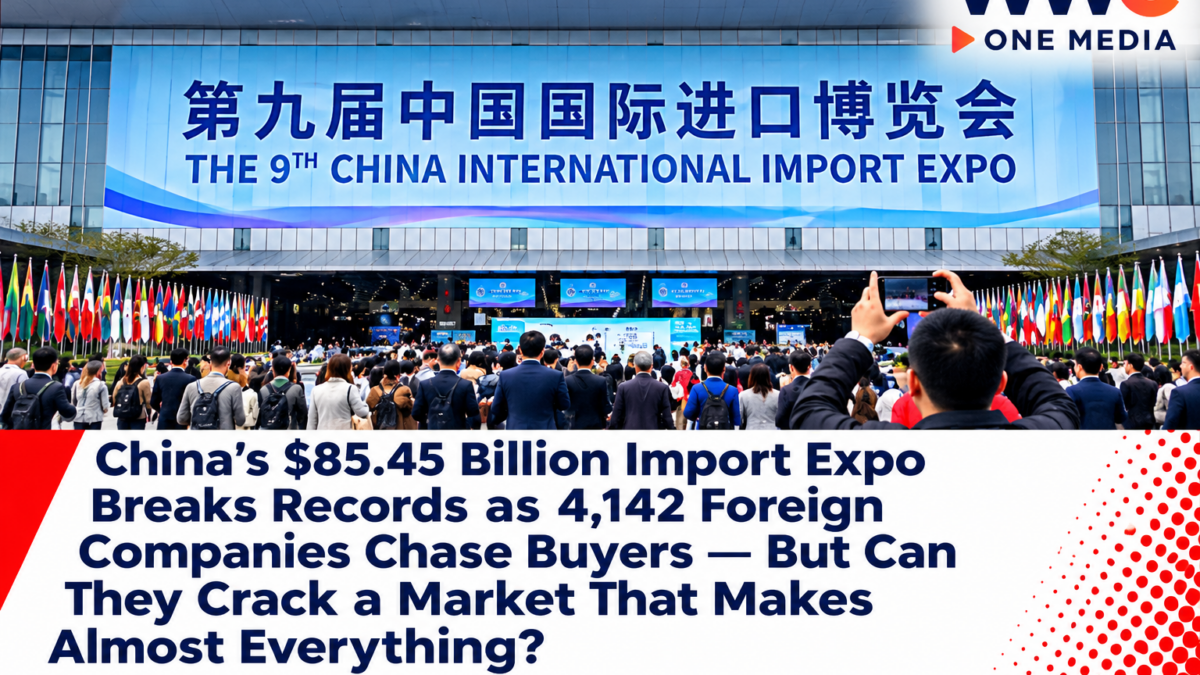
SHANGHAI, CHINA / MANILA, PHILIPPINES — November 11, 2026 — Thousands of foreign companies have descended on Shanghai hoping to capture a share of China’s enormous consumer and industrial markets. But behind the record-breaking trade agreements and impressive exhibitions lies a difficult economic reality: selling to China is becoming one of the toughest challenges in international business.
The ninth China International Import Expo (CIIE), held from November 5 to November 10, concluded with a record US$85.45 billion in intended one-year transactions, a 2.3% increase from the previous year.
The event attracted 4,142 overseas exhibitors, including more than 300 Fortune Global 500 companies and industry leaders.
Products ranged from American soybeans and German fountain pens to Canadian vitamins, Japanese camera lenses and Zimbabwean blueberries.
Yet the ambitious exhibition took place against an uncomfortable backdrop.
China’s merchandise trade surplus reached approximately US$1.04 trillion during the first ten months of 2026, reflecting the country’s extraordinary export capabilities and its continuing reliance on international demand.
Foreign companies are eager to sell into China’s vast economy.
But they must compete against increasingly sophisticated domestic manufacturers, price-sensitive shoppers and established local supply chains.
For Beijing, the expo is an opportunity to demonstrate that China welcomes imports.
For foreign businesses, the harder task begins when the exhibition closes.
China has opened the doors to thousands of international sellers. But can those companies persuade Chinese consumers to buy foreign products when domestic competitors increasingly offer comparable technology, quality and lower prices?
Shanghai Import Expo Breaks Records With $85.45 Billion in Intended Deals
The official closing figures confirm that the 2026 expo was the largest edition in several important respects.
According to the CIIE Bureau, one-year intended business transactions reached $85.45 billion, compared with approximately $83.49 billion the previous year.
That represented 2.3% growth.
The event also achieved record participation and product launches.
Key figures include:
- 4,142 overseas exhibiting companies.
- More than 300 Fortune Global 500 companies and industry leaders.
- Over 470,000 registered visitors.
- 485 exhibits making global, Asian or Chinese market debuts.
- 633 innovation projects from nearly 40 countries and regions.
- More than 440,000 square meters of total exhibition space.
The business exhibition occupied approximately 370,000 square meters within the larger venue.
These records indicate strong interest in commercial opportunities involving China.
But they do not guarantee that every participating company will secure profitable sales.
Most importantly, the $85.45 billion represents intended agreements over a one-year period rather than completed purchases or cash already received.
Final orders, deliveries and payments may differ from the amount announced.
Why Foreign Companies Still Want Access to China
China remains one of the world’s largest economies and consumer markets.
Its enormous population, extensive distribution networks and highly developed industrial ecosystem create opportunities across many sectors.
International companies can find customers for agricultural commodities, medical equipment, luxury goods, industrial machinery and specialized technologies.
China also has sophisticated manufacturers that need imported components, materials and equipment.
That demand extends beyond ordinary consumer shopping.
Factories may require specialized instruments or advanced production systems.
Hospitals can seek new medical devices.
Food distributors may look for imported products unavailable from domestic suppliers.
Luxury retailers may target affluent consumers willing to pay premiums for established international brands.
These opportunities help explain why foreign exhibitors continue investing in the Shanghai event.
But the Chinese market is not uniformly attractive across every industry.
The prospects for a German industrial equipment supplier can differ greatly from those of a small foreign food brand.
Successfully identifying a profitable customer segment is often more important than the overall size of China’s economy.
The Biggest Challenge: China Already Manufactures Almost Everything
One of the central themes in Bloomberg’s November 10 feature is China’s remarkable manufacturing capacity.
China produces an enormous range of goods, from low-cost household products to sophisticated industrial machinery, electric vehicles and advanced electronics.
Its factories benefit from extensive supplier networks, skilled workers, infrastructure and considerable manufacturing experience.
That makes competition difficult for imported products.
A foreign manufacturer may offer something unique when it first enters the country.
But domestic companies can improve their own products rapidly.
In some industries, Chinese suppliers eventually produce comparable alternatives at highly competitive prices.
The difficulty is particularly severe when imported products have no distinctive technological, quality or brand advantage.
As WWC ONE MEDIA previously reported on China’s factory boom and the growing gap between industrial production and consumer spending, China’s extraordinary ability to manufacture goods has become both an economic strength and a source of pressure on domestic markets.
Strong production capacity does not automatically translate into equally strong demand.
And when supply expands faster than spending, businesses can become trapped in aggressive price competition.
For foreign sellers, this means that entering China requires more than bringing a product that has already succeeded elsewhere.
They must convince customers that the imported alternative offers something worth paying for.
American Soybeans Show China Still Needs Foreign Suppliers
Agriculture is one area where international trade remains essential.
American soybean exporters have long viewed China as a major market because of its demand for animal feed and food processing inputs.
China has substantial agricultural production of its own, but its needs for certain commodities exceed what domestic supplies can efficiently provide.
Imported soybeans support China’s livestock and food industries.
The presence of American agricultural products at the expo underscores the continuing commercial links between the world’s two largest economies.
But agriculture is also exposed to political risk.
US-China trade disagreements, tariffs and changes in purchasing arrangements can affect demand.
Buyers may shift between suppliers depending on prices, logistics, availability and government policy.
For American farmers, maintaining access to China’s market can be commercially important.
For Beijing, obtaining agricultural products from several countries can reduce dependence on one source.
The outcome is a complex relationship in which countries compete fiercely while remaining economically connected.
German Brands Face a Market Filled With Local Competitors
Germany is one of the important international participants in China’s industrial and consumer markets.
German companies have long supplied automobiles, machinery, chemicals and premium consumer products to Chinese buyers.
But China’s domestic technological capabilities have improved significantly.
Chinese electric vehicle manufacturers now compete with international automakers in areas such as battery technology, software features and pricing.
Industrial firms are also strengthening their capabilities in automation, components and equipment manufacturing.
This changes the competitive equation.
A German company may still have advantages in specialized engineering, brand reputation or precision manufacturing.
But it can no longer assume that foreign origin automatically creates a premium position.
Consumers and businesses increasingly evaluate products according to performance, price, service and reliability.
For exhibitors at the import fair, the challenge is to convert technical advantages into purchases that Chinese buyers consider worthwhile.
China’s Trade Surplus Exceeds $1 Trillion Despite Rising Imports
The strongest evidence of the country’s economic imbalance comes from the latest customs data.
According to Reuters and China’s customs authorities, exports jumped 35.2% year over year in October 2026, while imports increased 41.6%.
Both figures exceeded economists’ expectations.
Imports were supported partly by purchases associated with energy and artificial intelligence infrastructure.
The resulting monthly trade surplus narrowed to approximately $105.3 billion.
But the cumulative surplus for January through October still reached around $1.04 trillion.
That is a remarkable figure.
It demonstrates the strength of Chinese exporters and the country’s ability to sell manufactured products internationally.
However, it does not mean that imports are declining in every category.
October imports actually grew substantially.
The deeper issue is the continuing scale of the difference between the value China exports and the value it imports.
The country remains a major supplier of goods to international markets while domestic demand has struggled to match the expansion of industrial output.
This is why the import expo carries political as well as commercial significance.
Beijing wants trading partners to see China as a market for their products, not merely an enormous export competitor.
Weak Consumer Confidence Makes Foreign Products Harder to Sell
China’s consumption problem is an important obstacle for international businesses.
Households have faced uncertainty involving property values, employment prospects and income growth.
The prolonged property-market downturn has affected confidence and household wealth.
That can encourage consumers to save rather than spend.
Even when people continue purchasing goods, they may seek discounts or shift toward lower-priced alternatives.
Foreign brands that once benefited from premium positioning can find themselves competing against domestic products with increasingly attractive features.
The latest private-sector services survey adds to the concerns.
China’s RatingDog services purchasing managers’ index declined to 50.8 in October from 51.6 in September, indicating slower expansion.
Businesses reported rising input costs while selling prices fell.
As WWC ONE MEDIA examined in its report on China’s three-month low in services activity and weakening consumer confidence, the combination of softer demand and intense competition is placing pressure on business profitability.
That is particularly relevant to foreign companies attempting to establish premium pricing.
A customer who is uncertain about future income may become less willing to pay more for an imported product unless its advantages are clear.
Foreign Agricultural Products Can Still Find Opportunities
The expo also showcased agricultural products from countries seeking access to China’s consumers.
Zimbabwean blueberries were among the products featured in Bloomberg’s reporting.
Such products illustrate a potential opportunity for emerging-market exporters.
China’s enormous urban population creates demand for fresh foods, specialty ingredients and products associated with particular regions.
But selling perishable agricultural goods internationally requires reliable logistics.
Exporters must meet customs requirements, food-safety standards and product-quality expectations.
They may also need cold-chain infrastructure and dependable distribution partners.
An agricultural exporter cannot rely solely on attracting visitors to an exhibition booth.
The business must secure import approvals, arrange shipments, establish relationships with retailers and deliver consistent quality.
For developing economies, these practical barriers can be as important as tariffs.
The import fair may provide introductions.
Sustainable trade requires the commercial infrastructure to support repeated orders.
GE Aerospace Demonstrates That Foreign Companies Can Still Win Major Contracts
Not every international business is struggling to secure Chinese customers.
One of the most significant announcements at the 2026 expo came from GE Aerospace.
According to Reuters, the American aerospace company announced sales and service agreements worth more than US$12.9 billion during the event.
The agreements included plans for China Eastern Airlines to purchase 202 LEAP-1A engines to power 101 Airbus A320neo-family aircraft.
Other arrangements involved spare engines, technical support and maintenance services.
The agreements represented a record signing value for GE Aerospace at the China import expo.
They show that major opportunities remain for foreign suppliers offering highly specialized products.
Aircraft engines are fundamentally different from ordinary consumer goods.
They require extensive engineering capabilities, certification, maintenance networks and long-term support.
Only a limited number of global companies can supply certain categories of commercial aviation engines.
That technological specialization can create a stronger competitive position than products that domestic manufacturers can readily substitute.
However, agreement values should not be confused with immediate revenue.
Deliveries and services may extend over several years, and their recognition in financial accounts depends on contractual performance.
The Real Opportunity May Be in Products China Cannot Easily Replace
Foreign companies may have stronger opportunities where they provide capabilities that remain difficult to replicate locally.
Examples include specialized industrial machinery, medical technology, advanced scientific equipment and distinctive agricultural products.
The advantage may come from patents, regulatory approvals, engineering expertise, quality or highly trusted brands.
But competitive advantages can change over time.
China’s domestic companies continue investing in research, development and manufacturing capabilities.
A foreign business may lead in one technology today and face stronger local competitors several years later.
This creates pressure to keep innovating rather than depending on established market positions.
It also explains why the import expo includes an innovation incubation section.
This year’s edition featured 633 projects from nearly 40 countries and regions.
The section highlights products and technologies that companies hope will create new market opportunities.
For exhibitors, the challenge is moving from demonstration to repeatable sales.
China’s Export Boom Is Also Creating International Resistance
China’s growing trade surplus has raised concerns among major trading partners.
Governments in Europe, North America and elsewhere have questioned whether Chinese manufacturing capacity is creating excessive competitive pressure on domestic industries.
Some countries have introduced tariffs or other restrictions affecting Chinese products.
Electric vehicles are a particularly prominent example.
Chinese manufacturers have expanded exports while facing intense domestic price competition.
As WWC ONE MEDIA reported on China’s booming automobile exports and the challenges confronting BYD and Chery, overseas expansion can strengthen sales while exposing manufacturers to trade barriers and higher logistics costs.
This is the other side of the problem facing exhibitors in Shanghai.
Foreign governments want China to purchase more imported goods.
Beijing wants international markets to remain open to Chinese exports.
Both goals can create political tension when countries believe trade is becoming unbalanced.
The import fair therefore serves an important diplomatic purpose by signaling support for international commerce.
But symbolism alone cannot resolve disputes over tariffs, market access or industrial competition.
Beijing Is Searching for New Sources of Consumer Spending
China’s government is attempting to strengthen domestic consumption through several strategies.
One involves expanding spending on services, sports and recreation.
Another focuses on older consumers.
China’s population aged 60 and above had reached approximately 323 million by the end of 2025.
That has encouraged interest in products and services designed for retirees, including healthcare, travel, fitness and specialized consumer goods.
As WWC ONE MEDIA reported on China’s effort to develop its silver economy, policymakers hope older consumers can become an important source of future demand.
For foreign exhibitors, this creates potential opportunities.
International healthcare brands, medical-device suppliers and companies specializing in older consumers may find customer segments that are expanding even when other parts of the economy remain weak.
But the size of the elderly population does not automatically translate into purchasing power.
Income, pensions, healthcare costs and regional differences will influence actual spending.
Businesses must understand which consumers can afford their products and which services solve genuine needs.
Could China’s Sports Industry Become Another Opening for Foreign Sellers?
Sports and recreation are another area being targeted for growth.
Beijing wants the country’s sports industry to exceed 7 trillion yuan in annual output by 2030, equivalent to roughly US$1 trillion at commonly cited exchange rates.
The target encompasses sporting goods, fitness facilities, events, outdoor recreation and associated services.
In related coverage, WWC ONE MEDIA examined China’s ambition to build a trillion-dollar sports industry while encouraging household spending and employment.
Foreign companies could benefit from demand for specialized sports equipment, training technology and premium recreation products.
But domestic Chinese sporting-goods producers are already highly competitive.
Success will require foreign businesses to identify distinctive products or services rather than assume that a growing industry benefits every supplier equally.
The 2030 target is also an industry-development ambition.
It is not a guarantee that consumer spending will reach a specific level or that foreign companies will capture a particular share.
What China’s Import Expo Means for Philippine Exporters
The Philippines is among the Asian economies with commercial interests in China’s market.
Potential opportunities include agricultural goods, specialty foods, ingredients, consumer products and services.
The large number of buyers and exhibitors at the Shanghai event demonstrates why trade exhibitions can be valuable for smaller exporters.
They create opportunities to meet importers, distributors and commercial partners.
However, Philippine businesses seeking entry into China must manage several practical challenges.
These include product standards, documentation, customs requirements, distribution networks and local consumer preferences.
Food exporters may face specific sanitary and phytosanitary requirements.
Consumer brands must assess pricing, packaging, language and online distribution channels.
Companies must also consider exchange rates and the cost of shipping.
Participation in an international trade exhibition may help establish relationships, but successful market entry requires compliance with China’s actual import regulations.
The broader lesson is that exporters should identify customers and distribution partners before committing substantial resources.
Can China Turn Record Intended Deals Into Actual Imports?
The $85.45 billion headline figure represents an encouraging result for expo organizers.
But the most important commercial test will come after the event.
Businesses must finalize contracts, arrange financing, satisfy regulatory conditions and deliver goods.
Some intended agreements may become completed transactions.
Others may change in value or schedule.
It is therefore essential to distinguish between announced intentions and realized trade.
The organizers’ figure also cannot simply be added to China’s official customs imports as though it represents a separate block of completed transactions.
Actual purchases may eventually appear in future customs figures, depending on where goods are produced, how contracts are performed and when deliveries occur.
For investors and policymakers, the most useful evidence will be whether foreign suppliers achieve sustained sales growth.
A one-time exhibition agreement is valuable.
A reliable, profitable business in China is far more significant.
What Happens Next for the World’s Biggest Import Market?
The tenth China International Import Expo is scheduled for November 5–10, 2027.
Organizers say 143 companies and institutions have already signed up, reserving more than 100,000 square meters of exhibition space.
Meanwhile, China’s future import demand will depend on several developments.
Household confidence must improve if consumer-facing businesses are to achieve stronger sales.
The property sector remains important because housing wealth influences spending decisions.
Trade relations with the United States and European Union will also affect market access.
Industrial policy and domestic technological development may influence the competitiveness of imported products.
Finally, international suppliers must continue adapting their offerings to Chinese customer needs.
A large market does not guarantee easy profits.
The ability to compete will depend on genuine commercial advantages and long-term execution.
The Bigger Picture: China’s Import Fair Reveals an Economic Contradiction
The 2026 China International Import Expo delivered record participation, product debuts and intended business transactions.
More than 4,100 overseas companies attended.
Proposed one-year transactions reached $85.45 billion.
Major companies announced substantial deals, including GE Aerospace’s agreements worth more than $12.9 billion.
These results demonstrate that China remains a commercially important market for international businesses.
But the wider economic picture is more complicated.
China’s trade surplus exceeded $1 trillion in the first ten months of the year.
Its manufacturers remain highly competitive.
Households are still cautious.
And foreign brands increasingly face domestic alternatives with improving quality and attractive prices.
The expo shows Beijing’s willingness to promote imports.
It does not prove that selling into China has become easy.
For foreign businesses, the next challenge is converting exhibition interest into sustainable profits.
For China’s government, the challenge is building stronger domestic demand while preserving its industrial competitiveness.
China has invited the world to compete for a share of its enormous market, and the Shanghai import expo has produced a record $85.45 billion in intended deals. But as domestic manufacturers expand, consumers tighten their budgets and the country’s trade surplus passes $1 trillion, will foreign companies finally find a profitable path into China—or discover that the world’s biggest manufacturing powerhouse is also one of the hardest places to sell?