
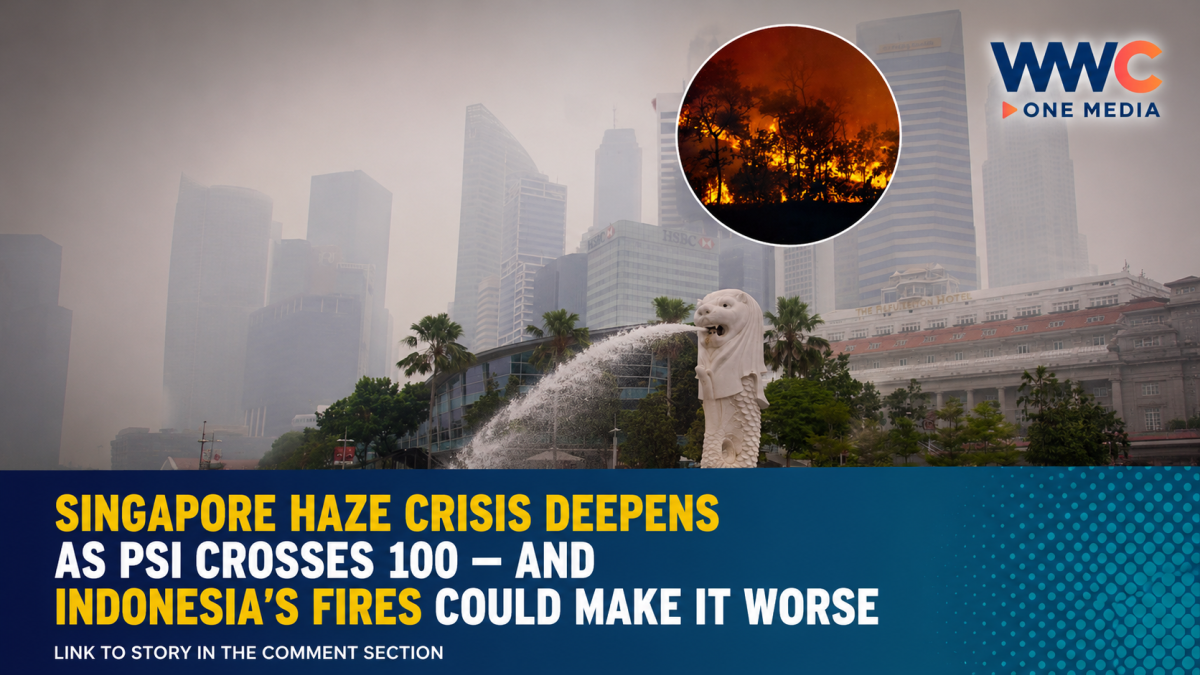
SINGAPORE — Singapore’s haze situation has entered a more serious phase, with air quality in the central region crossing into the unhealthy range as fires continue to burn across parts of Indonesia and dry conditions persist across Southeast Asia.
The National Environment Agency (NEA) recorded a 24-hour Pollutant Standards Index (PSI) reading of 101 in central Singapore at 7am on Friday, September 4, pushing the area into the unhealthy band of 101 to 200. The reading later climbed to 103.
Other parts of Singapore remained in the moderate range, although readings were also elevated.
The development comes as Indonesia struggles to contain widespread forest and land fires that have intensified during an exceptionally dry period associated with a strong El Niño.
Indonesia fires fuel growing regional concern
Reuters reported that Indonesian authorities are inspecting 19 companies linked to fires detected within their concession areas. Satellite monitoring identified fires covering about 11,047 hectares in those concessions, while authorities have identified dozens of companies considered to be at high fire risk.
Indonesia has deployed thousands of personnel and aircraft to fight fires in several provinces, while aerial water-bombing operations and other measures are being used to contain the outbreaks.
The scale of the fires has raised concern beyond Indonesia’s borders.
Reuters reported that nearly 95,000 hectares of land burned in Indonesia in July alone, while satellite data showed more than 9,000 hotspots in August. Carbon emissions from the fires have also surged sharply.
Haze spreads beyond Indonesia
Singapore’s latest conditions are part of a broader regional problem.
NEA reported unhealthy to hazardous air-quality readings at numerous monitoring stations in Kalimantan, central and southern Sumatra, as well as parts of Sabah and Sarawak.
Moderate to dense smoke haze has also been observed over portions of Borneo and the southwestern Philippines.
The agency warned that dry weather is expected to continue across much of the southern ASEAN region in the coming days. That could allow existing fires to persist and increase the risk of additional transboundary haze.
Why the PSI reading matters
Singapore’s 24-hour PSI is calculated using several pollutants, including particulate matter, ozone, sulphur dioxide, nitrogen dioxide and carbon monoxide.
During haze episodes, however, PM2.5 is a particular health concern because the tiny particles can penetrate deep into the respiratory system.
Unlike the one-hour PM2.5 measurement, which reflects conditions at a specific point in time, the 24-hour PSI represents an average over the previous 24 hours and forms the basis for Singapore’s daily health advisories.
NEA said it issues daily haze advisories when the 24-hour PSI enters the unhealthy range.
Singapore activates its haze preparations
Singapore has already maintained an inter-agency haze task force involving 28 public agencies. The group is responsible for coordinating preparations and responses should air quality deteriorate.
The ASEAN Specialised Meteorological Centre had also raised the southern ASEAN region’s haze alert to Level 2 earlier in August, reflecting increasing hotspot activity and the presence of smoke haze over consecutive days.
The current conditions therefore represent more than an isolated pollution episode. They highlight the continuing regional vulnerability to transboundary haze whenever prolonged dry weather combines with vegetation and peatland fires.
The bigger warning
The immediate question is whether the haze will remain localized or worsen across the region.
Indonesia’s firefighting efforts are continuing, but prolonged dry conditions could allow fires to persist. Reuters has reported that the current El Niño has produced exceptionally favorable conditions for wildfire activity, while peatlands can allow fires to burn and smolder for extended periods.
For Singapore and neighboring countries, wind direction, rainfall and the number and location of hotspots will be critical in determining how much smoke crosses national borders.
For now, Singapore’s central region has already crossed the unhealthy threshold.
And with fires still burning across Indonesia and dry weather forecast to persist in parts of Southeast Asia, the region is facing a potentially prolonged haze threat rather than a one-day pollution spike.
The next few days could determine whether Singapore’s current haze episode remains manageable — or becomes a much wider regional air-quality crisis.
WWC ONE MEDIA G.A




Leave a Reply