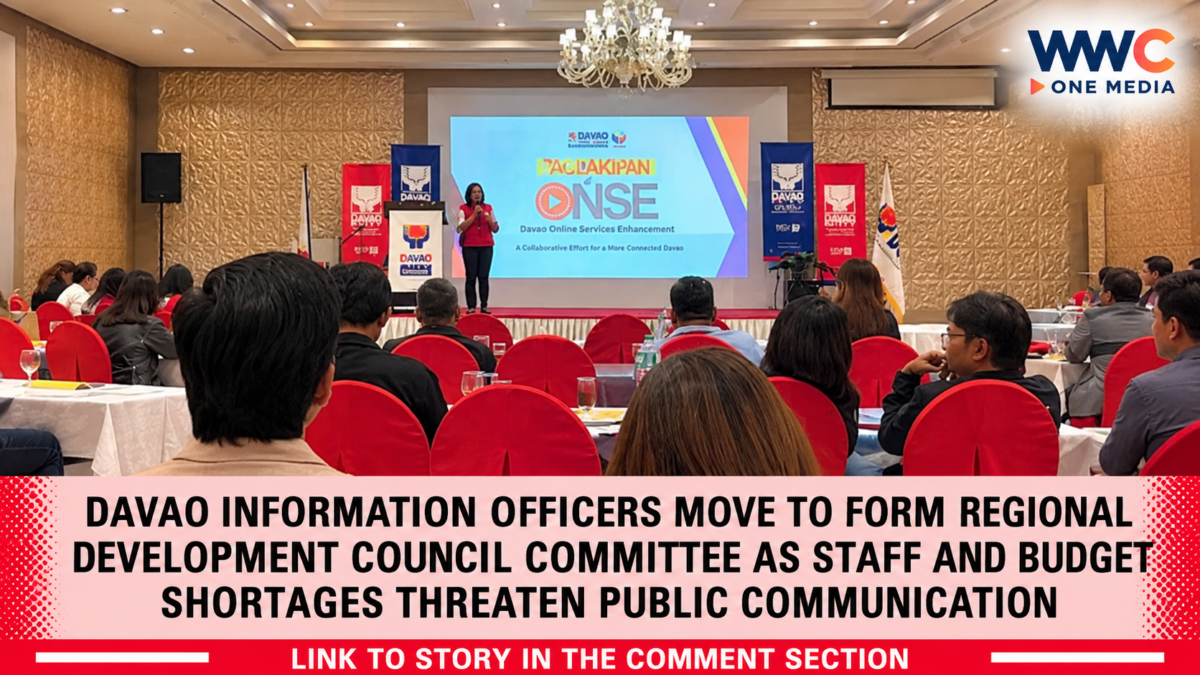
Government information officers across Davao Region are preparing to establish a committee under the Regional Development Council (RDC) after identifying two persistent problems affecting public communication: insufficient personnel and limited funding.
The proposed initiative aims to strengthen coordination among information officers from local government units, national government agencies and other organizations, making it easier for residents to receive accurate, timely and consistent information about government programs and public services.
The plan emerged during the Talakayan sa Onse: Regional Information Officers’ Conference held on November 9, 2026, at The Royal Mandaya Hotel in Davao City. More than 70 information officers, public communicators and representatives from government agencies, schools and the media participated in the gathering organized by the Department of Social Welfare and Development in Davao Region (DSWD-Davao), in partnership with the Philippine Information Agency (PIA)-Davao.
Michelle Franca, DSWD-Davao regional information officer, said the biggest challenge identified by participants was a lack of resources, particularly manpower and budget.
She explained that these limitations affect government offices across the region, making it difficult to sustain communication activities, develop content and respond effectively to public information needs.
To address the problem, PIA-Davao and the Davao Region Information Officers Network are preparing the terms of reference for an ad hoc body that could eventually become an official RDC committee.
The proposal is still being developed. It has not yet become an established RDC committee, and its formal creation will require further coordination and support from regional and local government leaders.
Davao Region Wants a Stronger Network of Government Communicators
The proposed committee is intended to bring government communicators together under a more organized regional structure.
Franca said PIA-Davao and the information officers’ network are working on the necessary terms of reference. The next step will involve seeking support from local chief executives and regional heads of national government agencies.
The goal is to establish a network where information officers can coordinate communication strategies, exchange resources and improve the way government announcements reach communities.
This is particularly important in a region where local government units and national agencies often operate their own communication channels.
Without sufficient coordination, government announcements can become fragmented, duplicated or difficult for residents to verify. A stronger network could help agencies communicate more consistently, especially during emergencies, public-service campaigns and major government initiatives.
Participants were also invited to join a Messenger group intended to connect information officers from national agencies and local government units.
However, creating a group chat is only an initial step. The larger challenge will be establishing a sustainable system with clear responsibilities, adequate resources and continuing institutional support.
Staff Shortages and Limited Budgets Remain Major Obstacles
The conference highlighted a problem that extends beyond Davao Region: government communication offices are expected to reach increasingly connected communities, even when their staffing and operating budgets remain limited.
Information officers are no longer responsible only for writing press releases and documenting official activities.
They are also expected to produce social media content, explain government policies, respond to public inquiries, coordinate with journalists, counter misinformation and communicate during emergencies.
These responsibilities require people with skills in writing, photography, video production, digital communication and public engagement.
For smaller local government units, however, communication work may be assigned to personnel who already have other responsibilities.
This can limit the frequency and quality of public information campaigns, particularly when offices lack dedicated staff, equipment or funding.
The problem is not simply how much information government agencies publish. It is whether residents understand the information, know what action to take and can access the services being announced.
PIA-Davao Offers Training Support to Local Government Offices
While the regional network is being organized, PIA-Davao and DSWD-Davao are offering assistance to offices that want to improve their communication capabilities.
Franca said government offices seeking training for personnel, including newly appointed barangay information officers, can provide the necessary logistical support.
PIA-Davao and DSWD-Davao will help invite experts from their respective agencies to conduct training without charging the participating offices for the trainers.
The proposed training will cover practical communication skills, including content creation and writing.
This arrangement could help smaller offices improve their communication capabilities without immediately requiring them to establish expensive training programs of their own.
However, participating offices will still need to shoulder logistical requirements, meaning that limited budgets could remain an obstacle for some local government units.
A regional communication planning session is also targeted for the first quarter of 2027. PIA-Davao is expected to lead the activity, with support from DSWD-Davao.
Franca emphasized that the immediate priority is to establish the network and maximize resources that government agencies already have.
Information Officers Must Do More Than Post Government Announcements
PIA-Davao Regional Director Rene Carbayas challenged participants to rethink the role of information officers in modern government communication.
He said an information officer should not simply document official events but should help influence public understanding and encourage people to take appropriate action.
Carbayas also urged communicators to avoid depending entirely on social media.
He recommended combining digital platforms with traditional communication channels such as radio, text messages and barangay announcements to reach residents who may not regularly access online information.
His point is particularly relevant to communities with limited internet connectivity or residents who rely on local announcements for updates about government assistance, health services, livelihood opportunities and emergency instructions.
Carbayas also emphasized the importance of measuring the actual impact of communication campaigns rather than focusing only on online engagement.
As he explained during the conference, likes and impressions indicate how widely information has been distributed, but they do not necessarily demonstrate whether people understood or acted on it.
For government agencies, the more important question is whether public communication helps residents access services, understand policies and make informed decisions.
4Ps Communication Takes Center Stage at the Conference
The conference also focused on improving how government agencies communicate the programs and services of the Pantawid Pamilyang Pilipino Program (4Ps).
The morning sessions covered the Kilos-Unlad framework, with presentations from Angeli Nacorda, 4Ps regional case manager, and John Leo Cheng, 4Ps regional monitoring and evaluation officer.
Margie Cabido-Sobretodo, chief of DSWD-Davao’s 4Ps Management Division, also addressed questions and concerns raised by participants about the implementation of the program.
In the afternoon, Johann Claire Bandiola-Bonifacio of DSWD-Davao’s Social Marketing Unit discussed how partner organizations could help communicate the experiences and achievements of 4Ps beneficiaries.
The agency wants to highlight stories involving children who completed their education, passed professional licensure examinations or became employed, as well as families that improved their health and nutrition practices.
Other priority stories include beneficiaries who established businesses, found jobs, became self-sufficient or eventually graduated from the program.
The campaign also seeks to recognize former beneficiaries who have become community leaders and volunteers, along with local government initiatives that provide job opportunities and skills training.
The objective is to present government programs through actual community experiences rather than relying exclusively on announcements and official statistics.
Davao’s Information Network Builds on Earlier Grassroots Communication Efforts
The proposed regional committee is not the first effort to strengthen government communication in Mindanao.
In May 2026, the Philippine Information Agency reported that around 20 government communicators had gathered in Davao City to discuss building a collaborative network among government agencies.
PIA-XI Regional Head Rene Carbayas said fragmented communication among agencies could lead to overlapping messages and information gaps. The proposed network was intended to improve coordination, strengthen communication strategies and help agencies reach communities more effectively.
The initiative also included plans to expand information activities at the barangay level.
A separate PIA report in November 2024 described efforts to strengthen Barangay Information Officer networks in Mindanao, emphasizing their role in bringing accurate government information closer to residents and helping communities recognize misinformation.
Davao Region’s latest initiative therefore builds on an ongoing effort to connect national agencies, local governments and barangay-level communicators.
The challenge now is turning these separate initiatives into a consistent and adequately supported regional system.
Why the Proposal Matters for Ordinary Davao Residents
A stronger network of information officers could have practical consequences for people who depend on government programs.
For families enrolled in 4Ps, better communication could mean clearer explanations of program requirements, available assistance and opportunities for employment or livelihood support.
For residents seeking social services, coordinated information could help them identify the correct government office and understand the documents needed before applying.
For communities facing emergencies, reliable communication across social media, radio, text messaging and barangay announcements could help reduce confusion and misinformation.
However, these benefits will depend on whether government offices can maintain enough trained personnel and provide the resources necessary to operate their communication channels.
The proposal also raises a broader question about the status of information offices in local governments. In a May 2023 report, SunStar highlighted calls from the Information Officers Network Association in Davao del Norte for LGUs to institutionalize information offices with dedicated personnel, physical offices and appropriate operating budgets.
That earlier concern mirrors the problem raised during the November 2026 conference: government communication cannot become more effective if the people responsible for delivering it lack the institutional support to do their jobs.
Related WWC ONE MEDIA Reports on Davao’s Government Modernization Challenges
The proposed information officers’ committee comes amid other efforts to improve government services, digital systems and public access to information.
WWC ONE MEDIA has previously reported on developments connected to these challenges:
- Davao City Set to Become First LGU to Approve Its Own Digital Signatures — Examines Davao City’s plan to reduce administrative delays through digital signatures.
- Government Transactions Still Take Months Despite the 3-7-20 Rule — Explores staffing, technology and coordination problems affecting public services.
- Philippine LGUs Lag in AI Readiness as Skills, Internet and Funding Gaps Hold Back Adoption — Highlights the digital infrastructure and skills shortages confronting local governments.
- Davao Councilor Urges ARTA to Tackle Hospital Aid Delays as Poor Families Face Long Lines and Mounting Medical Bills — Looks at the difficulties residents face when seeking government assistance.
These developments point to a common issue: government modernization requires more than new policies and digital platforms. It also depends on trained personnel, adequate funding, reliable infrastructure and effective coordination.
Davao’s Communication Reform Faces Its Biggest Test in 2027
DSWD-Davao’s November conference brought together more than 70 participants and produced a proposed direction for strengthening regional public communication.
The immediate priorities are to complete the terms of reference, organize the information officers’ network, secure support from local and national government leaders, and provide training opportunities for participating offices.
The first-quarter 2027 communication planning session could help turn those discussions into a more coordinated regional strategy.
But the proposal will face the same obstacles that participants identified during the conference: limited manpower, insufficient budgets and uneven institutional support.
For residents, the success of the initiative should not be measured by the number of meetings held or social media posts published. It should be measured by whether people receive accurate information when they need it, understand the services available to them and can act on that information without unnecessary confusion.
Davao Region is moving toward a more unified government communication system. The real question is whether local and national agencies will provide the people, funding and long-term support needed to make that system work.