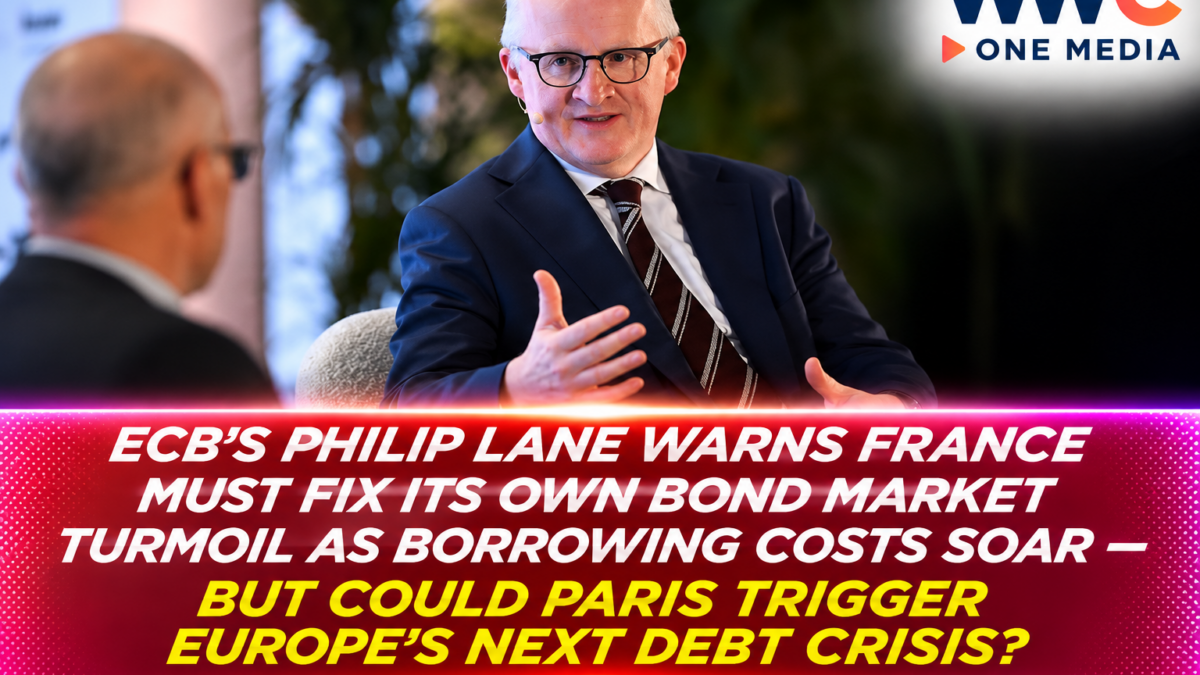
PARIS / FRANKFURT — November 10, 2026 — France’s worsening debt troubles are putting the European Central Bank under growing pressure, but the message from Frankfurt is becoming increasingly clear: Paris cannot expect monetary authorities to solve a financial problem rooted in its own political and budgetary uncertainty.
European Central Bank chief economist Philip Lane has emphasized that uncertainty surrounding France’s government bond market needs to be addressed in Paris, according to Bloomberg’s November 10 reporting.
His reported position comes as investors demand higher returns for holding French government debt, reflecting concerns about persistent budget deficits, mounting public borrowing and political divisions ahead of the country’s 2027 presidential election.
The warning adds to a series of statements from senior European monetary officials who have resisted suggestions that the ECB should immediately intervene to bring French borrowing costs down.
French government bond yields have recently climbed above 5%, their highest levels in roughly 24 years, while the country faces growing pressure to convince investors that its public finances can be stabilized.
For Europe’s second-largest economy, the consequences could be substantial.
Higher borrowing costs threaten to increase debt-servicing expenses, squeeze government spending and complicate efforts to restore economic growth.
But the danger extends beyond France.
If investors lose confidence in the fiscal stability of a major eurozone economy, the effects could spread to other government bond markets, European banks and the wider financial system.
The critical question is whether France can restore credibility through political and budgetary reforms—or whether the European Central Bank will eventually face a financial emergency that threatens the entire eurozone.
Philip Lane Puts Responsibility for French Bond Uncertainty on Paris
The warning attributed to Lane reinforces a fundamental distinction in European economic governance.
The European Central Bank is responsible for maintaining price stability across the eurozone and ensuring that monetary policy operates effectively.
National governments, meanwhile, are responsible for fiscal policies involving taxation, spending and public borrowing.
France’s current bond-market problems are closely linked to domestic political disagreements over how to reduce its deficit and manage its debt.
Investors are concerned that political fragmentation could prevent the government from implementing credible fiscal adjustments.
The approach of the 2027 presidential election adds uncertainty.
Some investors fear that election-related spending commitments or political gridlock could make deficit reduction even more difficult.
This is why the ECB has been reluctant to suggest that higher French bond yields automatically justify central-bank intervention.
If investors are demanding higher returns because of legitimate concerns about France’s public finances, those concerns cannot simply be eliminated through monetary policy.
The primary response must come from the country’s elected government and legislature.
France’s €3.5-Trillion Debt Burden Is Becoming More Expensive
The scale of France’s financial challenges explains why bond investors are increasingly nervous.
Recent reporting places French public debt at approximately €3.5 trillion, equivalent to around 119% of gross domestic product.
The country’s budget deficit has remained well above the European Union’s reference limit of 3% of GDP.
France also faces substantial refinancing requirements.
Its government debt-management agency, Agence France Trésor, plans approximately €340 billion in medium- and long-term bond issuance during 2027, net of buybacks.
That amount includes refinancing needs and should not be confused with the annual budget deficit.
Higher bond yields make this borrowing more expensive.
When existing low-interest government bonds mature, replacing them with new securities carrying higher yields can gradually increase the government’s interest payments.
WWC ONE MEDIA previously examined this challenge in its report on France’s rising borrowing costs and the warning issued by Banque de France Governor Emmanuel Moulin.
Related WWC ONE MEDIA report: France’s Borrowing Costs Near 5% as Central Bank Chief Sounds Alarm — But the Bigger Threat Is a Debt Trap Politics May Struggle to Escape
The danger is not necessarily an immediate inability to borrow.
France continues to access financial markets.
Instead, its problem could become increasingly expensive over time.
As a larger share of government resources goes toward debt servicing, less fiscal room may remain for public services, infrastructure and economic investment.
Why Investors Are Demanding Higher Interest Rates
Government bond yields reflect several factors, including inflation expectations, central-bank policy and perceptions of sovereign credit risk.
In the eurozone, German government bonds are commonly used as a benchmark against which investors compare the borrowing costs of other member states.
The difference between French and German yields is known as the sovereign bond spread.
When that spread increases, investors are demanding additional compensation for holding French debt.
During the October bond selloff, the premium on French 10-year securities rose to approximately 170 basis points over comparable German bonds.
A basis point equals one-hundredth of a percentage point.
A 170-basis-point spread therefore represents a yield difference of 1.70 percentage points.
The widening spread reflects concern about France’s fiscal position and political uncertainty.
It does not automatically mean a sovereign default is imminent.
However, persistently elevated spreads can create financing pressure and undermine investor confidence.
The situation has become serious enough to attract repeated warnings from European officials and international financial institutions.
Christine Lagarde Has Already Told France to Solve Its Own Debt Problems
Lane’s reported comments are consistent with earlier statements from ECB President Christine Lagarde.
On October 14, Lagarde said that France’s fiscal difficulties required domestic policy solutions.
Her remarks followed weeks of bond-market turbulence and speculation about whether the ECB might intervene.
Lagarde emphasized that the responsibility for restoring fiscal confidence rests primarily with France.
The ECB’s message is significant because it limits expectations of an automatic rescue whenever government bond yields rise.
European monetary authorities have instruments designed to address certain forms of financial-market instability.
But those tools are not intended to permanently finance government deficits or shield countries from the consequences of unsustainable fiscal policies.
The distinction is especially important as France struggles to approve a credible budget.
If the government demonstrates a realistic path toward deficit reduction, investor confidence could improve.
If political disagreements continue preventing fiscal adjustments, market pressure may persist.
Could the ECB Activate Its Emergency Bond-Buying Tool?
The European Central Bank established the Transmission Protection Instrument, or TPI, in 2022.
It was designed to address unwarranted and disorderly movements in government bond markets that threaten the transmission of monetary policy across the eurozone.
In principle, the instrument allows the ECB to purchase eligible government bonds under certain circumstances.
However, its use is subject to policy and eligibility considerations.
The ECB evaluates factors such as compliance with European fiscal rules, debt sustainability and the nature of market disturbances.
France faces complications because it is already subject to the European Union’s excessive deficit procedure.
Its large fiscal shortfall and political uncertainty also make it difficult to argue that the entire increase in borrowing costs is unjustified.
Reuters reported in October that policymakers considered an immediate ECB intervention unlikely.
Former ECB president Mario Draghi likewise indicated that the threshold for deploying crisis-fighting measures remains high.
The central bank could potentially respond if a sharp deterioration threatened financial stability or the functioning of monetary policy across multiple eurozone countries.
But such intervention would not eliminate France’s underlying fiscal obligations.
Related WWC ONE MEDIA report: Europe’s Debt-Heavy Governments Bow to Bond Market Pressure — But a Bigger Fiscal Reckoning Could Be Ahead
The broader European debt situation demonstrates why investors are watching government spending and borrowing policies more closely.
ECB Also Faces Inflation at Twice Its Target
France’s debt difficulties come at an especially challenging moment for the European Central Bank.
Eurozone inflation reached approximately 4% in October, twice the ECB’s 2% medium-term objective.
Higher energy costs linked to the Middle East conflict have contributed to renewed inflation pressure.
The ECB has already raised interest rates during 2026 and is considering whether additional tightening will be necessary.
Lane said on November 6 that policymakers would evaluate incoming economic information before making their December decision.
This creates a difficult policy balance.
Higher interest rates may help prevent inflation from becoming entrenched.
But tighter monetary policy can also increase financing costs for businesses, households and governments.
France is particularly vulnerable because of its substantial public debt and refinancing requirements.
Related WWC ONE MEDIA report: Europe’s Inflation Hits 4% as Lagarde Warns Prices Will Stay High for Months — But Could the ECB Raise Interest Rates Again Before Christmas?
The ECB must therefore consider inflation risks alongside the possibility that rising bond yields will weaken economic activity.
However, those competing concerns do not mean that monetary policymakers can simply abandon their price-stability mandate to lower France’s borrowing costs.
Fitch’s Negative Outlook Adds to France’s Financial Pressure
France’s fiscal problems have also attracted greater scrutiny from credit-rating agencies.
On October 30, Fitch Ratings maintained France’s sovereign credit rating at A+ but revised its outlook from stable to negative.
The move reflected concerns about the country’s debt trajectory, fiscal performance and ability to implement reforms.
Fitch projected that French public debt could reach approximately 124% of GDP by 2028.
It also warned that interest expenses could consume an increasing share of national economic output.
A negative outlook does not constitute an immediate rating downgrade.
Instead, it indicates that the balance of risks surrounding the country’s credit profile has deteriorated.
Related WWC ONE MEDIA report: France Faces Fresh Debt Crisis Warning as Fitch Turns Negative and Borrowing Costs Hit 24-Year Highs — But Could a Bigger Downgrade Be Next?
The combination of higher borrowing costs and negative ratings pressure places additional responsibility on French policymakers.
A credible budget could help reassure investors.
But sustained political gridlock or further fiscal deterioration could create additional market volatility.
French Political Gridlock Makes the Crisis Harder to Solve
France’s financial challenges cannot be separated from its political environment.
The government must balance pressure to reduce spending with public opposition to fiscal austerity.
Proposals involving spending restraint, taxation and public-sector reforms have encountered political resistance.
The approaching 2027 presidential election adds another complication.
Political parties are under pressure to respond to voters concerned about living costs, employment, pensions and public services.
These demands can conflict with the need to reduce deficits.
A government that cuts spending too aggressively may face political backlash and slower growth.
A government that fails to control borrowing risks further weakening market confidence.
That is the dilemma confronting Paris.
The ECB can influence eurozone monetary conditions, but it cannot resolve disagreements inside France’s parliament.
Those decisions must ultimately be made through the country’s domestic political institutions.
Could France’s Troubles Spread Across Europe?
The most serious wider risk is contagion.
France is one of the eurozone’s largest economies and a major participant in European financial markets.
Its government bonds are held by banks, investment funds, insurers and international investors.
A severe loss of confidence could affect the valuation of those holdings.
It could also influence risk premiums demanded for government debt issued by other eurozone countries.
Some spillover was already visible during the October selloff, when borrowing costs rose in several other European markets.
However, the financial positions of eurozone governments differ considerably.
Not every country faces the same fiscal pressures.
The immediate risk is not that the entire currency union is automatically entering a sovereign debt crisis.
Rather, the concern is that worsening conditions in one major bond market could undermine confidence and increase financing costs elsewhere.
Investment managers at Robeco warned on November 5 that additional French bond-market stress could complicate the ECB’s interest-rate plans.
They identified wider sovereign spreads, market liquidity and possible spillovers to other eurozone countries as developments worth monitoring.
An ECB Leadership Transition Adds Another Layer of Uncertainty
The French debt debate is unfolding alongside major changes in European Central Bank leadership.
ECB President Christine Lagarde has announced plans to leave her position in February 2027, ahead of the scheduled expiration of her term.
European governments are preparing to choose her successor.
Former Dutch central bank governor Klaas Knot and former Bank of Spain governor Pablo Hernández de Cos are among the leading names being discussed.
The ECB also faces changes involving other senior executive positions, including Lane’s chief economist role, whose term concludes in May 2027.
These appointments could affect perceptions of the central bank’s future policy direction.
However, monetary-policy decisions remain the responsibility of the ECB’s Governing Council.
Leadership changes do not automatically alter the bank’s legal mandate or guarantee a different response to France’s difficulties.
Related WWC ONE MEDIA report: Christine Lagarde to Leave ECB Nine Months Early as Inflation Hits 3.8% — But Who Will Save Europe From Its Next Economic Crisis?
The next ECB president could inherit a complicated environment involving elevated inflation, fragile growth and persistent sovereign debt concerns.
Why France’s Bond Crisis Matters Beyond Europe
Financial instability in a major European economy can affect international markets.
A prolonged French bond selloff could influence the euro, European banking shares and global investor demand for government securities.
Higher sovereign borrowing costs can also affect corporate financing because government yields help establish benchmarks for other debt instruments.
International investors may respond by changing the allocation of their portfolios.
These decisions could influence global capital flows and financial conditions.
For emerging markets, including the Philippines, developments in Europe matter partly through their effects on investor confidence and international interest rates.
However, a direct impact on Philippine borrowing costs or the peso cannot be assumed from French bond movements alone.
Domestic economic fundamentals, US monetary policy and global risk appetite also play important roles.
The principal international concern is whether financial-market stress remains contained within France or spreads more broadly.
What Happens Next for France and the European Central Bank?
Several developments will determine how the situation evolves.
The first is whether French policymakers can approve a credible 2027 budget.
The second is whether investors begin demanding even higher risk premiums for French government bonds.
The third involves the European Central Bank’s December interest-rate decision.
If inflation remains elevated, further monetary tightening could complicate borrowing conditions.
Conversely, worsening financial instability could lead policymakers to reassess how additional rate increases might affect the wider eurozone economy.
Investors will also monitor sovereign credit ratings, European bank shares and the direction of bond spreads.
The 2027 French presidential election will remain another important source of political uncertainty.
The ECB has tools to respond to certain forms of financial-market disruption, but it continues emphasizing the importance of credible domestic fiscal policies.
For France, the most immediate challenge is restoring confidence before borrowing costs become still more difficult to manage.
The Bigger Picture: Paris Cannot Simply Wait for Frankfurt to Solve Its Problems
The message emerging from European monetary officials is increasingly consistent.
France must demonstrate that it has a credible strategy for managing its public finances.
Its large economy, deep financial markets and eurozone membership remain important strengths.
But those advantages do not eliminate the consequences of persistent deficits, rising public debt and political uncertainty.
Higher bond yields are already increasing pressure on the government.
Credit-rating agencies are watching the country’s fiscal trajectory more closely.
And the European Central Bank is reluctant to suggest that it will intervene simply because investors have become more demanding.
A financial crisis is not inevitable.
France retains access to capital markets and significant economic resources.
Nevertheless, confidence can become increasingly expensive to maintain when governments fail to resolve structural fiscal problems.
Philip Lane’s reported warning places the responsibility where European policymakers believe it belongs: with France’s political leadership.
The question is whether Paris can deliver a credible solution before investors demand an even greater premium for financing its debt.
And if French borrowing costs continue climbing while political divisions deepen, will the European Central Bank maintain its distance—or could Europe’s second-largest economy eventually force Frankfurt into the toughest financial rescue decision since the eurozone debt crisis?