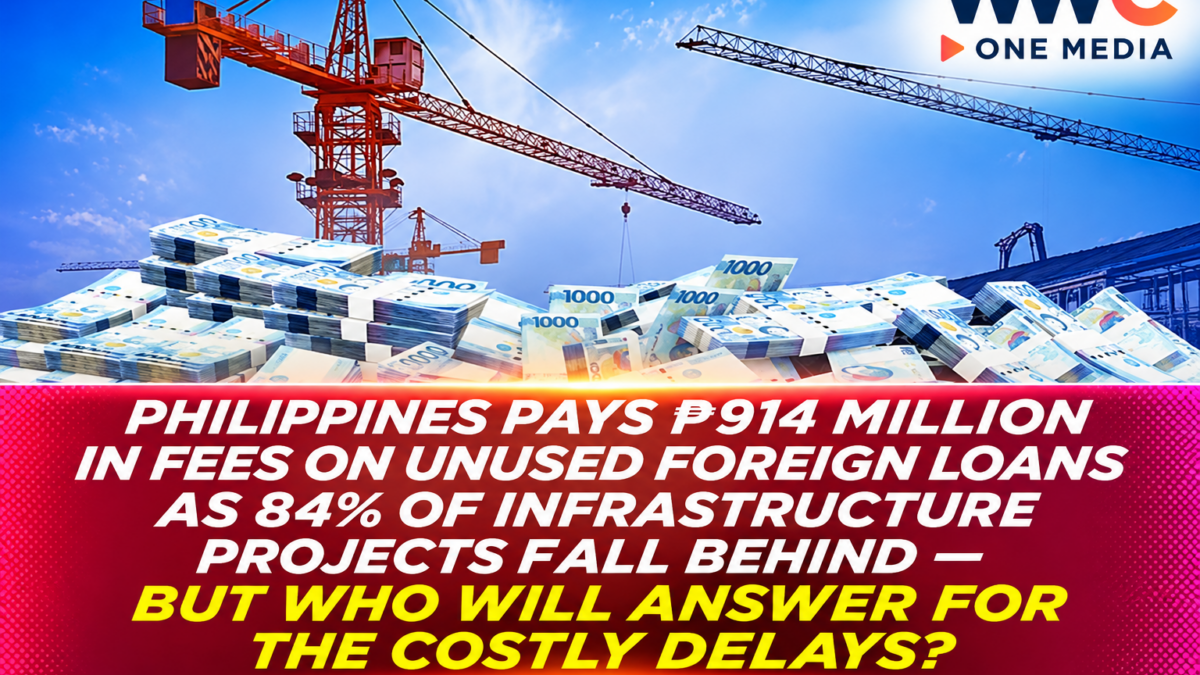
MANILA, PHILIPPINES — November 10, 2026 — The Philippine government incurred nearly ₱914 million in charges on foreign loans that had not yet been fully utilized in 2025, even as a staggering 84% of the ongoing foreign-assisted projects reviewed by state auditors failed to meet their scheduled progress targets.
The findings raise fresh questions about how billions of pesos in infrastructure financing are being managed, particularly as Filipinos continue waiting for roads, bridges, transportation systems and water facilities promised under major government development programs.
According to the Commission on Audit (COA), the government incurred ₱913.94 million in commitment fees on undrawn foreign loans during 2025.
More troubling, seven loans that recorded absolutely no drawdowns still generated ₱150.62 million in commitment fees.
That means the government incurred charges for keeping financing available even though none of the funds under those seven loans had been released.
The audit also found that 52 of 62 ongoing foreign loan-funded projects reviewed had missed their progress targets by the end of 2025.
The stalled or delayed projects included major transport and water infrastructure developments such as the Cebu Bus Rapid Transit, EDSA Greenways, Davao Public Transport Modernization, Bataan-Cavite Interlink Bridge and Kaliwa Dam.
For taxpayers, the central concern is straightforward: Why is the government continuing to incur financing costs when so many projects are struggling to move forward?
And with billions more earmarked for infrastructure development, can public agencies prevent the same delays from repeating?
COA Reveals ₱913.94 Million in Foreign Loan Commitment Fees
The latest findings were disclosed in COA’s 2025 Consolidated Audit Report on Official Development Assistance-Funded Programs and Projects, released in October 2026.
The report examines how government agencies managed projects funded through loans from international development partners.
These financing arrangements help the Philippines build infrastructure that may require substantial capital beyond immediately available public funds.
Foreign-assisted projects can support transport modernization, water security, flood protection and other long-term development priorities.
However, financing comes with contractual obligations.
One of these is the commitment fee.
This charge is imposed by lenders for maintaining funds that borrowers have agreed to access but have not yet withdrawn.
Unlike interest, which is generally charged on disbursed loan principal, commitment fees apply to specified undrawn loan balances under the relevant agreements.
The fees compensate lenders for making financing available.
They are not automatically evidence of corruption or illegal spending.
However, when projects are delayed and loan proceeds remain unused for extended periods, commitment fees become an additional cost without the planned infrastructure benefits arriving on schedule.
The COA findings show that this has become a persistent concern for Philippine government finances.
Seven Loans Generate ₱150.62 Million in Fees Without a Single Drawdown
One of the audit’s most striking findings concerns seven foreign loans that registered zero drawdowns.
Despite the absence of fund releases, these loans generated ₱150.62 million in commitment fees.
The financing supported six infrastructure projects, including several major transportation developments.
Among the projects identified were the Cebu Bus Rapid Transit, EDSA Greenways, Davao Public Transport Modernization and Bataan-Cavite Interlink Bridge.
The finding does not mean these projects received no government spending from any source.
It means the seven specific foreign loans identified by auditors had recorded no drawdowns during the period examined.
That distinction matters because some developments may have separate financing arrangements, government counterpart funding or work carried out under other contracts.
Nevertheless, the result exposes a financial problem.
Borrowing arrangements were established, but the government had not reached the point of utilizing the financing.
Meanwhile, commitment charges continued accumulating under the loan agreements.
For taxpayers, those charges represent funds that could otherwise have supported public priorities.
The central issue is whether agencies can improve project readiness before committing to additional financing.
Why 84% of Foreign-Funded Projects Missed Their Targets
COA reviewed 62 ongoing foreign loan-funded projects and found that 52 had fallen behind their scheduled progress targets by the end of 2025.
That represents approximately 83.9%, rounded to 84%.
The scale of the problem indicates that implementation delays are not confined to one agency or development.
Auditors identified recurring obstacles involving procurement, right-of-way acquisition, contractor performance and project design.
These issues can become interconnected.
A project may secure international financing before all necessary land has been acquired.
Contractors may then be unable to begin construction in certain areas.
Design changes can create additional procurement requirements.
Disputes over compensation, environmental permits or technical specifications can delay work further.
When projects are postponed, the financial consequences may extend beyond commitment fees.
Construction materials can become more expensive, equipment costs may change and contractors may seek adjustments to schedules.
The public also loses the economic and social benefits expected from completed infrastructure.
For commuters, that can mean longer travel times.
For businesses, it can mean continued logistics problems.
And for communities relying on water or flood-control improvements, delays can prolong exposure to existing risks.
Cebu Bus Rapid Transit Becomes a Warning Sign
The Cebu Bus Rapid Transit project is among the clearest examples of the problem.
Designed to improve public transportation in Cebu, the BRT system has faced years of difficulties involving land acquisition, procurement and project implementation.
According to the COA findings cited by Bilyonaryo, the project had achieved only 11.43% physical completion by the end of 2025.
It had also accumulated approximately ₱82.07 million in commitment fees.
The Department of Transportation sought the cancellation of undrawn loan commitments under three loans in November 2025.
However, lender approval remained pending at year-end.
The project’s difficulties extended into 2026.
In September, affected Cebu property owners were still awaiting compensation for land acquired or cleared for the transportation development.
As WWC ONE MEDIA reported in its coverage of unpaid Cebu BRT landowners and the approaching World Bank financing deadline, unresolved right-of-way claims remained a significant challenge.
The World Bank-supported project was subsequently restructured, including cancellation of portions of its original financing and removal of certain construction packages from that funding arrangement.
These developments illustrate how unresolved land acquisition can affect both construction progress and the financing structure of a major public transportation project.
The audit’s 11.43% completion figure refers to the position at the end of 2025 and should not be presented as the project’s confirmed physical completion rate in November 2026.
EDSA Greenways and Davao Transport Modernization Also Face Delays
The audit also flagged foreign loans associated with the EDSA Greenways project and the Davao Public Transport Modernization Project.
Both initiatives were intended to improve transportation infrastructure.
EDSA Greenways was designed to strengthen pedestrian connectivity around major Metro Manila railway stations.
The Davao modernization initiative aimed to improve public transportation through a more integrated and efficient system.
However, financing availability has not automatically translated into timely construction.
In September 2026, Senate President Sherwin Gatchalian questioned approximately ₱295 million in commitment fees linked to delayed foreign-assisted transport projects.
During Department of Transportation budget discussions, he urged agencies to examine projects that had not progressed sufficiently and consider whether unused loan commitments should be retained.
The senator’s concerns reinforce the broader findings in COA’s consolidated audit.
However, the ₱295-million figure discussed during the Senate hearing should not simply be added to COA’s ₱913.94-million total.
The two figures arise from different reporting exercises and may cover overlapping loans and periods.
Without a reconciliation of their underlying data, adding them together could overstate the government’s costs.
Bataan-Cavite Bridge Raises Questions About Project Readiness
The proposed Bataan-Cavite Interlink Bridge is another major development identified among projects associated with undrawn foreign financing.
The bridge is intended to create a direct road connection across Manila Bay between Bataan and Cavite.
If completed, it could significantly reduce travel times between the two provinces and create additional opportunities for trade, tourism and regional investment.
However, large bridge projects require extensive planning.
Engineering teams must assess seabed conditions, foundations, maritime navigation requirements, environmental impacts and complex construction logistics.
Land acquisition and procurement can also influence the schedule.
The project’s inclusion in COA’s findings highlights the need to distinguish between securing financing and achieving construction readiness.
A signed loan agreement is not proof that a bridge has been built.
Likewise, a project appearing among loans with zero drawdowns does not establish that all engineering or preparatory activities have stopped.
For investors and taxpayers, the priority should be understanding the actual status of construction packages, funding releases and remaining approvals.
Government Cancels ₱15.59 Billion in Foreign Loan Commitments
COA also reported approximately ₱15.59 billion in reductions to foreign loan commitments across 10 official development assistance loans during 2025.
These reductions included roughly ₱9 billion connected with two stalled infrastructure developments.
The affected commitments included:
Angat Water Transmission Improvement Project — ₱6.18 billion
The project encountered difficulties involving contractor performance and procurement.
The initiative was intended to support improvements in water transmission infrastructure.
Metro Manila Interchange Construction Project Phase VI — ₱2.82 billion
The project experienced prolonged setbacks involving design conflicts, rail alignment issues and unsuccessful bidding.
According to the audit findings, work had advanced only to consultancy-related activities roughly a decade after the loan became effective in 2015.
The cancelled balance represented 94.92% of the original loan commitment.
The scale of these reductions shows how financing plans may have to be revised when implementation repeatedly fails to advance.
However, cancelling an undrawn loan commitment is different from losing the entire amount in cash.
The ₱15.59 billion refers to reductions in available financing commitments, not ₱15.59 billion in commitment fees or proven cash losses.
The actual financial consequences depend on previously incurred charges, any applicable cancellation costs and the arrangements used to finance remaining work.
Kaliwa Dam’s China-Funded Loan Closes Before Project Completion
The audit also raised concerns about the Kaliwa Dam project, a major water infrastructure initiative intended to strengthen supply for Metro Manila and nearby areas.
According to Bilyonaryo’s account of the COA report, the China-funded loan closed in May 2025 before the planned construction work had been completed.
The government had sought an extension from China Eximbank, but agreement was not secured before the financing closed.
The Metropolitan Waterworks and Sewerage System subsequently proposed that private water concessionaires finance the remaining 85% of the civil works contract.
The financing difficulty illustrates how construction delays can create consequences beyond additional charges.
When an international loan closes before completion, the implementing agency must identify another source of funding or revise the project.
That can complicate contracts, financing arrangements and the expected completion timetable.
However, the closure of the original loan does not automatically mean the entire dam project has been abandoned.
The status of the civil works and any replacement financing must be assessed separately.
For Metro Manila, the issue is especially consequential because long-term water security depends on infrastructure that can reliably deliver additional water resources.
Delayed Infrastructure Could Add Pressure to Philippine Economic Growth
The financial impact of delayed public construction is becoming more important as the Philippine economy faces a difficult period.
Recent economic figures show that infrastructure activity has been a source of weakness.
In related reporting, WWC ONE MEDIA examined the Philippine economy’s slowdown to 2.1% growth in the third quarter of 2026, alongside a continued contraction in public construction.
That economic slowdown cannot be attributed exclusively to the delayed ODA projects identified by COA.
Growth depends on many factors, including consumption, investment, inflation, interest rates and trade conditions.
However, slow implementation of major infrastructure programs can weaken economic activity.
Construction generates demand for materials, equipment, professional services and labor.
Completed infrastructure can also improve the movement of goods and people.
When projects remain unfinished, these benefits arrive later than planned.
The country’s challenge is therefore not only securing financing from international development partners.
It is ensuring that public agencies can deliver the promised infrastructure efficiently.
A ₱644 Billion Public Works Budget Raises the Stakes
The audit findings are particularly relevant as the government prepares its infrastructure spending program for 2027.
The Department of Public Works and Highways has proposed approximately ₱643.95 billion in funding for next year.
The proposal represents a substantial increase from its 2026 allocation.
Public Works officials have also discussed improving multi-year project financing to reduce disruptions caused by annual budget processes.
These proposals are relevant to the audit findings because incomplete project preparation and uncertain funding can contribute to implementation problems.
But a larger budget does not automatically improve performance.
Agencies must demonstrate that projects are ready to proceed, contractors can deliver and the required land and permits are available.
The proposed 2027 allocation remains subject to congressional approval.
The government’s success should ultimately be measured by completed infrastructure and actual public benefits, not simply the size of spending commitments.
Right-of-Way Problems Remain a Major Infrastructure Obstacle
The acquisition of land and relocation of existing utilities are recurring challenges in Philippine infrastructure development.
Major roads, bridges and railway lines often cross densely populated or already developed areas.
Construction may require private property acquisition, compensation negotiations and the relocation of pipelines, cables and drainage facilities.
These tasks can be time-consuming.
In some cases, contractors cannot proceed with important construction activities until the affected areas have been cleared.
A separate example is the Metro Manila Subway.
As WWC ONE MEDIA reported on the relocation of major Manila Water pipelines along the subway route, utility relocation must be coordinated with underground railway construction while protecting existing water services.
The subway is a separate project from those individually flagged in the latest COA findings.
Nevertheless, it demonstrates the technical complexity that can arise when major infrastructure is built in established urban areas.
Better early-stage coordination among implementing agencies, local governments, landowners and utility operators may help reduce avoidable delays.
Senate Budget Debate Highlights the Cost of Delayed Foreign Projects
Lawmakers are also raising concerns about how delayed budgets and uncertain funding arrangements may affect foreign-assisted infrastructure.
Senator JV Ejercito has warned that interruptions to financing could create additional costs for projects already covered by international loan agreements.
In related coverage, WWC ONE MEDIA examined the debate over Senate budget reductions and warnings that delayed foreign-assisted projects could accumulate further financial obligations.
The issue illustrates an important policy trade-off.
Government agencies should not continue borrowing indefinitely for projects that cannot be implemented.
But cancelling or delaying financing without a workable alternative can also create contractual and development consequences.
The appropriate response depends on each project’s economic value, implementation status and remaining requirements.
A project facing temporary delays may still be worth completing.
Another project with persistent design, financing or procurement failures may require restructuring or cancellation.
Making those decisions early can help reduce unnecessary costs.
Why Commitment Fees Are Not the Same as Corruption
A critical distinction in the COA findings concerns the nature of commitment fees.
These are contractual charges imposed by lenders for maintaining undrawn financing.
They are not the same as illicit commissions, kickbacks or bribes.
The fact that the government incurred ₱913.94 million in commitment fees does not, by itself, establish that officials stole that amount.
Similarly, missing a construction target does not automatically prove fraud.
Some delays arise from legitimate engineering, environmental, procurement or land acquisition difficulties.
However, repeated delays may indicate weaknesses in planning, coordination or project management.
Auditors and oversight bodies must determine whether individual agencies complied with applicable rules and whether preventable problems were adequately addressed.
Accountability should therefore be based on documented decisions, contractual obligations and actual performance.
The issue is not whether every delayed project involves wrongdoing.
It is whether the government has taken reasonable steps to prevent avoidable financial costs and deliver infrastructure on time.
Government Urged to Review Projects That Cannot Move Forward
COA recommended improvements in project preparation, contractor evaluation, fund releases and implementation monitoring.
The Department of Economy, Planning, and Development has also called for a review of projects experiencing persistent problems.
The objective is to determine whether those developments should be restructured, redesigned or terminated.
These recommendations reflect a broader lesson from the audit.
A project should not be judged solely by the availability of financing.
Before entering into major loan agreements, agencies must assess whether the project is technically prepared, financially viable and ready for implementation.
They must also consider whether procurement procedures, right-of-way arrangements and other approvals can be completed within the planned timetable.
Once financing is secured, agencies need reliable monitoring systems capable of identifying emerging delays before they become severe.
For projects that remain stalled, the government should compare the cost of continuing with the potential consequences of restructuring or cancellation.
Such decisions require careful evaluation.
But allowing financing charges to accumulate indefinitely without a credible implementation plan is difficult to justify.
What Taxpayers and Lawmakers Should Watch Next
The latest audit presents several important questions for government agencies.
First: What happened to the projects that missed their 2025 targets?
The public needs updated implementation figures rather than relying solely on year-end audit findings.
Second: How many of the seven loans with zero drawdowns have since been utilized, cancelled or restructured?
Updated financing information would clarify whether commitment fees are still accumulating.
Third: What progress has been made on Cebu BRT, EDSA Greenways and Davao Public Transport Modernization?
Each project needs a realistic timetable supported by actual construction and procurement milestones.
Fourth: How will the government finance the remaining Kaliwa Dam works?
The closure of its China-funded loan makes replacement financing and project implementation particularly important.
Fifth: Can future borrowing agreements be coordinated more effectively with project readiness?
Stronger preparation could reduce the gap between signing loans and using the funds.
Finally: Will COA’s recommendations lead to measurable reforms?
The ultimate test will be whether commitment fees fall, projects meet milestones and public infrastructure is completed without unnecessary additional costs.
The Bigger Picture: Filipinos Are Paying for Delays Before They Receive the Benefits
The Philippine government’s ₱913.94-million commitment-fee burden is more than an accounting concern.
It illustrates the financial consequences of slow infrastructure execution.
State auditors found that 52 of the 62 ongoing foreign loan-funded projects they reviewed failed to meet their 2025 progress targets.
Seven loans recorded no drawdowns while generating ₱150.62 million in charges.
Major developments involving roads, bridges, public transportation and water infrastructure faced continuing implementation challenges.
And the government reduced foreign loan commitments by ₱15.59 billion across ten loans as financing arrangements were revised.
The findings show that securing international financing is only one step toward delivering infrastructure.
The benefits arrive when projects are actually completed and begin serving communities.
For the government, the challenge is to align borrowing with realistic project schedules, competent contractors and timely implementation.
For lawmakers, the responsibility is to ensure oversight and funding decisions support effective delivery.
For taxpayers, the expectation is simpler: money committed to public infrastructure should produce results.
The Philippines has already incurred nearly ₱914 million in charges on undrawn foreign loans while most of the audited projects missed their targets. But as billions more are planned for roads, bridges, transit systems and water facilities, will the government finally fix its infrastructure bottlenecks—or will Filipino taxpayers continue paying for projects that remain unfinished?