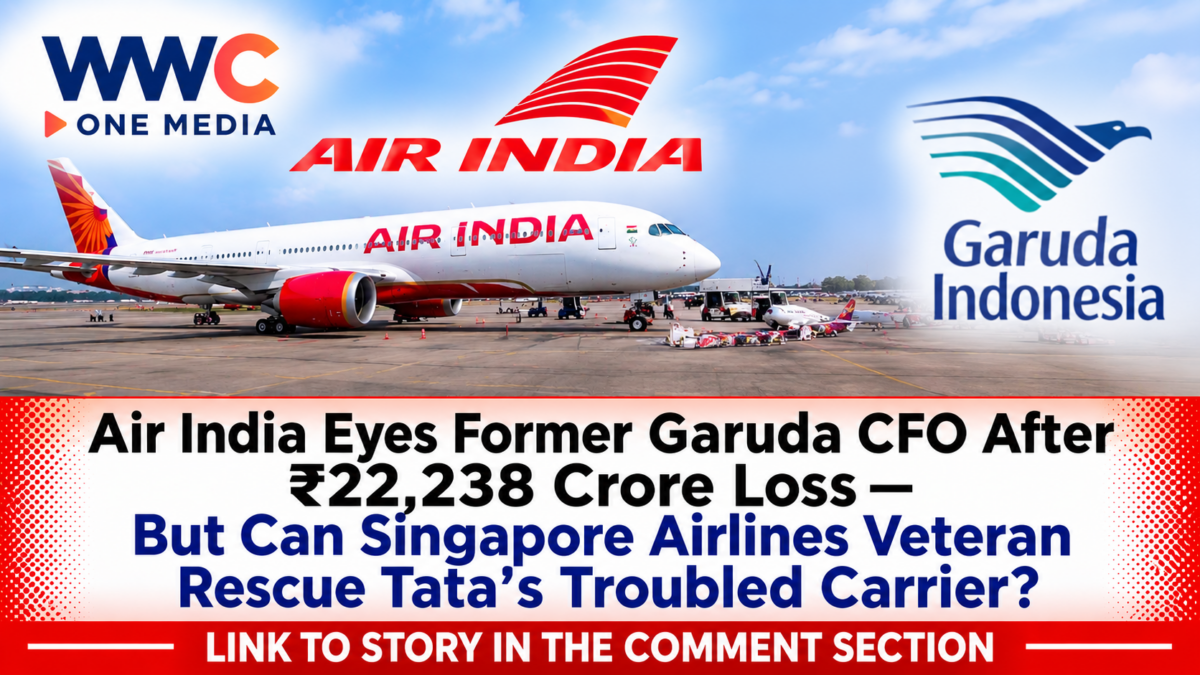
NEW DELHI / JAKARTA — November 10, 2026 — Air India is considering appointing Balagopal Kunduvara, the former chief financial officer of Garuda Indonesia and a longtime Singapore Airlines executive, as its next finance chief as the Tata-controlled carrier battles record losses, rising operating expenses and growing pressure to secure fresh funding.
The potential appointment comes just days after Kunduvara resigned from Garuda Indonesia on November 6, ending a tenure of slightly more than one year.
According to Bloomberg’s November 9 report, Kunduvara has emerged as a frontrunner for the senior position, although Air India has not publicly announced a final appointment.
The timing is critical.
Air India Group reported a ₹22,238 crore consolidated loss for the financial year ended March 2026, more than double the previous year’s loss of ₹10,859 crore, according to financial figures reported by Mint.
The airline is also seeking approximately ₹10,000 crore, or $1.1 billion, in additional financial support from its shareholders, according to Bloomberg.
Meanwhile, Singapore Airlines, which owns approximately one-quarter of Air India alongside Tata Group, is demanding greater financial discipline as its investment continues to weigh on earnings.
New Air India chief executive Tewolde Gebremariam is attempting to cut costs, improve international operations and strengthen the carrier’s underperforming cargo business.
Kunduvara’s experience at Singapore Airlines and Garuda could make him an important part of that transformation.
But the financial challenges are substantial.
As Air India searches for a new finance chief while seeking another billion-dollar funding lifeline, can Kunduvara help turn one of Asia’s most ambitious airline transformations into a profitable business—or will soaring costs and geopolitical disruption overwhelm the recovery?
Air India Considers Balagopal Kunduvara for CFO Role
Bloomberg reported that Air India is considering Kunduvara for its chief financial officer position, citing people familiar with private discussions.
The executive is reportedly among the leading candidates.
However, the process has not been publicly finalized.
An Air India spokesperson did not immediately respond to Bloomberg’s request for comment.
That means Kunduvara should not yet be described as the airline’s appointed or incoming CFO.
His candidacy is significant because of his extensive experience in the Asian aviation industry.
Before joining Garuda Indonesia, Kunduvara spent approximately 25 years at Singapore Airlines.
His most recent position there was divisional vice president of financial services.
He subsequently became Garuda Indonesia’s director of finance and risk management in October 2025.
His career has included financial management responsibilities at airlines operating across international markets.
Air India is now considering whether that experience could support its own restructuring.
Garuda Indonesia Confirms Kunduvara’s Departure
Kunduvara resigned from Garuda Indonesia effective November 6.
He publicly confirmed the move through a LinkedIn announcement on November 8.
Indonesian financial publications, including CNBC Indonesia, Bisnis.com and Bloomberg Technoz, reported the resignation on November 9.
Garuda also confirmed his departure to Bloomberg.
Kunduvara had taken office on October 15, 2025, following an extraordinary general meeting of shareholders.
His appointment formed part of Garuda Indonesia’s broader restructuring and financial transformation.
Although his tenure was relatively brief, he said he had worked with the company’s teams to strengthen financial discipline and build a foundation for sustainable growth.
His departure does not, by itself, establish that Garuda’s restructuring failed.
Nor does the resignation confirm that he has accepted a position at Air India.
The timing has nevertheless attracted attention because it coincides with Air India’s search for an experienced finance executive.
Air India’s ₹22,238 Crore Loss Reveals the Scale of the Crisis
The most important reason behind the leadership search is Air India’s difficult financial position.
The carrier and its low-cost operations have faced substantial losses despite the Tata Group’s multibillion-dollar modernization program.
For fiscal 2025–26, Air India Group reported consolidated losses of approximately ₹22,238 crore.
That compares with ₹10,859 crore during the previous financial year.
The deterioration reflects the combined effects of high operating expenses, route disruptions, aircraft-related costs and weaker-than-expected international performance.
Singapore Airlines’ financial disclosures independently demonstrate the severity of the situation.
Its annual financial statements reported substantial Air India losses using Singapore-dollar accounting figures.
Those figures are not directly interchangeable with Air India’s rupee-denominated consolidated results because the disclosures use different accounting presentations and currency treatments.
Nevertheless, both sets of reporting point to major financial strain.
For any incoming CFO, reducing losses while maintaining the investment necessary to modernize the airline would be an immediate priority.
Air India Seeks Another $1.1 Billion From Shareholders
Air India is also trying to secure fresh capital.
Bloomberg reported that the airline is seeking ₹100 billion, equivalent to approximately $1.1 billion, from its owners.
Tata Group holds approximately 74.9% of Air India, while Singapore Airlines owns about 25.1%.
The funding request highlights the financial requirements of a carrier undergoing an extensive operational transformation.
New aircraft, cabin refurbishment, maintenance systems, technology and employee training all demand significant investment.
But shareholder funding is not automatically available simply because management requests it.
The size, structure and conditions of any capital injection must be agreed by the relevant parties.
Earlier Reuters reporting in August described a larger request of approximately $1.5 billion.
The differences between reported amounts may reflect evolving financing discussions or different proposals.
The figures should not be combined into a single new funding commitment.
As of November 10, the sources reviewed do not establish that the latest $1.1 billion request has been fully approved and paid.
Singapore Airlines Wants Greater Financial Control
The involvement of Singapore Airlines is especially important.
The airline became a significant shareholder in Air India after the integration of Vistara into the Indian carrier.
Its investment gives it exposure to India’s expanding aviation market.
But the financial consequences have been substantial.
Singapore Airlines reported that its share of Air India’s losses weighed heavily on group profitability during fiscal 2025–26.
According to Reuters’ September reporting, Singapore Airlines was expected to seek stronger governance rights and greater management influence before agreeing to further financial support.
Possible conditions included additional board voting influence and requirements to reduce losses.
Those were reported negotiating positions, not an announced final agreement.
The potential appointment of Kunduvara, who spent decades working at Singapore Airlines, could add an executive familiar with the shareholder’s financial-management approach.
However, it would not necessarily mean Singapore Airlines had taken control of Air India’s finance department.
WWC ONE MEDIA previously explored the wider controversy in Singapore’s Air India Fight Takes a Sharper Turn — Kenneth Tiong Responds After Shanmugam’s Racism Warning.
That report also examined the financial risks facing Singapore Airlines through its investment in Air India.
New CEO Tewolde Gebremariam Is Leading the Turnaround
Air India’s finance leadership search comes during a major management transition.
The airline is now led by chief executive Tewolde Gebremariam, the former head of Ethiopian Airlines Group.
Tewolde has extensive experience managing a major international carrier.
He is seeking to improve efficiency, strengthen profitability and expand Air India’s role in international aviation.
Reuters reported on November 3 that the chief executive is considering additional wide-body aircraft to support international growth.
Air India has held discussions with Airbus and Boeing about potentially increasing its aircraft orders.
But adding planes requires financial resources.
New aircraft may improve fuel efficiency and reduce maintenance expenses compared with older models.
They also involve significant capital commitments, financing costs and delivery schedules.
The challenge is deciding which investments can deliver the strongest long-term returns while reducing immediate financial pressure.
A new CFO would be central to those decisions.
Pakistan’s Airspace Restrictions Are Increasing Costs
One of Air India’s biggest operating challenges is the closure of Pakistani airspace to Indian airlines.
The restriction forces certain westbound flights departing from New Delhi to follow longer routes.
Those detours can increase flying time, fuel consumption and operating expenses.
They may also affect aircraft availability and scheduling.
For long-haul routes to Europe and North America, additional flying time can materially influence operating economics.
Tewolde is reportedly evaluating whether routing more services through Mumbai could reduce some of the disruption.
However, such adjustments involve trade-offs.
They may affect connecting passengers, airport capacity, crew assignments and aircraft rotations.
A different departure hub is not automatically a complete solution.
Air India’s finance team must assess the cost of each alternative against expected passenger demand and revenue.
Middle East Conflict Raises Fuel Costs and Disrupts Demand
Air India is also navigating the impact of the Iran conflict and wider Middle East instability.
International airlines have faced elevated fuel costs and disruptions to routes serving the region.
Fuel is one of the largest variable expenses in airline operations.
A sustained increase can significantly affect profitability, particularly when competitive conditions make it difficult to raise ticket prices.
Reduced traffic on some Middle Eastern routes has added to the pressure.
The combination is especially difficult for airlines already investing heavily in aircraft and operational modernization.
Higher fuel expenses consume cash that could otherwise support maintenance, debt obligations or future growth.
The challenge extends beyond Air India.
Singapore Airlines and other major international carriers have also faced pressures related to energy costs and changing air routes.
For Kunduvara, if appointed, managing exposure to fuel prices and financial risks would be central to the position.
The 2025 Air India Crash Adds Another Challenge
Air India’s restructuring is also taking place against the backdrop of the June 2025 Boeing 787 crash in Ahmedabad, which killed 260 people.
The disaster triggered heightened scrutiny of safety, operating procedures and regulatory oversight.
It also affected the carrier’s reputation and international operations.
Aviation safety and financial performance are different responsibilities, but they interact.
Investment in maintenance, training, modern aircraft and operational systems is essential even when a company is under pressure to reduce costs.
Air India cannot solve its financial difficulties by compromising safety standards.
WWC ONE MEDIA previously examined a separate operational incident in Air India Flight Plunged Nearly 300 Feet—Then Investigators Found Something Else in the Cockpit.
That report covered an unrelated August 2026 flight incident involving a temporary loss of hydraulic pressure and an ongoing safety investigation.
Neither incident should be attributed to a prospective CFO.
However, both illustrate the importance of maintaining adequate resources for airline operations while pursuing financial efficiency.
Air India and Air India Express Could Share More Operations
Another part of the turnaround involves closer cooperation between Air India and its low-cost subsidiary, Air India Express.
The group has already consolidated its former airline brands.
It is now examining opportunities to integrate selected administrative and operational functions.
According to The Financial Express, Air India’s board has approved deeper cooperation in principle across areas such as procurement, technology, administration, engineering management and maintenance resources.
The objective is to eliminate duplication and improve efficiency.
For example, shared purchasing arrangements could strengthen the group’s negotiating position with suppliers.
Common systems may reduce administrative costs and improve coordination.
But integration also requires careful execution.
The two airlines serve different market segments and operate different business models.
Cost reductions must not undermine operational flexibility or the customer experience.
A CFO would help assess which functions should be integrated and how the resulting savings should be measured.
Cargo Could Become Another Revenue Opportunity
Tewolde is also examining ways to improve Air India’s cargo operations.
Air freight can be an important source of airline revenue, particularly on international routes.
Passenger aircraft often transport cargo in their lower-deck compartments.
Dedicated freight operations may provide additional opportunities.
India’s expanding manufacturing and export sectors could support long-term air-cargo demand.
However, cargo profitability depends on freight rates, aircraft capacity, route networks and competition.
Expanding cargo operations requires more than carrying additional shipments.
The airline must attract customers, develop efficient handling systems and ensure routes generate sufficient revenue to cover operating costs.
A finance chief with international airline experience could help evaluate the economics of those opportunities.
Tata Group’s Wider Leadership Faces Pressure
Air India’s financial difficulties have implications for its parent company.
Tata Group regained control of the former state-owned airline in 2022.
The acquisition was part of a broader strategy to build an internationally competitive Indian aviation business.
But restructuring a large airline has proved expensive and time-consuming.
Tata must balance aviation investments against commitments in other industries.
WWC ONE MEDIA examined these pressures in Tata’s Chairman Said He Was Leaving Just Five Weeks Ago — Now He Has Another Five-Year Term, But the Family Trusts May Fight It.
The report discussed the aviation business as one of the largest financial challenges facing Tata’s leadership.
The longer Air India’s losses continue, the more important its funding needs become to shareholders.
A successful turnaround would strengthen Tata’s position in one of the world’s most promising aviation markets.
A prolonged recovery could require additional capital and difficult decisions about investment priorities.
Why Kunduvara’s Garuda Experience Matters
Kunduvara’s background at Garuda Indonesia could be particularly relevant.
Garuda has undergone years of restructuring involving financial discipline, operating changes and efforts to strengthen its balance sheet.
Kunduvara joined the airline during an important stage of that process.
His experience may provide useful lessons about managing costs and implementing reforms within a complex aviation organization.
But his Garuda tenure lasted only slightly more than one year.
It would be inappropriate to credit him personally for every improvement or setback experienced by the Indonesian airline during that period.
Garuda’s restructuring involved many executives, employees, government stakeholders and financial partners.
The important point for Air India is that Kunduvara has worked in two aviation businesses with different financial and operational challenges.
His long career at Singapore Airlines may also provide experience with disciplined financial planning and international airline performance.
What Happens Next for Air India?
The immediate question is whether Air India will formally appoint Kunduvara.
Bloomberg identified him as a leading candidate, but the selection process remains private.
Any appointment would need to pass the airline’s internal governance and approval requirements.
The next issue is shareholder funding.
Air India needs clarity about the amount, timing and conditions of additional capital from Tata and Singapore Airlines.
Management must also demonstrate progress in reducing operating losses.
The CEO’s plans to improve cargo revenue, coordinate operations with Air India Express and reconsider long-haul routing will require detailed financial analysis.
Further decisions concerning new wide-body aircraft may add to funding requirements.
For passengers, the important measures of progress will include reliable operations, improved cabin products, competitive fares and stronger customer service.
For shareholders, the central test will be whether those improvements eventually produce positive financial returns.
The Bigger Picture: Air India’s Next CFO Could Help Shape Its Survival Strategy
Air India’s potential appointment of Kunduvara reflects the growing urgency of its financial turnaround.
The airline has ambitions to become a major international aviation competitor.
It has a powerful corporate parent, a significant strategic shareholder and a large long-term aircraft investment program.
Yet those advantages have not prevented record losses.
The company faces expensive fuel, disrupted international routes, heavy investment requirements and pressure to improve operational efficiency.
A new CFO could bring valuable expertise to the transformation.
But no executive appointment alone can eliminate the underlying challenges.
Recovery will require disciplined spending, sound investment decisions, stronger revenue and sustained operational improvements.
As Air India considers bringing in former Garuda finance chief Balagopal Kunduvara after reporting a ₹22,238 crore annual loss, the defining question is whether new financial leadership and another shareholder funding lifeline can finally put the Tata-controlled airline on a path to profitability—or whether geopolitical shocks and rising expenses will prolong its multibillion-dollar crisis.