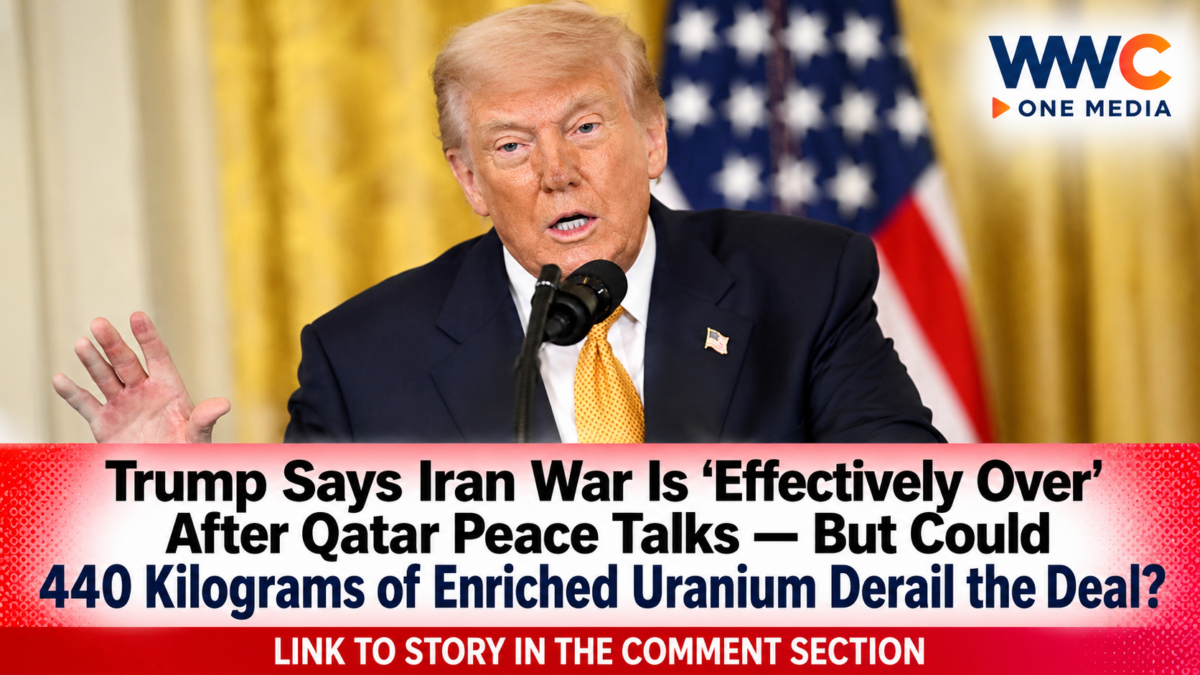
WASHINGTON / DOHA / TEHRAN — November 10, 2026 — US President Donald Trump has declared that the war with Iran is militarily “effectively over,” raising hopes of a diplomatic breakthrough after a high-level White House meeting with Qatar’s prime minister.
But despite the president’s optimistic assessment, the conflict remains unresolved.
American forces continue enforcing a naval blockade against Iran. Tehran is demanding sanctions relief and an end to maritime restrictions. And negotiators remain divided over one of the most sensitive issues in the Middle East: Iran’s highly enriched uranium stockpile.
Speaking on November 9 after meeting Qatari Prime Minister Sheikh Mohammed bin Abdulrahman Al Thani, Trump said Washington was seeing positive progress toward ending the conflict.
The president also suggested that another large-scale American bombing campaign was unlikely in the immediate future.
However, he warned that US military forces remain prepared to resume strikes if circumstances change.
The meeting represented an important diplomatic development in a war that began on February 28 and has disrupted Middle Eastern energy supplies, maritime trade and global financial markets for more than eight months.
Qatar has become a central intermediary between Washington and Tehran, relaying proposals and attempting to narrow disagreements over nuclear restrictions, sanctions and the Strait of Hormuz.
But with no final agreement signed and both sides refusing to surrender their biggest bargaining advantages, could Trump’s latest peace initiative finally end the war—or is another dangerous escalation still only one failed negotiation away?
Trump Declares Iran War Militarily ‘Effectively Over’
Trump delivered his latest assessment during a surprise appearance in the White House briefing room on Monday.
The remarks followed a meeting with Qatar’s prime minister, who also serves as the country’s foreign minister.
Trump characterized Iran’s military capabilities as severely weakened following months of US and Israeli operations.
He indicated that Washington did not currently see a need for another major offensive.
However, the president stopped short of formally declaring the conflict finished.
He also emphasized that any lasting agreement must prevent Iran from obtaining nuclear weapons.
The distinction matters.
A president’s assessment that military objectives have largely been achieved does not mean hostilities have legally or operationally ended.
American forces remain deployed in the region.
The US naval blockade remains active.
And sporadic military incidents continue.
The latest comments therefore represent a shift in Washington’s diplomatic messaging, rather than confirmation of a completed peace settlement.
Qatar’s Prime Minister Becomes the Key Peace Mediator
Qatar’s prime minister, Sheikh Mohammed bin Abdulrahman Al Thani, traveled to Washington for discussions with Trump and Vice President JD Vance.
Qatar has played a central role in carrying messages between the United States and Iran.
Its government maintains diplomatic relationships that allow it to communicate with both sides despite their deep disagreements.
Following the White House meetings, the Qatari leader described the conversations positively and expressed hope for progress toward a regional peace agreement.
The diplomatic engagement followed earlier contacts with Iranian officials.
Qatar has been presenting proposals aimed at resolving disagreements about nuclear activities, maritime access and economic restrictions.
The negotiations are especially difficult because the two sides have different priorities.
Washington wants verifiable nuclear limitations and protection for international shipping.
Tehran wants the blockade lifted, economic sanctions eased and assurances against renewed military attacks.
Qatar’s challenge is finding a sequence of commitments acceptable to both governments.
Reuters: Gulf Allies Want a Diplomatic Solution
In a November 9 telephone interview with Reuters, Trump said Qatar and Saudi Arabia preferred a peaceful settlement.
He also emphasized that Washington remained capable of conducting additional strikes.
His comments suggest that regional governments are encouraging restraint while the US maintains military pressure.
Saudi Arabia, the United Arab Emirates, Bahrain, Kuwait and Qatar have strong reasons to avoid another major escalation.
Their economies depend heavily on regional stability, international investment, aviation and maritime commerce.
A renewed military campaign could threaten energy infrastructure and transport corridors across the Persian Gulf.
It could also expose countries hosting US facilities to retaliation.
For Gulf governments, ending the war would provide significant economic and security benefits.
But their support for negotiations does not mean they have accepted every American or Iranian demand.
The diplomatic challenge remains translating shared concerns about regional stability into a workable agreement.
Iran Rejects Claims That Peace Is Already Secured
Iranian officials have challenged Trump’s suggestion that the conflict is effectively finished.
Tehran maintains that the United States cannot declare the war over while continuing a naval blockade and other coercive measures.
Iran wants Washington to address sanctions, restrictions on shipping and the broader consequences of the military campaign.
The country has also called for access to frozen assets and measures addressing damage from the conflict.
From Tehran’s perspective, a settlement that leaves major economic restrictions intact would not amount to a comprehensive peace.
That position conflicts with Washington’s desire to retain leverage until Iran accepts nuclear and security commitments.
The disagreement helps explain why negotiations can continue even while leaders publicly express optimism.
Both sides are signaling interest in reducing conflict, but they have not agreed on what must happen first.
The US Naval Blockade Remains a Major Obstacle
One of the biggest unresolved issues is the American naval blockade affecting Iran’s ports and maritime trade.
Washington views the blockade as a means of maintaining economic pressure while negotiations continue.
Trump has repeatedly expressed confidence in the strategy.
Iran, however, argues that the restrictions must end as part of any meaningful peace settlement.
The dispute is directly connected to access through the Strait of Hormuz.
The waterway is one of the world’s most important energy-shipping routes.
Restrictions on shipping or renewed attacks can disrupt the movement of crude oil and other petroleum products.
WWC ONE MEDIA previously examined the deadlock in Iran and US Remain Far Apart on Peace Deal as Trump Warns He Is Ready for More Strikes — Is Another War About to Begin?.
The report explored the disagreements over sanctions, maritime restrictions, enriched uranium and the sequence of concessions.
Those questions remain central to the latest talks.
The 440-Kilogram Nuclear Question Could Decide Everything
The most sensitive issue may be Iran’s stockpile of highly enriched uranium.
According to reporting by the Financial Times, approximately 440 kilograms of highly enriched uranium remain at the center of the negotiations.
Washington wants Iran to surrender the material and permit international inspectors to examine nuclear facilities affected by the conflict.
Iran has resisted transferring the stockpile abroad.
The dispute involves several complex questions.
The governments would need to agree on the treatment or disposition of the material.
They would also need a credible verification process.
International inspectors would have to establish what nuclear materials and activities remain.
And any agreement would need mechanisms to monitor compliance over time.
The existence of highly enriched uranium does not, by itself, establish that Iran has an operational nuclear weapon.
But the material raises serious proliferation concerns and remains a major obstacle to rebuilding confidence.
Trump has described preventing an Iranian nuclear weapon as non-negotiable.
Tehran insists that its nuclear rights and security concerns must also be addressed.
Until negotiators bridge that divide, a final settlement remains uncertain.
A Seven-Day Proposal Could Provide a Temporary Breakthrough
Diplomats have been examining an interim framework based on an Iranian proposal dating from September.
The Financial Times reported that the proposal contemplated an initial arrangement lasting approximately seven days.
Under the potential framework, Iran would restore greater access to the Strait of Hormuz in exchange for changes to the US blockade and restrictions affecting oil exports.
Additional measures could involve releasing some frozen Iranian assets.
The temporary arrangement would create space for negotiations on a wider agreement.
Such an approach could help address an immediate problem without requiring every political and nuclear issue to be settled at once.
However, the framework has not been accepted by both governments.
Disagreements over timing and sequencing remain substantial.
Washington does not want to give up leverage without credible Iranian commitments.
Tehran does not want to offer concessions while American restrictions remain in force.
The proposal is therefore a possible diplomatic pathway, not an agreed ceasefire.
Why the War Continues Despite Diplomatic Optimism
The United States and Israel began their military campaign against Iran on February 28, 2026.
The conflict has involved airstrikes, maritime confrontations and attacks affecting regional infrastructure.
Although large-scale fighting has become less frequent, military incidents have not stopped.
Reuters reported on November 9 that US forces had recently struck targets on Iran’s Qeshm Island.
American officials described earlier operations there as defensive responses.
Iranian authorities also reported incidents involving vessels near the Persian Gulf and Strait of Hormuz.
Some accounts remain based on statements from the parties involved and have not been independently verified in full.
The continuing incidents underscore the danger of describing the war as conclusively over.
A single major attack could derail talks or trigger retaliation.
WWC ONE MEDIA documented the earlier military confrontation in US Carries Out ‘Defensive’ Strikes on Iran’s Qeshm Island as Trump Talks Down Renewed War — But Is the Strait of Hormuz Heading Toward Another Escalation?.
The incident demonstrates how limited military operations can continue even when leaders publicly favor diplomacy.
Trump Faces Pressure After the US Midterm Elections
The renewed peace effort comes after major Republican losses in the November 3 US midterm elections.
The prolonged Iran conflict and its economic consequences became important political issues.
High fuel prices increased costs for American households and businesses.
The war also raised questions about federal spending, national security and the administration’s foreign-policy decisions.
Trump has acknowledged that the conflict contributed to Republican political difficulties.
However, he has continued defending his decision to launch military operations.
WWC ONE MEDIA previously examined that political pressure in Trump Admits Iran War Hurt Republicans in Midterm Defeat but Says He Would Do It Again — Why His ‘Transfer the Love’ Remark Is Raising Bigger Questions.
The election results may strengthen incentives for a diplomatic settlement.
But they do not automatically change the military situation or guarantee that Tehran will accept Washington’s conditions.
The conflict’s political consequences are one factor among several influencing the administration’s decisions.
Oil Prices Crash as Investors Bet on Peace
Financial markets reacted strongly to indications that the United States might avoid another major military escalation.
On November 9, Brent crude fell approximately 5.85% to settle at $92.57 per barrel.
US West Texas Intermediate declined approximately 4.38% to $86.85.
The decline reflected expectations that diplomatic progress could reduce the risk of severe disruption to Middle Eastern oil supplies.
WWC ONE MEDIA examined the selloff in Oil Prices Crash Nearly 6% to $92 as Trump Pauses Iran Strikes — But Could One Tanker Attack Send Brent Back Above $100?.
The latest oil-market movement is important because energy prices affect inflation, transportation costs and household spending around the world.
Lower crude prices could eventually benefit countries that import substantial quantities of petroleum.
That includes the Philippines and many other Asian economies.
But a temporary market decline is not proof that the conflict has ended.
Oil traders are responding to the expected probability of future disruption.
If negotiations collapse or attacks intensify, prices could rise again.
Why the Strait of Hormuz Remains a Global Economic Threat
The Strait of Hormuz connects the Persian Gulf to major international shipping routes.
Under normal circumstances, it handles a substantial share of global petroleum movements.
Any sustained disruption can affect buyers in Asia, Europe and elsewhere.
Shipping companies also face risks involving insurance costs, vessel availability and navigational safety.
Even if crude futures decline, transportation expenses may remain elevated.
Iran has imposed restrictions on certain maritime movements during the conflict.
The United States has simultaneously maintained its blockade.
These measures create uncertainty for commercial vessels.
WWC ONE MEDIA reported on the latest maritime developments in Iran Says No Unauthorized Ships Crossed Strait of Hormuz After Navigation Systems Destroyed — New Warning Raises Fears for Global Oil Shipping.
Some claims about particular incidents remain based on Iranian official accounts.
Nevertheless, the wider threat to international shipping is an established concern.
A comprehensive peace settlement would need to address maritime security as well as military operations on land.
Gulf Countries Fear a Wider Regional Conflict
The Financial Times reported that Gulf leaders have pressed Washington to avoid renewing large-scale attacks.
Their concern is that Iranian retaliation could spread beyond the original targets.
Energy facilities, ports, airports and other important infrastructure could become vulnerable during a renewed escalation.
The economic consequences could be substantial.
Disruption in one Gulf country may affect transportation and investment across the region.
A wider conflict could also undermine international confidence in energy supplies.
According to reporting on the diplomatic discussions, Israeli Prime Minister Benjamin Netanyahu has favored a tougher military approach than several regional governments.
The competing preferences create additional complexity for Washington.
The United States must consider its security relationship with Israel while responding to Gulf partners seeking de-escalation.
That makes Qatar’s mediation particularly important.
Does Trump’s Statement Mean There Is a Ceasefire?
Not necessarily.
A ceasefire is an agreement or arrangement under which parties suspend fighting, often subject to specified terms.
A final peace agreement goes further, addressing the underlying conditions needed to end a conflict.
Trump’s November 9 remarks were an assessment of military progress and diplomatic prospects.
They were not an announcement that all parties had signed a new agreement.
The continuing US blockade and reports of limited military activity demonstrate the distinction.
Iran has not accepted Washington’s full demands.
Washington has not accepted Tehran’s conditions for ending maritime restrictions and sanctions.
Qatar is continuing mediation.
For those reasons, the most accurate description is that diplomatic efforts have gained momentum while major disagreements remain unresolved.
What a Successful US-Iran Deal Could Include
Based on the proposals reported by Bloomberg, Reuters and the Financial Times, a comprehensive arrangement could involve several interconnected components.
One would be the restoration of safer maritime transit through the Strait of Hormuz.
Another would address the US blockade and Iran’s access to international oil markets.
A third would involve the treatment of highly enriched uranium and independent monitoring of nuclear activities.
A fourth would concern sanctions relief, frozen assets and economic restrictions.
A fifth would establish security commitments designed to reduce the risk of renewed military attacks.
The precise terms remain under negotiation.
Some proposals may be politically difficult for one side or the other.
A successful settlement would require agreement not just on the objectives but also on their implementation sequence.
That is the central diplomatic challenge facing Qatar’s mediators.
What Happens Next for the Middle East?
The immediate focus is whether Qatar can translate the positive tone of its Washington meetings into concrete negotiations between the United States and Iran.
Diplomats will be looking for movement on the naval blockade and Strait of Hormuz access.
They will also watch for concessions involving enriched uranium and international inspections.
Any new military incident could complicate discussions.
Oil markets will respond to developments affecting the likelihood of renewed disruption.
Regional governments will continue pressing for measures that protect their security and economic interests.
The United States must also decide how much pressure to maintain while pursuing an agreement.
Iran faces its own decision about whether the potential benefits of sanctions relief justify the concessions Washington is demanding.
A diplomatic breakthrough is possible.
But the positions remain far enough apart that a final agreement cannot be assumed.
The Bigger Picture: A Possible End to the War, but Not Yet Peace
Trump’s November 9 meeting with Qatar’s prime minister has renewed hope that the prolonged conflict with Iran may be approaching a diplomatic turning point.
The president says the war is militarily effectively over.
Qatar is actively mediating.
Saudi Arabia and other Gulf governments favor a peaceful settlement.
And oil markets have responded positively to the possibility of reduced military escalation.
But the obstacles are formidable.
The United States continues its naval blockade.
Iran is demanding sanctions relief and changes to maritime restrictions.
The countries remain divided over nuclear verification and a stockpile of highly enriched uranium.
Military incidents are still possible.
And no comprehensive agreement has been announced.
For the Middle East, the consequences extend beyond diplomatic prestige.
A lasting settlement could reduce risks to civilians, protect international shipping and ease pressure on global energy prices.
A failed agreement could reverse those gains.
As Donald Trump declares that the Iran war is militarily effectively over following talks with Qatar’s prime minister, the decisive question is whether negotiators can overcome the disputes involving uranium, sanctions and the Strait of Hormuz—or whether the next military confrontation could destroy what may be the strongest opportunity for peace in months.