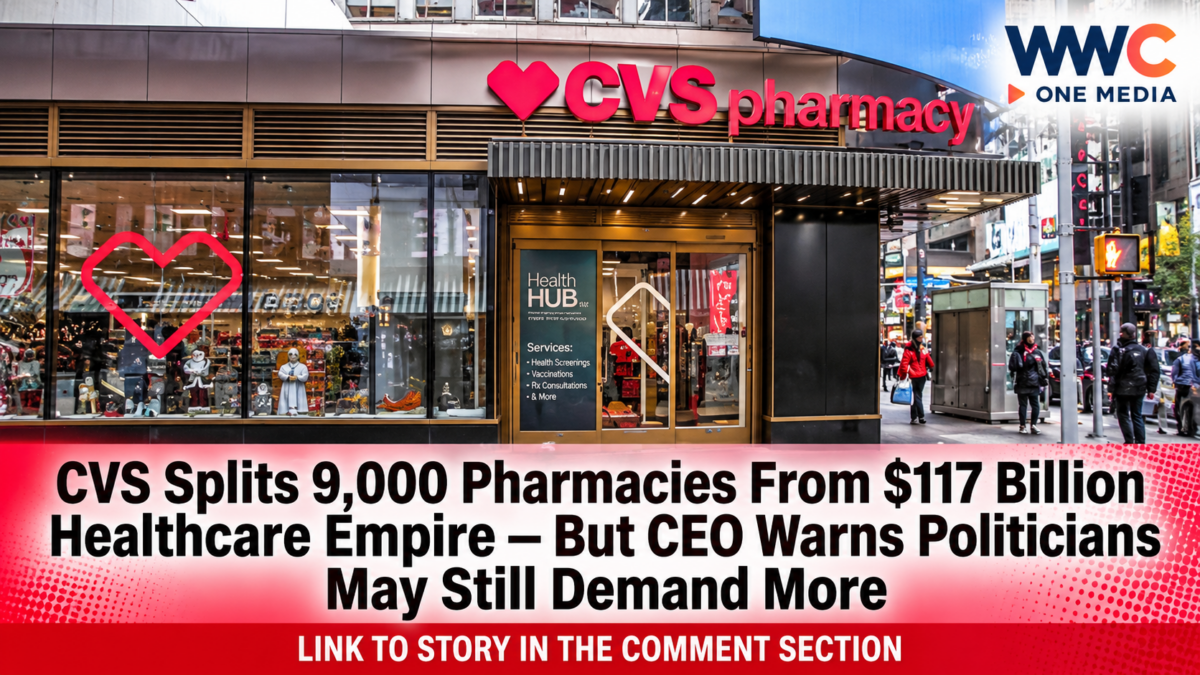
NEW YORK / WOONSOCKET, RHODE ISLAND — November 10, 2026 — CVS Health is preparing one of the largest corporate breakups in American healthcare history, but chief executive David Joyner is warning that separating the company’s roughly 9,000 retail pharmacies from its insurance and pharmacy-benefit operations may not be enough to satisfy politicians demanding major changes to the nation’s prescription-drug industry.
The warning follows CVS’s November 4 announcement that it intends to create two independent publicly traded companies, reversing nearly two decades of expansion that transformed the neighborhood drugstore chain into an enormous healthcare conglomerate.
One company, CVS Pharmacy, would operate the retail drugstore network, mail-order pharmacies, MinuteClinic services and the Health100 technology business.
The other, retaining the CVS Health name, would continue operating Aetna health insurance, pharmacy-benefit manager CVS Caremark, CVS Specialty, Oak Street Health and Signify Health.
But the proposed restructuring has raised a fundamental question.
If the company’s powerful insurance and pharmacy-benefit businesses remain under the same corporate roof, will the breakup actually resolve lawmakers’ concerns about competition, drug prices and conflicts of interest?
Speaking at the Wolfe Research Healthcare Conference on November 9, Joyner defended the decision as a strategic move designed to create two stronger businesses.
He also acknowledged that the regulatory environment has changed significantly since CVS began combining pharmacies, prescription-benefit management and insurance.
The political pressure is unlikely to disappear.
Meanwhile, the financial stakes are enormous.
CVS shares fell 12.5% following the breakup announcement, wiping nearly $15 billion from the company’s market capitalization.
Executives also estimate that operating the businesses separately could involve roughly $500 million in recurring annual costs.
Could CVS’s historic restructuring create a healthier and more competitive healthcare system—or is Wall Street watching the company dismantle a multibillion-dollar empire without solving the problems that made politicians demand change?
CVS Will Separate Its 9,000 Pharmacies Into a New Company
On November 4, CVS confirmed plans to divide its operations into two independent publicly traded corporations.
The transaction is expected to be completed during the first half of 2028, subject to required approvals and other conditions.
The proposed structure would create two distinct businesses.
| Future company | Planned operations |
|---|---|
| CVS Pharmacy | Approximately 9,000 retail pharmacies, mail-order prescriptions, MinuteClinic and Health100 |
| CVS Health | Aetna, CVS Caremark, CVS Specialty, Oak Street Health and Signify Health |
David Joyner would remain chairman and chief executive of CVS Health.
Prem Shah, currently a senior CVS executive, would become chief executive of the independent pharmacy company.
CVS expects the separation to be structured as a transaction intended to be tax-free to the company and shareholders.
Existing shareholders are expected to hold interests in both companies after completion.
However, the final capital structure, distribution arrangements and other transaction details remain subject to implementation.
The breakup has been announced, not completed.
WWC ONE MEDIA previously covered the initial restructuring plans in CVS Stock Surges as $117-Billion Healthcare Giant Eyes Historic Breakup of 9,000 Pharmacies — But Could Splitting From Aetna Backfire?.
That earlier report examined the proposed separation before the company’s formal announcement and subsequent negative stock-market reaction.
Why CVS’s CEO Doubts Politicians Will Be Satisfied
The most significant development in Bloomberg’s November 9 report is Joyner’s assessment of the political environment.
CVS has faced growing criticism from lawmakers who argue that large healthcare conglomerates possess too much influence over prescription-drug pricing and pharmacy access.
The company combines several important functions in the healthcare system.
Aetna provides health insurance.
Caremark manages prescription-drug benefits for health plans and employers.
CVS operates thousands of pharmacies and provides additional healthcare services.
Critics argue that companies controlling multiple stages of healthcare delivery may face financial incentives that conflict with patients’ or independent pharmacies’ interests.
CVS disputes the suggestion that its structure inherently harms consumers and maintains that integration can improve care coordination and affordability.
The proposed split would remove common ownership between its retail pharmacy chain and Caremark.
But it would not separate Caremark from Aetna or CVS Specialty.
That means lawmakers concerned about the broader structure of the pharmacy-benefit industry may still see issues requiring attention.
Joyner’s comments suggest he recognizes that changing corporate ownership alone will not end the political debate.
What Are Pharmacy Benefit Managers — And Why Are They Under Fire?
Pharmacy benefit managers, commonly known as PBMs, play a central role in determining how Americans obtain prescription medicines.
They negotiate arrangements with drug manufacturers, administer prescription benefits, help determine which medicines receive insurance coverage and establish reimbursement terms for pharmacies.
Three major PBM businesses dominate a large share of the US market:
CVS Caremark, UnitedHealth Group’s Optum Rx and Cigna’s Express Scripts.
Supporters of the PBM model argue that these companies can negotiate discounts, manage drug spending and help insurers provide prescription coverage efficiently.
Critics contend that complex rebate arrangements, payment structures and ownership relationships make it difficult to determine whether negotiated savings actually reach patients.
Independent pharmacies have also alleged that certain reimbursement and audit practices place them at a competitive disadvantage.
These allegations are subjects of regulatory and legislative scrutiny.
They should not be treated as proof that every PBM arrangement violates competition or consumer-protection laws.
Nevertheless, bipartisan support for reform has intensified.
Lawmakers Are Investigating PBM Practices
Political pressure has expanded beyond general criticism.
On October 23, Republican Representative James Comer, chairman of the House Oversight Committee, launched an investigation into allegations that major PBMs conducted retaliatory audits of independent pharmacies.
The inquiry sought documents and explanations from CVS Caremark, Express Scripts and Optum Rx.
Comer raised concerns that certain pharmacies experienced increased auditing after supporting legislation intended to regulate PBM practices.
The investigation is examining whether the companies’ audit procedures were applied improperly.
But the committee’s allegations have not established that the PBMs engaged in retaliation.
The investigation demonstrates why CVS’s corporate separation may not resolve every concern.
Even after its retail stores become independent, Caremark will remain a major pharmacy-benefit manager.
Its pricing arrangements, contracting practices and regulatory obligations will continue attracting scrutiny.
Elizabeth Warren and Josh Hawley Want Stronger Restrictions
Bipartisan proposals targeting the relationship between PBMs and pharmacies have added to the uncertainty.
Senators Elizabeth Warren and Josh Hawley have supported legislation aimed at limiting the ability of powerful healthcare conglomerates to own certain pharmacy businesses while operating prescription-benefit management operations.
Supporters argue that common ownership can create conflicts of interest.
They believe greater separation could strengthen competition and improve opportunities for independent pharmacies.
Opponents argue that restrictions could disrupt existing healthcare arrangements and potentially increase administrative costs.
The debate intensified after Arkansas and Tennessee adopted legislation restricting certain pharmacy and PBM ownership structures.
CVS and other companies have challenged aspects of those state laws in court.
The ultimate effects depend on litigation outcomes, implementation and the precise rules applied.
CVS’s planned breakup may address some ownership concerns.
But it does not automatically resolve every pending legal issue or regulatory obligation.
The Breakup Reverses Nearly 20 Years of Expansion
CVS’s decision represents a dramatic reversal of its long-term corporate strategy.
In 2007, the company acquired Caremark, bringing prescription-benefit management into its pharmacy business.
In 2018, CVS completed its approximately $78 billion acquisition of health insurer Aetna.
The company subsequently expanded into medical services through transactions involving Oak Street Health and Signify Health.
The underlying strategy was to create a more integrated healthcare organization.
Management argued that combining pharmacy access, insurance coverage, prescription-benefit administration and clinical services could improve patient outcomes while reducing costs.
However, the model also created operational complexity and attracted criticism over competition.
The planned separation suggests CVS now believes its businesses may perform better with greater independence.
It does not necessarily mean every earlier acquisition failed.
Aetna, Caremark and several healthcare-service operations will remain together.
But the decision represents a major change in how the company expects to generate long-term value.
Why CVS Shares Crashed 12.5% After the Announcement
Investors did not immediately welcome the restructuring.
CVS shares fell 12.5% to close at $79.96 on November 4.
The decline wiped nearly $15 billion from the company’s stock-market valuation.
The selloff was particularly striking because the company had simultaneously reported stronger-than-expected third-quarter earnings.
Analysts cited uncertainty about the financial structure and future profitability of the two companies.
Some questioned whether the independent pharmacy chain could deliver sufficient earnings growth without the advantages of belonging to a larger healthcare group.
Others worried about the costs of separating shared technology, administrative and operational systems.
There were also concerns about the company’s 2027 earnings outlook relative to its competitors.
UBS analyst Kevin Caliendo suggested investors initially viewed the split as potentially defensive rather than a purely growth-oriented decision.
Management rejected the idea that CVS was acting from financial distress.
Joyner argued that improvements across the company had created a stronger foundation for the separation.
The Hidden $500 Million Cost of Operating Separately
The proposed breakup will not be free.
At the November 9 Wolfe Research Healthcare Conference, Joyner discussed the expected financial disadvantages of separating the businesses.
Executives indicated that recurring dis-synergies could be closer to $500 million annually.
The term refers to financial benefits or efficiencies that may disappear when an integrated company becomes two independent organizations.
For example, separate businesses may need their own corporate functions, administrative systems and financing arrangements.
This estimated $500 million should not be confused with a confirmed one-time transaction expense.
CVS expects additional costs associated with carrying out the separation.
Some investors had previously estimated that recurring dis-synergies could exceed $1 billion.
Management’s lower estimate may reduce concerns about the financial burden, but it remains a forecast.
The final amount will depend on how the two companies organize their operations.
CVS Reports $108.4 Billion in Quarterly Revenue
Despite investor concerns, CVS’s latest financial results showed improvement.
For the third quarter ended September 30, 2026, CVS reported:
- Revenue of $108.4 billion, up 5.4% year over year.
- GAAP diluted earnings of $1.68 per share.
- Adjusted earnings of $2.09 per share.
- Net income of approximately $2.17 billion.
- Operating cash flow of $15.3 billion during the first nine months.
The company raised its 2026 adjusted earnings-per-share forecast to at least $8.20.
It also projected full-year revenue of at least $420 billion.
These results demonstrate that CVS remains a major revenue-generating business.
However, strong consolidated sales do not guarantee that the two independent companies will achieve equivalent profitability after the separation.
Investors must consider how costs, debt, assets and future cash flow will be distributed.
Aetna’s Recovery Is Important to the Breakup
One reason management believes the timing is appropriate involves improvements at Aetna.
The health insurer had experienced financial pressure from medical claims exceeding earlier expectations.
In response, CVS revised its insurance offerings, adjusted pricing and pursued cost-control measures.
Those changes have improved financial performance.
The company’s third-quarter medical-benefit ratio was approximately 91.3%.
That ratio measures medical costs relative to relevant premium revenue.
A lower ratio generally indicates that a smaller share of premiums is being consumed by medical claims, although profitability also depends on other expenses.
The improvement has strengthened management’s confidence in Aetna’s ability to remain a central part of CVS Health.
Still, elevated healthcare costs remain a significant industry-wide concern.
WWC ONE MEDIA examined a rival insurer’s financial recovery in UnitedHealth Raises 2026 Profit Forecast as Earnings Jump 61% — But Is Wall Street’s Troubled Insurance Giant Finally Making a Comeback?.
UnitedHealth and CVS operate different business structures, but both face pressure to control medical costs while maintaining affordable coverage.
The New CVS Pharmacy Will Face Intense Competition
The proposed independent CVS Pharmacy would inherit one of America’s largest retail drugstore networks.
It would operate approximately 9,000 locations alongside MinuteClinic and mail-order pharmacy services.
But scale does not guarantee profitability.
Traditional pharmacies face competition from online delivery services, mass-market retailers and alternative prescription distribution models.
Operating expenses, labor costs and reimbursement arrangements also affect earnings.
Some pharmacies have struggled with lower foot traffic and weaker margins.
CVS has previously closed stores and reorganized operations to improve efficiency.
Management believes the independent company could focus more effectively on retail services, direct-to-consumer products and community healthcare.
Prem Shah is expected to lead that transformation.
The business would need to maintain customer access while developing sustainable revenue sources.
Will Patients Actually Pay Less for Medicines?
This is perhaps the most important unanswered question.
Separating retail pharmacies from Aetna and Caremark may reduce certain conflicts associated with common ownership.
But prescription-drug prices are influenced by many factors.
These include manufacturer pricing, insurance coverage, pharmacy reimbursement, negotiated rebates and patient cost-sharing.
Changing corporate ownership does not automatically lower those costs.
For example, Caremark could continue managing drug benefits for major employers and insurers after the restructuring.
Likewise, the new CVS Pharmacy would still need to negotiate reimbursement contracts and purchase medicines through established supply arrangements.
Some healthcare analysts believe the separation could improve competition by making CVS pharmacies less closely connected with Caremark’s decisions.
Others argue that meaningful savings will depend more heavily on transparency and regulation.
The practical test will be whether patients experience improved access and lower out-of-pocket expenses.
Trump’s Drug-Pricing Agenda Adds Another Layer of Pressure
CVS’s restructuring comes during a broader national debate about prescription-drug affordability.
President Donald Trump’s administration has pursued agreements with pharmaceutical manufacturers intended to reduce US medicine costs.
WWC ONE MEDIA examined one such arrangement in Pfizer Deal Reveals Revenue-Sharing Provision in Trump Drug-Pricing Agreement.
The report explored the government’s most-favored-nation pricing strategy and previously undisclosed provisions involving international drug prices.
Those manufacturer agreements are separate from CVS’s restructuring.
However, they demonstrate the number of different approaches policymakers are considering to address expensive medications.
Some proposals focus on drug manufacturers.
Others target insurers or pharmacy-benefit managers.
Still others seek to change the ownership structure of healthcare companies.
For patients, the effectiveness of these measures will depend on measurable changes in affordability rather than announcements alone.
America’s Healthcare Spending Problem Is Much Bigger Than CVS
The political debate also reflects the rising cost of healthcare across the United States.
Insurance companies, public programs, medical providers and patients are all affected.
For example, New York’s Medicaid program has experienced substantial spending growth in recent years.
WWC ONE MEDIA examined those pressures in New York’s Medicaid Costs Soar by a Reported $45 Billion in Five Years — But Could the Healthcare Crisis Force Cuts to Schools and Public Services?.
Medicaid spending and CVS’s PBM practices involve different financial and policy questions.
But both illustrate the difficulty of managing healthcare costs.
A corporate breakup could improve certain incentives or competitive conditions.
It cannot by itself resolve medical inflation, expensive pharmaceuticals or public health funding pressures.
That broader reality helps explain why Joyner expects political scrutiny to continue.
Could UnitedHealth and Cigna Be Forced to Follow CVS?
The breakup has sparked questions about whether other major healthcare companies could eventually face similar pressure.
UnitedHealth Group owns Optum Rx and extensive medical-service operations.
Cigna operates Express Scripts and other healthcare businesses.
Both have faced scrutiny over the structure and practices of pharmacy-benefit managers.
However, analysts have emphasized that CVS’s retail drugstore footprint makes its corporate situation unusual.
Neither UnitedHealth nor Cigna has announced an identical separation plan in response to CVS’s decision.
It would therefore be premature to conclude that the entire industry is about to break apart.
Nevertheless, the CVS move could influence how regulators, investors and executives assess healthcare conglomerates.
If the independent companies perform well, other businesses might consider similar changes.
If the breakup proves costly or fails to improve competition, it could become a warning about restructuring as a substitute for operational reform.
What Happens Next for CVS?
The company faces several important milestones.
Management must determine how debt, cash flow, assets and corporate functions will be divided between the two planned businesses.
The companies will need independent leadership structures and operational arrangements.
CVS must also continue improving financial results while preparing for the separation.
Federal and state lawmakers will continue debating PBM reforms.
Regulators and courts may determine the future of laws restricting certain pharmacy ownership arrangements.
Meanwhile, investors will monitor the financial performance of Aetna, Caremark and the retail pharmacy network.
The separation is targeted for the first half of 2028.
Until it is completed, CVS remains one consolidated company.
The Bigger Picture: CVS’s Breakup May Not End the Fight Over Drug Prices
CVS Health’s proposed restructuring represents a defining moment in the American healthcare industry.
After spending nearly two decades building an integrated organization, the company is preparing to separate its retail pharmacies from its insurance and pharmaceutical-benefit businesses.
Management believes two independent companies can operate more effectively and create greater long-term value.
But lawmakers remain concerned about drug pricing, market concentration and the practices of powerful PBMs.
The planned restructuring addresses some ownership relationships but leaves others intact.
It also introduces financial costs and operational uncertainties.
For investors, the biggest question is whether the breakup will improve earnings enough to justify the disruption.
For politicians, the concern is whether it meaningfully addresses the competition problems they have identified.
For patients, the central issue is much simpler: Will medicines and healthcare become more affordable and accessible?
As CVS prepares to dismantle its 9,000-store pharmacy empire and create two independent businesses, David Joyner’s warning leaves a crucial question unanswered: Will the breakup satisfy Washington’s demands for healthcare reform—or will regulators and lawmakers pursue even more aggressive measures against the industry?