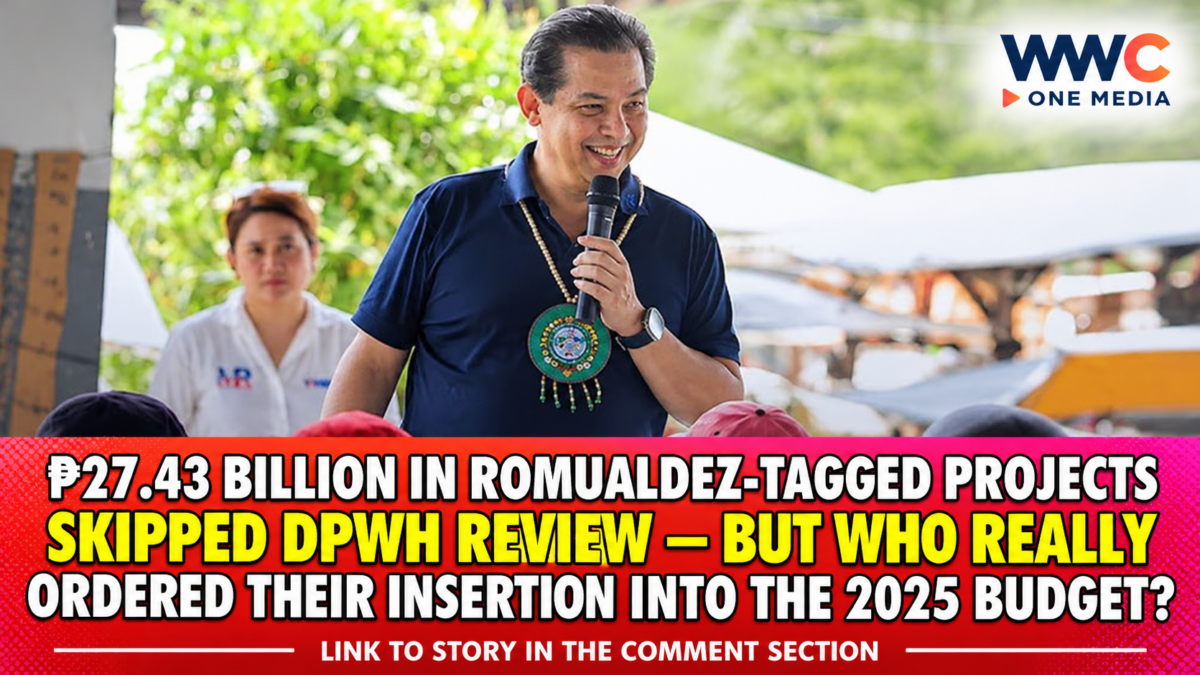
A Department of Public Works and Highways (DPWH) official has testified that 444 infrastructure projects worth approximately ₱27.43 billion, listed under former House Speaker Martin Romualdez in the 2025 national budget, did not undergo the regular technical review by his division before appearing in the enacted budget.
The testimony was delivered by DPWH Programming Division chief Peter Paul Cortez during Romualdez’s bail hearing before the Sandiganbayan Third Division on November 9, 2026. The projects were not included in the department’s original annual budget proposal or the National Expenditure Program (NEP), according to Cortez.
But the testimony also contained an important qualification: Cortez said he had no personal knowledge that Romualdez himself requested the projects or directed their insertion. The names of lawmakers identified as project proponents were supplied to his office through instructions attributed to the late DPWH undersecretary Maria Catalina “Cathy” Cabral.
That distinction is central to the case. The testimony raises questions about how billions of pesos in projects entered the national budget without the usual departmental vetting, but it does not independently establish that Romualdez personally ordered the insertions or received money from them. ABS-CBN News+2
444 Projects Were Listed Under Romualdez’s Name
Cortez told the anti-graft court that 444 projects worth ₱27.43 billion were recorded in the DPWH database with Romualdez identified as a proponent.
The projects were not part of the DPWH’s original annual budget proposal or the NEP prepared by the executive branch. However, they eventually appeared in the 2025 General Appropriations Act, the law authorizing the national government’s spending for that fiscal year.
Cortez explained that his division used the term “inserted” for projects that appeared in the enacted budget but were not included in the department’s original submissions.
He said the projects may have entered the budget during the bicameral conference committee stage, when the House and Senate reconcile differences between their respective versions of the proposed national budget.
The testimony did not establish exactly who introduced each project during those deliberations. Cortez described the bicameral process as his best assessment of when the projects could have been added, given their absence from the earlier budget documents. SunStar Publishing Inc.+2
The Names Came From Late DPWH Undersecretary Cathy Cabral
A key part of Cortez’s testimony concerned how lawmakers were identified as project proponents.
He said the information came from the late DPWH Undersecretary Maria Catalina “Cathy” Cabral, whose instructions were relayed to his office verbally or through written notes.
Cortez said his staff encoded the names based on those instructions. He also acknowledged that his division did not independently verify whether the lawmakers had personally requested the projects.
During cross-examination, he said he had never personally dealt with Romualdez or former Ako Bicol representative Elizaldy “Zaldy” Co about the projects. He also said he could not establish whether Romualdez had agreed to be identified as a proponent.
Cortez further acknowledged that he had no document directly showing Cabral instructing him to identify Romualdez as a proponent. He said the information was passed through Cabral’s office, sometimes verbally and sometimes through handwritten notes.
The witness also testified that he did not know whether Romualdez or any other lawmaker received commissions connected to the projects. The DPWH database, he said, contained no details about alleged commissions.
These admissions are significant because they distinguish the existence of project entries in government records from proof of personal involvement by the individuals whose names appeared in those records. Pilipino Star Ngayon+2
Cortez Said the Projects Were Not Properly Vetted
Cortez’s testimony focused on the absence of the usual technical evaluation by his division.
He explained that identifying a lawmaker as a project proponent was not automatically improper. Legislators regularly submit requests for infrastructure projects in their districts, but those proposals are still expected to undergo the appropriate technical review and evaluation.
The problem, according to the witness, was that the projects in question did not pass through the regular vetting process handled by his division.
He said his office relied on information and instructions coming from Cabral’s office, which it treated as authoritative.
This raises a major public-accountability question: how could hundreds of infrastructure projects worth billions of pesos become part of the final national budget without the usual departmental review?
Technical evaluation is important because infrastructure projects require more than a proposed location and a funding amount. Depending on the project, agencies may need to examine engineering requirements, feasibility, design, cost estimates, right-of-way concerns and implementation readiness.
Without proper assessment, government spending may face higher risks of cost overruns, delays, unsuitable designs or projects that fail to address actual community needs.
However, the testimony alone does not establish that all 444 projects were defective, overpriced, unfinished or fraudulent. It establishes that Cortez said they did not undergo the regular review by his division. witness+2
Zaldy Co and Other Lawmakers Also Appeared in the Records
Cortez’s testimony did not involve Romualdez alone.
He also identified projects associated with former Ako Bicol representative Zaldy Co, who previously chaired the House Committee on Appropriations.
The witness said the list of proponents supplied to his office included several lawmakers, not just Romualdez and Co.
He also explained that the name encoded in the DPWH database could be changed based on instructions from Cabral’s office, even when another lawmaker had originally requested a project.
This aspect of the testimony has drawn attention to the process by which project proponents were identified and how information moved between the DPWH and lawmakers during budget preparation.
The issue is particularly important because the House Committee on Appropriations plays a central role in scrutinizing and shaping the national budget. But a lawmaker’s position, the appearance of a name in a database or the size of a district’s allocation does not by itself prove criminal conduct. witness+2
The ₱27.43-Billion Testimony Is Separate From the ₱7.4-Billion Plunder Charge
Romualdez is facing a plunder case involving allegations that he accumulated approximately ₱7.4 billion in ill-gotten wealth through transactions connected to government infrastructure projects.
The prosecution alleges that the former House Speaker and his co-accused received commissions, kickbacks or other financial benefits from projects funded by public money.
Romualdez has denied wrongdoing and is contesting the allegations in court.
The ₱27.43-billion figure raised during Cortez’s testimony refers to the value of the 444 projects listed under Romualdez’s name in the 2025 budget. It is not the amount of money the prosecution says he personally received.
These are two different figures involving different questions: the value of projects identified in government records and the alleged ill-gotten wealth at the center of the plunder charge.
The distinction matters because project allocations cannot automatically be treated as personal proceeds or proof that a lawmaker received kickbacks. Prosecutors must establish the alleged financial transactions and the accused’s participation through evidence. witness+2
Romualdez’s Bail Hearing Continues as the Prosecution Presents Evidence
Cortez testified during the prosecution’s presentation of evidence in Romualdez’s bail hearing before the Sandiganbayan Third Division.
A bail hearing is not the same as a final trial on the question of guilt. The court examines evidence relevant to the bail application, particularly whether the prosecution has presented strong evidence in a case where the law restricts bail.
The hearing is part of the broader legal proceedings involving the former House Speaker and his co-accused.
According to reports published on November 9, the hearing was scheduled to resume on November 10, with the prosecution expected to continue presenting witnesses before completing its presentation later in November.
The defense, meanwhile, has the opportunity to question prosecution witnesses and challenge the evidence presented against Romualdez.
The court has yet to issue a final determination of his guilt or innocence. witness+2
A Wider DPWH Budget Controversy Is Emerging
The latest testimony comes amid broader investigations into alleged irregularities in the country’s infrastructure and flood-control spending.
The controversy has raised questions about how projects are selected, how public funds are distributed among congressional districts, and whether political influence can affect the budget process.
An earlier investigation by the Philippine Center for Investigative Journalism found that Leyte’s First District, which Romualdez represented during the period examined, received approximately ₱57 billion in DPWH infrastructure funding from 2023 to 2025.
That figure covers a broader set of infrastructure allocations and should not be confused with the ₱27.43-billion group of projects discussed in Cortez’s testimony.
A large district allocation does not automatically establish corruption. But the concentration of public infrastructure spending, combined with questions about project selection and technical review, makes transparent budget records and independent oversight especially important.
WWC ONE MEDIA previously examined the issue in its report, Romualdez’s Leyte District Emerges as Top DPWH Fund Recipient, Records Show.
The publication has also covered the broader scrutiny of public infrastructure spending in ₱1.9 Trillion Spent, Yet Filipinos Still Flood: Senate Moves to Scrutinize ₱107-Billion DPWH Budget.
Another related report examines how contractors linked to the flood-control controversy secured government school infrastructure contracts: Billions in School Projects Went to Contractors Linked to Flood Control Scandal, PCIJ Investigation Finds.
The legal proceedings surrounding Romualdez have also been covered in Ex-DPWH Official Takes the Witness Stand Against Romualdez and Philippine Court Orders Arrest of Marcos Cousin Over Alleged ₱7.4 Billion Flood-Control Kickbacks.
Together, these reports show why the issue extends beyond one witness or one budget year: the public is demanding clearer answers about how infrastructure projects are proposed, reviewed, funded and implemented.
The Biggest Question: Who Authorized the Projects and Why Was Review Bypassed?
Cortez’s testimony has placed the DPWH’s internal budget procedures under renewed scrutiny.
The 444 projects were listed under Romualdez’s name, but the witness said that identification came from information supplied by Cabral’s office and was not independently verified by his division.
He also said the projects were not included in the original DPWH budget proposal or the NEP and did not undergo the regular technical vetting by his office before appearing in the 2025 national budget.
The next questions are therefore crucial: Who actually requested each project? Who authorized its inclusion in the final budget? Why were the regular review procedures not followed? And can investigators establish whether any public funds were improperly diverted?
Those questions cannot be answered by database entries alone. They require documentary evidence, testimony from people directly involved and a careful examination of the budget process.
For taxpayers, the stakes are enormous. Every peso allocated to public infrastructure is supposed to deliver roads, bridges, flood-control systems and other facilities that communities need.
If projects worth billions can enter the national budget without the usual technical checks, the problem goes beyond political controversy. It raises a fundamental question about the safeguards protecting public money.