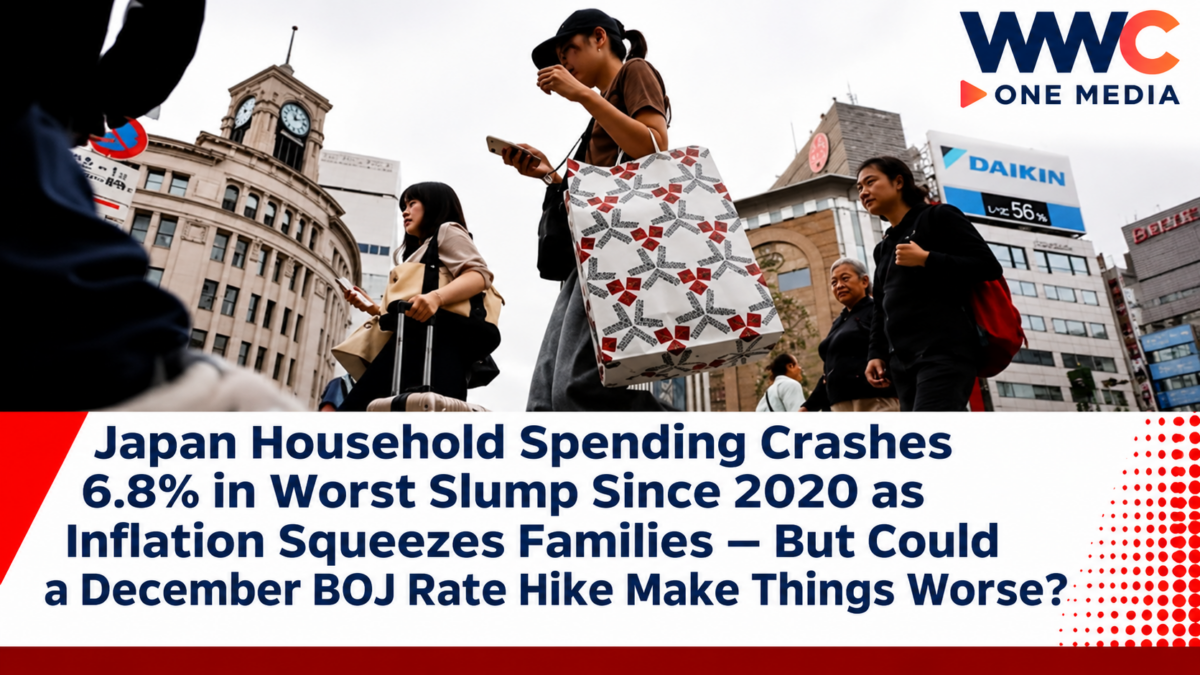
TOKYO, JAPAN — November 10, 2026 — Japan’s household spending plunged at its fastest annual pace since the COVID-19 pandemic, raising serious concerns about the strength of the world’s fourth-largest economy just as the Bank of Japan prepares for another possible interest-rate increase.
Official figures released Tuesday showed that inflation-adjusted household consumption fell 6.8% in September compared with a year earlier, marking the tenth consecutive month of decline.
The collapse was more than twice as severe as economists had expected.
According to Reuters, analysts had forecast a 3.1% fall. Bloomberg reported a consensus estimate of approximately 3%.
Instead, spending recorded its sharpest annual contraction since September 2020, when the pandemic was disrupting Japan’s economy.
The figures expose a growing contradiction in Japan’s economic recovery.
Workers are earning more, yet households are spending less.
Japan’s nominal wages increased 4.6% in September, their fastest annual rise since 1997, while inflation-adjusted wages rose 2.2%.
But consumers are still holding back as food prices, household expenses and uncertainty about the future weigh on purchasing decisions.
With the Bank of Japan considering another interest-rate increase as early as December, could policymakers unintentionally deepen Japan’s consumer-spending crisis while trying to control inflation?
Japan’s Household Spending Falls for 10 Consecutive Months
Japan’s Ministry of Internal Affairs and Communications reported that real household expenditure declined 6.8% in September from the same month in 2025.
The data covers spending by households with two or more members and adjusts for changes in consumer prices.
On a seasonally adjusted monthly basis, consumption fell 2.8% from August.
Economists surveyed by Reuters had expected a 0.3% monthly increase.
This means the decline was not only substantially worse than forecast on an annual basis; spending also weakened sharply from the previous month after accounting for seasonal patterns.
September extended the uninterrupted sequence of annual declines that began in December 2025.
The latest results follow decreases of 3.6% in July and 3.1% in August.
The September contraction was therefore a significant deterioration from the preceding months.
The figures suggest that stronger wages have not yet translated into a sustained recovery in household demand.
That matters because consumer spending is a major component of Japan’s economic activity.
When households reduce expenditure on goods and services, businesses can experience weaker sales, reduced earnings and greater uncertainty about future investment.
Why Are Japanese Families Spending Less Despite Higher Wages?
One of the biggest puzzles in Japan’s latest economic data is the divergence between wages and consumption.
Separate government figures showed that nominal cash earnings increased 4.6% in September from a year earlier.
That was the fastest annual pace since January 1997.
Real wages, which account for inflation, also increased 2.2%.
Ordinarily, stronger real earnings can support greater household purchasing power.
But Japan’s latest spending figures suggest that many consumers remain cautious.
Economists have pointed to persistent concerns about rising prices, uncertainty about future expenses and uneven distribution of wage gains.
Not every household benefits equally from stronger employment income.
Retirees and households dependent on fixed sources of income may experience inflation differently from full-time employees receiving substantial pay increases.
Japan’s aging population makes that distinction particularly important.
Even when average wage indicators improve, millions of consumers may continue facing financial pressure.
The country’s long history of limited inflation also shapes consumer behavior.
Many Japanese households became accustomed to relatively stable prices over several decades.
The recent transition toward sustained inflation has required significant adjustments in budgeting and purchasing decisions.
Inflation Is Still Squeezing Household Budgets
Japan’s nationwide core consumer price index increased 2.1% in September from a year earlier.
The measure excludes fresh food but includes energy.
A separate inflation indicator excluding both fresh food and energy increased 2.4%.
These figures indicate that price pressures remain significant even as wage growth improves.
Japan relies heavily on imports of energy, food ingredients and industrial materials.
That dependence leaves households and businesses exposed to changes in global commodity prices and the value of the yen.
When imported materials become more expensive, businesses may pass those costs to customers.
For families, the effect can accumulate across groceries, transport, utilities and everyday household purchases.
WWC ONE MEDIA previously examined the broader inflation problem in Japan’s Inflation Hits 2% as BOJ Chief Warns Price Stability May Not Last.
The report explored Governor Kazuo Ueda’s concerns about maintaining stable inflation as Japan moves away from decades of unusually low borrowing costs.
The latest consumer-spending figures demonstrate why the transition is proving difficult.
A country can experience positive wage growth while still struggling to restore confidence among households.
Bad Weather Helped Trigger September’s Spending Slump
Inflation was not the only reason Japanese consumers spent less in September.
A government official cited unusually poor weather as an important contributor to the contraction.
According to Reuters, Tokyo experienced measurable precipitation on every day of September, an exceptional weather pattern that discouraged residents from going outside.
Bad weather can reduce spending on shopping trips, entertainment, travel and other activities requiring people to leave home.
Some of these purchases may be postponed rather than permanently canceled.
That means part of September’s decline could prove temporary.
However, the weather explanation does not account for the entire ten-month sequence of falling household expenditure.
The broader trend suggests that consumer caution predates September’s unusually wet conditions.
Economists will therefore examine subsequent spending figures to determine how much of the latest contraction reflects temporary disruption and how much represents persistent weakness in domestic demand.
Transportation, Education and Entertainment Take a Hit
Bloomberg reported that weaker spending on transportation, education and entertainment contributed to the September decline.
These categories are important because they often include purchases that households can postpone when budgets are under pressure.
Families may reduce discretionary travel, delay certain educational expenses or spend less on leisure activities.
Official category-level data also showed annual real spending declines in food, transportation and communications, recreation, and utilities.
However, individual category movements should not be interpreted as proof that every household reduced spending in the same way.
Some expenses fluctuate because of timing, seasonal patterns or government subsidies.
For example, utility expenditure can change because of weather, consumption levels and adjustments to energy-support programs.
The key finding is that overall inflation-adjusted spending weakened sharply across the surveyed households.
Japan’s Most Affordable Brands Are Feeling the Pressure
The changing consumer environment is becoming visible in the country’s retail industry.
Even companies known for low prices are facing difficult decisions about how much additional cost consumers will tolerate.
Clothing giant Uniqlo recently abandoned a proposed 34% increase on one of its popular sock products following customer resistance.
Meanwhile, restaurant chain Saizeriya introduced broader menu-price increases after years of trying to protect customers from higher operating costs.
WWC ONE MEDIA examined these developments in Uniqlo Scraps 34% Sock Price Hike as Japan’s Inflation Squeezes Shoppers, While Saizeriya Raises Prices After Six Years.
The experiences of these brands illustrate the difficulty companies face when production costs rise but customers remain price-sensitive.
Businesses may need to raise prices to protect profitability.
But higher prices can encourage consumers to buy fewer products, switch brands or delay purchases.
That creates a difficult balancing act for companies and policymakers alike.
Bank of Japan Faces a Dangerous Interest-Rate Decision
The spending collapse arrives at an especially sensitive moment for Japanese monetary policy.
The Bank of Japan held its benchmark interest rate at 1.25% during its October 29–30 meeting.
That is the highest level in approximately three decades.
However, a summary of policymakers’ opinions released November 10 revealed that several officials favor additional interest-rate increases.
Some believe the central bank should move faster toward a neutral policy setting because underlying inflation has reached its 2% objective.
Others warned that weak consumption and the delayed effects of previous rate increases make further tightening risky.
Reuters reported that economists expect the BOJ could increase its benchmark rate to 1.50% in December.
Such a move would represent an additional 25-basis-point increase.
But the December hike remains a forecast, not an announced decision.
The September spending figures could strengthen arguments for caution.
Higher interest rates may help contain inflation, but they can also increase borrowing expenses for households and businesses.
WWC ONE MEDIA explored this dilemma in Japan’s Inflation Enters a New Era as Wages Rise and Interest Rates Hit 31-Year High.
The report explained how Japan’s transition away from exceptionally low interest rates is creating new challenges for consumers, employers and financial markets.
Could a December Rate Hike Make the Economy Worse?
The Bank of Japan must consider two competing risks.
If it maintains monetary policy that is too accommodative, inflation could remain above its target and continue eroding purchasing power.
But if it raises rates too aggressively, consumers and businesses could reduce spending and investment further.
The situation is particularly complicated because interest-rate changes affect the economy gradually.
Households with variable-rate borrowing may experience higher financing costs.
Companies may delay expansion plans if borrowing becomes more expensive.
At the same time, higher interest rates can benefit some savers through improved deposit returns.
A stronger yen could also reduce the domestic cost of imported goods, potentially easing some inflation pressures.
The overall effect depends on the economy’s response, including wage trends, exchange rates and business confidence.
The September household-spending report does not establish that the BOJ should cancel its next increase.
It does, however, provide an important reason for policymakers to evaluate the strength of domestic demand before acting.
Prime Minister Takaichi Looks to Tax Cuts for Relief
Prime Minister Sanae Takaichi’s government has been pursuing policies intended to reduce the burden of rising living costs.
Among the proposals is a temporary reduction in Japan’s consumption tax on food from 8% to 1% for two years, beginning in April.
The proposal is designed to provide financial relief for households facing higher grocery expenses.
However, the change is subject to legislative and fiscal considerations.
WWC ONE MEDIA examined the government’s approach in Takaichi Pushes for Japan Food Tax Cut as Passage Faces Hurdles in Parliament.
The proposed tax reduction could improve affordability for some purchases if implemented and passed through to consumers.
But economists have questioned whether temporary tax relief would produce a sustained increase in household spending.
Some families might use the savings to rebuild financial reserves rather than immediately increase consumption.
The government also faces difficult questions about how to finance tax reductions while managing Japan’s large public-debt burden.
The Japanese Yen Adds Another Layer of Uncertainty
Japan’s currency can influence household costs because many imported goods are priced in foreign currencies.
A weaker yen increases the local-currency cost of some imports, including fuel and raw materials.
A stronger yen can have the opposite effect.
The BOJ’s interest-rate decisions therefore matter not only for domestic borrowing costs but also for exchange-rate expectations.
WWC ONE MEDIA previously examined the currency outlook in Japanese Yen Holds Gains Near ¥157 as Bank of Japan Keeps Rates at 1.25%.
An additional Japanese interest-rate increase could support the yen under some market conditions.
That might ease imported inflation.
However, a stronger currency can also create challenges for exporters by reducing the yen value of overseas earnings.
The BOJ must consider these competing effects when assessing the broader economic outlook.
Why the Spending Slump Matters to Global Investors
Japan is a major global economy and an important source of international investment capital.
Weak household demand can influence expectations for corporate earnings, especially among retailers, restaurants and other consumer-facing businesses.
It may also affect forecasts for economic growth and government tax revenue.
Financial markets are particularly sensitive to signals about future BOJ interest rates.
If policymakers delay tightening because of weak consumption, investors may adjust expectations for the yen and Japanese government bonds.
If the central bank raises rates despite the spending decline, attention may shift toward the risk of slower growth.
These developments can affect international capital markets.
But a weak household-spending report does not automatically imply that Japan is entering a recession.
A recession assessment requires examination of broader economic indicators, including output, employment, investment and trade.
The latest figures establish a serious consumer-demand weakness, not a confirmed economy-wide contraction.
What Happens Next for Japan’s Economy?
The coming weeks will be especially important for Japan’s monetary-policy outlook.
Economists will monitor October household expenditure to determine whether September’s weather-related weakness was temporary.
Additional wage data will help establish whether rising pay is translating into stronger household purchasing power.
Inflation figures will also show whether price pressures are moderating or becoming more persistent.
The BOJ’s December meeting will provide the next major test.
A further rate increase could signal that policymakers remain confident in Japan’s underlying inflation and wage trends.
A decision to hold would suggest greater caution about the economic effects of tightening.
For households, the most important issue will be whether real incomes and consumer confidence improve enough to support a sustained recovery in spending.
The Bigger Picture: Japan’s Inflation Victory Is Becoming a Consumer Crisis
Japan’s latest economic figures expose the difficulty of emerging from decades of weak inflation.
The country has finally achieved stronger wage growth and more persistent price increases.
But households remain reluctant to spend.
September’s 6.8% annual decline was the sharpest since the pandemic and extended a ten-month stretch of falling real consumption.
Bad weather contributed to the latest contraction, but the prolonged weakness suggests deeper economic pressures.
Meanwhile, the Bank of Japan is considering another possible interest-rate increase as it attempts to keep inflation near its 2% objective.
The government is pursuing tax and cost-of-living measures to support families.
And businesses are struggling to maintain profitability without driving away price-sensitive customers.
With Japanese household spending collapsing despite the strongest nominal wage growth in nearly three decades, the central question is whether policymakers can restore consumer confidence before higher interest rates and persistent inflation undermine the recovery they have worked so long to achieve.