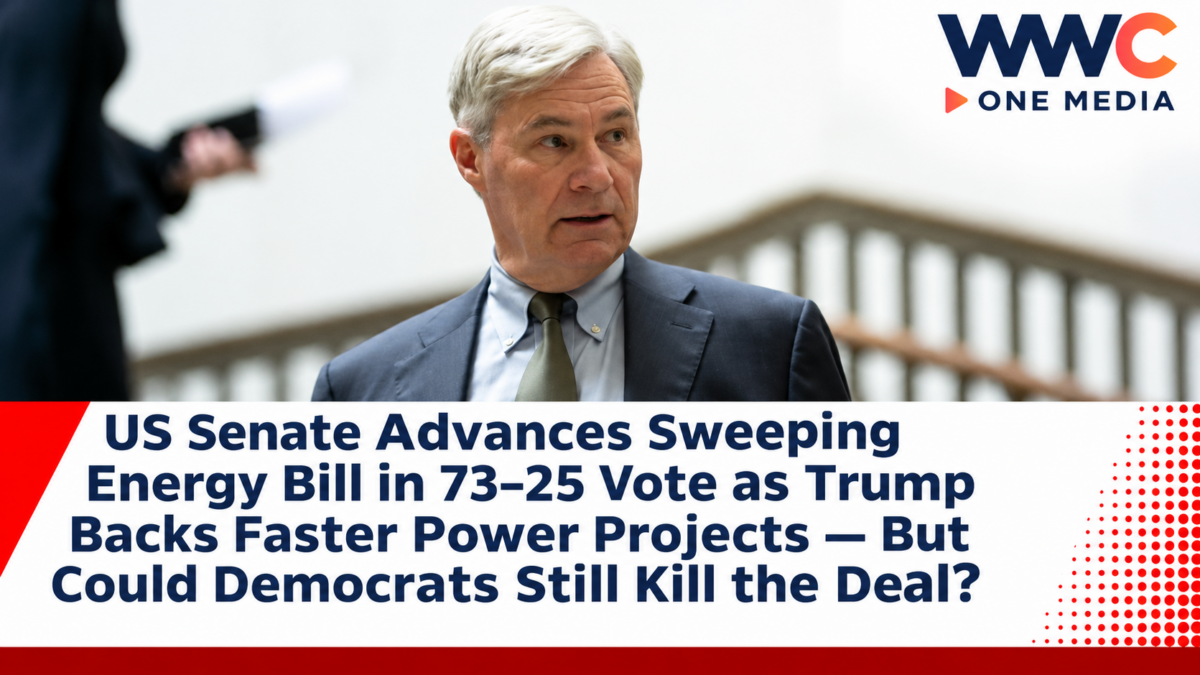
WASHINGTON, D.C. — November 10, 2026 — The United States Senate has delivered a major breakthrough for President Donald Trump’s energy agenda, voting 73–25 to advance sweeping bipartisan legislation that could transform how America approves power plants, oil and gas pipelines, electricity transmission lines and massive artificial intelligence data centers.
The legislation, known as the Bipartisan American Affordability and Jobs Act of 2026, cleared a crucial procedural hurdle on Monday, November 9, bringing Congress closer to one of the most consequential changes to federal energy permitting in years.
The proposal aims to eliminate costly approval delays that supporters say have prevented billions of dollars in potential infrastructure investment from moving forward.
But the vote has exposed deep divisions over environmental protections, Native American tribal rights, fossil-fuel development and the growing electricity demands of artificial intelligence.
Despite overwhelming Senate support for advancing debate, the bill still faces significant obstacles in both chambers of Congress.
Democrats’ sweeping victories in the November 3 midterm elections have further complicated the negotiations, with some lawmakers arguing that their party should wait until 2027 to pursue a stronger agreement.
Could the Senate’s bipartisan breakthrough finally unlock America’s stalled energy infrastructure—or will the same political divisions that have delayed reform for years derail the deal before it reaches Trump’s desk?
Senate Votes 73–25 to Advance Historic Energy Permitting Overhaul
The Senate voted 73–25 on November 9 to proceed with consideration of the bipartisan legislation.
The proposal cleared the 60-vote procedural threshold by a substantial margin.
Bloomberg reported that the measure would overhaul the federal approval process for major energy projects, potentially reducing years of regulatory uncertainty for developers.
The legislation was negotiated by four senators from both political parties: Democrats Martin Heinrich of New Mexico and Sheldon Whitehouse of Rhode Island, and Republicans Shelley Moore Capito of West Virginia and Mike Lee of Utah.
Their proposal targets longstanding complaints about the complexity of federal permitting requirements.
Large infrastructure projects frequently require approvals involving multiple federal agencies, environmental assessments and potential legal challenges.
Supporters argue that these procedures can create substantial expenses and make investment decisions difficult.
The proposed reforms would attempt to establish more predictable timelines while modifying several major environmental statutes.
However, the November 9 vote only allowed the Senate to proceed with the measure.
It did not constitute final Senate approval, passage by the House of Representatives or enactment into federal law.
Trump Throws His Support Behind the Energy Bill
President Trump endorsed the legislation ahead of the Senate vote.
In a public statement on Sunday, November 8, he urged lawmakers to support the proposal, arguing that faster permitting would help expand domestic energy production.
Trump believes reducing regulatory delays could accelerate construction of pipelines, mines and power plants.
The administration has made energy production and infrastructure development important parts of its economic agenda.
Supporters argue that the bill could improve energy security, create construction jobs and make electricity supplies more reliable.
But Trump’s support comes with an unusual complication.
The president has repeatedly criticized wind energy, even though the bipartisan legislation includes provisions intended to protect approved renewable-energy projects.
Speaking to reporters Monday, Trump reiterated his opposition to wind turbines.
That position has raised concerns among Democrats who want stronger safeguards against political interference with renewable-energy projects.
The contradiction illustrates the political difficulty facing the measure.
A bill designed to accelerate both fossil-fuel and renewable-energy development must retain the support of lawmakers who disagree sharply about which energy technologies should dominate America’s future.
What the Bipartisan American Affordability and Jobs Act Would Change
The legislation proposes broad changes to how the United States evaluates and approves energy infrastructure.
One major objective is to reduce delays involving the National Environmental Policy Act, commonly known as NEPA.
The law requires federal agencies to examine environmental consequences before approving certain major projects.
Supporters of reform argue that the existing review process can become excessively slow and expensive.
Critics maintain that environmental assessments are essential for protecting communities, public lands, wildlife and natural resources.
The bill would impose new limits on certain review timelines, legal challenges and permitting procedures.
It would also modify aspects of federal authority over major electricity transmission projects.
These changes could affect renewable energy, fossil-fuel infrastructure, mining operations and other developments requiring federal approvals.
A revised version released November 7 also included changes intended to provide stronger protection for previously approved energy projects.
For developers, such protections could reduce the risk that a change in presidential administration disrupts projects that already secured necessary permits.
But environmental groups argue that limiting legal challenges could also reduce public oversight when harmful projects receive approval.
The debate centers on how to accelerate construction while maintaining meaningful safeguards.
America’s AI Data Center Boom Is Driving the Urgency
One of the most consequential aspects of the legislation concerns artificial intelligence.
Major technology companies are investing heavily in computing facilities capable of running increasingly powerful AI systems.
These data centers require enormous electricity supplies, sophisticated cooling equipment and extensive transmission infrastructure.
In several regions, power-grid limitations have become a major obstacle to development.
The new legislation includes provisions intended to accelerate the construction of electricity transmission lines and improve planning for additional demand.
It also seeks to ensure that large electricity consumers contribute appropriately toward the infrastructure required to serve them.
This could have major implications for technology companies building new AI facilities.
WWC ONE MEDIA previously examined the issue in AI Data Centers Are Setting Off Alarms in Washington — And Now Congress Is Moving on the Power Bill.
The report explained how the rapid growth of artificial intelligence has intensified concerns about electricity bills, grid upgrades and cost allocation.
The Senate’s latest measure attempts to address some of those challenges.
However, faster federal permitting alone cannot guarantee that every data center will receive sufficient electricity.
Projects may still encounter local opposition, equipment shortages, financing difficulties and other infrastructure constraints.
Could Big Tech Be Forced to Pay More for Electricity Infrastructure?
The proposed law also addresses concerns that households could end up paying for grid improvements primarily needed by enormous data centers.
When large facilities connect to electricity networks, utilities may need to construct additional substations, transmission lines and generating capacity.
Those upgrades can require substantial investment.
The central policy question is how the costs should be distributed.
Supporters of the Senate bill argue that large users should bear an appropriate share of expenses resulting from their energy needs.
That approach could reduce the risk that ordinary electricity customers subsidize major technology companies.
WWC ONE MEDIA examined the broader debate in Trump Tells Big Tech to Pay Americans for Hosting AI Data Centers — But Who Will Really Foot the Electricity Bill?.
The earlier report highlighted demands for technology companies to provide greater financial benefits to communities hosting large computing facilities.
The permitting proposal does not establish a nationwide program giving every household direct cash payments from data center operators.
Instead, it focuses partly on infrastructure planning and the allocation of electricity-related costs.
The precise impact on consumers would depend on the final legislation and its implementation.
Environmental Groups Warn the Bill Could Weaken Protections
Despite the bipartisan vote, environmental opposition remains substantial.
Organizations including the Sierra Club and National Wildlife Federation have criticized the proposal.
They argue that restrictions on environmental reviews and litigation could make it harder for communities to challenge projects that threaten water supplies, wildlife habitats or public lands.
Native American organizations have also raised concerns about tribal sovereignty and consultation over projects affecting sacred sites.
The bill’s sponsors attempted to address some objections through revisions released November 7.
Those changes strengthened language involving tribal consultation, state participation and protections for certain approved projects.
However, critics say the revised provisions do not fully resolve their concerns.
Reuters reported that environmental and tribal organizations remained opposed to important elements of the agreement even after the changes.
Supporters counter that slow permitting can also damage environmental objectives.
For example, lengthy delays in constructing transmission lines can prevent renewable electricity from reaching customers.
The debate therefore involves difficult trade-offs between infrastructure expansion and environmental protection.
Could Faster Permitting Help Renewable Energy?
Renewable-energy developers have long argued that approval delays can slow construction of wind farms, solar facilities and transmission infrastructure.
Electricity generated in one region cannot necessarily reach consumers elsewhere without sufficient grid capacity.
That means new power lines are essential for connecting renewable projects to demand centers.
The American Clean Power Association and other industry organizations have supported broader efforts to make permitting more predictable.
Some environmental advocates also argue that accelerating transmission construction could reduce reliance on fossil-fuel generation.
However, the same permitting reforms could benefit natural gas pipelines, fossil-fuel infrastructure and mining operations.
That has divided climate organizations.
Some believe the clean-energy benefits justify a compromise.
Others argue that the potential expansion of fossil-fuel development could outweigh the advantages.
The legislation’s long-term impact on carbon emissions is therefore uncertain.
It would depend on which projects actually receive approval and enter operation.
House Democrats Could Become the Biggest Obstacle
Even if the Senate ultimately approves the legislation, the House of Representatives remains a major obstacle.
House Democratic leader Hakeem Jeffries has criticized the current proposal, saying it does not adequately address concerns raised by members of his party.
Some Democrats believe the November 3 election results have strengthened their negotiating position.
Because Democrats are preparing to control Congress in January 2027, they may prefer to pursue different legislation rather than accept the existing compromise.
Representative Jared Huffman and other critics have argued that Congress should consider stronger environmental protections before approving such sweeping changes.
Meanwhile, the bill’s Democratic Senate sponsors believe delaying action could jeopardize years of negotiations.
The dispute is particularly important because the current congressional session is approaching its end.
A proposal that does not complete the legislative process before the current Congress adjourns would generally need to be reintroduced in the next Congress.
WWC ONE MEDIA previously examined the political uncertainty in US Senate’s 417-Page Energy Bill Faces November 9 Showdown as Democrats Threaten to Block Deal — But Could America’s AI and Power Grid Expansion Be Delayed?.
That report covered the negotiations before the successful procedural vote.
The November 9 result represents important progress, but the dispute over final passage remains unresolved.
Could the Bill Lower Electricity Bills?
Supporters argue that the proposed reforms could reduce long-term electricity costs by allowing the United States to construct additional energy infrastructure more efficiently.
Faster transmission development may reduce grid congestion and help lower-cost generation reach more customers.
More reliable electricity infrastructure could also reduce expenses caused by shortages and construction delays.
However, the bill would not automatically produce immediate reductions in household electricity bills.
Electricity prices are affected by fuel costs, generation capacity, utility regulation, regional demand and investment expenses.
Some analysts have projected long-term household savings from permitting reform.
But those estimates depend on modeling assumptions and should not be presented as guaranteed results.
The actual financial benefits would require successful construction of new infrastructure.
Consumers could also face higher bills in some areas if utilities make substantial investments and regulators allow costs to be recovered through electricity rates.
For lawmakers, ensuring that large data center operators pay an appropriate share is therefore central to the affordability debate.
Trump’s Public-Land Data Center Strategy Faces Scrutiny
The legislation also intersects with broader questions about how the Trump administration intends to expand energy and technology infrastructure.
The federal government has identified public land that could potentially support new data centers and related facilities.
But those plans have raised concerns about environmental reviews, local impacts and public participation.
WWC ONE MEDIA examined the controversy in Trump’s AI Data Center Plan Targets Over 17,000 Acres of US Public Land as Top Democrat Demands Answers — But Who Will Pay the Environmental Price?.
The dispute illustrates why permitting reform has become politically sensitive.
The United States wants to attract investment in advanced computing and energy production.
But communities also want assurances that major projects will not create disproportionate environmental costs.
Faster permits may help development proceed.
Whether that development is economically and environmentally beneficial will depend on project-specific decisions and effective oversight.
Can Congress Pass the Bill Before January?
The Senate’s 73–25 procedural vote demonstrates substantial bipartisan support for continuing debate.
However, that support may not translate into an identical vote on final passage.
Lawmakers may propose additional amendments affecting environmental safeguards, transmission planning and data center obligations.
Changes could attract new supporters while alienating others.
If the Senate passes the legislation, the House would need to approve the same text or reconcile differences.
President Trump would then need to sign the measure for it to become law.
Time is becoming an important factor.
The current Congress has limited legislative days remaining before the next session begins.
WWC ONE MEDIA examined that political deadline in Trump’s Republicans Have Just 57 Days to Push Through Final Agenda After Democrats Seize Congress — But Could a Last-Minute Power Play Change America’s Future?.
Energy permitting reform may become one of the last major opportunities for bipartisan legislation during the current congressional session.
But the strong procedural vote should not be mistaken for a guarantee of enactment.
The Bigger Picture: Can America Build Faster Without Sacrificing Protections?
The November 9 Senate vote marks an important development in America’s long-running debate over energy infrastructure.
Lawmakers from both parties recognize that permitting delays can complicate construction of power plants, pipelines, transmission networks and other essential projects.
The growth of artificial intelligence has made the issue more urgent by placing extraordinary demands on electricity systems.
At the same time, environmental groups and Native American organizations warn that accelerating approvals must not come at the expense of public health, tribal sovereignty and meaningful community oversight.
The bipartisan proposal attempts to balance those competing priorities.
But its political future remains uncertain.
For President Trump, the legislation offers an opportunity to advance a major infrastructure priority.
For congressional Democrats, it presents a decision about whether to support the current compromise or negotiate a different framework after taking control of Congress.
For consumers, the ultimate test will be whether any new rules actually improve electricity affordability and reliability.
The US Senate has taken a major step toward rewriting America’s energy-permitting rules. But as lawmakers confront environmental opposition, Democratic demands for changes and the rapidly approaching end of the congressional session, one question remains: Will this historic 73–25 vote finally unlock America’s energy future—or become another bipartisan breakthrough that collapses before reaching the president’s desk?