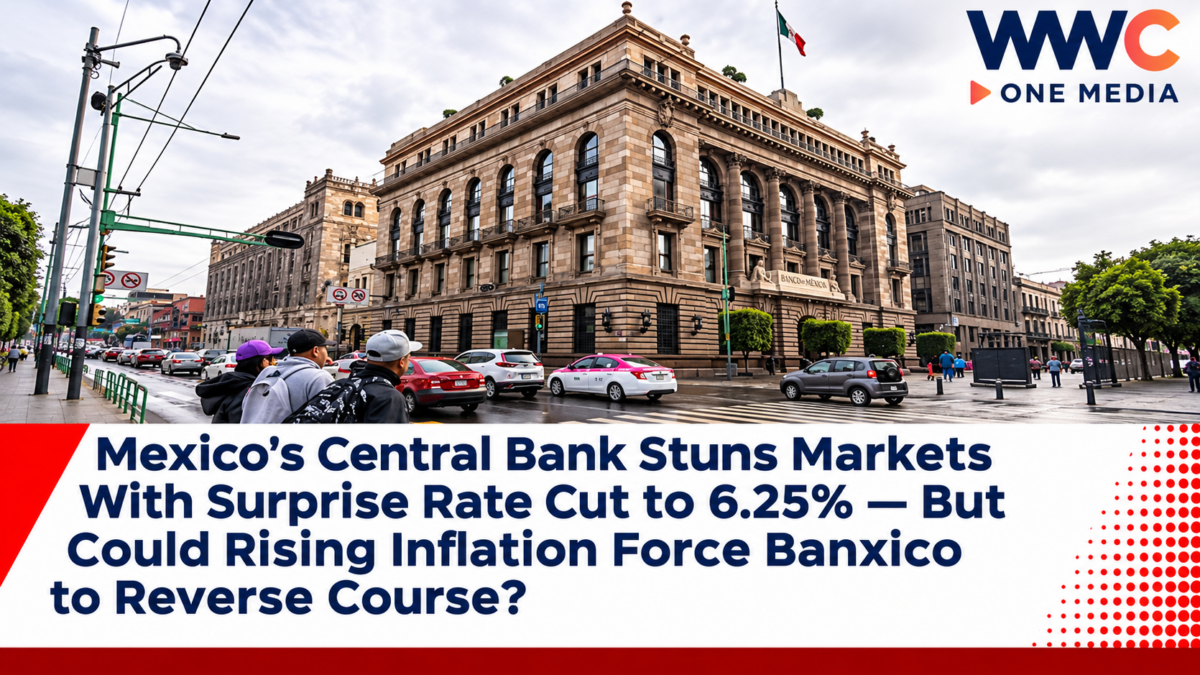
MEXICO CITY — November 10, 2026 — Mexico’s central bank has signaled that it is in no hurry to reduce interest rates again after delivering a surprise cut that caught financial markets off guard, even as fresh inflation data show consumer prices accelerating faster than economists expected.
Bank of Mexico Governor Victoria Rodríguez Ceja indicated that the institution’s decision to lower its benchmark interest rate from 6.50% to 6.25% on November 5 was a carefully considered adjustment rather than the beginning of an aggressive new easing campaign.
The decision was approved by a narrow 3–2 vote, exposing divisions among policymakers over whether Mexico can afford cheaper borrowing while inflation remains stubbornly above the central bank’s target.
The latest warning comes at a delicate moment for Latin America’s second-largest economy.
Mexico’s annual inflation accelerated to 3.75% in October, compared with 3.45% in September, while the Mexican peso faces uncertainty from US interest rates, international trade tensions and global investment flows.
According to Bloomberg’s November 10 report, Rodríguez’s comments suggest Banxico intends to maintain its new policy rate for some time rather than immediately follow the unexpected reduction with another cut.
But with inflation moving in the wrong direction, could Mexico’s surprise rate cut prove premature—and eventually force the central bank to reconsider its policy?
Banxico Surprises Wall Street With Interest-Rate Cut
Mexico’s central bank shocked financial markets on November 5 when it reduced its overnight benchmark rate by 25 basis points to 6.25%.
The decision ended a sequence of three meetings during which policymakers kept the rate unchanged at 6.50%.
It also took borrowing costs to their lowest level since February 2022.
The move was unexpected because most analysts believed Banxico would wait for stronger evidence that inflation was returning sustainably toward its 3% target.
According to a Citi survey conducted before the announcement, only six of 36 economists expected an immediate rate cut.
The surprise highlights the difficulty investors have faced in predicting Mexico’s monetary-policy direction.
While some central banks are raising interest rates to control renewed inflation, Banxico chose to deliver limited relief to an economy confronting weak domestic demand and external uncertainty.
But the central bank’s message was unusually cautious.
Rather than promising further reductions, policymakers indicated that maintaining the new 6.25% level for an extended period would be appropriate.
The signal suggests that the November decision was intended as a one-time adjustment rather than an open-ended commitment to cheaper credit.
The Vote Reveals a Deep Divide Inside Mexico’s Central Bank
The November decision exposed disagreements among Banxico’s five-member Governing Board.
Governor Victoria Rodríguez Ceja supported the reduction, alongside Deputy Governors José Gabriel Cuadra García and Omar Mejía Castelazo.
Deputy Governors Galia Borja Gómez and Jonathan Heath voted to keep the benchmark rate at 6.50%.
The 3–2 result illustrates how narrowly the decision was approved.
Officials supporting the cut argued that the adjustment was compatible with their assessment of inflation and the country’s broader economic conditions.
They also emphasized the importance of responding to external economic challenges.
The dissenting members favored maintaining the existing level of monetary restraint.
Their opposition came amid concerns that price pressures remained too persistent to justify additional easing.
The division matters because Banxico’s credibility depends partly on maintaining confidence that inflation will eventually return to its target.
A narrow decision can indicate that the policy outlook is more uncertain than a unanimous vote might suggest.
For investors, the question is whether future inflation figures will strengthen the case for holding rates or renew pressure for tighter policy.
Governor Rodríguez Says the Cut Was Under Consideration Since September
Rodríguez has pushed back against the impression that the surprise reduction was an impulsive policy decision.
In an interview with Mexican financial newspaper El Financiero, the governor explained that the possibility of a quarter-point cut had been under consideration since September.
She said policymakers had evaluated the inflation outlook and its underlying drivers before deciding to act.
The remarks suggest that the Governing Board had been discussing the appropriate timing of another adjustment for several weeks.
But the governor also stressed that the central bank did not intend to rush into further reductions.
She indicated that keeping the rate at 6.25% for an extended period would help support inflation’s convergence toward the official target.
That statement is central to understanding the Bloomberg report.
Banxico is not announcing the start of another rapid series of rate cuts. It is signaling a prolonged pause after a carefully limited reduction.
The message could help reassure investors who were concerned that the central bank was becoming too tolerant of inflation.
Nevertheless, the effectiveness of the strategy will depend on how prices behave over the coming months.
Mexico’s Inflation Accelerates to 3.75%
The latest consumer-price figures have made Banxico’s policy decision more controversial.
Mexico’s annual headline inflation reached 3.75% in October, compared with 3.45% in September.
The result exceeded the 3.65% rate expected by economists in a Reuters survey.
Monthly consumer prices increased 0.65%, also above expectations of a 0.55% rise.
Core inflation, which excludes certain volatile food and energy prices, accelerated to 3.80% from 3.75%.
The core figure is particularly important because it provides information about underlying price pressures.
While headline inflation can change sharply because of energy or agricultural prices, persistent increases in core prices can indicate that inflation is spreading more broadly through the economy.
Both headline and core inflation remain within Banxico’s tolerance range of 2% to 4%.
However, they are still above the central bank’s 3% target.
The distinction is critical.
Being inside the tolerance band does not mean inflation has returned to the desired midpoint.
For households, an annual inflation rate of 3.75% means the overall consumer-price index is still increasing, not that living costs are falling.
Could Banxico’s Inflation Strategy Backfire?
The November inflation data raise questions about the timing of the rate cut.
When a central bank reduces interest rates, borrowing can become less expensive over time.
Lower financing costs may encourage consumer spending and business investment.
That can support economic growth.
But easier monetary conditions can also increase demand at a time when price pressures remain elevated.
If economic activity strengthens before inflation is firmly under control, policymakers may find it more difficult to achieve their target.
That is the risk facing Banxico.
The central bank believes that maintaining rates at 6.25% will provide sufficient restraint.
Some economists are less confident.
BBVA Research said the decision revealed stronger confidence in the inflation outlook than recent price data appeared to justify.
Capital Economics expects Banxico to keep rates unchanged for an extended period.
Banco Base economist Gabriela Siller has also expressed skepticism about whether inflation can return to the 3% target during 2027.
These assessments are forecasts and opinions, not official changes to monetary policy.
For now, Banxico continues projecting that inflation will converge to 3% in the fourth quarter of 2027.
Mexican Peso Faces Another Test
The surprise rate cut also carries implications for the Mexican peso.
Higher domestic interest rates can make peso-denominated investments attractive to international investors seeking income.
When Banxico lowers rates, that interest-rate advantage may narrow.
The effect becomes particularly important when other major central banks are raising their policy rates.
The US Federal Reserve increased its benchmark target range to 3.75%–4.00% in September.
If US borrowing costs rise further while Mexican rates remain unchanged, the difference between the two countries’ policy rates could narrow.
That may influence international investment decisions and demand for pesos.
However, exchange rates are driven by more than interest-rate differentials.
Trade expectations, economic growth, geopolitical risks and global investor sentiment also matter.
Rodríguez has argued that fluctuations in the peso have a relatively limited effect on consumer inflation, particularly when the economy has spare capacity.
She also noted that the currency remained stronger than its average level during 2025.
Nevertheless, analysts at BBVA Research warned that risks had tilted toward further peso weakness.
A weaker currency could raise the cost of imports priced in dollars, although the actual effect would depend on exchange-rate movements and businesses’ pricing decisions.
The Federal Reserve Is Complicating Mexico’s Decision
Mexico’s monetary-policy outlook is closely connected to conditions in the United States.
The two economies share extensive trade, manufacturing and investment relationships.
US interest rates influence global borrowing costs and investment flows, including those affecting Mexico.
The Federal Reserve’s renewed tightening has created additional challenges for emerging-market central banks.
WWC ONE MEDIA previously examined the shift in Fed Raises Interest Rates Again and Signals Another 2026 Hike — Inflation Keeps the Pressure On.
The report explained how persistent American inflation led policymakers to increase the federal funds target range in September.
Further increases could influence the attractiveness of US dollar assets relative to peso-denominated investments.
But Mexico does not automatically need to match every Federal Reserve decision.
Banxico must focus on its own inflation outlook, domestic economic activity and financial stability.
The challenge is maintaining investor confidence while responding to Mexico’s specific economic conditions.
Weak Economic Activity Helps Explain the Rate Cut
One reason Banxico was willing to reduce rates is that Mexico’s domestic economy has shown signs of weakness.
When consumer spending and investment are subdued, businesses may have less ability to raise prices.
The central bank believes this economic slack can help limit inflation pressure.
Lower interest rates may also reduce borrowing costs for companies seeking financing.
But the benefits take time to emerge.
Banks do not necessarily reduce every loan rate immediately after a central-bank announcement.
Businesses may also delay investment if demand remains uncertain.
For households, a reduction in the policy rate does not guarantee an immediate decrease in existing fixed-rate loan payments.
The eventual impact depends on lending contracts and the transmission of central-bank decisions through the financial system.
Mexico’s Manufacturing Sector Faces a Bigger Economic Challenge
Mexico’s economic performance depends heavily on manufacturing and international trade.
Its proximity to the United States has made it an important destination for companies reorganizing global supply chains.
Automotive production, aerospace, electronics and industrial manufacturing all contribute to the country’s economic activity.
However, tariff uncertainty and changing trade policies can discourage new investment.
WWC ONE MEDIA previously examined Mexico’s investment opportunities in Latin America Has Its Best Investment Tailwinds in Decades — But the Biggest Opportunity May Still Be Hiding in Plain Sight.
The report explored how nearshoring is changing supply-chain decisions and why Mexico has become an important destination for international manufacturers.
But attracting new investment requires more than competitive labor costs or favorable geography.
Businesses also assess financing conditions, exchange-rate stability and regulatory certainty.
Banxico’s decisions influence part of that investment environment.
Lower interest rates could eventually support financing, but uncontrolled inflation or currency instability could undermine those benefits.
Aerospace and Industrial Investment Remain Important
Mexico continues attracting interest from companies seeking a stronger presence in North American manufacturing.
South Korean businesses have been exploring additional cooperation with the country’s aerospace industry.
WWC ONE MEDIA covered the development in South Korea’s KAI and POSCO International Join Mexico Aerospace Push — FA-50 and Supply Chains in Focus.
These initiatives illustrate Mexico’s potential to benefit from international investment diversification.
However, planned partnerships do not automatically translate into completed factories or immediate increases in employment.
Economic conditions, financing costs and trade policy remain important to investment decisions.
For Banxico, the challenge is maintaining monetary stability while allowing productive industries room to expand.
Could US-Mexico Trade Tensions Add More Pressure?
Trade uncertainty remains another potential risk to Mexico’s economy.
The United States has pursued additional trade restrictions and reviews affecting several trading partners.
Mexico’s close integration with American manufacturing makes it particularly sensitive to changes in US trade policy.
WWC ONE MEDIA examined the wider North American trade relationship in Trump Backs Down on Key Canada Trade Demands as Carney Claims Major Breakthrough — But Will Washington Finally Lift Its 50% Tariffs?.
Although that report focuses on Canada, it also discusses the broader framework of the United States-Mexico-Canada Agreement.
Future changes to regional trade arrangements could affect investment planning and manufacturing costs across North America.
For Mexico, uncertainty about export demand can influence economic growth and private investment.
These are additional factors Banxico must consider when assessing whether interest rates are sufficiently restrictive.
What Happens Next for Banxico?
The next scheduled monetary-policy announcement is December 17, 2026.
Investors will be watching whether policymakers maintain the current rate at 6.25%, as Rodríguez’s comments suggest.
The central bank will also receive additional inflation and economic data before the meeting.
Several developments could influence its outlook.
Persistent core inflation would support a cautious approach.
A weaker peso could raise questions about import-price pressures.
Slower economic growth could strengthen arguments for providing additional monetary support.
Changes in US interest rates could also influence financial conditions.
For now, however, Banxico has indicated that the November reduction should be followed by an extended period of stability.
The decision to pause does not guarantee that the bank will never cut again.
Nor does rising inflation establish that an interest-rate increase is imminent.
Future policy will depend on the inflation outlook and the central bank’s assessment of the economy.
The Bigger Picture: Mexico Is Walking a Monetary-Policy Tightrope
Mexico’s latest interest-rate decision has created a delicate balancing act for the country’s monetary authorities.
The surprise reduction to 6.25% may provide modest support to an economy facing weak demand and international uncertainty.
But October’s inflation figures have complicated the outlook.
Headline inflation accelerated to 3.75%, while core inflation reached 3.80%.
Both remain above Banxico’s target midpoint.
Governor Victoria Rodríguez Ceja is attempting to reassure investors that the reduction was deliberate, limited and consistent with the central bank’s inflation strategy.
The planned extended pause could help maintain confidence.
But the central bank must still demonstrate that its inflation forecasts are achievable.
If price increases continue accelerating, policymakers may face growing criticism for cutting rates too early.
If the economy weakens further, pressure for additional easing could eventually return.
Mexico’s central bank has surprised investors by cutting interest rates while inflation remains elevated. But with Governor Rodríguez now signaling a prolonged pause, the bigger question is whether Banxico has found the right balance between supporting growth and controlling prices—or whether rising inflation will eventually force another dramatic policy reversal.