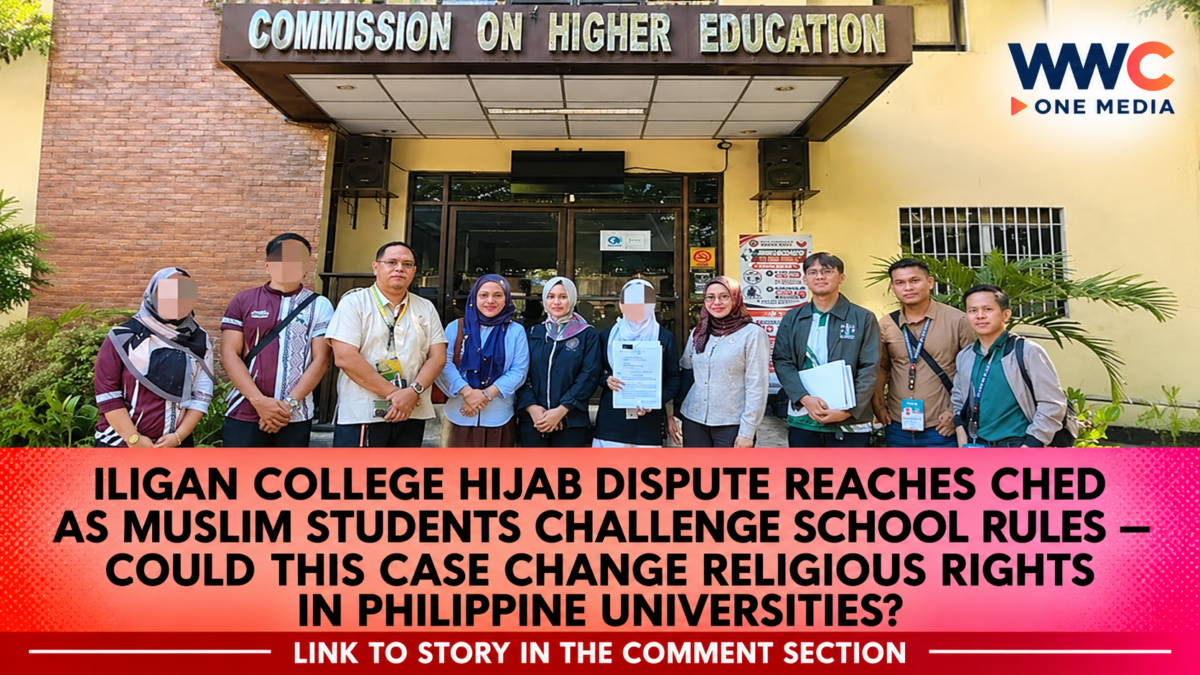
A dispute over a Muslim nursing student’s request to wear a hijab during a capping ceremony at Iligan Medical Center College (IMCC) has escalated to the Commission on Higher Education (CHED), bringing renewed attention to religious freedom, student rights and the responsibility of colleges to accommodate religious practices.
The National Commission on Muslim Filipinos in Northern Mindanao (NCMF-10) formally lodged a complaint with CHED Regional Office 10 on November 4, 2026, seeking intervention over what it described as restrictions on Islamic religious attire at the Iligan City college.
The complaint was filed through the NCMF-10 Legal Division, together with members of the IMCC Muslim Student Association and representatives of Al-Jalis As-Salih Inc.
The controversy centers on a nursing student’s request to wear her hijab during a capping ceremony, a significant academic milestone for nursing students. The dispute has since developed into a wider debate about whether institutional dress and clinical requirements can unnecessarily interfere with a student’s religious beliefs. SunStar Publishing Inc.+2
NCMF Says School Did Not Accommodate Earlier Dialogue Requests
According to NCMF-10, its representatives first approached the college’s College of Nursing dean to explain the religious significance of the hijab and request that the alleged restriction be lifted.
The commission also sent a formal letter seeking a meeting with the school’s senior officials, including its president and Board of Directors.
NCMF-10 said the requested meeting was not accommodated and the issue remained unresolved. It subsequently brought the matter to CHED, accompanied by Muslim student representatives and Al-Jalis As-Salih Inc.
The delegation included NCMF-10 Legal Division Chief Atty. Shayma A. Abdullah, lawyers Naira Dirampatun-Alonto and Ellyssahanna U. Espinosa, Alic M. Mohamad, and Mohammad Shuaib H. Batara.
The commission said its intervention was part of its mandate to protect the religious rights and welfare of Muslim Filipinos, including students seeking to practice their faith while pursuing higher education. SunStar Publishing Inc.+1
IMCC Denies Having a Campus-Wide Hijab Ban
The college, however, has disputed the broader allegation.
In an official statement issued on November 7, IMCC said it had never implemented a campus-wide policy prohibiting hijab during its 51-year history.
The institution maintained that it promotes an inclusive environment that respects the different religious beliefs and cultural backgrounds of its students, faculty members and employees.
This distinction is important: the college’s denial of a general campus-wide hijab ban does not, by itself, resolve the specific disagreement over the nursing student’s request to wear the head covering during the capping ceremony or the concerns raised about particular academic and clinical requirements.
UCA News also reported the college’s denial and the NCMF’s complaint, confirming that the two sides have presented different accounts of the issue.
The college further expressed concern about online threats, harassment and calls for violence directed at the institution and its members following the controversy. It urged the public to discuss the matter responsibly and avoid spreading unverified claims or encouraging hostility.
The dispute should therefore be addressed through evidence, institutional clarification and the appropriate regulatory process—not threats or online harassment. UCA News+1
Muslim Student Groups Say the Issue Goes Beyond a School Uniform
The controversy has also drawn attention from Muslim student organizations and religious advocates who argue that the hijab is an expression of faith, modesty and religious identity rather than simply an item of clothing.
In a report published by Daily Tribune on November 10, Muslim student groups said the issue extends beyond the capping ceremony. They raised concerns about requirements affecting clinical rotations and other mandatory academic activities, where female Muslim students allegedly face restrictions on wearing their head coverings.
The groups argued that students should not have to choose between completing their education and observing their religious beliefs.
They also emphasized that their campaign is directed at the disputed institutional rules, rather than against the college or its contribution to Muslim education.
These allegations remain part of the dispute and should not be treated as a final finding by CHED. The regulatory agency’s intervention will be important in determining how the applicable rules and the school’s actual policies should be interpreted. Daily Tribune+1
What Philippine Law Says About Students’ Religious Rights
The controversy has brought renewed attention to existing protections for religious freedom in Philippine education.
The 1987 Philippine Constitution guarantees the free exercise and enjoyment of religious profession and worship without discrimination or preference under Article III, Section 5.
More specifically, CHED Memorandum Order No. 47, series of 2016, is titled Strengthening the Protection of Religious Rights of Students in Higher Education Institutions.
The memorandum directs higher education institutions to give the highest degree of respect, protection and consideration to students’ religious rights when developing institutional policies.
It recognizes that religious clothing can become a point of conflict between institutional rules, security requirements and students’ constitutional freedoms.
The policy is particularly relevant to the IMCC dispute because it concerns a higher education institution and a student’s request to observe a religious practice while participating in an academic activity. FEU Public Policy Center+1
Nursing and Clinical Requirements Also Raise Practical Questions
Because the controversy involves a nursing student, the discussion also extends to the requirements of health care education and clinical training.
The Department of Health’s Department Memorandum No. 2009-0107 addresses the religious rights of Muslim health care workers, students and trainees, including the wearing of hijab in health care settings.
However, clinical environments also have legitimate requirements involving hygiene, infection prevention, identification and patient safety.
The challenge is to determine whether those requirements can be met through reasonable adjustments to clothing and protective equipment, rather than imposing unnecessary restrictions on religious attire.
This is an important distinction. Respecting religious freedom does not eliminate the need for safe clinical practices, but safety requirements should also be clearly explained and applied in a way that does not unnecessarily disadvantage students because of their faith.
CHED’s review could help clarify how these considerations should be balanced in higher education institutions offering health-related programs. SunStar Publishing Inc.+1
February 1 Is Now the National Day of Awareness on Hijab
The issue also comes amid the country’s growing recognition of traditional and religious garments.
Republic Act No. 12224, approved on June 18, 2025, declares February 1 of every year as the National Day of Awareness on Hijab and Other Traditional Garments and Attire.
The law aims to promote diversity, awareness and tolerance of different religious and cultural beliefs through traditional clothing, head garments and coverings.
It directs the National Commission on Muslim Filipinos, the National Commission on Indigenous Peoples and the National Commission for Culture and the Arts to coordinate activities promoting awareness of traditional garments.
Importantly, the law does not require anyone to wear or refrain from wearing a particular garment. Its purpose is to encourage cultural understanding and respect.
The legislation nevertheless reinforces the importance of recognizing the cultural and religious significance of attire such as the hijab. Issuances Library+1
Proposed Student Religious Rights Bill Adds to the Debate
Advocates have also cited Senate Bill No. 611, filed by Senator Robinhood Padilla, known as the proposed Protection of Students’ Religious Belief Act.
The proposal seeks stronger safeguards for students against discrimination based on religious beliefs and practices in educational institutions.
However, it is important to distinguish a proposed bill from an existing law. Senate Bill No. 611 should not be presented as an already enacted nationwide protection.
For now, the constitutional guarantee and existing CHED guidelines provide the relevant framework for examining the Iligan college dispute.
Muslim Education and Inclusion Remain Important Across Mindanao
The controversy also highlights the wider importance of educational institutions that serve Muslim communities.
WWC ONE MEDIA has previously reported on Davao City’s proposed development of a dedicated Muslim cemetery, a local government initiative intended to accommodate Islamic burial traditions and provide culturally appropriate public services.
The importance of Muslim representation in education and public life has also appeared in other developments across the region and beyond.
Meanwhile, the Filipino film Amir has brought elements of Muslim cultural heritage in Mindanao to a wider audience, demonstrating the importance of representing the region’s traditions and identity.
These developments are different from the dispute at IMCC, but they reflect a broader national conversation about cultural recognition, representation and equal opportunities for Muslim Filipinos.
What Happens Next as CHED Reviews the Complaint?
The formal complaint places the issue before CHED Regional Office 10, which is now being asked to intervene in the dispute.
The central questions include whether the college has rules that restrict hijab use during specific academic activities, how those rules are implemented, and whether they comply with the constitutional protection of religious freedom and CHED Memorandum Order No. 47.
The college’s denial of a campus-wide ban and the allegations raised by NCMF and student groups will need to be considered carefully.
A clear written policy could help prevent similar disputes by explaining how religious attire can be accommodated during ceremonies, classroom activities and clinical training while maintaining legitimate safety and identification standards.
For Muslim students, the outcome could have implications beyond one capping ceremony. It could influence how religious accommodation is handled in other higher education institutions, particularly those offering nursing and other health-related courses.
The issue is ultimately about ensuring that students can pursue professional qualifications without facing unnecessary barriers to their religious practices.