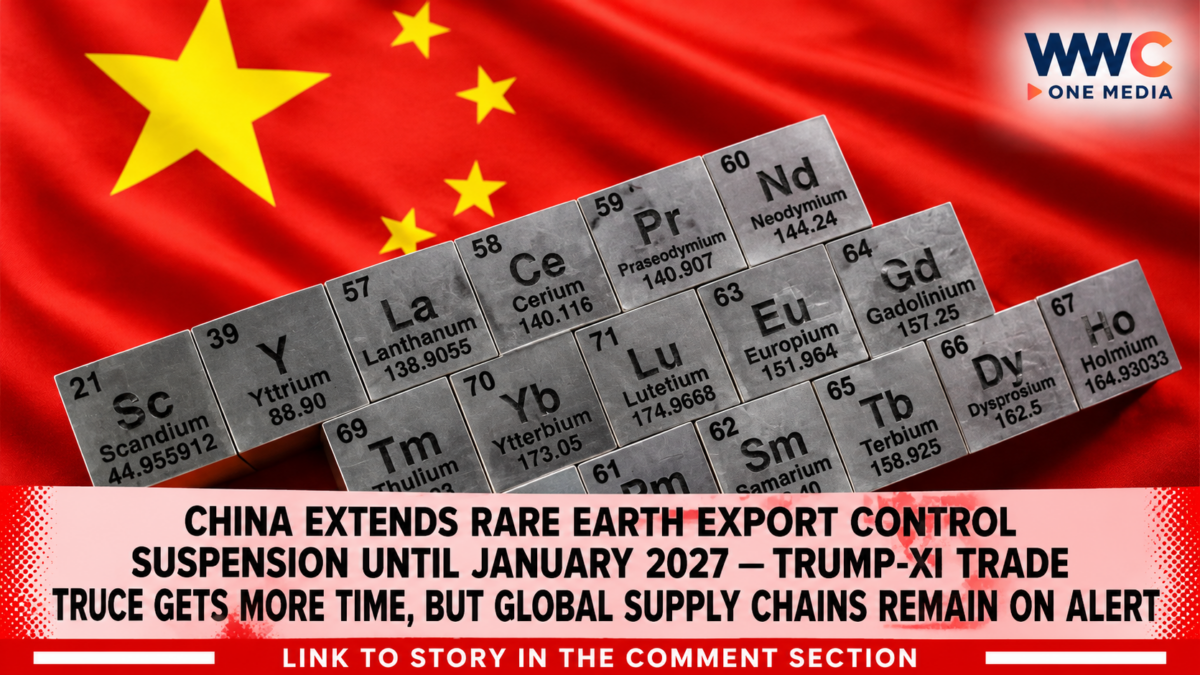
China has extended its suspension of several expanded rare-earth export controls until January 10, 2027, giving Beijing and Washington additional time to negotiate a longer-term trade agreement and avoid another damaging escalation between the world’s two largest economies.
The announcement, made by China’s Ministry of Commerce on November 9, 2026, extends the temporary suspension of specific export-control measures that were due to resume in November. The extension will run from November 11, 2026, through January 10, 2027.
The decision preserves an important part of the trade understanding reached by Chinese President Xi Jinping and US President Donald Trump following their meeting in Busan, South Korea, in October 2025.
However, the latest move does not mean China has completely removed its rare-earth export controls. Instead, Beijing is continuing to suspend selected expanded restrictions introduced in 2025, while other export-control requirements remain relevant.
The distinction matters because rare earths are essential to electric vehicles, smartphones, advanced electronics, wind turbines, industrial equipment and military technologies. Any uncertainty surrounding their supply can affect manufacturers and consumers far beyond China and the United States.
For global businesses, the extension provides additional breathing room. But with the new deadline approaching in January, the bigger question is whether Washington and Beijing can turn their temporary trade truce into a lasting agreement.
China Extends Suspension of Expanded Rare Earth Restrictions
China’s Ministry of Commerce announced on November 9 that the suspension of several export-control announcements issued in 2025 would continue until January 10, 2027.
The affected measures include specific restrictions covering rare-earth-related materials, equipment, technologies and certain overseas-related activities. The wider package also involves controls concerning industrial diamonds and lithium battery technology.
The measures were originally introduced or expanded in October 2025, when Beijing broadened its export-control framework amid escalating trade tensions with Washington.
The restrictions were subsequently suspended for one year following the Trump-Xi meeting in South Korea.
The latest announcement extends that suspension by another two months.
According to Reuters, China’s Ministry of Commerce provided limited explanation beyond confirming the extension. The decision forms part of a broader suspension of trade countermeasures and tariffs as both governments continue negotiating an enduring trade arrangement.
This means the latest announcement should not be interpreted as a complete removal of China’s export-control system.
Export controls that were not included in the suspension remain subject to their existing requirements.
Why China’s Rare Earths Matter to the Entire World
Rare earth elements are a group of 17 metallic elements with properties that make them important for modern manufacturing and advanced technology.
Despite their name, many are not particularly rare in the Earth’s crust. The difficulty lies in economically extracting, separating and processing them at commercial scale.
They are used in products and technologies including:
- Electric vehicle motors and permanent magnets
- Smartphones, computers and consumer electronics
- Wind turbines and renewable energy equipment
- Aerospace and advanced defence systems
- Industrial machinery and precision manufacturing
- Medical equipment and specialised electronic components
China has a particularly powerful position in the global rare-earth industry because it dominates not only mining but also processing and permanent magnet manufacturing.
The International Energy Agency has highlighted the concentration of rare-earth supply chains in China, particularly in refining and magnet production.
That concentration creates a vulnerability for countries and companies that depend on Chinese materials.
Even manufacturers with factories outside China may rely on Chinese-processed minerals or components. If licensing requirements become stricter or shipments are delayed, production costs can rise and manufacturing schedules can be disrupted.
The European Parliamentary Research Service has also warned that China’s dominance in rare-earth processing creates significant supply risks for European industries, including clean energy, digital technology and defence.
How the Rare Earth Dispute Became Part of the US-China Trade War
The current situation developed through successive rounds of trade restrictions.
In April 2025, China introduced export controls covering seven medium and heavy rare-earth elements and related products.
The measures required exporters to obtain government licences before shipping covered materials overseas.
In October 2025, Beijing expanded its restrictions, adding further rare-earth-related products, equipment, technologies and overseas-related activities.
The broader controls also covered selected industrial diamonds and lithium battery technology.
The expansion intensified concerns among international manufacturers because it increased the number of materials and activities potentially affected by Chinese licensing requirements.
The dispute became part of the wider economic confrontation between Washington and Beijing, which had already involved tariffs, technology restrictions and countermeasures.
The temporary suspension agreed after the October 2025 summit helped prevent the expanded restrictions from taking full effect.
The latest two-month extension now gives negotiators additional time to address unresolved issues.
WWC ONE MEDIA previously examined the European supply-chain implications in China Offers Europe Rare-Earth Supply Lifeline as US Trade Deadline Looms.
That report highlighted how European manufacturers remain dependent on Chinese materials even as Beijing attempts to improve export licensing arrangements with selected trading partners.
Trump and Xi Face Another Important Trade Deadline
The extension is particularly significant because the existing US-China trade arrangement is approaching another critical deadline.
Trump and Xi reached an understanding in Busan in October 2025 intended to ease tensions after months of escalating trade measures.
The arrangement included a pause in selected tariffs and export restrictions, alongside commitments involving agricultural purchases and critical minerals.
However, the agreement did not resolve every disagreement between the two governments.
Washington has continued pressing Beijing to demonstrate that it is fulfilling its commitments, particularly regarding rare-earth supplies and American agricultural purchases.
Chinese officials, meanwhile, have raised concerns about US restrictions affecting Chinese businesses and access to advanced technologies.
The latest extension gives both governments more time to negotiate.
Trump is expected to travel to Shenzhen later in November for the Asia-Pacific Economic Cooperation leaders’ summit, where another meeting with Xi is anticipated.
Such discussions could become important opportunities to address the remaining disagreements.
However, an extended suspension should not be confused with a permanent trade settlement.
The two governments still need to agree on longer-term arrangements covering tariffs, critical minerals, market access and other economic issues.
The US Still Wants More Reliable Access to Chinese Rare Earths
For Washington, access to critical minerals has become a major economic and national security priority.
American manufacturers depend on rare-earth materials for electric vehicles, electronics, renewable energy equipment and defence-related technologies.
Although the United States has been investing in alternative mining and processing capacity, developing an independent supply chain takes considerable time and capital.
The problem is not simply finding rare-earth deposits. Companies also need specialised processing facilities, technical expertise, infrastructure and reliable commercial customers.
China’s dominance therefore gives Beijing considerable influence over international supply chains.
US officials have repeatedly raised concerns about the speed and reliability of Chinese rare-earth deliveries.
As WWC ONE MEDIA previously reported in Trump Pressures Xi Over US Soybeans and Rare-Earth Supplies Ahead of Crucial Summits, Washington wants Beijing to translate its trade commitments into measurable results.
The dispute is not limited to minerals. Agricultural purchases, tariffs and other trade concessions remain part of the negotiations.
China Is Also Protecting Its Strategic Economic Interests
Beijing’s decision to extend the suspension does not mean it is abandoning its ability to regulate strategic materials.
China has consistently maintained that export controls are legitimate instruments for protecting national security and regulating sensitive technologies.
At the same time, the government has economic reasons to avoid unnecessary disruption to international trade.
Rare-earth exports support Chinese businesses and maintain the country’s position in global manufacturing networks.
A sudden return to expanded restrictions could encourage overseas companies to accelerate efforts to find alternative suppliers, potentially reducing China’s long-term market influence.
Maintaining the suspension while continuing negotiations gives Beijing more flexibility.
It allows China to preserve the existing trade arrangement without permanently giving up its regulatory authority over strategically important materials.
This is a delicate balance between maintaining economic influence and avoiding further damage to international commercial relationships.
Could the Extension Help European and Asian Manufacturers?
The latest announcement could provide additional certainty for manufacturers that depend on the specific materials covered by the suspended measures.
European companies are particularly exposed because their electric vehicle, wind energy, industrial and defence sectors rely heavily on rare-earth supply chains connected to China.
Japan and South Korea also have significant exposure through their electronics, automotive and advanced manufacturing industries.
For Southeast Asia, the implications extend to electronics production, industrial equipment and other sectors connected to international supply networks.
The Philippines may also feel indirect effects through its participation in global electronics and manufacturing supply chains.
However, the extension does not guarantee unrestricted shipments or eliminate all licensing requirements.
Businesses must still comply with the export rules applicable to their products and destinations.
For companies, the most important benefit is additional time to plan purchases, manage inventories and monitor the progress of trade negotiations.
WWC ONE MEDIA has also examined the broader mineral competition in China Tightens Its Mineral Grip as the US and Japan Race to Protect Global Chip Supply Chains.
The report explored how governments are attempting to reduce their dependence on Chinese-controlled materials used in semiconductors and other advanced technologies.
Why the January 10, 2027 Deadline Matters
The new suspension period provides another two months for negotiations, but it also creates another deadline that manufacturers and investors will be watching closely.
If Washington and Beijing reach a broader agreement, the temporary suspension could become part of a more stable trade framework.
If negotiations fail, the future of the suspended measures could become uncertain again.
A return to expanded restrictions would not necessarily mean an immediate worldwide shortage of every rare-earth material. The impact would depend on which products are affected, the licensing process, available inventories and alternative suppliers.
Nevertheless, renewed uncertainty could create additional costs for businesses that depend on predictable shipments.
Companies may respond by increasing inventories, diversifying suppliers or investing in alternative processing facilities.
Those measures can reduce exposure over time, but they are unlikely to eliminate dependence on China immediately.
The latest extension therefore offers temporary relief rather than a permanent solution.
The Bigger Picture: China Still Holds a Powerful Position in Critical Minerals
The rare-earth dispute illustrates how control over essential industrial materials has become an important part of international economic competition.
Countries can impose tariffs on imported products, restrict access to advanced technology and negotiate trade concessions. But when one country dominates the processing of materials required by entire industries, its influence extends across global manufacturing.
China’s position in rare-earth processing and permanent magnets gives it considerable strategic leverage.
The United States, Europe and other economies are responding by investing in alternative supply chains, recycling and domestic processing capabilities.
However, building those alternatives requires years of investment and technical development.
For now, international manufacturers remain closely connected to Chinese supply networks.
That makes the latest extension important not only for Washington and Beijing but also for businesses across Asia, Europe and North America.
A Temporary Reprieve, Not the End of the Rare Earth Trade War
China’s decision to extend the suspension of selected expanded rare-earth export controls until January 10, 2027, provides additional time for negotiations and reduces the immediate risk of those measures returning in November.
But it does not eliminate existing export controls, settle the wider US-China trade dispute or guarantee uninterrupted supplies of every critical mineral.
The next two months will be important for both governments.
Washington wants reliable access to strategic materials and progress on agricultural trade commitments. Beijing wants reciprocal treatment and greater certainty for Chinese businesses.
For manufacturers, the priority is stability.
For investors, the concern is whether the trade truce can survive another round of negotiations.
And for the rest of the world, the stakes are enormous because rare earths are no longer just industrial commodities. They are essential materials powering modern technology, clean energy, transportation and defence.
China has bought itself and Washington another two months. But if Trump and Xi fail to secure a lasting agreement before January 10, the next rare-earth deadline could once again put global manufacturers on edge.