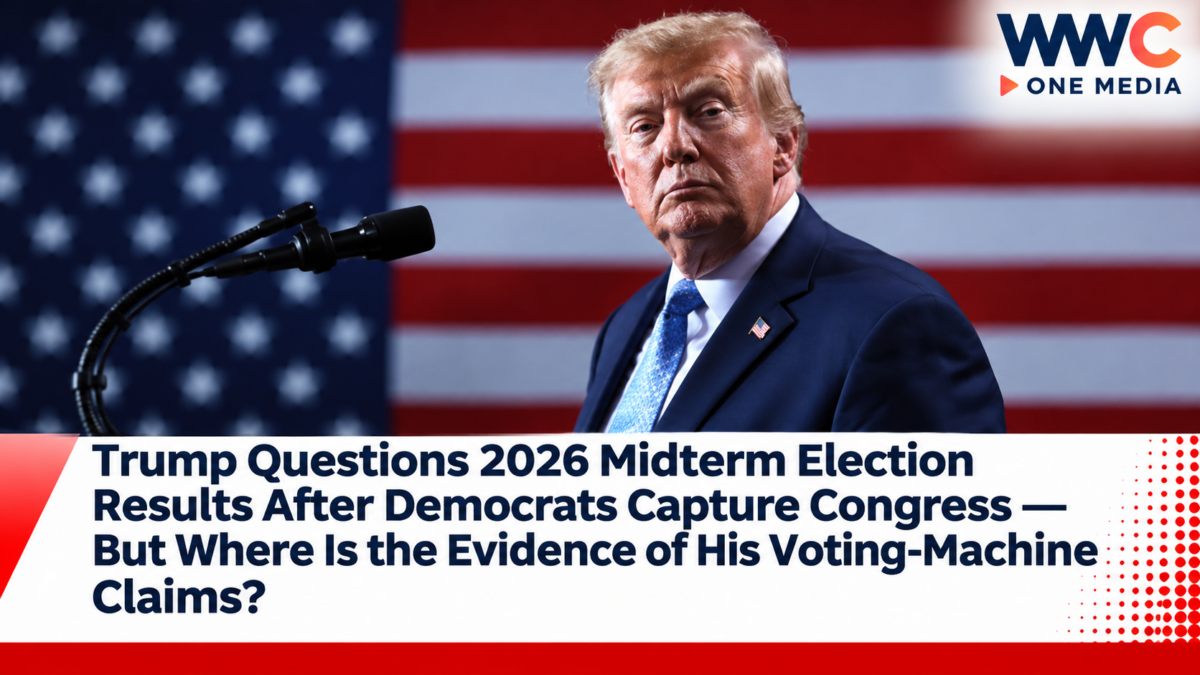
WASHINGTON, D.C. — November 10, 2026 — President Donald Trump has reignited controversy over American election integrity after questioning the legitimacy of the November 3 midterm elections, just days after Democrats delivered a historic defeat to his Republican Party and captured control of both chambers of Congress.
In a Truth Social post on Monday, November 9, Trump suggested that unusually large early-voting totals and voting machines may have played a role in Republican losses.
The president questioned whether the election had been conducted honestly and criticized the accuracy of pre-election opinion polls.
But Trump offered no evidence establishing widespread election fraud, manipulated voting machines or an organized effort to change the outcome.
The allegations represent a striking shift from his initial response to the election.
Immediately after the November 3 vote, Trump acknowledged Republican losses and told reporters that his party had struggled because he was not personally on the ballot.
He also indicated that he would accept the election results and expressed a willingness to negotiate with Democrats.
Less than a week later, however, the president’s latest remarks revived questions that have followed his political career since the disputed aftermath of the 2020 presidential election.
The controversy comes as Democrats prepare to take control of the House of Representatives and Senate in January 2027, giving them powerful tools to investigate the administration, challenge its policies and potentially block much of Trump’s legislative agenda.
But with election officials reporting no evidence of a nationwide voting-machine conspiracy, could Trump’s renewed accusations undermine public confidence in American elections—or will they deepen the political divisions already exposed by the Republican defeat?
Trump Questions Whether the Midterm Election Was Honest
Trump’s latest statements were published on Truth Social on November 9.
He questioned how opinion polls could have been so inaccurate and suggested that exceptionally large early-voting totals made Republican victories impossible in certain races.
He also pointed toward voting machines, implying that technology used in elections had played a suspicious role.
The allegations were reported by CNBC and independently documented by The Washington Post.
However, Trump did not provide supporting evidence demonstrating that election machines changed votes, that ballots were improperly counted on a large scale or that the national election results were fraudulent.
That distinction is essential.
A political leader can question an election, but the existence of a claim does not establish wrongdoing.
Accusations involving voting systems require credible documentation, investigations or other verifiable evidence.
As of November 10, the reports reviewed do not establish widespread fraud capable of explaining the sweeping Democratic victories.
Democrats Capture Both the House and Senate
The president’s remarks follow an extraordinary election outcome.
Democrats won control of both chambers in the November 3 midterm elections, overturning Republican majorities and making significant gains even in traditionally conservative states.
The Associated Press and Reuters reported major Democratic Senate victories in states including Texas, Kansas and South Carolina.
Democrats also made large gains in the House of Representatives.
Some closely contested races remained unresolved during the days following the election, meaning final seat totals could still change.
But the outcome determining control of both chambers was already clear.
Democratic candidates had won enough races to secure the incoming majorities.
As previously reported by WWC ONE MEDIA, the election represented one of the most significant political setbacks of Trump’s second presidency.
Related WWC ONE MEDIA coverage: Democrats Capture Both Houses of Congress in Sweeping Midterm Victory — Trump Faces Major Political Setback With Two Years Left in Office
The election results will change the balance of power in Washington when the newly elected Congress convenes in January 2027.
Until then, Republicans retain control of the outgoing House and Senate.
Trump Initially Accepted the Losses
The November 9 accusations contrast with Trump’s statements immediately following the election.
On election night, the president congratulated Democrats during a telephone interview with CBS News.
He said he looked forward to working with the opposition party and suggested that negotiations could produce agreements.
He also acknowledged that Republican candidates had lost, arguing that his own absence from the ballot reduced voter turnout among his supporters.
Trump expressed the belief that Republicans would have performed better if he had personally been running.
But that assertion is a political assessment, not something the election results can conclusively prove.
The important point is that his initial response focused on campaign performance and candidate strength rather than alleging nationwide voting-machine fraud.
The Washington Post also reported that Trump told The New York Times he would accept the election results.
His subsequent shift toward questioning their legitimacy therefore represents a significant change in public messaging.
Were the Polls Really Wrong?
One of Trump’s arguments concerns the accuracy of pre-election polls.
But the available evidence does not support the claim that polling failures establish election fraud.
National and state-level surveys had broadly suggested that Democrats were positioned to make substantial gains.
The eventual Democratic victory was larger than many forecasts anticipated.
That is a meaningful polling error, but it is not proof that votes were manipulated.
Opinion polls are estimates based on surveys of selected voters.
They are subject to uncertainty involving sampling, turnout assumptions, responses and changes in voter sentiment.
Even a well-conducted survey can underestimate the scale of an election result.
The Washington Post noted that polling generally predicted Democratic victories, although it did not fully capture the strength of the eventual outcome.
To establish electoral wrongdoing, investigators would need actual evidence involving voting procedures, ballot handling or tabulation.
A difference between polling forecasts and final results does not provide that evidence.
Why Early Votes Can Produce Large Democratic Leads
Trump also questioned large early-voting totals.
But early voting and mail voting are routine parts of American elections, subject to differing state laws and procedures.
Political parties do not necessarily use those methods at the same rate.
In some states, Democratic voters may be more likely to cast ballots before Election Day, while Republican voters may be more likely to vote in person on the day itself.
That difference can influence when candidates appear to gain or lose ground during ballot counting.
An early advantage for one party does not establish fraud.
Nor does the size of an early-vote total indicate whether the ballots were legitimate.
Those questions must be assessed using voter eligibility rules, ballot records, reconciliation procedures and other relevant evidence.
According to reporting cited by The Washington Post, Democratic Senate candidates in Georgia, North Carolina and Texas had enough early and mail votes to prevail even without their Election Day vote totals.
That finding illustrates the strength of Democratic early voting.
It does not establish improper ballot counting.
Voting-Machine Allegations Revive Familiar Controversies
Trump’s reference to voting machines has reopened a politically sensitive debate.
Following the 2020 presidential election, Trump and several allies promoted allegations about voting equipment and election administration.
Many of those claims were challenged through recounts, audits, litigation and official investigations.
The November 2026 statements resemble that earlier rhetoric.
However, the current midterm results must be evaluated independently.
The fact that allegations were previously made in another election does not determine whether any particular problem occurred in 2026.
At the same time, officials need specific evidence before treating allegations as credible.
The available November 9 reporting does not identify verified, widespread manipulation of voting machines capable of changing control of Congress.
Localized technical problems may require investigation and correction.
But they should not automatically be presented as proof of a nationwide conspiracy.
Election Officials Reported a Largely Normal Voting Day
The Washington Post reported that the November 3 election proceeded relatively smoothly despite heightened public concern over possible interference.
Some jurisdictions experienced administrative problems.
These included long lines, ballot shortages, changes to polling locations and equipment-programming issues.
For example, flooding affected voting arrangements in parts of Florida.
Other jurisdictions extended voting hours or addressed ballot-processing difficulties.
Such problems can cause delays and inconvenience.
They may also require official reviews or judicial intervention.
But the reports reviewed did not establish that these incidents amounted to coordinated nationwide fraud.
Election administrators and observers generally described the voting process as functioning normally.
The distinction between isolated administrative errors and systematic manipulation remains central to evaluating Trump’s claims.
Justice Department Sent More Than 900 Election Monitors
The election also attracted unusual attention because of the federal government’s monitoring activities.
According to The Washington Post, the Department of Justice deployed more than 900 election monitors across approximately 120 jurisdictions in all 50 states.
Critics expressed concern about whether the unusually large deployment could intimidate voters or interfere with election administration.
Federal officials maintained that the monitoring effort was intended to support compliance with election laws.
The newspaper reported no major nationwide incidents associated with the deployment.
There were concerns about individual monitors’ activities in certain jurisdictions, but those reports did not establish widespread manipulation of election results.
The presence of federal monitors should not be confused with a finding of electoral fraud.
Monitoring is an oversight activity.
An investigation or legal finding requires additional evidence.
Cost of Living Became a Major Election Issue
Independent polling suggests that Americans’ economic concerns played an important role in the Republican defeat.
A Reuters/Ipsos survey conducted from November 6 to November 9 found Trump’s overall approval rating at approximately 32%.
Only 21% approved of his handling of the cost of living.
About 25% approved of his economic stewardship.
The survey included 1,705 US adults and reported a margin of error of approximately two percentage points.
These figures indicate widespread dissatisfaction with the administration’s handling of everyday expenses.
They do not prove the motivation of every voter.
But they provide broader context for why the Republican Party struggled.
High fuel prices, household costs and uncertainty surrounding economic policy became major campaign issues.
For many voters, those concerns appeared more immediate than the political arguments emphasized by national party leaders.
Iran War Also Damaged Republican Support
The US conflict with Iran was another major issue during the midterm campaign.
Military operations began in February 2026 and contributed to rising energy-market uncertainty.
Fuel prices increased sharply, placing additional pressure on American households.
Following the election, Trump acknowledged that the conflict had hurt Republican candidates.
However, he defended the decision to take military action and said he would make the same choice again.
As WWC ONE MEDIA previously reported, Trump argued that preventing Iran from obtaining nuclear weapons justified the intervention despite its political consequences.
Related WWC ONE MEDIA coverage: Trump Admits Iran War Hurt Republicans in Midterm Defeat but Says He Would Do It Again — Why His ‘Transfer the Love’ Remark Is Raising Bigger Questions
The war provides an important explanation for political dissatisfaction.
But its contribution to the election outcome should not be confused with Trump’s separate allegations about voting machines.
One concerns voter preferences and government policy.
The other concerns the integrity of election administration.
They require different evidence.
Democrats Prepare to Challenge the White House
The incoming Democratic majorities will substantially change the political environment.
When the new Congress takes office, Democratic lawmakers will gain control of congressional committees and their investigative agendas.
They can hold hearings, request documents and issue subpoenas under applicable rules.
Areas of expected scrutiny include government spending, the Iran war, executive-branch decisions and financial relationships involving administration officials.
Democrats will also have greater power to block legislation and examine budget proposals.
As previously covered by WWC ONE MEDIA, Democratic leaders are preparing a broad oversight agenda covering congressional investigations, federal spending, military policy, artificial intelligence and cryptocurrency regulation.
Related WWC ONE MEDIA coverage: Democrats Prepare Five-Front Congressional Offensive Against Trump After Historic Midterm Sweep — But Could Subpoenas, Iran War Probes and Crypto Investigations Shake the White House?
But Democratic control will not mean that every proposed law can automatically pass.
The president retains veto authority.
Senate procedures and constitutional requirements can also limit legislative action.
The result may be a period of intense oversight combined with legislative deadlock.
Trump’s Election Claims Could Complicate Negotiations
The president’s renewed allegations create another potential obstacle to cooperation.
Trump initially indicated that he was prepared to work with Democrats on matters of mutual interest.
But suggesting that their electoral victories resulted from a dishonest process could make negotiations more contentious.
Democratic leaders may respond by defending the legitimacy of the results and demanding evidence for any allegations.
Republican lawmakers may also face pressure to take positions on Trump’s statements.
Some may support calls for reviews of election procedures.
Others may prefer to focus on understanding why voters rejected the party’s candidates.
These responses remain political possibilities rather than confirmed future actions.
There is no verified announcement that Trump’s November 9 post has overturned any congressional election result.
What Does the Constitution Say About Election Results?
American elections are administered primarily by state and local authorities under federal and state legal frameworks.
The process involves counting ballots, canvassing results, resolving applicable disputes and certifying winners.
Presidential dissatisfaction with an outcome does not itself invalidate votes.
Election challenges must proceed through the applicable legal and administrative processes.
Evidence matters.
If a candidate alleges a counting error or unlawful voting, the appropriate authorities can examine the specific claim.
But broad allegations do not substitute for documented irregularities.
Control of Congress is determined by election outcomes established through the relevant processes, not by a president’s personal assessment of whether the results were fair.
The incoming Congress is scheduled to convene on January 3, 2027.
Could the Political Crisis Affect America’s Allies?
The election outcome has international implications.
Democratic control of Congress could change how the United States approaches foreign aid, defense spending and oversight of military operations.
Allies in Europe and Asia may face uncertainty over the relationship between the White House and the incoming congressional majority.
Trump retains significant authority over diplomacy and the executive branch.
But congressional control of spending and legislation can influence his administration’s ability to implement major policies.
As previously reported by WWC ONE MEDIA, the Democratic victory has raised questions among American allies about how a politically weakened president will manage international crises.
Related WWC ONE MEDIA coverage: Trump Loses Congress in Historic Midterm Defeat, Leaving US Allies on Edge — But Could His Final Two Years Trigger a Bigger Global Crisis?
Trump’s election allegations add another political uncertainty.
But they do not, by themselves, change the constitutional authority of the incoming Congress or establish that the United States faces an immediate institutional breakdown.
What Happens Next?
Several developments will determine whether the latest controversy escalates.
State election authorities will continue finalizing and certifying results according to their laws.
Any specific allegations involving voting machines or ballot counting can be examined through established procedures.
Political leaders may also respond publicly to Trump’s accusations.
Meanwhile, the outgoing Congress has a limited period to address unfinished legislative business.
The incoming Democratic majorities will assume power in January.
Further elections-related disputes could generate litigation or calls for congressional hearings.
But as of November 10, the available reporting does not establish a nationwide fraud scheme or an official reversal of Democratic victories.
The burden remains on those making allegations to produce credible evidence.
The Bigger Picture: Can Trump Accept a Congress Controlled by His Opponents?
The 2026 midterm elections have fundamentally changed the political outlook for the final two years of Trump’s second presidency.
Democrats won control of the House and Senate.
Republicans suffered major losses in states once considered dependable strongholds.
And opinion surveys indicate that the cost of living and the Iran war contributed to dissatisfaction with the administration.
Trump initially acknowledged the defeats, congratulated Democrats and suggested that he could negotiate with the new congressional majorities.
But his November 9 social media comments have revived unsupported claims about election integrity.
The controversy now places two separate issues before the American public.
The first is whether Republican leaders will reassess the policies and campaign strategies that contributed to their losses.
The second is whether the president’s allegations will be supported by credible evidence.
Those questions should not be confused.
An unexpected electoral defeat is not proof of fraud, and disagreements about election procedures do not justify dismissing legitimate votes.
America’s election system provides mechanisms for reviewing specific irregularities.
It also requires political leaders to recognize outcomes established through lawful procedures.
And as Trump questions the November 3 results while Democrats prepare to take control of Congress, one question now hangs over Washington: Will the president provide evidence to support his allegations—or will another battle over election legitimacy overshadow the political reckoning his party faces after a historic defeat?