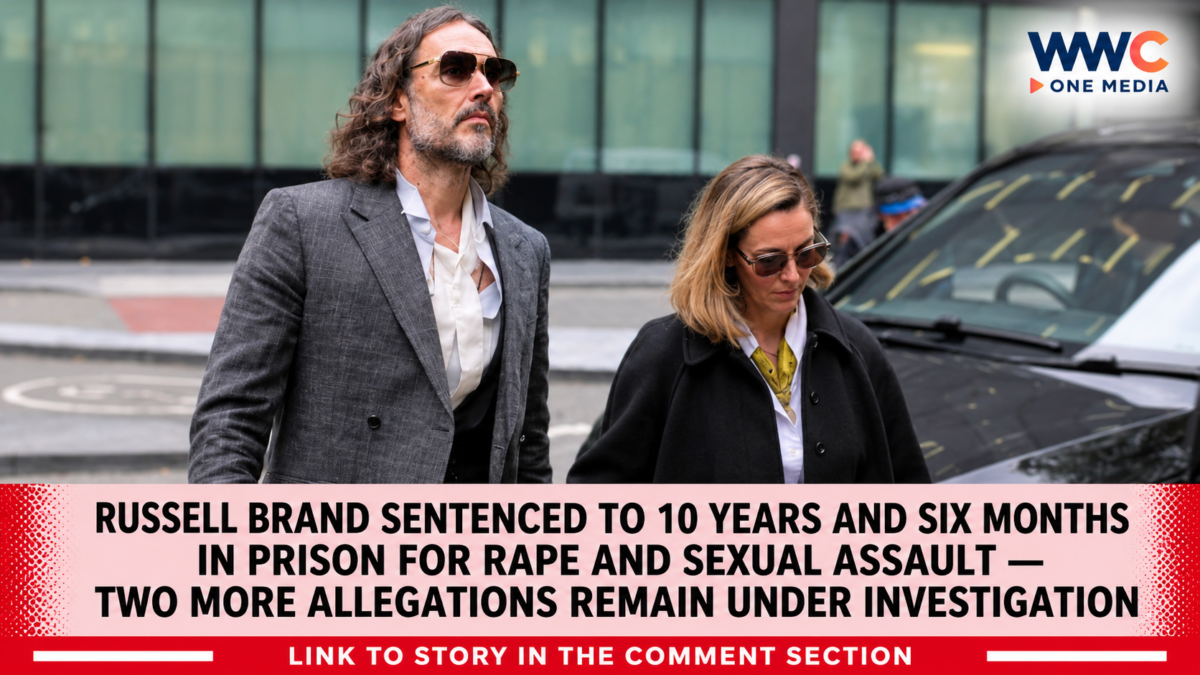
British comedian and actor Russell Brand has been sentenced to 10 years and six months in prison after a jury found him guilty of raping one woman and sexually assaulting three others in a landmark criminal case in the United Kingdom.
The sentence was handed down on Monday, November 9, 2026, at Southwark Crown Court in London, following a four-week trial that exposed allegations of sexual violence dating back to the height of Brand’s entertainment career.
The 51-year-old was convicted on November 5 of one count of rape and three counts of sexual assault involving four women between 2004 and 2009. He was acquitted of two additional rape charges and one count of attempted indecent assault.
Brand had denied the charges, maintaining that his sexual encounters were consensual. He was taken into custody after the guilty verdicts, when the judge refused his application for bail.
The sentencing now marks a dramatic fall for a celebrity who once dominated British comedy, television and radio. It also comes as police continue investigating two further rape allegations involving Brand.
Judge Condemns Brand’s Conduct as He Delivers Sentence
Judge Joel Bennathan described Brand’s behaviour as being driven by what he called “staggering arrogance”, telling the comedian that his growing fame had been accompanied by conduct that treated women with profound disrespect.
The judge said Brand had used his celebrity status as though it allowed him to act without regard for the boundaries and rights of others.
He also criticised Brand’s evidence during the trial, saying the jury’s findings showed that Brand had lied when he claimed he had never touched a woman sexually without her consent.
The court imposed nine years’ imprisonment for the rape conviction. The sentences for the three sexual assault offences totalled 35 months, but those terms are to run concurrently. The nine-year rape sentence is consecutive, bringing the overall prison term to 10 years and six months.
The judge reduced the sentence for the rape offence by one year after considering factors including Brand’s lack of a substantial previous criminal record and his work helping people struggling with addiction.
Brand must serve two-thirds of his sentence before becoming eligible for release, according to the judge. He will also be subject indefinitely to notification requirements under the UK’s Sexual Offences Act 2003.
Four Women Described the Lasting Impact of the Offences
Before sentencing, the court heard victim impact statements from the four women whose cases resulted in convictions.
The women described the long-term consequences of the offences, including emotional trauma, humiliation and the difficulty of coming forward against someone who was famous and influential.
The Crown Prosecution Service said the women did not know one another and had carried the experiences for almost two decades.
Prosecutors also praised their courage in giving evidence and facing questioning about deeply personal events.
The women are legally entitled to lifelong anonymity, meaning their identities cannot be publicly disclosed.
The prosecution said Brand had used his growing fame and influence to create situations in which he pursued women sexually regardless of their wishes.
The court’s findings established his criminal responsibility for the four offences of which he was convicted. The acquittals on the other charges remain equally important when describing the outcome of the trial.
Brand Was Acquitted of Three Charges
Although the guilty verdicts resulted in a substantial prison sentence, Brand was not convicted on every charge he faced.
The jury found him guilty of:
- One count of rape.
- Three counts of sexual assault.
He was acquitted of:
- Two counts of rape.
- One count of attempted indecent assault.
The charges arose from allegations made by six women concerning incidents between 1999 and 2009. The four convictions related to offences committed between 2004 and 2009.
Brand pleaded not guilty and maintained that the encounters were consensual. His defence challenged the allegations and the credibility of the accounts presented by the prosecution.
The jury considered the evidence over a four-week trial at Southwark Crown Court before reaching its verdicts on November 5.
Police Are Investigating Two More Rape Allegations
Brand’s sentencing does not mark the end of the legal scrutiny surrounding him.
The Metropolitan Police confirmed that investigators are examining two additional rape allegations involving the comedian.
The allegations are separate from the four offences for which he was convicted.
Police have said Brand has already been questioned in connection with the further allegations and that the investigation remains ongoing.
One of the reported allegations involves a woman who was 16 at the time of the alleged incident. No additional conviction has been secured in relation to these investigations.
The Metropolitan Police have also encouraged anyone who may have experienced sexual offences to contact investigators.
The existence of further investigations does not mean Brand has been found guilty of those alleged offences. Any additional criminal proceedings would require their own investigation and legal process.
How the Investigation Began
The case gained major public attention in September 2023, when investigations by The Times and Channel 4’s Dispatches published allegations from multiple women about Brand’s behaviour during his years in entertainment.
The reports prompted a police investigation and encouraged additional people to come forward.
Detectives subsequently gathered evidence from more than 100 witnesses and reviewed thousands of documents, according to the Metropolitan Police.
The investigation examined allegations involving incidents dating back several years, including the period when Brand was a prominent comedian, actor and broadcaster.
The case also renewed questions about how entertainment companies and media organisations respond when allegations are raised against high-profile personalities.
An Associated Press report following the conviction noted that the BBC and Channel 4 faced renewed scrutiny over how earlier complaints and concerns about Brand had been handled.
The BBC apologised over what it described as a culture of silence during his time working for the broadcaster, while Channel 4 also apologised over its handling of a serious complaint.
These institutional questions are separate from the criminal verdict, but they have become part of the wider debate surrounding the case.
From Hollywood and British Comedy to a Prison Sentence
Brand rose to prominence through stand-up comedy, television, radio and film.
He became widely recognised for his provocative humour, flamboyant public persona and outspoken commentary. His acting credits included films such as Forgetting Sarah Marshall and Get Him to the Greek.
He later developed a substantial online following through political commentary, interviews and discussions about spirituality, wellness and public affairs.
His criminal conviction and prison sentence represent a dramatic reversal for a public figure whose career once extended across major entertainment platforms.
The case has also prompted renewed discussion about celebrity influence, workplace power and the difficulties faced by people reporting sexual misconduct involving well-known personalities.
WWC ONE MEDIA has previously covered other high-profile entertainment and court cases involving sexual offences, including a Singapore actor’s departure from Jack Neo’s film after a previous sexual assault conviction resurfaced.
The publication also reported on former Singapore Idol judge Ken Lim’s appeal against his molestation conviction and 13-month jail sentence.
In another case, a man was sentenced to 21 years in prison for sexually abusing 11 girls over several decades.
WWC ONE MEDIA has also followed Chris Brown’s London court case involving a nightclub bottle attack, another example of a major entertainment figure facing serious legal consequences in the UK.
These cases involve different facts, offences and legal outcomes, but they underline the continuing public interest in accountability when prominent personalities face criminal proceedings.
What Happens Next for Russell Brand?
Brand’s immediate future is now centred on serving his prison sentence, while police continue examining the two additional rape allegations.
His conviction also places him under indefinite notification requirements under UK sexual-offence legislation.
The case is likely to remain a major subject of public discussion because of the number of women who came forward, the length of time between the alleged offences and the trial, and the renewed scrutiny of the media organisations that once worked with him.
For the four women whose cases resulted in convictions, the sentencing marks the conclusion of a long criminal process, although the judge acknowledged that a prison term cannot undo the harm they experienced.
For the entertainment industry, the case raises difficult questions about how celebrity power, workplace culture and institutional responsibility can affect whether victims feel able to report abuse.
And with two further allegations still being investigated, the legal consequences for Brand may not yet be over.
After receiving a 10-and-a-half-year prison sentence, could Russell Brand face another courtroom battle as British police continue investigating two more rape allegations?