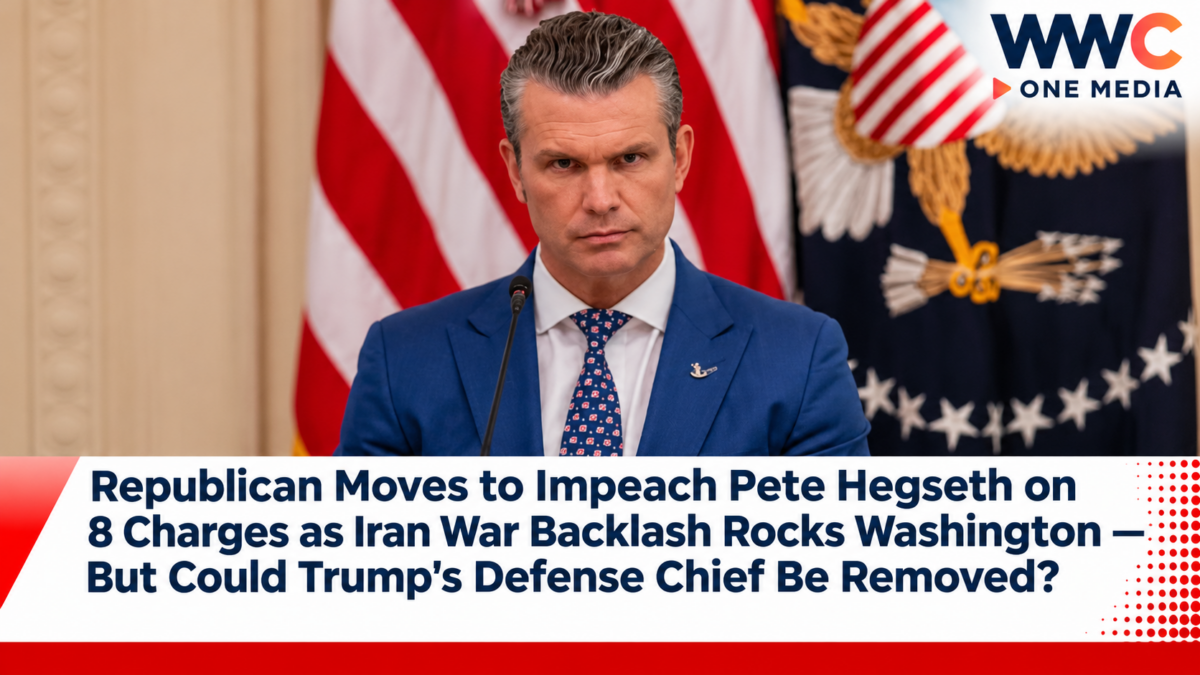
WASHINGTON, D.C. — November 10, 2026 — President Donald Trump’s defense secretary is facing an extraordinary challenge from within his own political party after Republican Representative Thomas Massie formally launched a new attempt to impeach Pete Hegseth over the Iran war and a series of controversial US military operations.
Massie, a Republican from Kentucky and a longtime critic of the administration’s military interventions, reintroduced eight articles of impeachment on Monday, November 9, potentially forcing the House of Representatives to confront the allegations within days.
The charges accuse Hegseth of abusing his authority, violating congressional war powers, disregarding protections for civilians during military operations and retaliating against a US senator who questioned unlawful military orders.
They also address American strikes on suspected drug-trafficking boats, the operation that captured former Venezuelan President Nicolás Maduro and military action in Yemen.
But the most explosive allegations concern the United States’ prolonged war with Iran.
Massie argues that Hegseth continued military operations without the authorization required by Congress, raising profound questions about the constitutional limits of presidential war-making authority.
The impeachment push comes just days after Republicans suffered major defeats in the November 3 midterm elections, with public opposition to the Iran war becoming an increasingly serious political problem for the Trump administration.
The crisis has divided Republicans, energized congressional Democrats and placed Hegseth’s future under intense scrutiny.
Yet Trump continues standing by his defense secretary, while Hegseth dismisses the impeachment attempt as politically motivated.
And with a House confrontation expected by November 11, Washington faces a dramatic question: Could a Republican-led impeachment effort force Trump’s defense chief out of office—or will the president’s allies stop it before it reaches the Senate?
Thomas Massie Forces a New Impeachment Showdown
Massie introduced his latest resolution on November 9, the first day the House returned following the midterm elections.
His action restarted a parliamentary process that could require the Republican-controlled chamber to consider the impeachment measure within two legislative days.
The congressman previously introduced substantially similar articles in September.
However, the House adjourned before a final vote could take place.
Massie has now revived the effort as lawmakers return for the final weeks of the current Congress.
The move creates political difficulties for Republican leaders.
Even lawmakers who oppose impeachment may be forced to take a public position on Hegseth’s conduct.
House Speaker Mike Johnson could attempt to defeat the resolution through a motion to table it or refer the matter to committee.
However, that would still place the controversy before Congress.
Reuters, CNBC, CBS News and The Washington Post reported that the impeachment effort could become one of the most significant tests of Republican unity following the party’s midterm defeat.
What Are the Eight Impeachment Charges Against Pete Hegseth?
Massie’s resolution contains eight separate articles.
They cover alleged constitutional violations, military operations and abuse of official authority.
| Article | Allegation in Massie’s resolution |
|---|---|
| I | Initiating war against Iran without sufficient constitutional or congressional authorization |
| II | Continuing the Iran war despite congressional direction to withdraw forces |
| III | Continuing hostilities beyond time limits established under the War Powers Resolution |
| IV | Disregarding laws and safeguards designed to minimize civilian casualties |
| V | Conducting unlawful lethal strikes against suspected drug-trafficking vessels |
| VI | Retaliating against Senator Mark Kelly over protected political expression |
| VII | Authorizing the operation to seize Nicolás Maduro and Cilia Flores in Venezuela |
| VIII | Conducting unauthorized military operations in Yemen |
These are allegations presented by Massie.
They do not represent criminal convictions or a final determination by Congress that Hegseth violated the law.
The defense secretary and the Trump administration reject the impeachment effort.
The Iran War Is at the Center of the Crisis
Three of the eight articles concern US military operations against Iran.
The conflict began on February 28, 2026, when American and Israeli forces launched attacks against Iranian targets.
Massie argues that the administration initiated hostilities without the congressional authorization he believes was constitutionally required.
He also alleges that Hegseth continued operations after Congress directed the withdrawal of American forces.
The resolution invokes the War Powers Resolution of 1973, which places requirements on the president’s use of military forces in hostilities.
Under the law, military operations generally must end within 60 days without congressional authorization, subject to specified exceptions and a possible additional withdrawal period.
The central dispute involves how those requirements apply to the administration’s actions.
Massie argues that Hegseth knowingly exceeded lawful authority.
The Trump administration maintains that its military campaign was justified and necessary for national security.
The disagreement is significant because presidential war powers have been contested for decades.
Courts have not conclusively resolved every constitutional dispute surrounding the War Powers Resolution.
That legal uncertainty is one reason the impeachment charges remain contested.
Republican Criticism of Hegseth Is Growing
The impeachment effort is particularly damaging politically because it comes from a member of Trump’s own party.
Massie has repeatedly challenged the administration over military interventions and presidential authority.
But he is no longer the only Republican expressing concerns about Hegseth.
Following the November 3 elections, other GOP lawmakers questioned the administration’s handling of the Iran conflict.
Some have expressed frustration about the absence of a clear strategy for ending hostilities.
As previously reported by WWC ONE MEDIA, House Oversight Committee Chairman James Comer declined to offer an unequivocal defense of Hegseth when questioned about whether Trump should replace him.
Related WWC ONE MEDIA coverage: Trump’s Defense Chief Pete Hegseth Faces Revolt From Republican Allies as Iran War Backlash Grows — But Could His Own Party Force Him Out?
That earlier report documented growing political pressure before Massie formally reintroduced the impeachment resolution.
The November 9 filing is a significant escalation because it places specific charges before the House.
Democrats Back Impeachment After Midterm Victories
The political landscape has changed substantially since Massie’s first attempt in September.
Democrats won control of both chambers for the incoming Congress in the November 3 elections.
Their new majorities will take office in January 2027.
For now, Republicans retain control of the outgoing Congress.
But the election results have weakened the administration’s political position.
Representative Hakeem Jeffries, expected to become House speaker in January, said he strongly supports impeaching Hegseth.
Other Democratic lawmakers have also expressed support.
Reuters reported that congressional sources believe the resolution could potentially secure a simple majority in the House.
However, that outcome is not guaranteed.
Republican leaders may attempt to block a direct vote on the articles.
Even if the House approves impeachment, the separate requirement for Senate conviction makes removal considerably more difficult.
As previously examined by WWC ONE MEDIA, Democrats are preparing to use their incoming congressional majorities to expand oversight of the Trump administration, including investigations involving the Pentagon, military spending and the Iran war.
Related WWC ONE MEDIA coverage: Democrats Prepare Five-Front Congressional Offensive Against Trump After Historic Midterm Sweep — But Could Subpoenas, Iran War Probes and Crypto Investigations Shake the White House?
The impeachment effort could therefore be an early indication of a much broader confrontation between Congress and the White House.
What Happened to the Iranian School Cited in the Resolution?
One of the most serious allegations concerns civilian casualties during the opening phase of the Iran war.
Massie’s fourth impeachment article cites an attack on an elementary school in Minab, Iran.
The resolution alleges that Hegseth weakened or disregarded safeguards intended to reduce civilian harm during military operations.
It also points to public statements favoring more aggressive rules of engagement.
The school attack has attracted international scrutiny.
However, the impeachment charge should not be treated as proof that Hegseth deliberately ordered an attack on civilians.
Earlier reporting on a preliminary US assessment indicated that American forces were likely responsible for the strike, but that the school was not intentionally targeted.
The distinction between responsibility for an attack, intent and potential violations of the laws of war is legally important.
Investigations must establish the relevant facts before conclusions about individual criminal responsibility can be drawn.
US Strikes on Suspected Drug Boats Become Another Impeachment Issue
The fifth article addresses American military operations targeting vessels suspected of drug trafficking in the Caribbean and eastern Pacific.
The administration argues that the strikes were part of a campaign against transnational criminal organizations.
Massie challenges the legal basis for using lethal military force against people suspected of criminal activity.
His resolution alleges that the operations bypassed ordinary law-enforcement procedures and failed to meet applicable legal safeguards.
It also raises allegations involving attacks on survivors and failures to rescue people at sea.
Different reporting accounts have cited varying casualty totals as the campaign continued.
Massie’s November 9 announcement refers to at least 243 deaths.
Those figures are part of the congressman’s charges and should not be presented as a court-established total of unlawful killings.
The fundamental issue is whether the operations complied with domestic and international law.
Hegseth’s responsibility for specific decisions remains contested.
Senator Mark Kelly Dispute Raises Free-Speech Questions
Another article concerns Arizona Democratic Senator Mark Kelly, a retired Navy captain and former astronaut.
Kelly participated in a public video reminding service members that they have an obligation not to follow unlawful military orders.
The Pentagon subsequently scrutinized his conduct.
Massie alleges that Hegseth improperly used the authority of the Defense Department to intimidate or punish Kelly for protected expression.
The administration has disputed the criticism of its actions.
The allegations raise questions about the boundary between military discipline, civilian oversight and the constitutional rights of elected officials.
However, they do not establish that a court has found Hegseth guilty of unlawful retaliation.
For Congress, the issue could become another focus of hearings and legal debate.
Venezuela Operation Also Comes Under Scrutiny
Massie’s seventh impeachment article challenges the US operation that captured former Venezuelan leader Nicolás Maduro and his wife, Cilia Flores, in January.
The Trump administration presented the operation in the context of criminal allegations and national-security objectives.
Massie argues that the operation amounted to an unauthorized use of military force against another sovereign country.
His resolution accuses Hegseth of participating in an operation that exceeded lawful executive authority.
The dispute involves significant questions of international law and the division of war powers within the United States.
Supporters of the administration defend the operation as legitimate.
Critics argue that its legal basis was insufficient.
The impeachment resolution is one side of that ongoing controversy rather than an independent judicial ruling.
Yemen Military Campaign Adds an Eighth Charge
The final article concerns US strikes in Yemen.
Massie alleges that Hegseth directed military operations against Houthi targets without obtaining the congressional authorization he considers necessary.
The resolution also raises concerns about reporting requirements and civilian casualties.
The administration has defended US operations against the Houthis as responses to threats involving shipping and regional security.
The legal questions surrounding those operations overlap with the broader debate about presidential war powers.
But the circumstances of the Yemen campaign differ from those of the Iran war.
Each operation must be assessed under its own facts and legal framework.
The impeachment charges do not resolve those disputes.
Trump Continues Defending His Defense Secretary
Despite the mounting controversy, President Trump remains publicly supportive of Hegseth.
The president has praised his defense secretary’s management of military operations and rejected calls for his dismissal.
Hegseth has likewise minimized the impeachment effort.
Speaking to reporters on November 9, he said the Pentagon was not worried about the challenge and indicated that he was prepared to defend his record.
House Speaker Mike Johnson has also opposed the impeachment push.
Johnson argues that attempting to remove the defense secretary during ongoing international hostilities could undermine US credibility and military leadership.
Supporters of Hegseth maintain that the administration is pursuing legitimate national-security objectives.
Critics counter that such objectives do not eliminate congressional oversight or constitutional limitations.
The disagreement has become a significant political and legal test.
Could the Iran War Cost Republicans More Political Support?
The impeachment confrontation follows a difficult midterm election for Trump’s party.
The Iran war played a significant role in political debate over the cost of living, energy prices and foreign policy.
President Trump acknowledged after the election that the conflict contributed to Republican losses.
However, he continued defending the decision to confront Iran over its nuclear program.
As WWC ONE MEDIA previously reported, Trump’s response revealed the political tension between maintaining his national-security position and responding to voters’ economic concerns.
Related WWC ONE MEDIA coverage: Trump Admits Iran War Hurt Republicans in Midterm Defeat but Says He Would Do It Again — Why His ‘Transfer the Love’ Remark Is Raising Bigger Questions
The connection matters because congressional Republicans are now reconsidering their political incentives.
Some may continue supporting Hegseth as a matter of loyalty to the president.
Others may seek to demonstrate greater independence following the election defeat.
But it remains uncertain how many Republicans would vote to impeach.
The Iran Conflict Still Threatens Global Energy Markets
The political dispute also has implications beyond Washington.
US military operations involving Iran have affected regional security and international energy markets.
The Strait of Hormuz remains particularly sensitive because of its importance to global oil shipments.
Renewed military action could disrupt shipping, influence insurance costs and affect oil prices.
As reported by WWC ONE MEDIA, the United States recently carried out what American officials characterized as defensive strikes on Iranian targets on Qeshm Island.
Related WWC ONE MEDIA coverage: US Carries Out ‘Defensive’ Strikes on Iran’s Qeshm Island as Trump Talks Down Renewed War — But Is the Strait of Hormuz Heading Toward Another Escalation?
The incident provides context for the ongoing military confrontation at the center of Massie’s impeachment allegations.
However, the Qeshm operation should not be treated as an independently established violation of the War Powers Resolution simply because it involved US military action.
That is part of the wider constitutional debate.
Could Hegseth Actually Be Removed From Office?
The impeachment process contains two major stages.
First, the House must approve articles of impeachment by a simple majority.
If that happens, Hegseth would be impeached.
But impeachment alone would not remove him from office.
The Senate would then consider the charges.
A conviction and removal would require support from two-thirds of senators present.
That threshold makes removal difficult even if the House approves the resolution.
Congress could also choose to dismiss, table or refer the measure before a direct vote on impeachment.
The historical comparison is unusual.
In 1876, Secretary of War William Belknap became the first US civilian military chief to be impeached.
The Senate ultimately acquitted him.
A successful impeachment of Hegseth would therefore be historically significant.
But the precedent also demonstrates that House impeachment and Senate conviction are separate outcomes.
What Happens Next in Congress?
As of November 10, Massie’s reintroduced resolution has placed the House under pressure to address the matter.
A vote or procedural action is expected by November 11.
Republican leadership could attempt to table the resolution or refer it to the Judiciary Committee.
A direct vote could reveal how much support Hegseth retains among Republican lawmakers.
If the articles are adopted, the matter would advance to the Senate.
If they are defeated or otherwise disposed of, Democrats could still pursue further investigations after taking control of Congress in January.
The administration’s proposed defense spending could also become a source of conflict.
Some Republicans have expressed concern that Hegseth’s deteriorating relationship with lawmakers could complicate efforts to approve Trump’s proposed $1.5-trillion defense budget.
That figure represents a proposal, not a final appropriation already enacted by Congress.
For now, Hegseth remains defense secretary.
No House impeachment vote, Senate conviction or removal from office has been established in the reporting available at publication.
The Bigger Picture: Is Trump Facing a Pentagon Crisis From Within His Own Party?
The effort to impeach Pete Hegseth represents a rare political challenge.
It is being led not by an opposition Democrat, but by a Republican who argues that the administration has exceeded constitutional limits.
Massie’s eight articles span the Iran war, civilian protection, maritime strikes, alleged retaliation against a senator and military operations in Venezuela and Yemen.
Hegseth denies wrongdoing and continues to enjoy Trump’s public support.
But the political environment has changed since the November 3 elections.
Democrats are preparing to assume control of Congress.
Republican criticism of the Iran war has grown.
And the House could soon be forced to decide whether to advance allegations against one of the administration’s most prominent Cabinet officials.
The legal questions are complicated and remain contested.
A vote to impeach would be historically significant, but it would not itself prove the allegations or remove the secretary.
What the upcoming vote could establish is whether Hegseth still has sufficient political support to survive a direct congressional challenge.
And as President Trump defends his Pentagon chief while lawmakers prepare for a potentially historic impeachment showdown, one question now hangs over Washington: Will Republican loyalty protect Pete Hegseth—or could the Iran war finally break the political alliance keeping him in office?