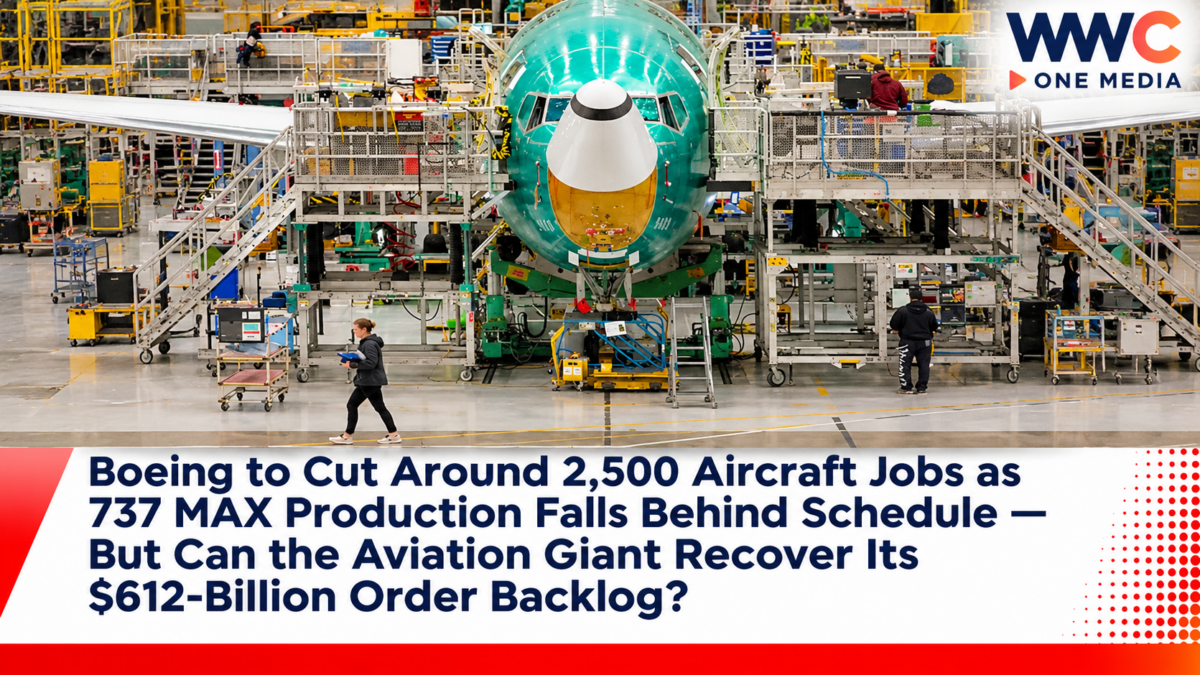
SEATTLE, WASHINGTON — November 10, 2026 — Boeing is preparing to eliminate approximately 5% of its commercial-airplane workforce, potentially affecting around 2,500 positions, as the American aerospace giant confronts another major setback in its efforts to restore aircraft production and financial stability.
The unexpected move comes despite strong global demand for Boeing jets and a commercial-airplane order backlog valued at approximately $612 billion.
Boeing Commercial Airplanes President and CEO Stephanie Pope informed employees on Monday, November 9, that the company must reduce staffing as factories and suppliers struggle to meet its previously announced production targets.
According to CNBC, Reuters and The Wall Street Journal, the reduction will involve a combination of involuntary layoffs and attrition, which occurs when employees leave and their positions are not replaced.
Formal layoff notifications are expected to begin in December.
The commercial-airplane division employed 50,494 people at the end of 2025, meaning a 5% reduction would represent approximately 2,525 positions if that workforce size were unchanged.
The final number of involuntary layoffs has not been disclosed.
The announcement is particularly troubling because Boeing has been working to recover from years of manufacturing-quality problems, production disruptions, labor disputes and financial losses.
Now, the company faces a difficult contradiction.
Airlines want more aircraft, but Boeing is cutting jobs because it cannot expand production as quickly as it anticipated.
And with its most important 737 MAX production targets pushed into 2027, investors are asking whether the latest restructuring will strengthen Boeing’s recovery—or delay it further.
Boeing Confirms 5% Workforce Reduction in Commercial Aircraft Division
The latest reductions were announced in an internal communication from Pope to Boeing’s commercial-airplane employees.
According to Reuters, Pope explained that the company had to revise its production plans after determining that factories and supply-chain partners needed more time to stabilize.
The adjustment means Boeing currently has more employees than required under its slower manufacturing schedule.
The cuts will be implemented through natural attrition and involuntary layoffs.
Employees affected by the restructuring could receive notifications beginning in December 2026.
Boeing has not yet provided a comprehensive list of affected facilities, job functions or individual departments.
The announcement therefore should not be interpreted as confirmation that exactly 2,500 employees will be involuntarily dismissed.
Some of the reduction may occur through positions becoming vacant and remaining unfilled.
However, the restructuring is expected to affect one of the largest aerospace manufacturing workforces in the United States.
Why Is Boeing Cutting Jobs When Airlines Are Still Ordering Jets?
One of the most striking elements of Boeing’s restructuring is that demand for its airplanes remains substantial.
At September 30, the manufacturer reported more than 6,300 commercial aircraft in its order backlog, with an estimated value of approximately $612 billion.
During the third quarter alone, Boeing booked 300 net commercial aircraft orders.
It delivered 161 commercial airplanes during the same period.
The figures demonstrate that airlines continue making long-term commitments to Boeing products.
But an order backlog does not immediately produce revenue or cash.
Aircraft must first move through manufacturing, inspection, certification and delivery.
Production delays can postpone payments and increase costs.
That creates a problem for Boeing.
Its commercial business needs higher output to improve profitability, but rapid production increases can create additional difficulties if factories and suppliers are not ready.
Management has concluded that staffing should be aligned with the revised output schedule.
The layoffs therefore reflect a production-capacity problem rather than a collapse in aircraft demand.
Boeing 737 MAX Production Recovery Falls Behind Schedule
The most important program affected by Boeing’s production challenges is the 737 MAX.
The aircraft family represents a major source of revenue and cash generation for the company.
Boeing previously expected to stabilize production at 47 aircraft per month by summer 2026.
That target has now moved to early 2027.
Chief Executive Kelly Ortberg acknowledged during Boeing’s October earnings discussion that factory operations had not stabilized as quickly as expected.
The company is particularly focused on improving consistency in wing production and ensuring that its suppliers can deliver components at the required pace.
Boeing also expects a further increase to approximately 52 737 MAX aircraft per month during the second half of 2027.
But those targets remain dependent on manufacturing performance and regulatory requirements.
A production target is not the same as a confirmed delivery total.
The company must demonstrate that it can sustain higher rates without compromising quality.
Boeing Expected to Miss Its 2026 Aircraft Delivery Goals
The delays are already affecting Boeing’s annual expectations.
Management has acknowledged that the company will not meet its previously targeted 500 deliveries of 737 MAX aircraft during 2026.
It also expects to miss certain broader commercial-aircraft delivery objectives.
The situation is financially important because Boeing generally receives substantial payments when it delivers completed aircraft to customers.
Delayed deliveries can push cash receipts into later reporting periods.
Meanwhile, the company continues paying employees, suppliers and other operating expenses.
That imbalance can weaken cash flow.
For Boeing, stabilizing production is therefore essential not only to meeting customer commitments but also to restoring financial strength.
Boeing’s Commercial Aircraft Business Still Losing Money
Boeing’s third-quarter financial disclosure highlights the pressures facing the commercial division.
For July through September 2026, Boeing Commercial Airplanes reported:
| Financial measure | Third-quarter result |
|---|---|
| Commercial aircraft deliveries | 161 |
| Commercial division revenue | $10.72 billion |
| Operating loss | $697 million |
| Operating margin | −6.5% |
| Commercial aircraft backlog | Approximately $612 billion |
The $697-million operating loss was substantially smaller than the $5.35-billion operating loss reported in the corresponding quarter of 2025.
That indicates a meaningful improvement.
However, the division remains unprofitable.
Boeing attributed its third-quarter commercial performance partly to an unfavorable mix of aircraft deliveries, higher estimated production-related costs and supply-chain expenses.
These issues show why management is concentrating on efficiency and production stability.
The latest workforce reduction may lower certain costs.
But it will not automatically resolve supplier bottlenecks or generate faster aircraft deliveries.
Boeing’s Overall Financial Recovery Remains Fragile
Across the entire company, Boeing reported $24.19 billion in third-quarter revenue, up 4% from a year earlier.
Its GAAP net loss narrowed to approximately $116 million.
The company also generated about $464 million in quarterly free cash flow on a non-GAAP basis.
These results show that Boeing has made progress compared with the severe financial difficulties it experienced during previous years.
Nevertheless, the manufacturer continues carrying a substantial debt burden.
At September 30, Boeing reported approximately $45.9 billion in consolidated debt and $20.7 billion in cash and marketable securities.
Its ability to generate stronger and more consistent cash flow remains crucial.
According to Reuters, management now expects to reach approximately $10 billion in annual free cash flow by 2029, later than previously anticipated.
That figure remains a target, not an achieved result.
The latest layoffs demonstrate how challenging the recovery remains even as some financial indicators improve.
Boeing 787 Dreamliner Production Also Faces Delays
Boeing’s difficulties extend beyond its best-selling narrowbody aircraft.
The company has also struggled to increase production of its 787 Dreamliner.
During the third quarter, the 787 program remained at a production rate of approximately eight aircraft per month.
Boeing has been working toward a higher rate of 10 aircraft monthly.
However, supplier constraints and the need to stabilize production have complicated that goal.
The company delivered 22 Dreamliners during the third quarter.
Widebody jets are particularly important because airlines use them on long-haul international routes.
Manufacturing delays can disrupt customers’ fleet-modernization and route-expansion plans.
For Boeing, higher 787 output could strengthen revenue and cash generation.
But increasing production without adequate quality controls would create additional risks.
FAA Certification Brings Progress, but Manufacturing Remains the Biggest Test
The job cuts arrive shortly after Boeing achieved important regulatory milestones.
The US Federal Aviation Administration granted amended type certification to the 737 MAX 7 during the third quarter.
The larger 737 MAX 10 subsequently received certification in October 2026.
These approvals represent major progress after years of delays.
However, aircraft certification and stable manufacturing are separate challenges.
An aircraft can receive regulatory approval while the manufacturer continues working to increase production reliably.
As previously reported by WWC ONE MEDIA, a flight-management software issue had complicated the MAX 10 certification process before regulators concluded that the issue did not pose an immediate flight-safety risk.
Related WWC ONE MEDIA coverage: FAA Clears Boeing 737 MAX Software Glitch as Non-Safety Issue, Paving Way for MAX 10 Certification
The October certification milestone has now been achieved.
But Boeing still needs to manufacture aircraft consistently and deliver them to customers on schedule.
That challenge is at the center of the November restructuring.
Boeing Has Already Experienced Major Layoffs and Labor Disruptions
The latest announcement follows an earlier period of sweeping workforce reductions.
In October 2024, Boeing announced plans to reduce its global workforce by approximately 10%, equivalent to about 17,000 positions at the time.
The company was then dealing with serious financial pressure, including the impact of a machinists’ strike and manufacturing-quality problems.
The earlier cuts followed years of turmoil linked to the 737 MAX program and broader production concerns.
The November 2026 reduction represents a new staffing adjustment within the commercial-airplane division.
It should not be confused with the 2024 companywide restructuring.
The latest move is specifically tied to slower-than-expected production increases.
Boeing management says its factories and supply partners require more time to achieve stable operating performance.
What Boeing’s Machinists and Engineers Are Saying
The latest announcement has raised concerns among workers and labor representatives.
The International Association of Machinists and Aerospace Workers District 751, which represents Boeing machinists in the Pacific Northwest, confirmed that it had been informed about the planned reductions.
According to Axios Seattle, the union did not yet know exactly which employees would be affected or how many involuntary layoffs would occur.
The news comes shortly after thousands of Boeing engineering and technical employees approved a new labor agreement.
That agreement helped avert another potential labor disruption.
For workers, the latest restructuring creates uncertainty about job security even as the company continues working through a substantial aircraft backlog.
For management, the challenge is retaining enough experience and technical expertise to support future production increases.
Losing skilled employees can make it more difficult to expand manufacturing later.
That is one reason the balance between near-term cost reductions and long-term production capacity matters.
Could the Job Cuts Hurt Boeing’s Ability to Build More Planes?
The restructuring presents an important business risk.
Boeing wants to lower its workforce to match the revised production schedule.
But it also intends to increase aircraft output during 2027.
Those objectives must be coordinated carefully.
Aircraft manufacturing requires specialized skills, training and extensive quality-control procedures.
If too many experienced workers leave, Boeing could face additional hiring and training expenses when production increases again.
Management appears to be betting that it can eliminate excess positions without losing the capabilities required for its recovery.
Whether that assumption proves correct will depend on which roles are reduced and how successfully the company manages future staffing needs.
There is no verified evidence that the newly announced layoffs have already caused additional aircraft safety problems.
But workforce planning will remain an important part of Boeing’s operational recovery.
Philippine Airlines’ Boeing Expansion Shows Why Delivery Reliability Matters
Boeing’s difficulties also matter to international airlines planning to modernize their fleets.
In the Philippines, flag carrier Philippine Airlines is pursuing a substantial aircraft-expansion program.
The airline has discussed acquiring additional Boeing 787-10 Dreamliner aircraft as part of a broader long-haul fleet strategy.
As previously covered by WWC ONE MEDIA, PAL signed a memorandum of understanding involving 15 Boeing 787-10 aircraft, with options for five more.
Related WWC ONE MEDIA coverage: Philippine Airlines Wins Investment-Grade BBB Rating From Japan — But Rising Debt and Fuel Costs Could Test Its Global Comeback
That proposed arrangement is distinct from completed deliveries or a fully finalized aircraft purchase contract.
There is also no verified announcement that Boeing’s November job cuts have caused a specific change to Philippine Airlines’ delivery timetable.
Nevertheless, manufacturers’ ability to meet production commitments matters to airlines investing in new aircraft.
Delays can complicate fleet planning, financing and route-expansion decisions.
Airlines Continue Hiring While Boeing Reduces Manufacturing Jobs
The contrast between aircraft demand and manufacturing capacity is visible across the international aviation industry.
Some airlines are expanding operations and recruiting employees while Boeing restructures its factories.
Emirates, for example, has been seeking experienced pilots to support its global fleet-expansion plans.
As WWC ONE MEDIA previously reported, the Dubai-based airline organized a recruitment campaign targeting qualified Filipino pilots.
Related WWC ONE MEDIA coverage: Emirates Targets Filipino Pilots in Major Dubai Recruitment Drive — But Only Experienced Aviators May Qualify for the Airline’s Global Expansion
Emirates’ recruitment program is unrelated to Boeing’s layoffs.
However, the comparison illustrates an important distinction.
Airlines may need more pilots and aircraft even while manufacturers face production constraints.
Demand for aviation services does not automatically translate into smooth growth across every business in the industry.
Investors Had Already Been Worried About Boeing’s Production Delays
Boeing’s share price has faced pressure as investors reassess the pace of the company’s recovery.
The November 9 workforce announcement added another concern.
Bloomberg reported that Boeing shares slipped following news of the cuts.
Earlier, the company’s production delays had already weighed on investor confidence.
As previously examined by WWC ONE MEDIA, Boeing was among several major US stocks facing technical selling pressure after executives acknowledged difficulties stabilizing 737 MAX output.
Related WWC ONE MEDIA coverage: S&P 500 Falls for Second Straight Week as Wall Street Searches for a Rebound — But Three Beaten-Down Stocks Face a Bigger Test
Stock-market movements reflect many factors and should not be attributed entirely to one company announcement without supporting evidence.
But Boeing’s operating performance remains an important consideration for investors.
The company’s ability to deliver aircraft, generate cash and control costs is central to its investment outlook.
Why Boeing’s $612-Billion Backlog Is Both an Opportunity and a Challenge
Boeing’s enormous order backlog is an important competitive asset.
It demonstrates that airlines still need its products.
But a backlog is not the same as cash in the bank.
Aircraft orders typically involve long delivery schedules, production expenses and contractual terms.
Some orders may be modified, delayed or canceled.
Boeing must also purchase parts, pay suppliers and employ workers before delivering finished aircraft.
If production runs below planned levels, the company may face higher unit costs and delayed customer payments.
The commercial division’s continuing operating losses show why large orders alone are not enough to guarantee profitability.
The challenge is converting demand into completed, certified aircraft delivered at sustainable margins.
What Happens Next for Boeing Workers and Production?
Several developments will determine whether the restructuring strengthens Boeing’s recovery.
First, layoff notifications are expected to begin in December.
Employees and labor representatives will want clearer information about which positions are affected and what support is available.
Second, Boeing must demonstrate more stable production of its 737 MAX family.
The company’s near-term objective is to establish a reliable rate of approximately 47 aircraft per month.
Third, management must make progress toward its 2027 production targets.
Fourth, the 787 program needs to advance without creating additional quality or supplier disruptions.
Finally, investors will assess whether commercial-airplane losses continue narrowing and whether Boeing can generate more consistent cash flow.
The company has achieved some important milestones.
But its latest workforce announcement makes clear that management considers the turnaround incomplete.
The Bigger Picture: Why Boeing Is Cutting Workers While Its Order Book Is Full
Boeing’s decision to reduce its commercial workforce by approximately 5% reflects one of the aerospace industry’s most difficult contradictions.
The company has customers waiting for thousands of aircraft.
Its commercial backlog is worth approximately $612 billion.
Yet its factories and supply partners are not increasing output as quickly as expected.
The resulting delays weaken cash generation, complicate deliveries and make existing staffing levels difficult to justify under management’s revised plans.
For employees, the restructuring creates uncertainty.
For airlines, it reinforces concerns about aircraft availability.
For investors, it raises further questions about Boeing’s financial recovery.
The manufacturer has made meaningful progress in certification, production quality and financial performance.
But its commercial division remains unprofitable, and key manufacturing targets have moved into 2027.
The success of the latest layoffs will depend not simply on how many positions Boeing eliminates, but on whether it can build and deliver more aircraft safely and consistently afterward.
And as Boeing prepares to cut around 2,500 commercial-airplane positions despite a $612-billion order backlog, one question could determine the future of America’s aviation giant: Will a leaner workforce finally help Boeing stabilize production—or could the cuts make its long-awaited recovery even harder to achieve?