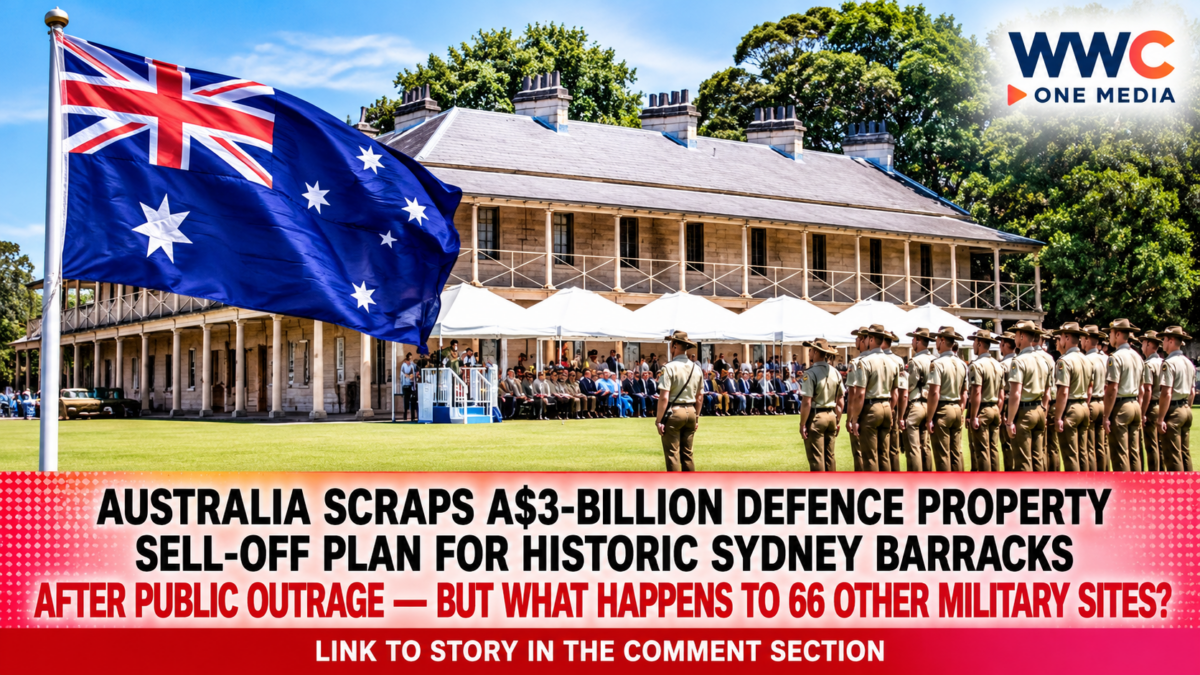
SYDNEY, AUSTRALIA — November 8, 2026 — Australian Prime Minister Anthony Albanese has reversed plans to sell Sydney’s historic Victoria Barracks following fierce public opposition, delivering a major victory for veterans, heritage campaigners and political leaders who warned that the government was putting national military history on the market.
The dramatic decision, reported by Bloomberg, the Australian Broadcasting Corporation (ABC), Reuters-affiliated Australian coverage and other major news organizations, means the landmark military complex in Sydney’s Paddington district will remain in public ownership.
Three other historically significant defence properties have also been spared from private sale: Victoria Barracks Melbourne, Fort Queenscliff and RAAF Williams–Point Cook in Victoria.
The reversal follows a controversial government program to dispose of 67 underused or costly military properties nationwide, a strategy originally expected to generate approximately A$3 billion in gross proceeds, or A$1.8 billion after remediation and associated costs.
But while the decision protects some of Australia’s most historically significant military buildings from private ownership, it does not mean the barracks will continue operating as active military facilities.
Australian Defence Force personnel will still be relocated, and the government intends to explore public access, heritage preservation and suitable commercial uses.
The question now is whether Canberra has genuinely secured the future of its military heritage—or simply changed how these historic properties will be managed while the broader defence sell-off continues.
Albanese Reverses Sydney Barracks Sale After Nationwide Backlash
The decision announced on Sunday, November 8, represents a significant reversal for the Albanese government, which had faced growing criticism over plans to sell Victoria Barracks Sydney.
Established in 1840, the complex occupies approximately 13 hectares in one of Sydney’s most prominent inner-city locations.
Its historic sandstone buildings have long been associated with Australia’s military establishment and the country’s colonial and national defence history.
The government’s original proposal triggered opposition from veterans’ organizations, heritage advocates, former prime ministers and politicians across party lines.
A petition opposing the sale attracted nearly 125,000 signatures, according to Australian media reports.
Prime Minister Albanese acknowledged the barracks’ importance to the country and confirmed that the property would remain publicly owned.
The decision means the historic buildings will no longer be offered to private buyers under the original divestment proposal.
However, the government is not abandoning its broader effort to modernize Australia’s defence estate.
Instead, it is attempting to separate military facilities considered essential for operational purposes from historically significant properties that could serve other public functions.
Four Historic Defence Properties Will Remain in Public Hands
According to an official November 8 statement from Australia’s Department of Defence and ministers responsible for the program, four properties have been identified for continued public ownership.
Victoria Barracks Sydney, New South Wales
The historic Paddington military complex will be retained in public hands. The government intends to preserve its important heritage features while considering increased community access and appropriate commercial activities.
Victoria Barracks Melbourne, Victoria
The heritage-listed military complex in Melbourne will also remain publicly owned, with authorities examining opportunities to preserve its historic significance and expand public use.
Fort Queenscliff, Victoria
The coastal fortification, which forms part of Australia’s military history, will be protected through continued public ownership. Alternative stewardship arrangements, including heritage-focused models, may be considered.
RAAF Williams–Point Cook, Victoria
The historic aviation site will remain in public hands, with future arrangements designed to protect its heritage and allow suitable community access.
The government will work with the Australian War Memorial to interpret and present the history of the sites.
The aim is to make more of Australia’s military heritage accessible to the public rather than leaving historically significant buildings entirely within closed defence facilities.
But maintaining public ownership is different from maintaining an active military presence.
The Defence Department still intends to vacate the affected facilities where planned.
Why the A$3-Billion Defence Property Program Sparked Outrage
The controversy began with an independent Defence Estate Audit that examined how Australia manages its extensive military property holdings.
The audit concluded that numerous properties were underutilized, unsuitable for modern operational requirements or expensive to maintain.
In February 2026, the government accepted recommendations to fully or partially divest 67 defence sites.
The program was expected to generate approximately A$3 billion before costs, with projected net proceeds of roughly A$1.8 billion after remediation and related expenses.
The government argued that the money and savings could help redirect resources toward military capabilities, modern infrastructure and facilities more closely aligned with Australia’s strategic needs.
Defence Minister Richard Marles defended the rationale for reviewing underused military properties.
The government maintains that it must avoid spending excessive amounts of money maintaining facilities that no longer make a meaningful contribution to military effectiveness.
However, critics argued that historically important defence sites should not be assessed solely through their commercial real-estate value.
Opponents warned that selling military heritage properties could permanently remove valuable public assets from government ownership.
Others questioned whether disposing of strategically located military land was appropriate at a time of growing security competition in the Indo-Pacific.
The debate quickly developed into a much broader dispute over national identity, defence preparedness and public accountability.
Former Prime Ministers and Veterans Unite Against the Sale
One of the most striking aspects of the controversy was the breadth of the opposition.
Former prime ministers John Howard, Tony Abbott and Paul Keating were among prominent political figures associated with opposition to the proposed disposal of historic military properties.
Veterans’ organizations, local communities and politicians from different parties also criticized the government’s approach.
John Howard participated in a protest opposing the Sydney barracks sale in October and accused the government of failing to adequately respect Australia’s military heritage.
The controversy also attracted criticism from New South Wales Premier Chris Minns, whose state Labor government publicly opposed the proposed sale by the federal Labor government.
The unusual political alignment increased pressure on Albanese to reconsider the plan.
The campaign demonstrated that historic military properties can hold significance extending far beyond their current operational use.
For veterans and military families, barracks and fortifications may represent generations of service, sacrifice and institutional memory.
For local communities, they also form part of the historical character of cities and towns.
The government’s reversal has therefore been welcomed as an important victory for preservation advocates.
But some opponents remain concerned that transferring the properties away from Defence could ultimately weaken their military connections.
The Barracks Are Saved From Private Sale — But Defence Is Still Moving Out
The most important detail in the government’s new decision is that the four historic properties will remain publicly owned while their administrative and operational roles change.
Victoria Barracks Sydney and the other protected sites will be transferred from the Defence portfolio to the Department of Finance.
Defence personnel will still move to other suitable facilities.
The government intends to assess how the properties can be preserved, maintained and opened for broader community use.
Some commercial activity could also be permitted, provided it is appropriate for the sites’ historic character and subject to relevant safeguards.
This creates an important distinction.
The government has cancelled the proposed private sale of the protected historic properties, but it has not promised to keep all four operating as military bases.
Future arrangements could include public heritage spaces, museums, educational facilities and other compatible uses, although specific projects have not yet been finalized.
Environmental, heritage and contamination assessments will also continue.
The challenge will be identifying uses that preserve the historic buildings while generating enough funding for long-term maintenance.
Without sustainable financing, public ownership alone will not eliminate the costs of protecting aging heritage infrastructure.
Australia’s Defence Estate Is Facing a Multibillion-Dollar Challenge
The broader financial pressures behind the original sell-off remain unresolved.
According to ABC reporting, the Defence Estate Audit identified substantial maintenance and modernization requirements across Australia’s military property portfolio.
The audit estimated that approximately A$3 billion in investment could be required over the coming decade to address defects at the facilities it examined if they were retained.
Australia’s defence estate includes major military bases, training facilities, administrative buildings and extensive land holdings.
Some properties have become increasingly expensive to maintain because of aging infrastructure and changing military requirements.
The government argues that modern defence planning requires prioritizing facilities that directly support operational capability.
Critics counter that decisions about military property should also consider national security flexibility, heritage protection and the potential future value of strategic sites.
The revised program attempts to address both concerns by keeping some historically important properties in public ownership while continuing divestment work elsewhere.
Whether that compromise delivers the expected financial benefits remains uncertain.
The original A$3-billion gross proceeds estimate cannot automatically be assumed to remain unchanged after the decision to protect four sites.
An updated financial projection will be necessary to establish the likely proceeds of the revised program.
Defence Property Sales Could Free Land for Thousands of Homes
Australia’s broader property disposal program also has implications for housing supply.
The Guardian reported that the government sees potential for approximately 6,000 homes to be developed on land released through the broader defence estate reform program.
That objective reflects Australia’s ongoing efforts to address housing affordability and supply constraints.
Some former military properties may be suitable for redevelopment, particularly when they are located near existing urban infrastructure.
However, the housing potential of each site depends on factors including planning restrictions, environmental remediation, infrastructure capacity and the availability of developers.
Historic properties such as Victoria Barracks Sydney present additional constraints because of their architectural and cultural significance.
The government has not announced that the preserved Sydney barracks will be converted into a residential development.
The broader connection between government land policy and Australia’s housing challenges is nevertheless significant.
As previously reported by WWC ONE MEDIA, Australia’s property market has been under pressure from higher borrowing costs, rising mortgage repayments and weakening housing conditions.
Related coverage: Australia Raises Interest Rates to 18-Year High of 4.85% as Inflation Surges — But Could a Housing Crash Be the Price of Victory?
The challenge for policymakers is balancing the release of underused public land with the preservation of historically and strategically important assets.
China and Indo-Pacific Security Add Urgency to Australia’s Defence Spending
The controversy also comes as Australia faces a more demanding regional security environment.
Canberra has been investing in military modernization and strengthening defence partnerships amid growing strategic competition in the Indo-Pacific.
China’s expanding military capabilities, tensions over Taiwan and disputes in the South China Sea have contributed to debates over Australia’s future defence requirements.
The Australian government argues that resources should be directed toward modern military capabilities rather than the upkeep of properties that no longer adequately support defence operations.
However, critics of the original sale proposal questioned whether disposing of military land could reduce flexibility if Australia’s strategic requirements change.
As WWC ONE MEDIA has reported, Australia’s relationship with China involves a complicated balance between economic engagement and security concerns.
Related coverage: Albanese Eyes Third Beijing Visit After APEC as Australia Rebuilds China Ties — But Could South China Sea Tensions Derail the Diplomatic Reset?
Canberra continues to pursue diplomatic and commercial relations with Beijing while maintaining close military cooperation with the United States and other regional partners.
The barracks controversy illustrates the difficult choices involved in funding defence modernization while safeguarding national assets.
However, there is no evidence that the reversal was directly caused by any new Chinese military activity or an immediate security threat.
The government’s stated reasons center on public feedback, heritage preservation and the management of defence resources.
What the Decision Means for Australia’s Relationship With Southeast Asia
Australia’s defence policies carry important implications for Southeast Asia, particularly countries with established military partnerships with Canberra.
The Philippines, Singapore, Indonesia and other regional states cooperate with Australia through security dialogues, training activities and bilateral or multilateral arrangements.
Australia’s future military spending priorities could influence these relationships.
The question is how Canberra will allocate limited resources across modern equipment, operational facilities, personnel and international commitments.
Singapore Senior Minister Lee Hsien Loong recently emphasized the importance of deeper Australian engagement with Southeast Asia as major-power competition intensifies.
Related coverage: Lee Hsien Loong Warns Australia to Strengthen ASEAN Ties as US-China Rivalry Deepens — But Could Southeast Asia Hold the Key to Its Economic Future?
His remarks reflect the broader strategic importance of maintaining strong regional partnerships.
Nevertheless, the decision to preserve Victoria Barracks does not directly alter Australia’s existing defence agreements or commitments to Southeast Asian partners.
The practical consequences will depend on how the government implements its wider estate reform and defence investment plans.
What Happens to Australia’s Remaining Military Properties?
The reversal involving four historic locations does not mean Australia’s wider property divestment program has ended.
In its November 8 update, the government confirmed that 11 sites had already been transferred to the Department of Finance for divestment.
Other sites are progressing through assessment, transfer and planning procedures.
The government also outlined arrangements for additional properties.
At HMAS Penguin in Sydney, Defence will retain areas supporting important military capabilities, while the Angophora Forest portion will be transferred to the Sydney Harbour Federation Trust.
In the Northern Territory, the Stokes Hill Fuel Installation will be returned to the Larrakia traditional owners.
These arrangements demonstrate that Australia’s property reform program is proceeding through different approaches depending on each location’s military, historical, environmental and community significance.
Some sites may be sold.
Others may be transferred between public institutions, retained for defence purposes or returned to traditional owners.
The final outcome will depend on due diligence, negotiations and decisions about future use.
For preservation advocates, the next major challenge will be ensuring that other historically important properties receive adequate protection.
For the government, the priority will be completing reforms without sacrificing defence readiness or public confidence.
The Bigger Picture: Has Albanese Solved Australia’s Military Heritage Crisis?
Australia’s decision to retain Sydney’s Victoria Barracks and three other historic military properties represents a significant political retreat by the Albanese government.
It also demonstrates the influence of public pressure when a controversial policy attracts opposition across traditional political divisions.
Veterans, former national leaders, heritage organizations and local communities successfully challenged a proposal that many believed placed too much emphasis on the commercial value of historically important public land.
But the broader debate is far from over.
Australia still faces the challenge of maintaining expensive infrastructure, funding military modernization and deciding what to do with underused government properties.
The four protected sites will remain publicly owned, but Defence personnel are still expected to leave.
Meanwhile, the government continues reviewing and transferring other military properties under the wider divestment program.
That leaves two unresolved questions.
Can Australia preserve its historic defence sites without placing an unsustainable financial burden on taxpayers?
And can the government modernize its military infrastructure without selling assets that future generations may consider irreplaceable?
For now, the public campaign to save Victoria Barracks Sydney has succeeded in preventing its sale into private ownership.
But as Australia’s A$3-billion defence property strategy continues in revised form, will the government protect other historic military sites—or could another politically explosive battle over public land be just around the corner?