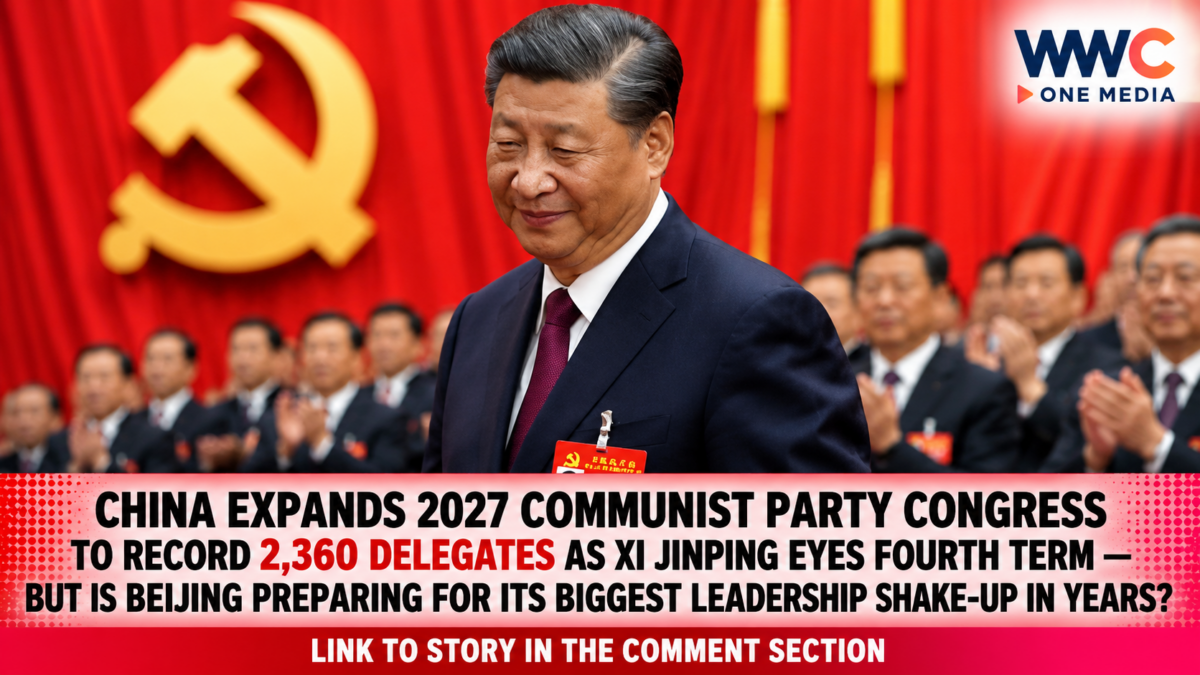
BEIJING, CHINA — November 8, 2026 — China has expanded the number of delegates attending its next Communist Party Congress to a record 2,360, officially launching a crucial political selection process that could determine President Xi Jinping’s future and reshape the leadership of the world’s second-largest economy.
The ruling Communist Party of China (CPC) has added 60 delegates compared with its previous national congress in 2022, according to Bloomberg and China’s official Xinhua News Agency.
The increase comes as Beijing prepares for its 21st National Congress in the second half of 2027, a gathering widely expected to determine whether Xi secures another five-year term as the Communist Party’s general secretary.
But the timing has attracted attention for another reason.
China’s political establishment is undergoing an extensive anti-corruption crackdown that has removed senior officials from the Communist Party, government institutions and military leadership.
The latest developments raise questions about who will occupy the country’s most powerful positions after 2027.
Will the expanded congress reinforce Xi Jinping’s authority, or could China’s sweeping political and military reshuffles produce a leadership structure different from what outside observers expect?
China Sets Record 2,360 Delegates for 2027 Communist Party Congress
According to Bloomberg’s November 8 report, China has allocated 2,360 delegate positions for the 21st National Congress, compared with 2,300 seats in both the 2017 and 2022 gatherings.
That represents an increase of approximately 2.6%.
The delegates will be elected through 38 electoral units, covering China’s regional party organizations and relevant institutions within its political system.
Xinhua reported that the allocation of seats will primarily consider the number of party organizations and members, while also taking previous congress allocations into account.
The selection process has officially begun and must be completed by the end of June 2027.
The congress itself will convene in Beijing during the second half of that year, although the precise dates have not yet been announced.
China’s Communist Party holds its national congress every five years.
The gathering establishes important political priorities and selects a new Central Committee, which subsequently plays a central role in determining the party’s highest leadership.
For China, the 2027 congress is particularly significant because of the potential for another term under Xi Jinping.
Xi Jinping’s Potential Fourth Term Takes Center Stage
Xi Jinping has led China’s Communist Party since November 2012.
He secured an unprecedented third consecutive term as general secretary in October 2022, breaking with the two-term leadership convention associated with his immediate predecessors.
The removal of presidential term limits through a constitutional amendment in 2018 also changed the political framework governing his continued tenure as China’s state president.
However, the presidency and the position of Communist Party general secretary are separate offices, selected through different institutional processes.
The Communist Party general secretary is chosen through the party’s leadership selection system, while the state president is elected by the National People’s Congress.
South Korea’s Korea Herald and Aju Press reported on November 7 that the upcoming congress is expected to confirm Xi’s fourth term as party leader.
Nevertheless, that remains an expectation, not a confirmed outcome.
Xi’s future leadership position will depend on decisions made through the Communist Party’s internal selection process.
As previously reported by WWC ONE MEDIA, Xi has placed increasing emphasis on political discipline and internal party governance ahead of the 2027 leadership cycle.
Related coverage: Xi Jinping Tightens Grip on China Ahead of 2027 Leadership Shake-Up — But What Is Beijing Really Preparing For?
The leadership choices made in 2027 could influence China’s domestic economic policies, military strategy, foreign relations and international commercial partnerships for years.
China Tightens Political Screening for Congress Delegates
One of the most important elements of the delegate selection process is the Communist Party’s emphasis on political loyalty.
According to the official announcement, delegates must demonstrate strong political qualifications, personal integrity and commitment to the party’s principles.
Candidates will be evaluated on their political positions, judgment, understanding of party policies and ability to implement central leadership decisions.
The rules include a strict disqualification mechanism for candidates deemed politically unsuitable.
China’s party leadership has also called for stronger oversight of the election process and warned against misconduct, vote-buying and attempts to interfere with delegate selection.
The South China Morning Post reported on November 7 that the Communist Party had pledged zero tolerance for election-related violations.
Under the selection rules, the number of candidates must exceed the number of available delegate positions by more than 15%.
Lianhe Zaobao noted that this requirement remains unchanged from the previous three party congresses.
Although that creates a degree of competition among eligible candidates, the process operates entirely within the Communist Party’s internal political structure.
It is not a nationwide multiparty election in which ordinary Chinese voters directly choose the country’s top leadership.
Why China’s Growing Communist Party Matters
China’s decision to increase delegate seats comes as the Communist Party’s membership continues to expand.
According to official figures cited by Lianhe Zaobao, the party had approximately 101.28 million members at the end of 2025.
That compares with just over 95 million members before the 2022 congress and approximately 88 million before the 2017 gathering.
The growing membership helps explain why the party periodically adjusts its delegate allocations.
For 2027, Beijing has also called for representation from a range of professional and social groups, including workers, farmers, technical specialists, women and ethnic-minority party members.
For the first time, the selection guidelines explicitly mention workers engaged in newer forms of employment.
These include occupations associated with the digital-platform economy, such as delivery services and ride-hailing.
The emphasis reflects changes in China’s labor market as new industries and employment arrangements become more prominent.
However, the higher delegate count should not automatically be interpreted as an expansion of political pluralism.
The central leadership continues to determine candidate qualifications and oversee the selection process.
Record Political Purges Shake China’s Leadership Before 2027
The announcement comes less than two weeks after an extraordinary Communist Party leadership meeting.
According to Reuters, the party’s fifth plenary session, which concluded on October 29, formally expelled 33 officials, an unusually large number.
Reuters also reported that only 279 of the 376 full and alternate Central Committee members selected in 2022 attended the meeting.
That represents an absence rate of approximately 25.8%.
Not every absence can be attributed to a disciplinary investigation, but the attendance figures highlight the extent of personnel disruption surrounding the current leadership.
The political shake-up has involved senior figures across government, party organizations and the military.
China’s official position is that its disciplinary campaign is designed to eliminate corruption, reinforce accountability and protect the Communist Party’s effectiveness.
Some outside analysts, however, have questioned whether repeated high-level removals could undermine institutional continuity and discourage officials from making difficult decisions.
The consequences are particularly important because the Communist Party’s Central Committee is responsible for selecting the country’s senior political leadership.
The removal of numerous officials could therefore influence the pool of experienced personnel available for future appointments.
As reported by WWC ONE MEDIA, former Politburo member Ma Xingrui was formally indicted on bribery charges in November, demonstrating how the ongoing anti-corruption campaign has reached senior figures within China’s political establishment.
Related coverage: China Indicts Former Politburo Member Ma Xingrui Over Massive Bribery Allegations — Xi Jinping’s Anti-Corruption Purge Reaches Another Powerful Political Figure
The indictment is part of the broader political context surrounding the 2027 congress, although it does not establish that the increased delegate quota is connected to the disciplinary campaign.
China’s Military Leadership Faces an Unusual Crisis
One of the most closely watched developments ahead of the congress is the extensive restructuring of the People’s Liberation Army’s senior command.
Reuters reported that five of the seven original members of China’s Central Military Commission appointed following the 2022 party congress have been removed.
The Central Military Commission is the Communist Party’s highest military leadership body.
It plays a critical role in overseeing China’s armed forces, implementing military policy and making senior command appointments.
The scale of the changes has raised questions about military leadership continuity and the selection of replacement officials.
On October 29, General Zhang Shengmin, a senior military disciplinary official, was promoted to the Communist Party’s Politburo.
The move placed him in a more prominent political position as Beijing prepares for further military leadership decisions.
WWC ONE MEDIA previously examined Zhang’s promotion and the challenge of rebuilding the military’s senior command structure.
Related coverage: Xi Jinping Promotes China’s Military Purge Chief as 5 Top Command Seats Remain Vacant — But Can His Most Trusted General Rebuild the PLA Before 2027?
The upcoming congress could provide an opportunity to reshape the party’s military leadership and establish a more stable command structure.
However, senior-level purges do not by themselves prove that China’s armed forces are incapable of conducting military operations.
The practical impact will depend on personnel replacements, command effectiveness and institutional continuity.
What China’s Leadership Changes Could Mean for Taiwan and the South China Sea
China’s political direction has significant implications for security across the Asia-Pacific region.
The 2027 congress will take place during an important year for the People’s Liberation Army, which will commemorate its 100th anniversary in August.
China’s military modernization program has identified 2027 as a major development milestone.
The United States has previously assessed that Beijing aims to improve its military capabilities for a potential Taiwan contingency by that year.
But this does not mean China has decided to launch an invasion in 2027.
Military preparedness targets and political decisions about using force are different matters.
China’s leadership appointments could influence long-term military priorities, regional diplomacy and national security policy.
For the Philippines, these developments are particularly relevant because of continuing maritime disputes with China in the South China Sea.
Any changes in Beijing’s approach to regional security could affect diplomatic engagement and military interactions in contested waters.
Nevertheless, there is no evidence that the decision to increase party congress delegates directly signals a change in China’s policy toward Taiwan or the Philippines.
The more important indicators will be future leadership appointments, official policy statements and military activity.
Xi Jinping’s Party Discipline Campaign Extends Beyond the Military
The Communist Party’s preparations for 2027 also reflect a broader effort to strengthen internal governance.
In recent years, Beijing has expanded party oversight in areas involving finance, technology, national security and social administration.
The leadership has repeatedly emphasized the importance of ensuring that officials implement central government policies effectively.
This approach reflects concerns about corruption, bureaucratic inefficiency and the ability of local officials to deliver national priorities.
As previously examined by WWC ONE MEDIA, the emergence of a high-level party body dedicated to social governance suggests Beijing is placing greater emphasis on coordinating social stability and grassroots administration.
Related coverage: China’s Communist Party Quietly Signals New Push for Social Stability With High-Level Body
The development forms part of the wider political environment leading toward the 2027 congress.
The central question is whether stronger party oversight will improve administrative performance or create additional pressure on officials already operating under strict disciplinary scrutiny.
Why Global Investors Are Watching China’s 2027 Leadership Congress
China’s Communist Party Congress is also a major event for international businesses and financial markets.
As the world’s second-largest economy, China plays a central role in global manufacturing, technology supply chains, international trade and commodity demand.
Leadership decisions made in Beijing can influence industrial policy, private-sector regulation, government spending and international economic relations.
Investors will be watching for indications of continuity or potential adjustments in China’s economic strategy.
Particular attention could focus on technological development, financial stability, domestic consumption and the country’s approach to foreign investment.
For Southeast Asian economies, including the Philippines, China’s future policy direction could influence commercial relationships and regional investment conditions.
However, the delegate announcement itself does not introduce new economic measures or establish any immediate market impact.
The significance lies in the leadership selection process that will unfold over the coming months.
Key Dates: China’s Road to the 2027 Communist Party Congress
October 26–29, 2026: China’s Communist Party holds its fifth plenary session, focusing on internal governance, political discipline and leadership matters.
October 29, 2026: Reuters reports that the plenum formally expelled 33 officials and confirmed plans for the 21st National Congress in the second half of 2027.
November 7, 2026: Xinhua announces the delegate selection arrangements, including the allocation of 2,360 seats.
November 8, 2026: Bloomberg reports the increase of 60 seats over the previous congress.
By June 30, 2027: The Communist Party aims to complete delegate elections.
Second half of 2027: The 21st National Congress is scheduled to convene in Beijing, where major party leadership decisions will be made.
The exact dates of the congress have not yet been announced.
The Bigger Picture: Will Xi Jinping’s 2027 Congress Reshape China’s Political Future?
China’s decision to expand the next Communist Party Congress to 2,360 delegates marks another important step toward one of the country’s most consequential political events.
The increase is modest in numerical terms.
But the environment surrounding the congress is far from routine.
Xi Jinping is approaching a potential fourth term as Communist Party general secretary.
A sweeping anti-corruption campaign has removed numerous senior political and military figures.
The party is reinforcing political screening and discipline while preparing to select the delegates who will participate in its next leadership cycle.
The outcome could shape China’s political direction, economic governance and security priorities beyond 2027.
Yet several critical questions remain unanswered.
Will Xi continue as general secretary? Who will fill the leadership positions affected by disciplinary removals? And will the next generation of officials bring policy continuity or changes in how Beijing governs?
For now, the increase in delegate seats confirms that the machinery of China’s next leadership transition is formally moving forward.
What remains uncertain is the final composition of the leadership that will emerge.
As Beijing prepares for its biggest political gathering in five years, the world will be watching whether the congress delivers another consolidation of Xi Jinping’s authority—or reveals an unexpected shift inside China’s ruling elite.