
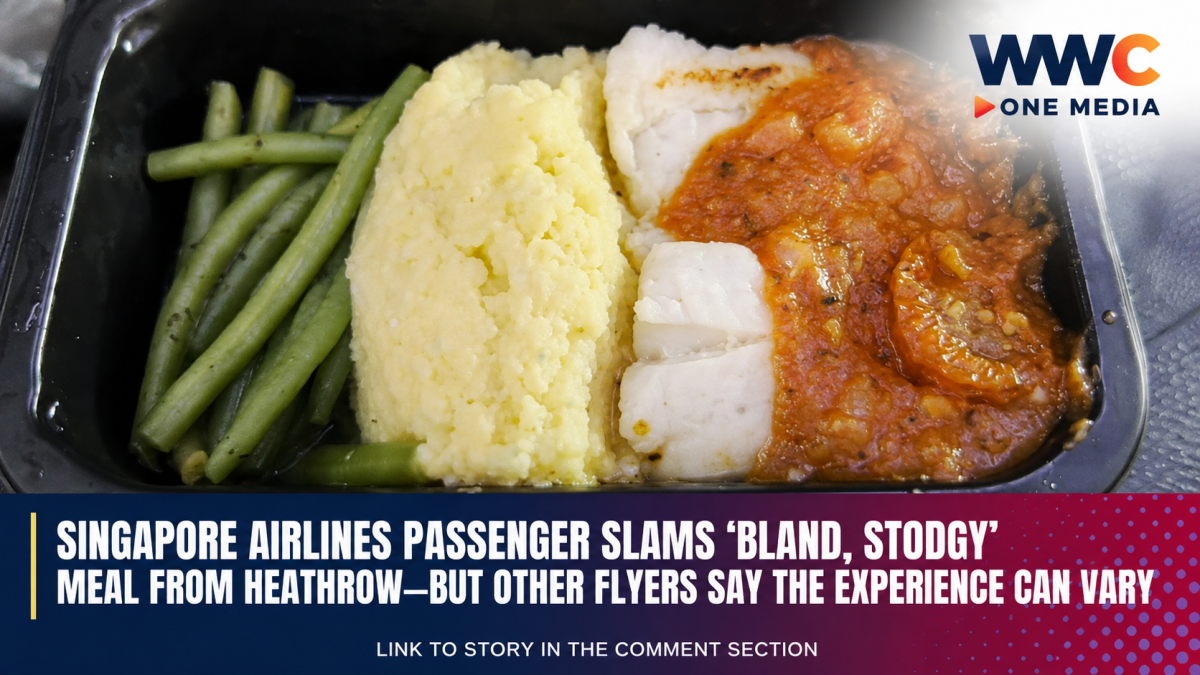
SINGAPORE — Singapore Airlines has long built its global reputation on premium service, comfortable cabins and an elevated in-flight experience. But for one passenger flying from London Heathrow to Singapore, a disappointing meal service was enough to significantly change their view of the journey.
The passenger, who shared their experience on the Facebook page Flight & Travel Explorer, criticised the food served during a recent Singapore Airlines flight, questioning whether poor catering could pull one of the world’s most highly regarded airlines down from a “perfect 10” to a rating of just seven out of 10.
According to the passenger’s account, they were seated in Economy Class near the back of the aircraft and were among the last travellers to receive their meals. By the time the service cart reached their row, the preferred beef option had reportedly run out.
The passenger was left with the fish dish instead.
Their verdict was blunt: “bland” and “stodgy.”
But the disappointment did not end there.
The passenger said breakfast was even worse, describing the beef noodles as dry, lacking sauce and overly salty, with only a small amount of meat.
While praising Singapore Airlines’ Economy Class seating and overall service, the traveller argued that the catering prevented the flight from delivering what they believed could have been a truly world-class experience.
The Bigger Issue: When Expectations Meet Reality at 35,000 Feet
The criticism has reignited a familiar debate surrounding Singapore Airlines: Are passengers expecting too much, or has the airline’s food experience become inconsistent?
Singapore Airlines is not an ordinary airline when it comes to customer expectations.
Its premium global branding means passengers often compare every aspect of the journey—from cabin service and seat comfort to meal presentation—against the image of a “world-class” carrier.
That expectation has previously made in-flight food a particularly sensitive issue.
In 2023, Singapore Airlines faced widespread online criticism after Economy Class passengers shared photos of meals they considered underwhelming. Some travellers compared the presentation to takeaway food and army-style meals, while others questioned whether the airline’s food standards had declined after the pandemic.
Singapore Airlines responded to the earlier backlash by restoring several meal components, including appetisers on longer Economy Class flights, while also bringing back items such as bread rolls, cheese and crackers, and muffins for continental breakfasts. The airline said its catering budget had not been cut and was approximately 20% higher than before the pandemic.
Not Everyone Agreed With the Heathrow Passenger
The latest complaint, however, did not receive universal agreement.
Several social media users pointed out that airline catering can vary significantly depending on where a flight originates and which catering provider prepares the meals.
One commenter argued that catering quality at overseas airports can differ from meals loaded in Singapore, while another passenger who said they were travelling on the same route a day later reported having an excellent experience, praising dishes including chicken curry and prawn pasta.
Others also noted that sitting near the back of the aircraft can increase the risk of a preferred meal option running out before the service cart arrives.
Singapore Airlines’ meal service rotation may also differ between services, meaning passengers seated farther back are not necessarily always served last.
The mixed reactions highlight a fundamental challenge for airlines: food is subjective, but consistency is not.
Why Airline Food Can Differ From Flight to Flight
Unlike restaurant chains, airlines operate across dozens of airports worldwide and rely on local catering operations to prepare and load meals.
That means a passenger’s experience can potentially be influenced by several factors, including:
- Departure airport
- Local catering provider
- Aircraft loading procedures
- Route-specific menus
- Cabin class
- Meal selection and passenger demand
- Where the passenger is seated
- Whether popular meal options run out during service
Travel reviews of Singapore Airlines’ Heathrow operations have also shown mixed experiences.
Some recent reviewers praised the food served at the airline’s London facilities, while others described certain dishes as disappointing or inconsistent. One review of Singapore Airlines’ London Heathrow First Class SilverKris Lounge praised the overall dining experience but found some individual dishes less impressive, demonstrating how subjective food quality can be even within the same premium airline ecosystem.
A Reputation Built on More Than Food
Singapore Airlines remains one of the world’s most recognisable premium airline brands, and one disappointing meal is unlikely to redefine the carrier’s overall reputation.
But for airlines charging premium fares, small details can have an outsized impact.
A comfortable seat may be forgotten. Good entertainment may be expected. Friendly cabin crew may be appreciated.
But a disappointing meal—particularly on a long-haul flight lasting more than 12 hours—can become the one thing passengers remember.
That is especially true when travellers board expecting an experience associated with Singapore Airlines’ long-standing reputation for high service standards.
Industry observers have previously argued that much of the criticism directed at SIA’s catering is linked not only to the food itself but also to the expectations created by its premium branding.
As CNA reported during an earlier wave of criticism, travellers paying a premium for Singapore Airlines tickets often expect an experience noticeably superior to standard airline catering—and presentation can matter almost as much as taste.
Singapore Airlines Has Expanded Its Menu Choices
The airline has also continued efforts to broaden its dining options.
In March 2024, Singapore Airlines announced an expanded Premium Economy dining selection, with the revamped offering featuring 175 main courses, 48 appetisers and 34 desserts, including dishes such as nasi lemak ayam rendang, beef bourguignon and slow-braised lamb ragout.
The expanded choices demonstrate the importance Singapore Airlines continues to place on food as part of its passenger experience.
However, the Heathrow complaint shows that having an extensive menu does not always guarantee that every passenger receives their preferred choice—or enjoys what eventually arrives on their tray.
One Bad Meal, or a Warning About Consistency?
The viral criticism ultimately raises a bigger question for Singapore Airlines and other premium carriers.
How much can one bad meal affect an entire flight experience?
For some passengers, food is simply a necessity between takeoff and landing.
For others—especially those paying premium fares—it is part of the product they believe they are buying.
The Heathrow passenger acknowledged that Singapore Airlines still delivered strong seating and service. Yet the disappointing meals reportedly changed their overall perception of the journey.
And perhaps that is the real lesson for premium airlines.
Passengers may forgive a bad meal.
But when an airline builds its reputation on being exceptional, “good enough” can suddenly feel like a disappointment.
With travellers increasingly documenting every aspect of their journeys on Facebook, TikTok, Reddit and travel forums, a single tray of “bland, stodgy fish” can quickly become part of a much larger conversation about whether one of aviation’s most respected brands is consistently living up to its world-class image.
WWC ONE MEDIA J.M.D

Leave a Reply