
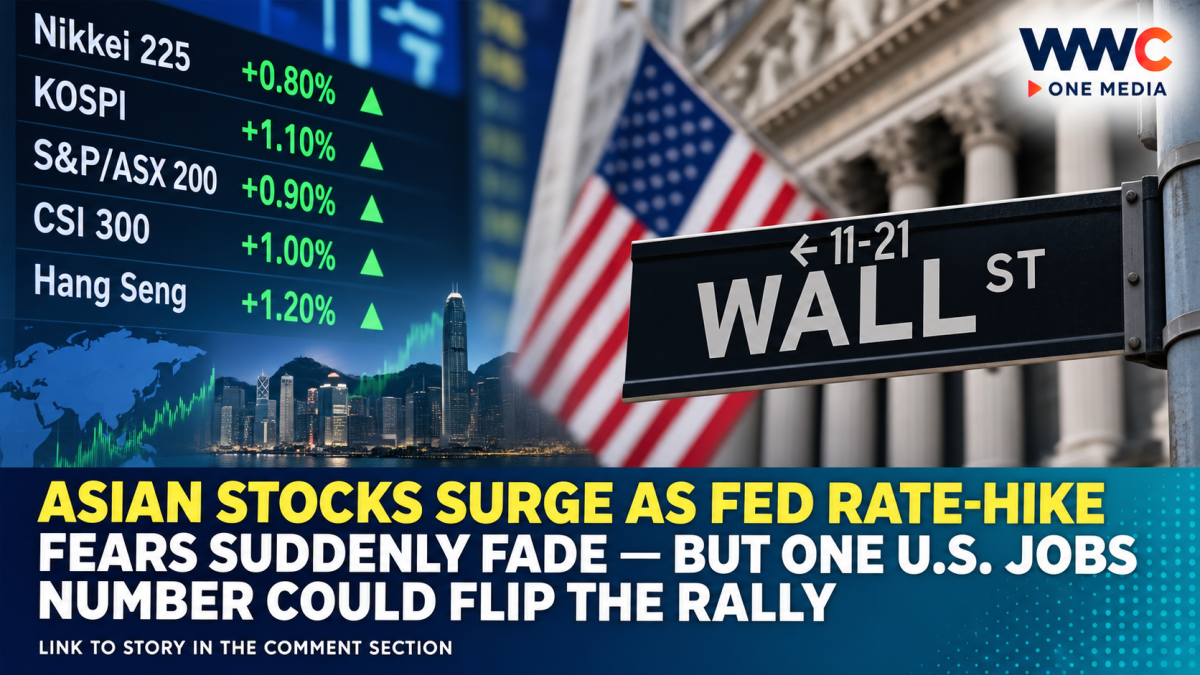
Asian shares pushed higher on September 4 after Federal Reserve Governor Christopher Waller opened the door to keeping U.S. interest rates unchanged at the central bank’s September meeting if incoming inflation data confirms that price pressures are easing.
The remarks immediately changed the mood across global markets.
MSCI’s broadest index of Asia-Pacific shares outside Japan climbed about 1% during Asian trading. Japan’s Nikkei gained around 0.8%, China’s blue-chip CSI 300 advanced roughly 1%, while South Korea’s KOSPI rose about 1.1%. Despite Friday’s rebound, the broader Asian index remained slightly lower for the week and the Nikkei was still down about 2.7%.
The rally followed a strong session on Wall Street and a retreat in government bond yields as investors reduced bets that the Federal Reserve will raise rates at its September 15-16 meeting.
Waller Just Changed the Rate-Hike Debate
At the centre of the market turnaround was Waller’s assessment that inflation may finally be moving in the right direction.
In an official speech on September 3, Waller said recent economic figures were showing signs of disinflation. If data released before the Fed meeting confirms that trend, he said he would be inclined to support leaving the federal funds rate at its current 3.50%-3.75% range.
But he stopped well short of ruling out another increase.
If August inflation accelerates again, Waller said a rate hike could still be appropriate.
That distinction matters because financial markets had spent much of the previous week preparing for tighter monetary policy.
Fed Chair Kevin Warsh had recently warned that inflation had not improved sufficiently, helping push investors toward expectations of another increase in borrowing costs.
Before Waller’s remarks, markets were assigning roughly a 63% to 65% probability to a September rate increase. Those odds subsequently dropped to around 50%, according to market pricing cited by Reuters and AP.
The Wall Street Journal also reported that government bond yields retreated as investors reassessed the urgency of another Federal Reserve increase.
That shift provided immediate relief to stocks.
But it did not settle the debate.
The U.S. Jobs Report Is the Next Big Trigger
Markets are now focused on the August U.S. employment report, scheduled for release Friday at 8:30 a.m. Eastern Time, according to the Bureau of Labor Statistics.
Economists surveyed in the market are expecting nonfarm payroll employment to increase by roughly 56,000 jobs after a surprising decline of 23,000 in the previous month, while unemployment is expected to remain around 4.1%.
That makes Friday’s number potentially market-moving.
A weaker-than-expected employment report could strengthen the case for the Fed to keep rates unchanged, potentially extending the rally in bonds and equities.
A surprisingly strong jobs number, however, could revive concerns that the U.S. economy remains hot enough to tolerate higher borrowing costs — particularly if inflation refuses to fall quickly.
Waller himself described the labour market as relatively stable and said his September decision would probably depend more heavily on August inflation than employment unless the labour data changes dramatically.
And that creates a second countdown for investors.
The August Consumer Price Index is scheduled for September 11, just days before the Fed’s September 15-16 policy meeting. AP reported that Waller sees that inflation report as particularly important in determining whether he supports another rate increase.
In other words, Friday’s jobs report matters — but it may not deliver the final verdict.
The Yen Is Sending Another Powerful Signal
One of the biggest market moves has been happening in currencies.
The Japanese yen has gained about 2.6% against the U.S. dollar this week, trading around 155.7 per dollar during Friday’s Asian session.
That put the currency close to the 155.2 level reached following joint intervention by Tokyo and Washington in late July.
The dollar’s retreat helped accelerate the yen’s rebound, but expectations surrounding the Bank of Japan are providing another powerful catalyst.
Markets are now pricing roughly a 75% probability of a Bank of Japan rate increase in September, according to Reuters, while an increase by October is effectively fully reflected in current pricing.
That creates an unusually important divergence for currency traders.
If the Federal Reserve pauses while the Bank of Japan tightens policy, the interest-rate gap that has weighed on the yen could narrow further.
But if U.S. inflation forces the Fed to raise rates again, the dollar could quickly regain support.
Bonds Finally Get Some Breathing Room
The bond market also welcomed Waller’s remarks after a difficult stretch.
U.S. two-year Treasury yields were around 4.34% during Asian trading Friday after retreating from a roughly 20-month high. Ten-year yields hovered near 4.76%, while 30-year yields remained above 5.2%.
Those levels are still elevated.
Investors remain concerned about persistent inflation, heavy government borrowing and geopolitical instability — particularly the U.S.-Iran conflict and disruptions surrounding the Strait of Hormuz.
Oil is therefore becoming increasingly important to the Fed story.
Brent crude was trading around $95.52 a barrel in Reuters’ Friday snapshot and had risen roughly 7% for the week. Higher energy costs risk feeding back into inflation at precisely the moment policymakers are trying to determine whether price pressures are finally cooling.
Waller acknowledged that energy prices remain an upside inflation risk, even though he said recent evidence suggested the previous energy shock had not spread broadly through other prices.
Gold Holds Near Elevated Levels
Gold, another closely watched indicator of investor anxiety, held near $4,470 an ounce after jumping about 2% in the previous session.
Despite that surge, the metal was on course to finish the week little changed, highlighting just how quickly expectations have shifted across global markets.
What Happens Next Could Move Far More Than Asian Stocks
Friday’s Asian rally may look like a simple relief bounce, but several forces are colliding at once.
Investors are trying to determine whether U.S. inflation is finally cooling, whether the Federal Reserve will raise rates again, whether the Bank of Japan is preparing another tightening move, whether the yen has further room to strengthen and whether rising oil prices will ignite another inflation shock.
For the moment, Waller has given bond and stock markets something they desperately wanted: evidence that a September Fed hike is not inevitable.
But he has not promised a pause.
The U.S. employment report arrives first. Inflation data follows on September 11. Then Federal Reserve officials must make their decision on September 15-16.
That means Friday’s rally may be less a declaration that the danger has passed — and more a temporary reprieve before the numbers that could decide where global markets go next.



Leave a Reply