
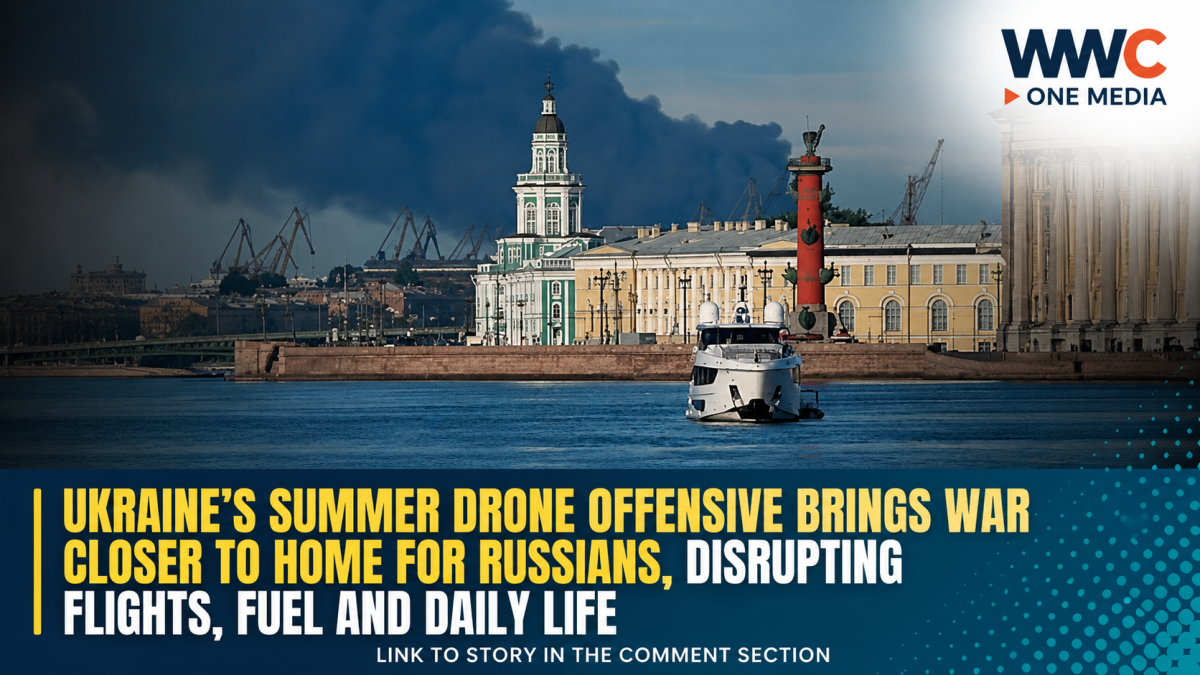
MOSCOW — For much of Russia’s population, the war in Ukraine once felt distant—a conflict largely confined to television screens and faraway battlefields.
But that changed dramatically over the summer.
A sustained wave of Ukrainian long-range drone attacks has disrupted airports, strained fuel supplies, hit oil infrastructure and damaged major commercial warehouses, bringing the consequences of the war closer to millions of Russians living far from the front line.
According to reporting by the Associated Press, Russian authorities said they intercepted more than 43,000 Ukrainian drones over Russian territory and Crimea between June and August, a dramatic increase compared with the same period a year earlier. The attacks have forced repeated airport closures, disrupted civilian travel and exposed the growing difficulty Russia faces in defending its vast territory.
The campaign represents a significant evolution in Ukraine’s strategy: rather than focusing solely on the battlefield, Kyiv is increasingly attempting to raise the economic and psychological cost of the war inside Russia itself.
From Oil Refineries to Online Shopping Warehouses
Ukraine’s drone campaign has increasingly targeted infrastructure with both economic and strategic importance.
Oil refineries have become a major focus, with attacks disrupting gasoline production and contributing to fuel shortages in several Russian regions.
Reuters reported in late August that Russia’s gasoline output had fallen to around 70% of domestic demand after a series of attacks on major refineries, forcing authorities to take emergency measures to stabilize supplies. Some regions reportedly introduced purchasing restrictions and adjusted fuel sales as the government sought alternative imports.
Analysts at the Institute for the Study of War’s Critical Threats Project have also documented a significant expansion of Ukrainian strikes against Russian energy and military infrastructure, arguing that Russia’s enormous geographic size has made it increasingly difficult to protect every critical facility.
But Ukraine’s targets have not been limited to energy.
Drone strikes have also hit warehouses belonging to major Russian e-commerce companies, including Wildberries and Ozon. The attacks have disrupted supply chains and attracted particular attention because of their direct impact on ordinary consumers.
For Russians accustomed to viewing the conflict as something happening hundreds or thousands of kilometers away, burning warehouses, delayed deliveries and disrupted flights have made the war increasingly difficult to ignore.
Airports Become the New Front Line
Civil aviation has also emerged as a major pressure point.
Repeated drone threats have forced Russian authorities to temporarily suspend operations at airports, particularly around Moscow and other major cities.
The disruptions have resulted in flight cancellations, diversions and lengthy delays, affecting both domestic and international travellers.
Ukrainian President Volodymyr Zelenskyy has warned that Russia’s continued military operations make its airspace increasingly risky, although Ukrainian officials have maintained that civilian aircraft are not their intended targets.
Russia, meanwhile, has rejected the warnings and said it remains committed to maintaining aviation safety. Flight disruptions, however, have continued to be recorded at Russian airports.
The growing aviation pressure has added another dimension to the conflict.
Ukraine may not be able to match Russia’s missile arsenal, but its expanding drone capabilities allow it to threaten infrastructure across a much wider area at comparatively lower cost.
‘Bringing the War Home’
Kyiv’s strategy appears increasingly focused on demonstrating that Russia cannot wage a prolonged war without consequences for life inside its own borders.
Ukrainian officials have previously described their long-range campaign as an effort to increase the cost of Moscow’s invasion.
The strategy is particularly significant because Russia’s full-scale invasion of Ukraine has inflicted devastating consequences on Ukrainian civilians for years, including repeated missile and drone attacks against cities, energy infrastructure and residential areas.
Ukraine’s drone campaign does not create equivalent destruction inside Russia, but it is increasingly capable of generating economic disruption and psychological pressure.
A major Ukrainian aerial assault in August involved hundreds of drones across Russia, targeting military and energy facilities while also causing disruption to civilian infrastructure.
However, the escalation has also brought serious risks.
Drone attacks inside Russia have caused civilian casualties. In August, a Ukrainian strike in the Russian city of Nizhnekamsk killed at least 13 people, according to Russian officials, while Ukraine said the intended target was the TANECO oil refinery.
The incident underscores the increasingly dangerous reality of the expanding long-range war: infrastructure strikes can have consequences beyond their intended military or economic targets.
Russia’s Vast Size Is Becoming a Vulnerability
Russia’s enormous territory was once viewed as one of its greatest strategic advantages.
But the expansion of inexpensive long-range drones may be changing that calculation.
Defending thousands of kilometers of territory—and every refinery, military base, airport, warehouse and energy facility—is an extraordinarily difficult task.
The Critical Threats Project has assessed that Ukraine’s expanding strike campaign is forcing Russia to spread its air-defense resources across a growing number of targets, creating new vulnerabilities.
The pressure is not necessarily about destroying every target.
Sometimes, simply forcing airports to close or refineries to suspend operations can produce significant economic consequences.
That is the central advantage of drone warfare.
A relatively inexpensive unmanned aircraft can potentially force an adversary to spend millions protecting infrastructure—or suffer the consequences of disruption.
Economic Pressure Is Becoming Part of the Battlefield
The drone campaign comes as Russia faces growing economic pressure from the prolonged war.
Russia’s government has acknowledged a widening budget deficit, while the cost of military spending continues to weigh on the economy. Reuters reported this week that disruptions affecting infrastructure, including refineries and commercial facilities, have added to broader economic pressures.
Russian officials insist that the country’s economy remains stable and that temporary fuel disruptions are being addressed.
But the combination of sanctions, war spending, labor shortages and attacks on critical infrastructure presents a growing challenge.
For Ukraine, the objective appears increasingly clear:
Make continuing the war more expensive—not only for the Russian military, but for the broader Russian economy.
A Psychological Shift Inside Russia
Perhaps the most significant impact of the summer drone offensive is psychological.
For years, Ukrainian cities have lived under the constant threat of air raid sirens, missile attacks and drone strikes.
Russia’s civilian population, with the exception of border regions and occupied territories, has generally experienced the war differently.
That gap is beginning to narrow.
Explosions, airport shutdowns, fuel shortages and disruptions to online deliveries have made the conflict more visible inside Russia’s major cities and regions.
The Associated Press reported that the growing disruptions have contributed to public anxiety and frustration, particularly as Russians face an increasingly uncertain economic environment.
Still, it is important to put the impact into perspective.
Ukraine continues to suffer vastly greater destruction and civilian casualties from Russia’s large-scale missile, drone and aerial attacks. The expanding Ukrainian drone campaign inside Russia represents an escalation in the geographic reach of the war, but the humanitarian toll remains heavily concentrated inside Ukraine.
The Drone War Is Entering a New Phase
Ukraine’s summer offensive may signal a broader transformation in the conflict.
The war is no longer defined solely by territorial battles in eastern Ukraine.
Increasingly, it is becoming a contest over infrastructure, energy, logistics, aviation and economic resilience.
Ukraine has demonstrated that even without a conventional air force capable of striking deep inside Russia at scale, it can use drones to threaten targets hundreds of kilometers from the battlefield.
Russia still possesses far greater military resources and continues its devastating aerial campaign against Ukraine.
But Kyiv’s expanding drone capabilities are changing one fundamental assumption of the war:
Distance no longer guarantees safety.
And after a summer of airport shutdowns, refinery fires, fuel shortages and drone alerts, millions of Russians are beginning to experience a reality Ukrainians have known for years—the war can reach far beyond the front line.
WWC ONE MEDIA J.M.D



Leave a Reply