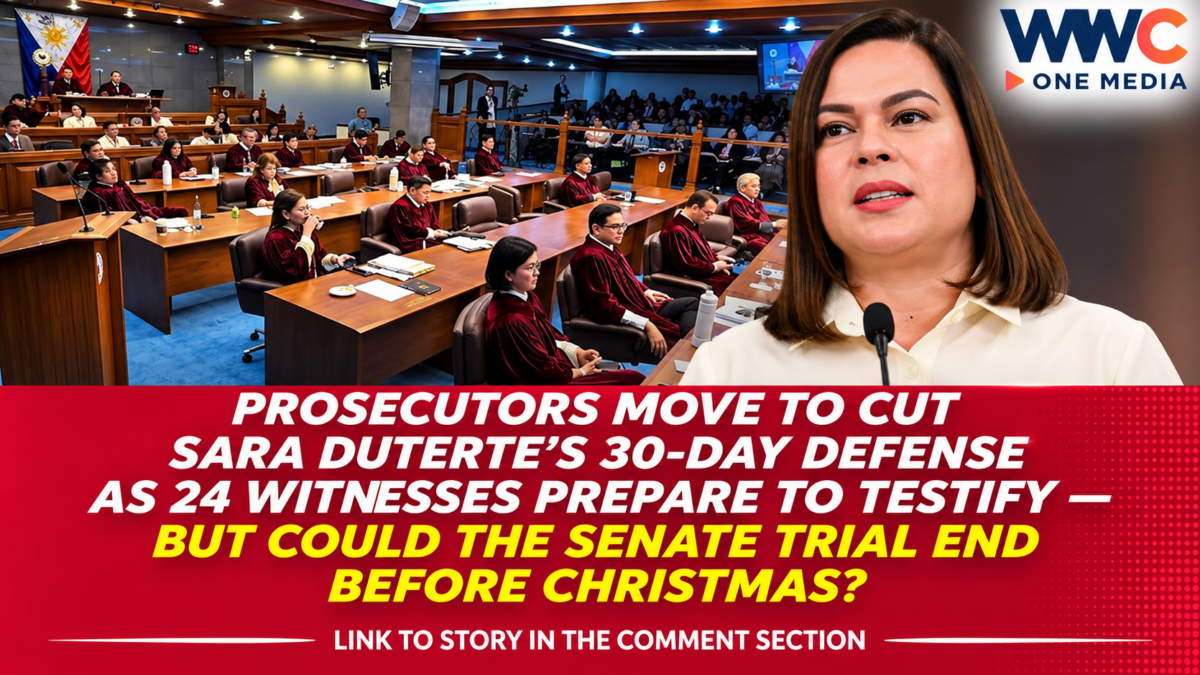
MANILA, PHILIPPINES — The impeachment battle against Vice President Sara Duterte is heading toward another high-stakes confrontation as House prosecutors prepare to challenge the amount of time her lawyers will be allowed to present their defense.
With the Senate impeachment court scheduled to resume hearings on Monday, November 9, prosecutors are considering a formal request to reduce the 30 trial days originally sought by Duterte’s legal team.
Their argument is straightforward: Only one of the original four impeachment articles remains, so the defense should no longer need the same amount of time allocated for all four charges.
But Duterte’s lawyers see a much bigger issue.
They argue that the prosecution’s decision to withdraw three charges should not prevent the vice president from answering accusations already presented publicly during the proceedings.
The disagreement comes as Duterte’s camp prepares an initial lineup of 24 prospective witnesses, including officials from major banks, private corporations and local government offices.
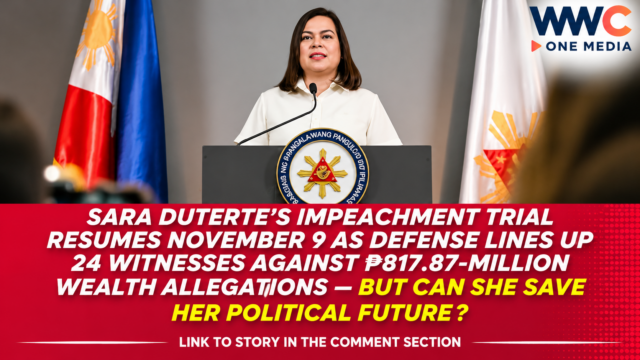
At the centre of the case is the House prosecution’s allegation that Duterte and her husband, lawyer Manases Carpio, accumulated or failed to properly account for at least ₱817.87 million in wealth and assets between 2022 and 2025.
Duterte denies wrongdoing.
The allegation has not been established as fact by the impeachment court.
With Senate hearings set to resume at 10 a.m. on November 9, the immediate battle is no longer just about financial evidence.
It is also about who gets to decide how long the defense can present its case.
Could the Senate conclude one of the Philippines’ most consequential political trials before Christmas, or will disagreements over due process push the proceedings into December?
Prosecution Wants Sara Duterte’s 30-Day Defense Schedule Reduced
House prosecution legal spokesperson and private prosecutor Benjamin “Jay” Tolosa Jr. said the panel is considering asking the Senate impeachment court to shorten the defense’s presentation period.
Speaking at the Saturday News Forum in Quezon City on November 7, Tolosa said the original 30-day request was intended to cover four impeachment articles.
But the prosecution withdrew three of those articles on October 13.
Only Article II, involving allegations of unexplained wealth, inaccurate financial declarations and failure to divest certain business interests, remains.
Tolosa argued that the allotted time should be reconsidered accordingly.
He emphasized that the vice president must receive sufficient opportunity to present evidence.
However, he said the proceedings should not become open-ended.
The prosecution is considering raising the issue during Monday’s hearing or filing a written request.
That means no final reduction in defense trial days has yet been confirmed.
The Senate impeachment court must decide whether any adjustment is appropriate.
Why Prosecutors Believe the Defense Could Delay the Trial
The prosecution is particularly concerned that Duterte’s lawyers may attempt to revisit allegations contained in the three withdrawn articles.
Those charges involved alleged misuse of confidential funds, bribery and grave threats.
Tolosa argued that presenting extensive evidence on those allegations would serve little purpose because the Senate will no longer decide whether to convict Duterte on those articles.
According to prosecutors, the trial should now focus on Article II.
They believe this would reduce unnecessary testimony and allow the court to complete its work sooner.
House prosecutor Terry Ridon also said the prosecution intends to examine whether the defense’s proposed witnesses can provide testimony relevant to the remaining charge.
Prosecutors may raise objections to evidence they consider repetitive, immaterial or unrelated.
However, objections do not automatically prevent a witness from testifying.
The court must evaluate them under its rules.
Duterte’s Lawyers Say Dropping Charges Cannot Silence Her Defense
Duterte’s legal team has strongly disputed the prosecution’s approach.
Defense lead counsel Sheila Sison previously argued that withdrawing an accusation should not give prosecutors the power to prevent the respondent from answering it.
Her concern is that allegations already aired during public hearings may have affected perceptions of the vice president.
The defense therefore maintains that procedural efficiency must not override fairness.
The disagreement raises an important legal question.
When prosecutors withdraw charges after presenting evidence, how much opportunity should the respondent have to address those allegations?
The prosecution argues that the court should concentrate on matters still being adjudicated.
The defense argues that the withdrawal should not erase its opportunity to respond to accusations already made.
Both positions must be assessed against the Senate impeachment court’s procedural orders and the vice president’s rights.
The prosecution cannot unilaterally determine which witnesses will be excluded.
Likewise, the defense cannot automatically require unlimited hearing time.
The court must balance efficiency with a meaningful opportunity to present a defense.
Sara Duterte’s Defense Prepares 24 Witnesses
The defense has identified an initial group of 24 prospective witnesses for the proceedings beginning November 9.
The lineup includes representatives from several Philippine financial institutions.
Among the banks identified in reporting are BDO Unibank, Bank of the Philippine Islands, EastWest Bank, Land Bank of the Philippines, Metrobank, Philippine Savings Bank, Security Bank and UnionBank.
Other prospective witnesses include corporate representatives and local government personnel.
Their testimony is expected to address financial transactions, property documents, business records and correspondence associated with Duterte and Carpio.
Some may be asked to authenticate records or clarify transactions cited by the prosecution.
The initial witness list does not guarantee that every person will testify.
The court will consider the relevance and procedural requirements of proposed testimony.
The defense may also submit additional witness names.
For the vice president, the November hearings provide an opportunity to challenge evidence that has dominated the trial for months.
Prosecution Offers to Agree on Undisputed Facts
One possible way to shorten proceedings involves stipulations.
A stipulation allows opposing parties to agree that a particular fact is not disputed.
For example, if both sides accept that a bank issued a particular document, a witness might not need to spend considerable time establishing that narrow fact.
Tolosa indicated that prosecutors were willing to consider such arrangements.
He specifically mentioned letters allegedly sent by Duterte or Carpio to financial institutions.
Agreeing on the existence or authenticity of a document, however, does not necessarily mean accepting every conclusion drawn from its contents.
A bank transaction may be genuine while its legal significance remains disputed.
Likewise, a verified property record does not automatically establish that an official violated financial-disclosure requirements.
This distinction could become crucial during the defense presentation.
Stipulations may save time without requiring either side to surrender contested arguments.
But the parties must actually agree on the relevant facts.
₱817.87-Million Wealth Allegation Remains at the Centre of the Case
The prosecution’s remaining case focuses on allegations involving the vice president’s financial declarations and assets.
Forensic accounting expert Alexander Cabrera presented an analysis that prosecutors say identified approximately ₱817.87 million in unexplained wealth or undeclared assets involving Duterte and Carpio.
The analysis considered bank records, tax documents, insurance information, corporate filings and Statements of Assets, Liabilities and Net Worth, commonly known as SALNs.
Cabrera also discussed a higher estimate under less conservative assumptions.
But those figures are the prosecution expert’s assessments.
They are not amounts that the Senate impeachment court has established were illegally obtained, concealed or misappropriated.
Duterte’s lawyers have challenged the underlying assumptions, interpretations and admissibility of various records.
The defense is expected to explain why those materials do not prove the remaining impeachment article.
As WWC ONE MEDIA reported in its earlier examination of the prosecution’s unexplained-wealth allegations, the dispute involves extensive financial records that must be evaluated in context.
The ultimate question is whether the admissible evidence establishes grounds for conviction, not merely whether large sums appear in financial documents.
Senate Admits Key Financial Evidence but Makes No Finding of Guilt
The prosecution entered the next phase of the trial after securing an important evidentiary ruling.
On November 5, the Senate impeachment court admitted substantial portions of the prosecution’s documentary evidence.
These included SALNs, bank records, tax documents, insurance and investment information, and other financial records.
The court also accepted much of Cabrera’s forensic accounting report.
However, it excluded certain corporate records involving JTC Group of Companies Philippines Inc. and Pikimong Pikimong Philippines Corporation.
Calculations derived from those excluded materials were also rejected.
Documents connected to the withdrawn confidential-funds article were likewise excluded from the remaining case.
Crucially, the court clarified that admitting a document does not mean its contents prove the prosecution’s allegations.
The senator-judges must still evaluate its credibility, relevance and weight.
That distinction protects the integrity of the trial.
The prosecution has secured permission to place significant evidence before the court.
But the defense retains the opportunity to challenge that evidence.
Sara Duterte’s SALNs Face Renewed Examination
The vice president’s SALNs remain one of the most important parts of Article II.
The prosecution has raised questions concerning the accuracy and completeness of her financial disclosures.
These include declared cash, bank deposits, property interests and business connections.
As WWC ONE MEDIA previously reported in its analysis of Duterte’s financial declarations, prosecutors have compared her sworn statements with other financial records to identify potential discrepancies.
However, an apparent omission does not automatically prove unexplained wealth.
The surrounding circumstances matter.
For example, investigators must establish whether an asset was subject to disclosure, whether the relevant official owned it at the applicable time and whether the declaration complied with legal requirements.
The defense may also challenge whether particular calculations accurately reflect income, ownership or liabilities.
These questions are expected to become central when the defense begins calling witnesses.
Bank Testimony Could Become a Major Battleground
The prosecution previously obtained testimony and records from banking and financial institutions.
Some of those records concern transactions associated with Duterte and Carpio.
As WWC ONE MEDIA reported when the impeachment court subpoenaed representatives from 14 banks and financial companies, the prosecution considered those records important to its financial case.
Now the defense intends to question or clarify aspects of that evidence.
This could involve confirming transaction details, examining account ownership and interpreting financial documents.
The prosecution has suggested that uncontested matters need not be repeated unnecessarily.
But the defense may consider some details essential to explaining the transactions.
The court will need to distinguish testimony that adds relevant information from testimony that merely duplicates facts already established.
The outcome could affect both the length of the proceedings and the eventual assessment of Article II.
Earlier Bank-Record Ruling Illustrates the Due Process Dispute
The debate over efficiency is not new.
In September, the Senate impeachment court ruled that Duterte could not be compelled to respond to a prosecution request for admission involving more than 100 matters.
These included questions related to financial records.
The court determined that her refusal to respond could not automatically be treated as an admission.
As WWC ONE MEDIA reported in its coverage of that decision, the ruling reflected the importance of protecting the respondent’s constitutional rights while allowing prosecutors to pursue appropriate evidentiary procedures.
It did not prevent the prosecution from introducing financial documents through other authorized methods.
The earlier ruling is relevant because the latest scheduling dispute again raises questions about balancing procedural efficiency with fairness.
The court must allow the parties to present relevant evidence while maintaining control over its proceedings.
Could the Impeachment Trial Finish in November?
House lead prosecutor Gerville Luistro has suggested that the trial could conclude before the end of November if the defense completes its presentation in approximately 10 full trial days.
The prosecution believes this may be achievable after the withdrawal of three impeachment articles.
But the target remains uncertain.
The defense has not completed its witness presentation.
Additional objections and procedural disputes could arise.
The court must also consider its legislative responsibilities.
Senators are simultaneously working on the proposed 2027 national budget.
That creates scheduling pressures.
Senate President Sherwin Gatchalian previously warned that the impeachment trial could continue into December.
Neither a November finish nor a Christmas deadline has been formally guaranteed.
The court’s actual schedule will depend on the number of witnesses, the pace of testimony and its procedural rulings.
November Hearing Schedule: What Happens Next?
The Senate impeachment court is scheduled to resume proceedings at 10 a.m. on Monday, November 9.
The current November calendar includes hearings on November 9 to 13, followed by November 19, 20 and 23.
Some dates allow extended proceedings, while others must accommodate legislative sessions.
The court may set additional dates if necessary.
Prosecutors are expected to scrutinize whether defense witnesses are relevant to Article II.
Duterte’s lawyers will seek to challenge the prosecution’s financial evidence.
The presiding officer will decide objections and procedural requests.
The central immediate question is whether prosecutors formally seek a reduction in the defense’s allocated trial days.
If they do, the court must decide whether to grant the request, reject it or adopt a different arrangement.
As of November 8, no final ruling shortening the original 30-day allocation has been verified.
The Political Stakes Extend to the 2028 Presidential Election
The trial carries implications beyond the vice president’s current position.
Duterte has publicly discussed plans to run for president in 2028.
An impeachment conviction could lead to removal from office and disqualification from holding public office.
That would have potentially decisive consequences for her future political ambitions.
However, such consequences depend on a conviction that has not occurred.
Duterte remains vice president.
The remaining impeachment allegation is contested.
The defense has not yet completed its presentation.
And the senator-judges have not issued a final verdict.
The case also unfolds amid tensions following the breakdown of the political alliance between Duterte and President Ferdinand Marcos Jr.
Supporters and critics have expressed sharply different views about the proceedings.
But the impeachment court must determine the case through the evidence and applicable rules, not public opinion alone.
Why the Defense’s Right to Be Heard Matters
The prosecution’s demand for speed and the defense’s insistence on fairness are not necessarily incompatible.
A court can require relevant testimony and enforce reasonable schedules while protecting the respondent’s ability to challenge the case.
The central question is where that balance should be drawn.
Witnesses should not be excluded merely because their testimony is inconvenient.
At the same time, proceedings need not be extended indefinitely through repetitive evidence or arguments unrelated to the remaining charge.
A fair process requires both discipline and meaningful participation.
The prosecution must establish its allegations.
The defense must have a genuine opportunity to respond.
And the senator-judges must reach their decision based on the evidence properly admitted.
That is why the November 9 hearing could become an important procedural turning point.
The Bottom Line: The Battle Over Trial Time Could Shape the Final Phase
The House prosecution is preparing to challenge the amount of time Vice President Sara Duterte’s lawyers may use to present their defense.
Prosecutor Benjamin Tolosa Jr. argues that the original 30-day request should be reduced because only one impeachment article remains.
The defense has identified 24 prospective witnesses and maintains that it must be allowed to respond fairly to the accusations raised against Duterte.
The prosecution has presented evidence supporting its allegation of at least ₱817.87 million in unexplained wealth and undeclared assets.
Duterte denies wrongdoing, and the financial allegations remain unproven.
The Senate impeachment court has admitted substantial financial records while excluding certain documents.
The next major stage begins November 9, when the defense is scheduled to present its case.
The proceedings may conclude before Christmas, but their final duration remains uncertain.
And as prosecutors seek to shorten Sara Duterte’s defense while her lawyers prepare 24 witnesses, one question could determine the next chapter of Philippine politics: Will the Senate find a way to finish the impeachment trial quickly without compromising due process—or could another courtroom battle over fairness delay a verdict with enormous consequences for the 2028 presidential election?