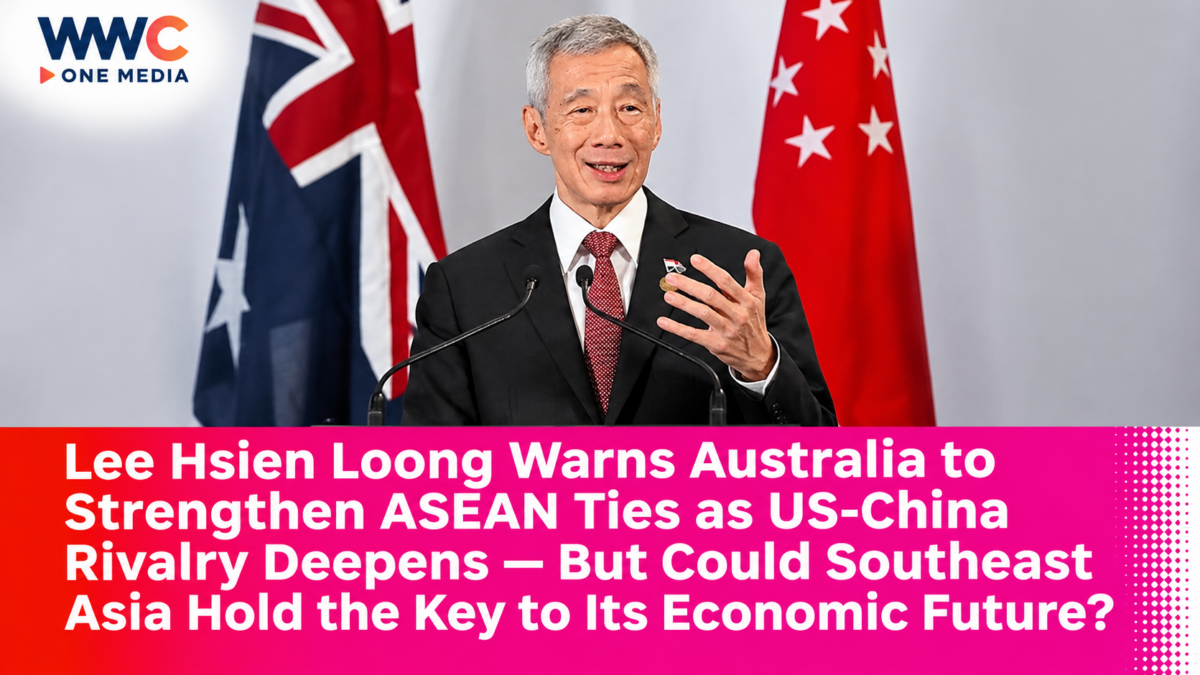
SINGAPORE — Singapore Senior Minister Lee Hsien Loong has delivered a powerful message to Australia: In a world increasingly divided by competition between the United States and China, Canberra’s future prosperity and security could depend on how deeply it strengthens its relationships with Southeast Asia.
Speaking in the fourth and final instalment of Australia’s prestigious 2026 ABC Boyer Lecture Series on Sunday, November 8, Lee called for stronger economic partnerships, greater Australian investment, continued defence cooperation and closer connections between people across the region.
But one observation stood out.
Australia invests no more in the 10 ASEAN countries combined than it does in New Zealand, despite Southeast Asia representing a market of approximately 700 million people.
That comparison highlights what Lee sees as a significant opportunity for Australian businesses to expand their regional presence.
With US-China tensions reshaping international trade, security alliances and investment decisions, the former Singapore prime minister argued that Australia cannot secure its future through self-reliance alone.
It needs dependable partners.
And Southeast Asia could be central to that strategy.
Lee Hsien Loong: Australia’s Future Is Closely Connected to Asia
Lee delivered his remarks during a lecture titled Engaging Asia from Down Under, part of the Australian Broadcasting Corporation’s annual Boyer Lectures.
The 2026 series examines Australia’s evolving relationship with Asia at a time of considerable geopolitical and economic change.
Lee, who served as Singapore’s prime minister from 2004 to 2024, said Australia’s long-term interests would be better protected through deeper regional engagement.
His argument was not that Australia should abandon its traditional allies.
Instead, he urged Canberra to complement those relationships with stronger Asian partnerships.
Australia remains a close security ally of the United States, participates in AUKUS alongside the United States and United Kingdom, and maintains longstanding defence relationships across the Indo-Pacific.
But Lee argued that changing global conditions require countries to develop additional sources of resilience.
He noted that the United States is reassessing its international role while China’s economic and strategic influence continues to grow.
For middle and smaller powers, relying exclusively on one major country could create vulnerabilities.
Stronger regional partnerships, he suggested, would give Australia more options to protect its interests.
ASEAN’s 700-Million-Person Market Presents an Enormous Opportunity
One of Lee’s strongest economic arguments concerned Southeast Asia’s scale.
ASEAN collectively represents approximately 700 million people and, according to the comparison cited in his lecture, the world’s fifth-largest economy.
The region includes fast-growing consumer markets, major manufacturing centres, international financial hubs and economies investing heavily in infrastructure and technology.
Yet Australia’s investment presence remains relatively modest.
Lee pointed out that Australian investment across ASEAN is comparable to its investment in New Zealand.
The comparison does not mean Australia has no significant commercial relationships with Southeast Asia.
Australia already trades extensively with ASEAN members and maintains important bilateral economic partnerships.
Rather, Lee’s point was that the scale of Australian investment has substantial room to grow.
He highlighted opportunities involving critical minerals, agriculture, renewable energy, digital technology and advanced industries.
Australian businesses possess expertise and resources that could complement Southeast Asian supply chains.
Regional companies, meanwhile, could become customers, suppliers, technology partners and investors.
For Canberra, deeper integration could diversify commercial relationships and reduce exposure to disruptions in individual markets.
For ASEAN members, additional Australian investment could support business development, infrastructure and employment.
The potential benefits are substantial—but they depend on actual projects, financing and commercial agreements rather than diplomatic statements alone.
Could Australia Be Missing a Major Investment Boom?
Lee’s comments come as Southeast Asia positions itself as an increasingly important destination for international investment.
Manufacturers are reassessing global supply chains, technology companies are expanding data-centre operations, and governments are investing in renewable energy and digital infrastructure.
Australia possesses strengths in several of these sectors.
Its mineral resources are particularly important to industries involving batteries, electronics and clean-energy technology.
Its agricultural sector also offers opportunities for food-security partnerships.
Lee argued that cooperation should move beyond viewing every regional business relationship through the lens of US-China competition.
That approach could encourage Australia and ASEAN countries to concentrate on mutually beneficial development projects.
The timing is important.
Southeast Asian economies are already working to modernise regional trade arrangements.
As previously reported by WWC ONE MEDIA in its coverage of ASEAN’s accelerated trade timetable, economic ministers agreed to begin applying parts of an upgraded ASEAN Trade in Goods Agreement ahead of its planned full implementation.
The initiative aims to improve cross-border commerce and supply-chain efficiency.
For Australian companies considering regional expansion, such developments could make Southeast Asia increasingly attractive.
However, regulatory differences, infrastructure requirements and market-specific risks remain important considerations.
US-China Rivalry Raises the Stakes for Australia
Lee’s message carries particular geopolitical weight because Australia has deep relationships with both Washington and Beijing.
The United States remains central to Australian defence planning.
China is one of Australia’s most important trading partners.
That creates a delicate balancing act.
Canberra must maintain its security commitments while protecting economic relationships with Asian markets.
Disputes over military activity, technology restrictions, tariffs and regional influence could complicate that balance.
Lee suggested that the answer is not necessarily choosing one major power over another.
Instead, Australia can strengthen its ability to act independently by expanding cooperation with a broader range of countries.
This does not remove the risks associated with major-power rivalry.
But it creates additional diplomatic and economic options.
Australia’s relationship with China illustrates that challenge.
As WWC ONE MEDIA reported in its coverage of Prime Minister Anthony Albanese’s interest in another Beijing visit, Canberra continues pursuing dialogue with Beijing despite disagreements over regional security.
The South China Sea remains an important source of tension.
Australia supports freedom of navigation and international law, while China maintains disputed maritime claims and has expanded its military presence in the region.
For Lee, maintaining communication is essential even when strategic interests differ.
Defence Cooperation: Australia Must Remain Engaged in Asia
Beyond trade and investment, Lee emphasized the importance of Australia’s continued security presence in the region.
He called for deeper defence relationships with countries that share Australia’s strategic interests.
But he also recommended maintaining practical communication with governments where relations are more complicated.
That approach reflects concerns about the possibility of military misunderstandings.
When rival armed forces operate in the same region, unexpected encounters can create dangerous situations.
Communication channels can help prevent incidents from escalating.
Australia already participates in several important regional security arrangements.
These include the Five Power Defence Arrangements involving Australia, Malaysia, New Zealand, Singapore and the United Kingdom.
The arrangement dates to 1971 and provides a framework for defence consultation and cooperation.
Australia also works closely with regional partners through bilateral exercises, military exchanges and other security initiatives.
Lee’s argument is that such engagement should remain a priority as the regional security environment becomes more complicated.
For countries such as Singapore and the Philippines, continued Australian involvement provides an additional source of defence cooperation.
It also supports a regional environment in which smaller countries can maintain relationships with multiple security partners.
What Lee’s Message Means for the Philippines
Lee’s remarks have implications beyond Singapore and Australia.
The Philippines is an ASEAN member with longstanding security relationships involving the United States, Australia and other regional partners.
It also has important commercial links with China.
That combination places Manila within many of the same geopolitical pressures affecting Canberra.
The Philippines has been strengthening defence cooperation with Australia while addressing maritime disputes in the West Philippine Sea.
At the same time, Philippine businesses are seeking greater international investment, infrastructure financing and technology partnerships.
Stronger Australia-ASEAN engagement could create opportunities involving renewable energy, critical minerals, agricultural technology and digital industries.
Regional energy cooperation is one example of how ASEAN countries are attempting to strengthen resilience.
As WWC ONE MEDIA reported in its coverage of a proposed Philippines–Singapore electricity connection, the two countries have been exploring cross-border power trade as part of wider ASEAN electricity-network ambitions.
That proposed connection is not an Australian project.
However, it illustrates the type of regional infrastructure development where international financing and technical cooperation could play important roles.
For Manila, diversification of economic and security partnerships may help reduce dependence on any single external power.
Singapore and Australia Already Have a Model for Cooperation
Lee pointed to the relationship between Singapore and Australia as an example of successful long-term cooperation.
Despite considerable differences in geography, natural resources and social policies, the countries have developed deep political, economic and defence ties.
Their relationship spans approximately six decades.
Singapore and Australia upgraded their Comprehensive Strategic Partnership in 2025, expanding the framework for future cooperation.
Lee argued that trust had developed through sustained communication and a willingness to understand one another’s perspectives.
The two countries do not agree on every issue.
Singapore’s strict approach to drug laws, for example, differs from some Australian policy and social attitudes.
Nevertheless, these differences have not prevented the countries from building a strong partnership.
For Lee, that experience offers a lesson for Australia’s relationships with other Asian countries.
Governments do not need identical political systems or social policies to pursue mutually beneficial cooperation.
They need practical engagement, consistent communication and respect for differences.
New Energy-Supply Agreement Shows How Partnerships Can Protect Economies
One of the most concrete examples Lee cited was the Singapore-Australia agreement on essential supplies.
On July 27, 2026, the two governments signed a protocol under the Singapore-Australia Free Trade Agreement covering economic resilience and essential supplies.
The arrangement is designed to strengthen cooperation during major supply-chain disruptions.
It covers agreed essential products, including petroleum oils and liquefied natural gas.
Both countries committed to endeavouring to avoid unnecessary export restrictions on covered supplies and established mechanisms for advance notification and consultation.
The agreement also creates an Australia-Singapore Economic Resilience Dialogue.
However, the protocol is not an unconditional guarantee that energy supplies will always remain uninterrupted.
According to Singapore’s Ministry of Energy, Trade and Industry, it will enter into force after both countries complete their domestic procedures.
The arrangement nevertheless represents a practical attempt to reduce vulnerability during international crises.
Australia’s government has noted that Singapore supplies significant shares of Australia’s transport fuels, illustrating the two countries’ existing energy interdependence.
For Lee, the agreement demonstrates how closer partnerships can provide protection when international markets become unstable.
He suggested similar arrangements could be explored for food supplies.
Regional energy security is increasingly important as countries respond to geopolitical disruptions and changing demand.
As WWC ONE MEDIA reported on Singapore’s new Saudi oil-storage arrangement, Singapore is also strengthening its energy-security strategy through international cooperation and storage infrastructure.
The Saudi arrangement is separate from the Singapore-Australia protocol.
But both demonstrate how governments are seeking to reduce exposure to energy-supply shocks.
Lee Urges Countries Not to Abandon Global Trade Rules
Another major theme of Lee’s lecture was the future of international trade.
He argued that countries should continue supporting the multilateral trading system even as cooperation becomes more difficult.
The World Trade Organization remains a central institution for trade rules and dispute resolution.
However, global trade cooperation has faced growing pressure from tariffs, geopolitical disagreements and economic-security measures.
Lee urged Australia and its partners to work toward strengthening the rules-based system wherever possible.
At the same time, he acknowledged that universal agreement may not always be achievable.
Countries should therefore make better use of existing trade agreements and explore links with other economic groupings.
These could include the European Union and regional trade frameworks.
Australia has previously played important roles in developing major international economic arrangements, including APEC and the Comprehensive and Progressive Agreement for Trans-Pacific Partnership.
Lee suggested that such diplomatic experience could become even more valuable.
The broader goal is to preserve opportunities for trade without making economies excessively dependent on a small number of partners.
Students, Migrants and Tourism Are Also Part of the Strategy
Lee emphasized that international partnerships cannot depend exclusively on governments and corporations.
Relationships between ordinary people also matter.
Educational exchanges, migration, tourism and professional networks can create connections that last for decades.
He highlighted the historical Colombo Plan and the New Colombo Plan as examples of initiatives supporting educational engagement between Australia and Asia.
These programmes have helped students develop personal and professional relationships across the region.
Lee also noted that people born overseas account for approximately one-third of Australia’s residents.
According to figures he cited, roughly 70,000 people from Singapore live in Australia.
Such communities strengthen ties through business, education, culture and family relationships.
However, he acknowledged that migration policy requires careful political management.
Governments must consider integration, public confidence and the interests of existing citizens.
Australia has recently introduced immigration-policy changes intended to better manage migration flows.
As WWC ONE MEDIA reported in its coverage of Australia’s revised migration rules and ASEAN student exemptions, Canberra has sought to balance tighter immigration controls with continued educational and regional engagement.
Lee’s broader argument is that long-term international relationships become stronger when people feel welcome and communities remain cohesive.
Could ASEAN Become Australia’s Most Important Regional Growth Opportunity?
The scale of Southeast Asia’s population and economic development makes the region difficult to overlook.
But Lee’s message was not simply a prediction that ASEAN would become Australia’s dominant investment destination.
It was a recommendation to pursue opportunities more actively.
The region offers access to expanding consumer markets, industrial supply chains and emerging technology sectors.
Australia brings natural resources, capital, advanced expertise and established institutions.
Combining these strengths could support growth in both regions.
However, successful investment requires more than diplomatic goodwill.
Projects must be commercially viable.
Regulatory conditions must support cross-border activity.
Infrastructure must be developed.
And governments must manage political and security risks.
The opportunity is substantial, but its eventual scale cannot be assumed.
For Australia, Lee’s central message is that stronger ASEAN relationships could provide additional economic choices in an increasingly uncertain world.
The Bigger Picture: Middle Powers Seek More Independence
Lee’s speech reflects a wider change in international diplomacy.
Countries that are neither the United States nor China are examining how to protect their interests amid growing competition between the two powers.
Some are strengthening regional alliances.
Others are expanding trade arrangements or investing in domestic strategic capabilities.
For Singapore, Australia and other middle or smaller powers, the challenge is finding ways to cooperate without becoming trapped in major-power confrontation.
Lee argued that greater self-reliance must be accompanied by dependable partnerships.
That approach recognizes the limits of acting alone.
Few countries can independently guarantee access to every critical resource, technology or market.
Cooperation can help reduce those vulnerabilities.
But partnerships also require difficult compromises and sustained political commitment.
They cannot eliminate every risk created by international rivalry.
What they can do is give countries more options when circumstances change.
The Bottom Line: Australia Faces a Strategic Choice About Its Future in Asia
Lee Hsien Loong’s November 8 Boyer Lecture delivered a clear call for Australia to deepen its engagement with Southeast Asia.
His message focused on three priorities: stronger economic relationships, continued security cooperation and deeper connections between people.
ASEAN’s approximately 700-million-person market offers substantial commercial opportunities.
But Lee argued that Australia’s investment presence remains modest relative to the region’s economic scale.
He also warned against allowing US-China rivalry to define every regional relationship.
Instead, countries should cooperate on practical issues such as energy security, digital technology, renewable energy, food supply, public health and defence communication.
Singapore’s longstanding partnership with Australia provides one example of how countries with different circumstances can build trust and mutual benefit.
The recently signed protocol on essential supplies demonstrates how cooperation can move beyond diplomatic statements toward practical economic arrangements.
For the Philippines and other ASEAN members, greater Australian engagement could offer additional investment, technology and security partnerships.
For Canberra, the challenge is turning diplomatic interest into sustained action.
And as global competition intensifies and Southeast Asia becomes increasingly important to international trade and security, one question remains: Will Australia seize the opportunity to build a deeper economic and strategic future with ASEAN—or could its hesitation allow other global powers to strengthen their influence across the region first?