JERUSALEM / TEL AVIV / MANILA — November 8, 2026 | WWC ONE MEDIA | World News, Middle East Politics and International Affairs
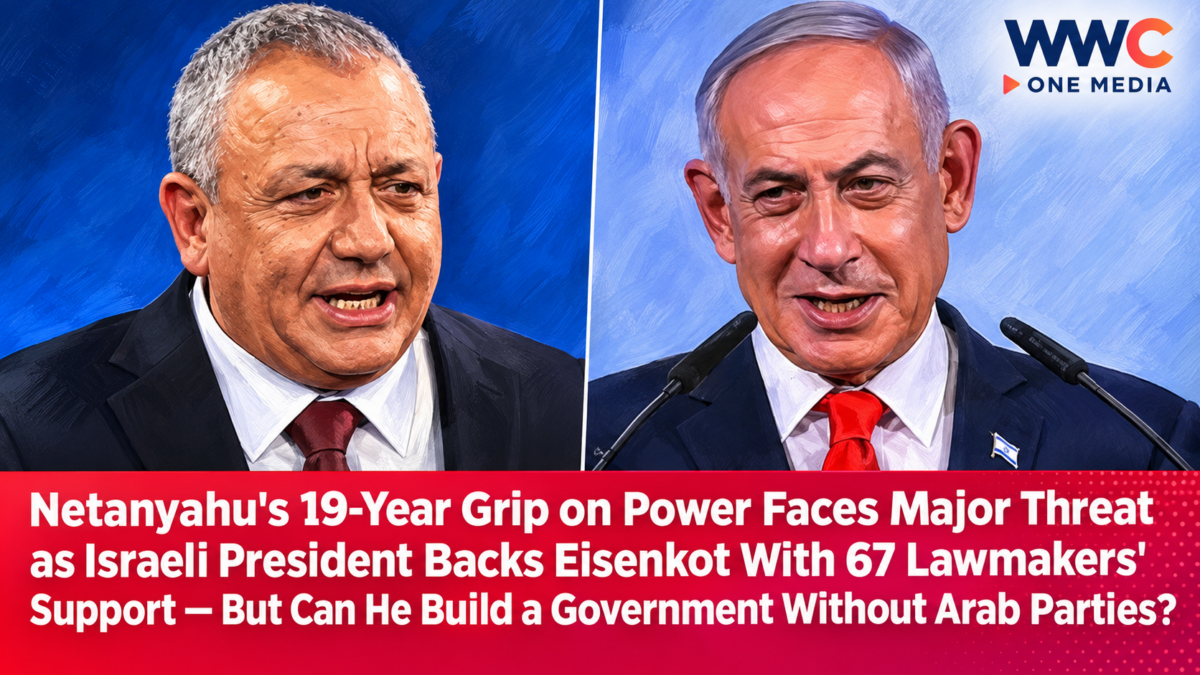
Israel is entering a crucial political showdown after President Isaac Herzog selected former military chief Gadi Eisenkot to attempt to form the country’s next government, dealing a potentially devastating setback to Prime Minister Benjamin Netanyahu.
The decision, announced on Saturday, November 7, follows a fiercely contested national election that stripped Netanyahu’s governing alliance of its parliamentary majority but failed to give the opposition a clear path to power.
According to Channel News Asia, Agence France-Presse, Reuters and the Associated Press, Eisenkot secured recommendations from parties representing 67 lawmakers, compared with 46 for Netanyahu.
That makes him the first candidate to receive the opportunity to assemble a new government following the October 27 election.
But the breakthrough comes with a major complication.
Although 67 lawmakers recommended Eisenkot, many belong to parties that strongly disagree on Israel’s security policies, religious obligations and the political role of Arab citizens.
Some of Eisenkot’s potential Jewish coalition partners have categorically rejected relying on Arab-led parties.
Those parties, however, may hold the decisive votes needed to replace Netanyahu.
Eisenkot now faces an extraordinary political challenge: building a workable coalition from groups whose disagreements may be almost as deep as their opposition to the incumbent prime minister.
Could the former Israeli military chief finally end Netanyahu’s long-running rule—or will the same political divisions that weakened the prime minister ultimately save his government?
President Herzog Gives Eisenkot the First Chance to Lead Israel
President Isaac Herzog’s decision follows several days of consultations with representatives of the parties elected to Israel’s 120-seat parliament, the Knesset.
On November 5, Herzog announced that factions representing 67 lawmakers had recommended Eisenkot.
Another 46 recommended Netanyahu.
The remaining seven lawmakers belonged to a faction that did not recommend either candidate.
The president acknowledged that the number of recommendations appeared to favor Eisenkot.
But he also warned that recommendations do not necessarily translate into a coalition capable of governing.
Herzog’s constitutional responsibility is to choose the lawmaker he believes has the best chance of assembling a viable government.
On November 7, his office announced that Eisenkot would receive the first opportunity.
The formal ceremony was scheduled for Sunday, November 8, at the president’s residence in Jerusalem.
That is a major political milestone, but it does not make Eisenkot prime minister.
He must still secure sufficient parliamentary backing to establish an administration.
Until a new government is formed, Netanyahu remains Israel’s incumbent prime minister.
Israel’s Election Results Reveal a Deep Political Deadlock
The October 27 election produced a divided parliament.
Netanyahu’s religious-nationalist bloc won 53 seats.
Eisenkot’s Jewish-led opposition bloc secured 48.
The two Arab-led parties won a combined 19 seats, giving them unusual influence over the formation of the next government.
The Knesset has 120 seats, meaning a majority requires 61.
The arithmetic creates an apparent opportunity for Eisenkot.
His 48-seat bloc, combined with the 19 Arab-party seats, would command 67 lawmakers.
But that calculation assumes cooperation between parties that do not necessarily share a governing agenda.
Some Jewish opposition politicians reject entering a coalition with Arab parties or depending on their votes.
Consequently, the 67 recommendations received during presidential consultations cannot be treated as 67 confirmed votes for an Eisenkot government.
As WWC ONE MEDIA previously reported on Arab parties supporting Eisenkot’s attempt to remove Netanyahu, the election has created an unusual opening for Arab lawmakers to influence Israel’s political leadership.
The central issue is whether that influence can translate into a workable governing arrangement.
Who Is Gadi Eisenkot?
Gadi Eisenkot is a former chief of staff of the Israel Defense Forces who entered national politics in 2022.
He later established the Yashar party and emerged as one of Netanyahu’s principal challengers.
His political appeal has centered on national security experience, institutional accountability and calls for a different approach to governing Israel after years of political conflict.
Unlike some traditional left-wing opposition leaders, Eisenkot comes from the country’s military establishment.
That background may help him appeal to voters concerned about national security while criticizing Netanyahu’s leadership.
Eisenkot has also experienced the personal consequences of the Gaza war.
His son and two nephews were killed during military operations in Gaza.
Those losses have become part of his public story, although they do not determine his political positions or the viability of his coalition.
Eisenkot has criticized Netanyahu’s handling of security affairs and the continued influence of far-right political allies.
He has also called for greater accountability following the Hamas-led attacks of October 7, 2023.
But his ability to replace Netanyahu depends on parliamentary negotiations rather than military credentials or personal popularity alone.
Arab Parties Hold the Key to the Next Government
One of the most important developments in the election was the performance of Arab-led political parties.
The Joint List and Ra’am won a combined 19 seats.
That result gave them significant negotiating power.
Both groups supported Eisenkot receiving the opportunity to form a government.
However, they differ in their approaches to cooperation.
Some Arab lawmakers have indicated they could support a government seeking to replace Netanyahu without formally joining its cabinet.
Such an arrangement could involve external parliamentary support.
Others have shown greater willingness to consider direct participation.
For Arab political leaders, the negotiations could create opportunities to press for action on issues affecting Palestinian citizens of Israel.
Those include public safety, housing, discrimination, local government resources and political representation.
However, their positions on the Israeli-Palestinian conflict and Israel’s national identity create significant disagreements with several Jewish-led parties.
Netanyahu has strongly criticized the idea of an opposition government depending on Arab-party support.
He argues that such an arrangement could threaten Israel’s security and political stability.
Arab party representatives reject the claim that their participation in democratic politics should automatically disqualify them from influencing the government.
The dispute is now central to the coalition negotiations.
Avigdor Liberman Could Become a Major Obstacle
One of Eisenkot’s most difficult potential partners is Avigdor Liberman.
The former defense minister leads Yisrael Beiteinu, a secular nationalist party.
Liberman is a fierce critic of Netanyahu.
But he also strongly opposes relying on Arab-led parties to form a government.
That position complicates Eisenkot’s most straightforward mathematical path to a majority.
Liberman’s opposition to cooperation with Arab parties has been based partly on disagreements over national identity and security policy.
Nevertheless, he has recently shown some flexibility on a separate issue involving ultra-Orthodox Jews and military service.
That shift could open another possible coalition route.
But it would require compromises that many of Eisenkot’s own supporters might find difficult to accept.
The challenge is therefore not merely finding enough lawmakers.
It is finding enough lawmakers who can agree on the same government.
Ultra-Orthodox Parties Could Determine Netanyahu’s Future
Israel’s ultra-Orthodox political parties have traditionally played an influential role in coalition negotiations.
Their support can be crucial when the main political blocs fall short of a majority.
Following the October election, the seven-seat United Torah Judaism faction declined to recommend either Netanyahu or Eisenkot during the presidential consultations.
That decision weakened Netanyahu’s position.
It also created an opening for Eisenkot to explore a possible alliance.
But cooperation would require difficult negotiations over military service.
Ultra-Orthodox exemptions from mandatory military service have become one of Israel’s most divisive domestic issues.
Many secular Israelis argue that military obligations should be shared more equally, particularly after years of conflict and repeated reserve deployments.
Ultra-Orthodox representatives argue that religious study is central to their communities and have resisted compulsory military service for many students.
Eisenkot has proposed a model involving national service obligations, with civilian alternatives potentially available.
That position may create room for negotiation.
But any compromise could produce resistance from politicians who campaigned on ending the exemptions.
The issue may become one of the biggest obstacles to forming the next government.
Netanyahu Calls for a National Unity Government
Netanyahu has not accepted that his political career is ending.
The veteran leader has called for a broad unity government involving major Jewish political parties.
He argues that Israel needs political stability amid continuing regional threats, including the confrontation with Iran.
A unity government could theoretically combine parties from different political blocs.
But the central dispute concerns who would lead it.
Netanyahu wants to remain prime minister.
Eisenkot and several opposition leaders insist that the country needs new leadership.
Eisenkot’s Yashar party has urged members of Netanyahu’s Likud and other parties to consider a government led by Eisenkot instead.
That creates a difficult political calculation.
For Netanyahu, a unity agreement could provide a route to remaining influential.
For Eisenkot, accepting a coalition led by Netanyahu would undermine one of the main objectives of his election campaign.
Neither side has confirmed a successful agreement.
A national unity government remains a possibility, not an established outcome.
Netanyahu Faces Growing Pressure Over October 7 Accountability
The election took place amid continuing public demands for an independent investigation into the failures surrounding the October 7, 2023, Hamas-led attacks.
Families of victims and hostages, survivors and civil society groups have called for a state commission of inquiry.
Critics argue that the public deserves an independent examination of intelligence, military and political decision-making before the attacks.
Netanyahu’s government has faced criticism over its approach to such an investigation.
As WWC ONE MEDIA reported on thousands of protesters gathering in Tel Aviv before the election, accountability became an important issue in the campaign.
Eisenkot was among the opposition figures who participated in the public debate.
A government led by Eisenkot could pursue a different approach to an inquiry.
However, the creation, scope and powers of any future commission would depend on government decisions and applicable law.
The election result does not automatically establish such an investigation.
Disputed Warning Allegations Added to the Political Tension
Netanyahu has also faced criticism over disputed claims that he received advance warnings before the October 7 attack.
As WWC ONE MEDIA previously examined in its report on an alleged warning from the United Arab Emirates, an Israeli newspaper reported that a warning had allegedly reached the prime minister before the Hamas assault.
Netanyahu’s office strongly denied the allegation.
The claim has not been independently established as fact.
Nevertheless, it contributed to the wider political debate about accountability and leadership.
For Eisenkot and other opposition figures, the October 7 failures form part of their argument for political change.
For Netanyahu, national security remains central to his defense of his leadership and the continuation of his political agenda.
These competing narratives have deepened the polarization surrounding the election.
Allegations of Election Interference Remain Unproven
The post-election debate has also involved accusations about the integrity of the vote.
Netanyahu and some Likud figures have alleged irregularities involving Arab political organizations and possible outside interference.
Arab political leaders have rejected accusations that their electoral gains resulted from systematic fraud.
The Associated Press reported that Israeli election authorities found no basis for claims that the election had been systematically compromised.
The authorities indicated that the results would stand.
Individual allegations may still be examined through appropriate legal procedures.
But the existence of an investigation into particular incidents does not establish that the overall election was fraudulent.
That distinction is essential.
The reported seat distribution remains the basis for the current government-formation process.
Trump’s Israel Aid Announcement Adds Another Complication
The political negotiations are unfolding while Israel’s relationship with the United States faces additional questions.
President Donald Trump recently said that the United States would stop providing nearly $4 billion in annual assistance to Israel after 2026.
However, the existing military assistance framework extends through September 2028.
The precise legal and financial steps needed to implement Trump’s proposed change have not been established.
As WWC ONE MEDIA reported on Trump’s proposed early termination of annual US aid, Eisenkot criticized the way the announcement was communicated.
The issue has created fresh questions about Israel’s future defense financing and strategic relationship with Washington.
A change in government could affect how Israeli leaders negotiate these arrangements.
But Eisenkot’s selection to attempt forming a coalition does not automatically alter existing US-Israel agreements.
Nor has a new government announced a revised defense policy.
The broader diplomatic implications will depend on who ultimately becomes prime minister and what policies the new administration adopts.
Could Israel’s Military Policy Change Under Eisenkot?
Foreign governments will be watching whether a change in leadership produces changes in Israeli military and diplomatic policy.
Eisenkot has criticized aspects of Netanyahu’s handling of the Gaza conflict and the influence of far-right coalition partners.
But a government led by a former military chief would not necessarily adopt every policy advocated by left-wing opposition or Arab parties.
Israel’s national security institutions, military assessments and regional threats would continue to influence government decisions.
The new coalition’s composition would also matter.
A government dependent on right-leaning parties could pursue different policies from one receiving significant support from Arab-led parties.
Questions involving Gaza, Lebanon, Iran and the occupied West Bank would remain central.
It would therefore be premature to claim that Eisenkot’s possible premiership guarantees an end to military operations or a major diplomatic breakthrough.
The political transition is not yet complete.
Eisenkot Has 28 Days to Form a Government
The next stage is governed by Israel’s coalition-formation procedures.
Once formally given the mandate, Eisenkot initially has 28 days to assemble a government.
A further extension of up to 14 days may be available.
If he fails, Herzog may offer another lawmaker an opportunity to form a coalition.
Netanyahu could therefore receive another chance.
If efforts to form a government ultimately fail, Israel may face another parliamentary election.
That possibility is not unprecedented.
Israel held five elections between 2019 and 2022 during a period of recurring political deadlock.
The prospect of another election could create pressure on parties to compromise.
But it could also encourage political leaders to maintain difficult positions in the hope of securing a better result later.
For Eisenkot, the immediate task is demonstrating that his support extends beyond presidential recommendations and can sustain an actual government.
Three Possible Outcomes for Israel’s Political Crisis
Scenario 1: Eisenkot forms a government with outside Arab-party support.
A Jewish-led opposition coalition could potentially depend on parliamentary votes from Arab parties without granting them cabinet positions.
Such an arrangement would require substantial political compromises.
Scenario 2: Eisenkot reaches an agreement with ultra-Orthodox or other parties.
Negotiations over military service, religious policy and government leadership could create an alternative majority.
However, these issues have already produced major disagreements among potential partners.
Scenario 3: Negotiations collapse and Netanyahu gets another opportunity.
If Eisenkot cannot form a government, another candidate may receive the mandate.
Continued failure could eventually produce another election.
These scenarios remain possibilities, not confirmed agreements.
The Bigger Question: Can Eisenkot End Netanyahu’s Era?
Israel’s political future has entered a decisive phase.
President Isaac Herzog has selected Gadi Eisenkot to attempt forming the next government.
The former military chief has received recommendations from 67 lawmakers.
Netanyahu’s bloc lost its parliamentary majority, and the opposition has an opportunity to end his long-running leadership.
But the numbers conceal difficult political realities.
Eisenkot’s core bloc controls only 48 seats.
The Arab-led parties hold 19.
Some potential allies reject relying on those votes.
Ultra-Orthodox parties are weighing their own demands.
And Netanyahu is still attempting to preserve his position through a possible unity government.
The verified development is that Eisenkot has been selected to receive the first opportunity to form a government. Netanyahu has not yet been replaced, and no stable coalition has been confirmed.
The coming negotiations will determine whether Israel enters a new political era or returns to another period of instability.
For voters seeking political change, the stakes are enormous.
For Netanyahu, the outcome could determine whether nearly two decades of political dominance are finally approaching their end.
And for Eisenkot, the hardest part may be just beginning.
Can Israel’s former military chief unite rival parties, overcome the Arab-party dilemma and end Netanyahu’s grip on power—or could another failed coalition deal hand the embattled prime minister an unexpected political comeback?